 Close
Close


Cataloguing the papers of Anthony Lester, Lord Lester of Herne Hill
By utnvweb, on 12 December 2023
By Martin Woodward, Cataloguing Archivist, Lester Papers
The Project to catalogue the Papers of Anthony Lester, Lord Lester of Herne Hill (1936-2020) is now complete. Lester was an eminent barrister (QC), Special Adviser to Labour Home Secretary Roy Jenkins in the 1970s, and for twenty-five years a Liberal Democrat peer. During his time in the Lords, Lester’s Private Member’s Bills and tireless political work on behalf of human rights, equality and free speech helped bring about the Human Rights Act 1998, the Civil Partnership Act 2004, the Equality Act 2010, and the Defamation Act 2013.
Lester held visiting professorships at UCL, and we are very pleased that the Lester Papers are now available for research at UCL Special Collections.
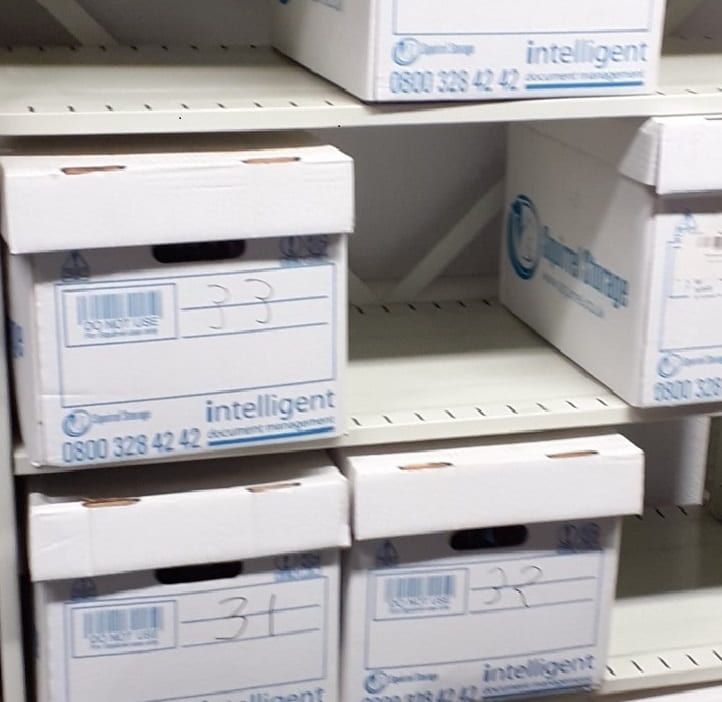
Boxes of files from the Lester archive as received from the donor
There were two main elements to the project: appraisal and cataloguing. A careful process of appraisal has seen the reduction of an original deposit of 59 banker’s boxes of files to thirty smaller archive boxes of papers. The priorities during appraisal were to retain anything written by Lester, such as publications and correspondence, and records of House of Lords Written Answers where Lester asked the question. Accompanying documents, such as official publications, reports, and policy statements, in which Lester had no involvement, were generally not retained.
This process led to three main classes of material for cataloguing.
The first of these was Lester’s Written Answers, principally in the form of an apparently comprehensive chronological run of six files of Lester’s questions to Government Ministers covering the years 1993-2005, and a scattering of similar records elsewhere. One cannot fail to be amazed at the sheer number of questions put by Lester in the House of Lords during this period.

LESTER/207: Lester was co-founder and Chairman (1991-1993) of the race relations and civil rights think tank the Runnymede Trust. Image published with the permission of the Runnymede Trust.
The second category of material was Lester’s publications: book chapters, articles, speeches, lectures, letters to the press, and so on. Here also there was a very carefully arranged chronological run of papers by Lester in nine files covering the years 1964-2011 (the index lists 335 items). The publications demonstrate all Lester’s main concerns in Parliament: race relations, human rights, equality, constitutional matters, Northern Ireland, European law, and free speech. Lester’s written output is immense, as is the depth of his legal knowledge. There are also several other files of Lester’s articles and speeches, which are recorded separately in the catalogue. Lester’s Jewish origins are often reflected in his writings, such as when he refers to his father’s witnessing the activities of Sir Oswald Mosley’s Blackshirts in the East End of London in the 1930s.
The third category was the subject files (such as papers on international Human Rights), reduced by appraisal largely to Lester’s own correspondence. Here again there was an original alphabetical subject file classification between LESTER/1 (Blasphemy) and LESTER/149 (Venice Commission), which has been followed in the online catalogue; thereafter the papers are not arranged in any recognisable order. The records of Lord Lester’s Office are in general extremely well kept. The subject files illustrate Lester’s work on behalf of the Social Democratic Party (SDP) in the early 1980s and the Liberal Democrats in the 1990s, and (principally) his political interests in the House of Lords between 1993 and 2015. The files contain letters, amongst many others, from Tony and Cherie Blair, Margaret Thatcher, Jack Straw, Shirley Williams, and Lord Scarman. Some of the correspondence is more personal in nature, such as a letter from Lester to Mohamed Al Fayed in 1994, thanking him for allowing Lester and his wife, Katya, to stay at Al Fayed’s Scottish estate.
The correspondence is notable for the evident warmth and respect in which Lester was held by his many contacts in the legal profession, politics and the media.
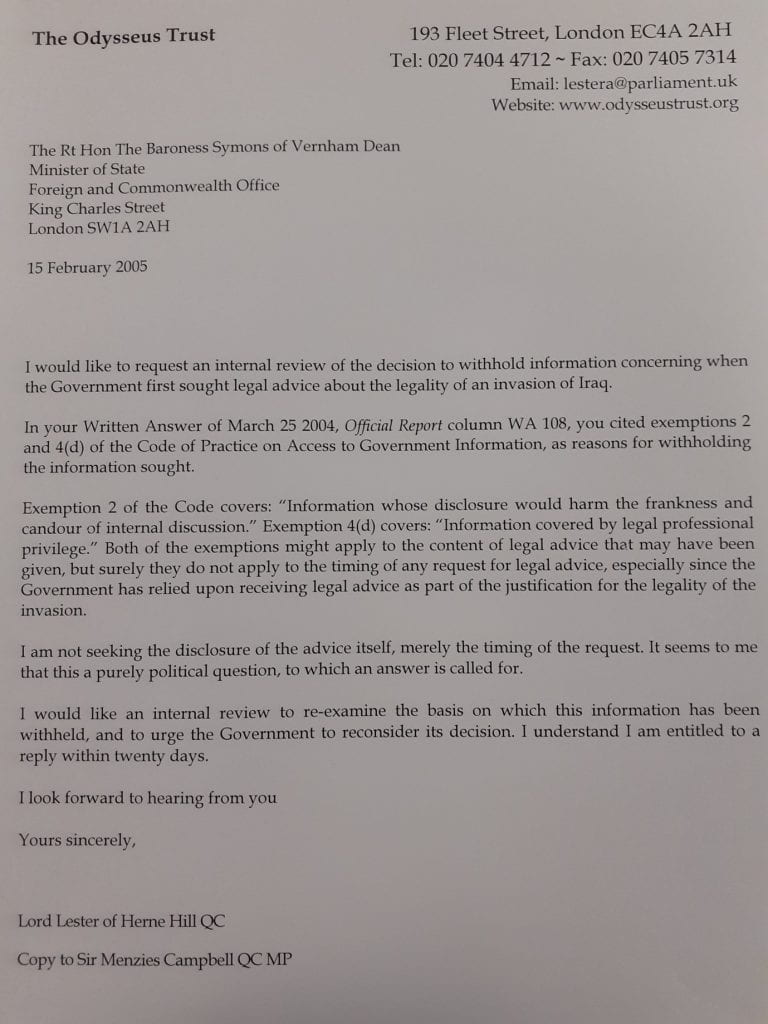
LESTER/195: letter from Lester to the Minister of State at the Foreign and Commonwealth Office, 2005, seeking a review of the Government’s decision to withhold information about the invasion of Iraq.

LESTER/165: one of Lester’s doodles, dating back to his days in the SDP.
Nor is humour lacking: a letter from the Parliamentary Group for World Government addressed to ‘Lord Anthony Leicester’ prompted the response: ‘Incidentally you might wish to note the spelling of my name because the Earl of Leicester would be upset’. Again, when Lester was asked his name and professional background by an interviewer in 2007 he replied: ‘Well, that’s not so easy because I changed my name when I became a member of the old people’s home but I was born Anthony Lester and I am now Lord Lester of Herne Hill QC’. And then there are the doodles. There is a scattering of these throughout the papers.
Government legislation on equality and human rights has produced enormous social change in this country since the Roy Jenkins era. It is my belief that the Lester archive will be a very important resource in future in understanding how that change occurred. The catalogue is available on our archives catalogue
An Unexpected Discovery
By Katy Makin, on 23 November 2023
The folklorist Katharine Mary Briggs (1898-1980) shared her love of folk tales and storytelling through her many publications, community work and children’s groups. A former president of the Folklore Society, a small archive of her papers and correspondence is now owned by the Society and deposited with UCL Special Collections as part of the Folklore Society Archive.

Katharine Briggs as a child, unknown artist. Image supplied by the Folklore Society
Although Briggs’ papers in the Folklore Society Archive are currently uncatalogued, access can still be provided for researchers who have the patience to work methodically through her letters, notes, poems and photographs. The letters in particular are tricky to use as they are only roughly sorted into bundles that span several years. But patience can be rewarded; whilst checking the bundles of letters ahead of a researcher’s visit as part of our data protection procedures I came across an unpublished letter from the author JRR Tolkien to Katharine Briggs.
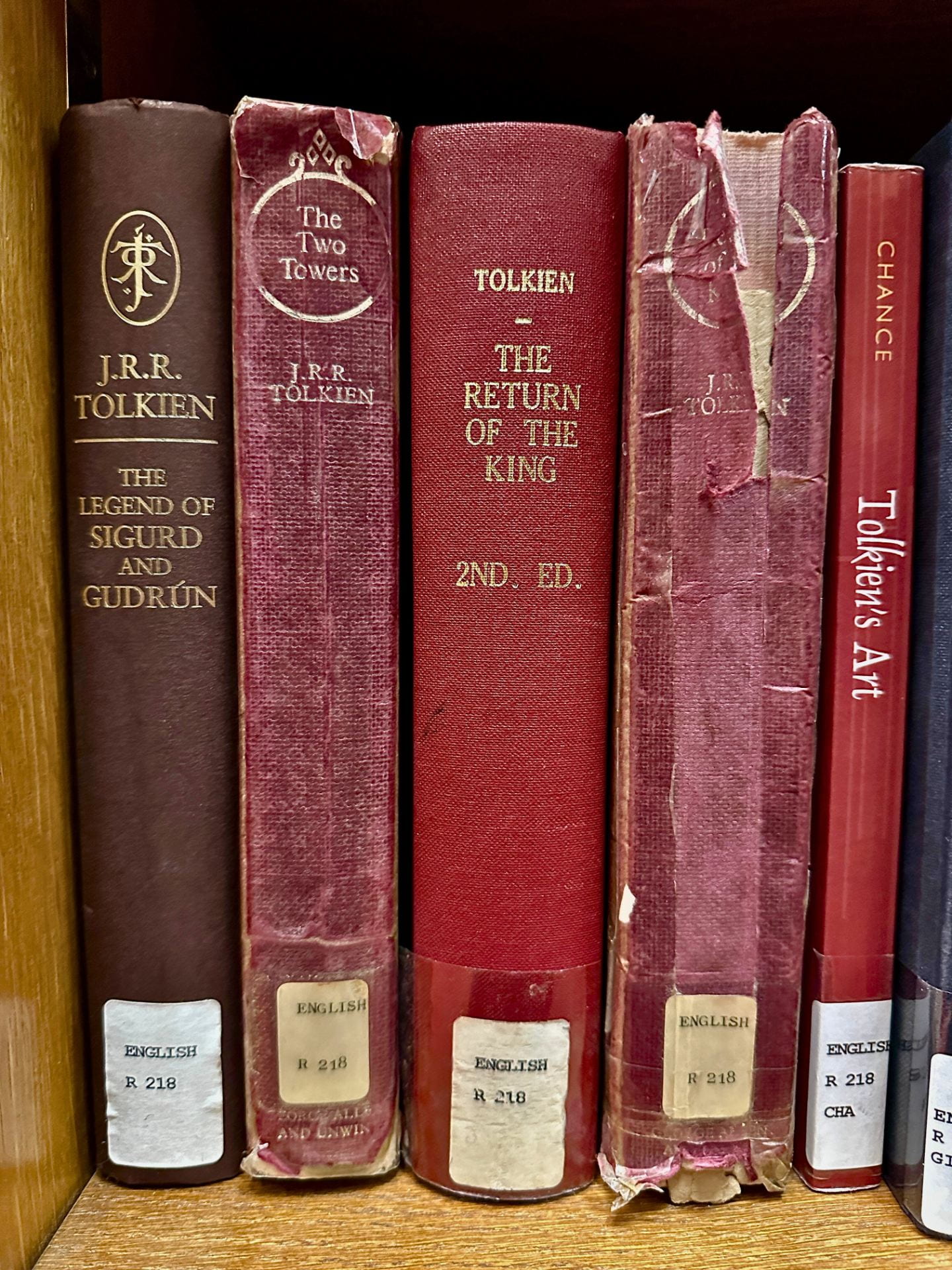
Tolkein’s books in UCL Main Library.
Two letters from Briggs to Tolkien are now part of the Tolkien archive held at the Bodleian Library, University of Oxford. In her first letter of October 11th 1954, Briggs describes being held in suspense, “reading and re-reading” The Fellowship of the Ring, and asks whether the second part of The Lord of the Rings will be published before Christmas. For her, the only flaw is the alteration of the Gollum incident from the way it had been told in The Hobbit and the nature of Bilbo’s finding of the One Ring, which had been her favourite part. In The Fellowship of the Ring, she says there is an implication that Bilbo thought of the Ring as a gift, which seems to her unlikely. On a minor point, she also found the description of Bilbo running away from Gollum with his hands in his pockets unconvincing: “You would never run away from a furious adversary with your hands in your pockets – try it and see. Particularly in a dark and narrow place”. [Letter from Katharine Briggs to JRR Tolkien, 11th October 1954, Oxford, Bodleian Libraries, Tolkien Family Archive (uncatalogued)]
Tolkien’s response came a few days later, on the 13th October. This is the letter now found in Briggs’ papers in the Folklore Society archives. He thanks Briggs for her appreciation of his work, and addresses some of her comments about the “Bilbo-Gollum business”. He confirms that Gollum would never willingly have gifted the Ring to Bilbo, but under the “evil pressure of the Ring and the cry of thief”, in one version of events Bilbo makes up the story of the Ring being a present.
Addressing her challenge, he says:
“Even in the abbreviated version of the ‘prologue’ Bilbo did not run away with his hands in his pockets. (I have not led an entirely sheltered life, and have no need to try it out). In the full version this is clearer.”
Tolkien ends his letter with good news: The Two Towers has gone to press and he hopes it will appear by November 1st (or not long after). In in the end, Briggs did not have much longer to wait as it was published on November 11th 1954.
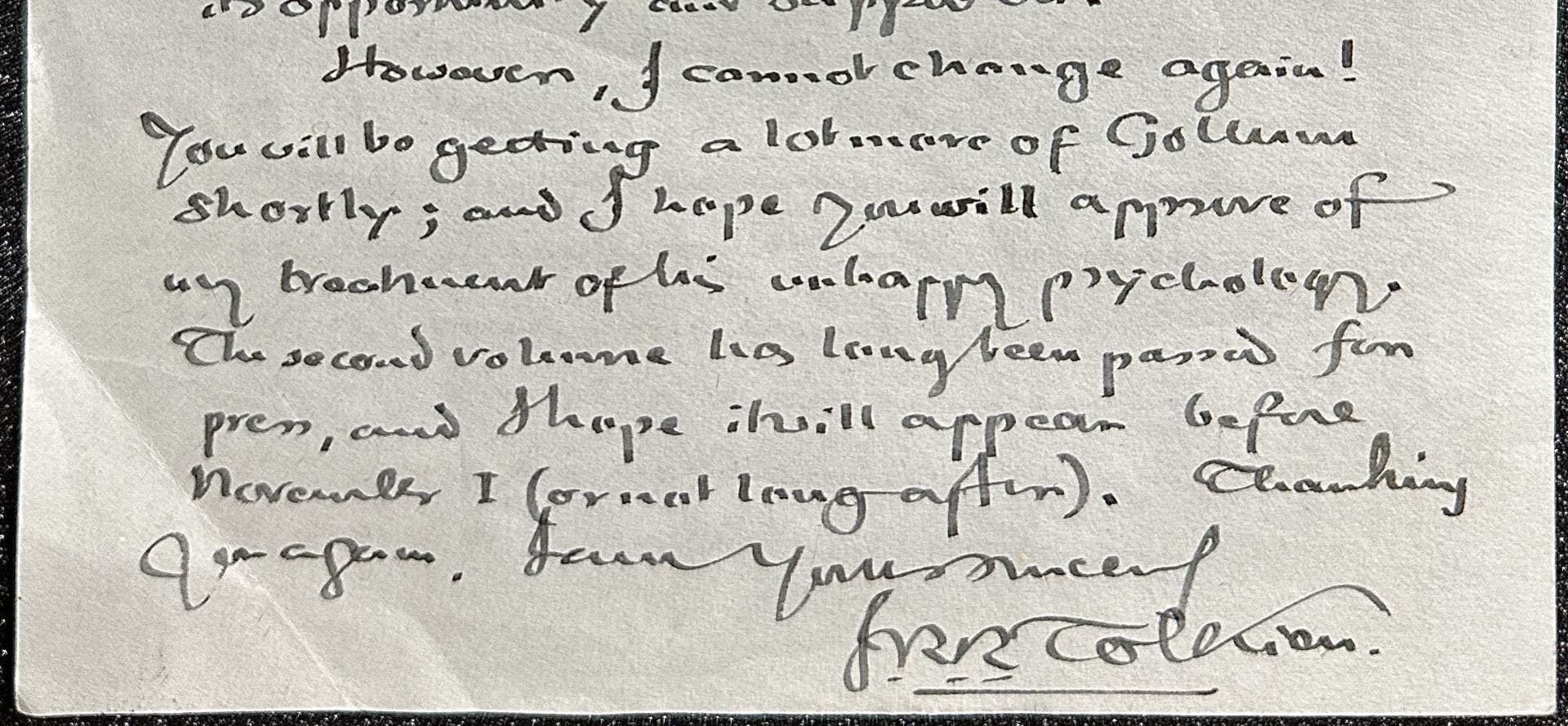
Letter from JRR Tolkien to Katharine Briggs, 13th October 1954, Folklore Society Archive T273, UCL Special Collections. Copyright of the Tolkien Estate and reproduced here with permission.
Briggs was effusive in her thanks. “The news that The Two Towers is to come out in November is the best I have heard for some time. Then we shall be all clamouring for The Return of the King (I hope this is Aragorn); and when we get that we shall be undoubtedly happy for a good many years.” In the meantime, she had purchased a new edition of The Hobbit and agreed that the full account of the meeting with Gollum is much clearer here than in the summary given in The Fellowship of the Ring. [Letter from Katharine Briggs to JRR Tolkien, 21 Oct 1954, Oxford, Bodleian Libraries, Tolkien Family Archive (uncatalogued)]

Briggs, Katharine M. (1953) The personnel of fairyland : a short account of the fairy people of Great Britain for those who tell stories to children / by K.M. Briggs / illustrated by Jane Moore. Oxford: Alden Press.
Copies of Katharine Briggs’ many books can be found around UCL Libraries, including one of her earliest collections of stories: “The Personnel of Fairyland: A short account of the fairy people of Great Britain for those who tell stories to children” (Stores FLS 12 BRI ) which has the charming frontispiece pictured above. Based on an image of medieval folklore, it includes a witch, an enchanted castle, a Friar raising his imps, a Fairy Ring, and a “Witch rideing on the Devill through the Aire”.
Some of her other books popular with children are part of the IOE Library’s collections, including “Nine Lives: Cats in Folklore” (IOE Library FOLKTALES 398.2 BRI) and “Abbey Lubbers, Banshees and Boggarts: A Who’s Who of Fairies” (IOE Library FOLKTALES 398.24 BRI).
If you’re visiting the IOE Library you can also borrow a copy of JRR Tolkien’s “The Lord of the Rings” at the same time (IOE Library FICTION TOL).

Briggs, Katharine M. (1980) Nine lives : cats in folklore / Katharine M. Briggs ; with illustrations by John Ward. London: Routledge & Kegan Paul.
The Folklore Society archive and rare books library are deposited at UCL Special Collections. For further information and to make an appointment, contact us.
Other archive material of Katharine Briggs and her family, including her sister Elspeth, is held at Leeds University Special Collections (MS 1309).
With thanks to Catherine McIlwaine, Tolkien Archivist, Bodleian Libraries University of Oxford, for her assistance. The letters from Katharine Briggs to JRR Tolkien are part of the uncatalogued family archives and not currently available for research.
‘There is no university without its students’
By Leah Johnston, on 16 October 2023
On the 25th September a new exhibition, ‘Generation UCL: 200 Years of Student Life in London’, opened in UCL’s Octagon Gallery. The exhibition explores two centuries of student life at UCL, placing them at the centre of the university’s history. Mounted in anticipation of UCL’s bicentenary celebrations in 2026, it also marks 130 years of Students’ Union UCL, one of the largest student-led organisations in the world. Material has been contributed by UCL Special Collections, UCL Museums, Students’ Union UCL, and UCL alumni.
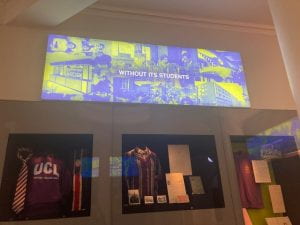
A photograph of one of the lightboxes in the exhibition stating that there is no university ‘without its students’.
The exhibition is part of the wider Generation UCL research project, which looks to explore the lives of UCL students and present them as the real ‘founders’ of the university.
Over the past 9 months, members of the Special Collections team have been working alongside Professor Georgina Brewis and Dr Sam Blaxland, of the Generation UCL team, to select and prepare material for display. Fifty of the items featured in the exhibition are taken from the University College and IOE archive collections, making it one of the largest Special Collections exhibitions in recent years.
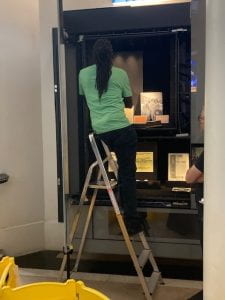
Members of the North Star team installing Institute of Education items
Items included range from official UCL publications and records, such as student record cards, files and calendars, to union and society magazines and posters. Thanks to a recent donation by Students’ Union UCL of the collection of UCL alum, Professor Mark Curtin, we have had the opportunity to display a number of objects too. These include a 1940s blazer and silk scarf worn by Geography student Enid Sampson, a UCL Botany department microscope, academic medals and union badges.
Other objects were uncovered in the process of putting together the initial longlist. A visit to the College Archives silver store back in April resulted in the discovery of a full set of 1950s cutlery (including fish knife!) that had been used by students at Bentham Hall.

Bentham Hall cutlery on display alongside a 1918 Union Magazine cartoon, showing diners crowding around Refectory menus.
With a vast amount of material to choose from the process of shortlisting was tough! However, some clever design on the part of Polytechnic studio meant that we have also been able to display material that would otherwise have been left out. The two arches that lead into the gallery have now been covered in digitised copies of publications, posters, adverts, and invitations, which were created for, or by, UCL students. If you are in the space, see if you can spot a Student’s Guide to Computers from 1996, an advert for a 1960s Pink Floyd gig and a 1981 Student Survival guide with the title ‘Don’t panic: it’s too late anyway!’.

A snapshot of one of the arches leading into the Octagon Gallery
The exhibition is open now until August 2024 and is free for all to attend. For more information about the creation of the exhibition visit the exhibition project page.
Gaster Cataloguing Project: Part 2
By Katy Makin, on 22 September 2023
In our previous blog post we introduced our project to catalogue the archive of Moses Gaster, and looked at some of the letters sent to Gaster on topics as diverse as Sunday trading and Hebrew braille. In the second of our two posts relating to the project, Gaster Project Cataloguer Israel Sandman discusses Gaster’s charitable activities.
From the Gaster Archives: A Glimpse into Moses Gaster’s Charity Activities
By Dr Israel M. Sandman, Gaster Project Cataloguer
Moses Gaster was a multifaceted person. He was the chief rabbi of the Spanish and Portuguese Synagogue in London, and, by extension, of all Spanish and Portuguese Jews’ congregations under the British Empire. He was a polymath academic scholar, with strong focuses on comparative folklore and linguistics. He was a key figure in the emergence of modern Zionism. And he was a go-to person for Jews worldwide, for help with their various needs and wants.
Charity Appeals to Gaster:
Daily, Moses Gaster received multiple charity appeals, some in the post, and some in person during his reception hours. While he donated from his personal funds to Jewish and other worthy causes, as seen in receipts, lists of donors, and gentle reminders to honour his pledges, what he could do from his own funds was a mere drop in the ocean of need.
![[Image and Transcription of Receipt for Donation made by Gaster (file 131, item 44)]](https://blogs.ucl.ac.uk/special-collections/files/2023/09/IMG_2918-1024x652.jpg)
UCL Special Collections, Gaster Archive, GASTER/9/1 [formerly file 131/44]
22, ALBEMARLE STREET, W.
346
March 15, 1900
Received from Dr. Gaster the sum of One Guinea as a donation to the Medical Fund.
£1-1-0
[Signed] Secretary
Charitable Funds on a Community Level:
Addressing the vast needs faced by people in fincial hardship required charitable funds on a community level. Charitable funds established in the Jewish community enabled Gaster to help the Jewish individuals and worthy institutions that turned to him from Palestine, North Africa, elsewhere in the Near East, India, West Indies, Eastern and Central Europe, the East End of London, the length and breadth of Britain, and elsewhere. We shall examine two such funds, one of which was well established, and another of which was an ad-hoc fund set up to meet a specific need.
Case 1: Gaster Helps S. Edelstein via the Board of Guardians of the Poor of the Spanish and Portuguese Synagogue:
Shalom Edelstein was a Romanian Jew residing in London’s East End, which at the turn from the 19th to the 20th century was the first place of settlement for many Jews from Central and Eastern Europe. Reading between the lines of Edelstein’s 21 March 1899 postcard to Gaster, written in ornate Hebrew full of allusions to classical Jewish literature, and in which he mentions his ill health, one gets the impression that Edelstein was more a man of the mind than a man of the body, and that he shared interests with his “landsman” Gaster.
| London 21/4/99 כבוד הרב החכם הבלשן סופר מהיר בלשונות החיות, רב ודרשן לעדת הפורטוגעזים, בעיר הבירה לונדן, והמדינה וע”א כש”ת מו[“]ה ד.ר. גאשטער נ”י. הנני בזה לכתוב למ”כ את רשומתי, כמו שבקש מאותי, אולי יאבה לכבדני במכתבו, ומפני כי מעת ראיתי פני כ”מ, לא נתחדש שום דבר, – רק שאני חלש מאד, ואנני בקו הבריאה, עד כי בכבדות אוכל לקום ממשכבי, – לכן אקצר ואומר שלום. והנני מוקירו ומכבדו כערכו הרם. פ”ש, כשמי, – שלום הן תוי ונוי S. Edelstein 17 Winterton St. Commercial Road, E. |
![Image of S. Edelstein’s 21 March 1899 Mostly Hebrew Postcard to Gaster (file 117, item 9)]](https://blogs.ucl.ac.uk/special-collections/files/2023/09/IMG_2919-238x300.jpg) |
| London 21/4/99
His honour, rabbi, sage, linguist, speedy scribe in living languages, rabbi and preacher to the congregation of Portuguese [Jews] in the capital city London and the [entire] country, and furthermore [possessor of] the ‘crown of Torah’, our Master Rabbi Dr Gaster, may his lamp shine! I am hereby writing my address [Hebrew: רשומתי or רשימתי] to his honour, as requested by him. Perchance he will desire to honour me with a letter? On account of the fact that since I have seen his honour’s face, nothing new has occurred – aside from my being very weak: I am not keeping in good health, so much so that it is only with difficulty that I can arise from my couch – I will therefore be brief, and say ‘farewell’ [Hebrew: Shalom]. I hereby hold him precious and honour him, in keeping with his lofty worthiness, Greetings of Shalom, in keeping with my name, Shalom [Peace], being my mark and my charm |
|
[Image, Transcription, and Translation of S. Edelstein’s 21 March 1899 Mostly Hebrew Postcard to Gaster. UCL Special Collections, Gaster Archive, GASTER/9/1. Formerly file 117, item 9]
Multiple Communications Between Edelstein and Gaster:
This was not their first communication. In the postcard, Edelstein refers to their having had a face-to-face meeting; and he notes that Gaster had asked him for his reshuma / רשומה [or: reshima / רשימה], presumably meaning his address. Presumably, this indicates that Edelstein had asked Gaster for assistance; and that Gaster was going to try and help him. Three days later, on 24 April 1899, Edelstein sent another postcard to Gaster, this one in Romanian. Apparently, to help Edelstein, Gaster turned to the charity board of the synagogue of which he was rabbi, the Board of Guardians of the Poor of the Spanish and Portuguese Synagogue.
![[S. Edelstein’s 24 March 1899 Romanian Postcard to Gaster (file 117, item 20)]](https://blogs.ucl.ac.uk/special-collections/files/2023/09/IMG_2920-1024x799.jpg)
UCL Special Collections, Gaster Archives, GASTER/9/1 [formerly file 117/20]
The Board of Guardians’ Approval:
Nine days later, on the 3rd of May, Gaster received a memo from the Board of Guardians. They would cover Edelstein’s train fare from London to Liverpool, and his boat fare from Liverpool to New York. However, that cost £5, and they did not have anything additional to offer Edelstein. Although that would mean that Edelstein would arrive penniless in New York, the Board had reason to believe that Edelstein would nonetheless be admitted to the USA. It seems that Edelstein was permitted to enter the United States, for we have a long letter, in Romanian, which he sent to Gaster from New York. Towards the end of that letter, he updates Gaster about a certain D. Gottheil. The Gaster Archive contains letters to Gaster from a Professor Richard Gottheil, relevant to the writing of Jewish Encyclopedia articles and possibly to Zionism; but it is unclear whether there is a link from Richard to D. Gottheil.

London May 3rd 1899
Dear Dr. Gaster,
re – S. Edelstein
With difficulty I succeeded in securing a passage for this man per “Tonfariro” which will sail from Liverpool on Saturday next. The fare came to £5 which includes railway fare to Liverpool so that I have nothing to hand over to the man. I am informed that by this line it is not necessary for him to have a certain sum of money in his pocket on arrival in New York.
Yours faithfully,
J.Piza
The Board
would do nothing
for Haham Abohab
J.P.
[UCL Special Collections, Gaster Archive, GASTER/9/1. Formerly file 118/11]
The Limitations of Working Through the Board of Guardians of the Poor:
In addition to the limits of what the Board felt capable of doing for Edelstein, at the end of their memo, the chairman adds an apologetic side note. He mentions that the Board did not approve a different request, for funding for a certain Hakham (rabbi/sage) Abohab. It is noteworthy that Edelstein was a Central / Eastern European Jew, while the name Abohab indicates a Jew from the Islamic countries. Although the Spanish and Portuguese tradition is more aligned with the traditions of the Islamicate Jews, the Spanish and Portuguese Board approved Edelstein’s request, not Abohab’s. This seems to indicate an objectivity on the part of the Board. It appears that the reason for the Board’s limits in giving was the fact that the Synagogue was experiencing financial difficulties; and in order for Gaster to carry out his wide range and full scale of charitable activities, he needed additional sources of funding, beyond those available through his own congregation

UCL Special Collections, Gaster Archive, GASTER/9/1 [formerly file 131/85]
Dear Sir,
The Gentlemen of the Mahamad [executive committee] invite your attention to the Statements of Accounts of the Synagogue, and the Report of same for the year 1899, which have been circulated amongst the Yehidim [members] of the Congregation, & I have particularly to point out that the result of the year’s working shews a deficit of £595.-, and that the Elders have been compelled to sell out Capital Stock to meet this & other deficiencies accrued since 1895, amounting in the aggregate to £1608.-
This position, which is a very serious one, was duly considered by the Elders at their recent Annual Meeting, and they requested the Mahamad to take such steps as they might think necessary, to call attention, in the first instance …
The Ad Hoc Fund for “Our Poor Roumanian Brethren”:
The Crisis of Romanian Jewry:
One additional source of charity funds, independent of the Spanish and Portuguese Synagogue and its Board of Guardians, is an ad hoc fund that Gaster seems to have created himself. The fund is for ‘our poor Roumanian Brethren’, as described in Benjamin Ritter’s letter to Gaster, accompanying a cheque from a collection taken up in Vine Court Synagogue. At this juncture (around 1900), Romanian Jews were experiencing an unusual level of persecution, and were seeking to leave Romania. From all directions, individuals and institutions were turning to Gaster for solutions and financial help; and Gaster did respond.
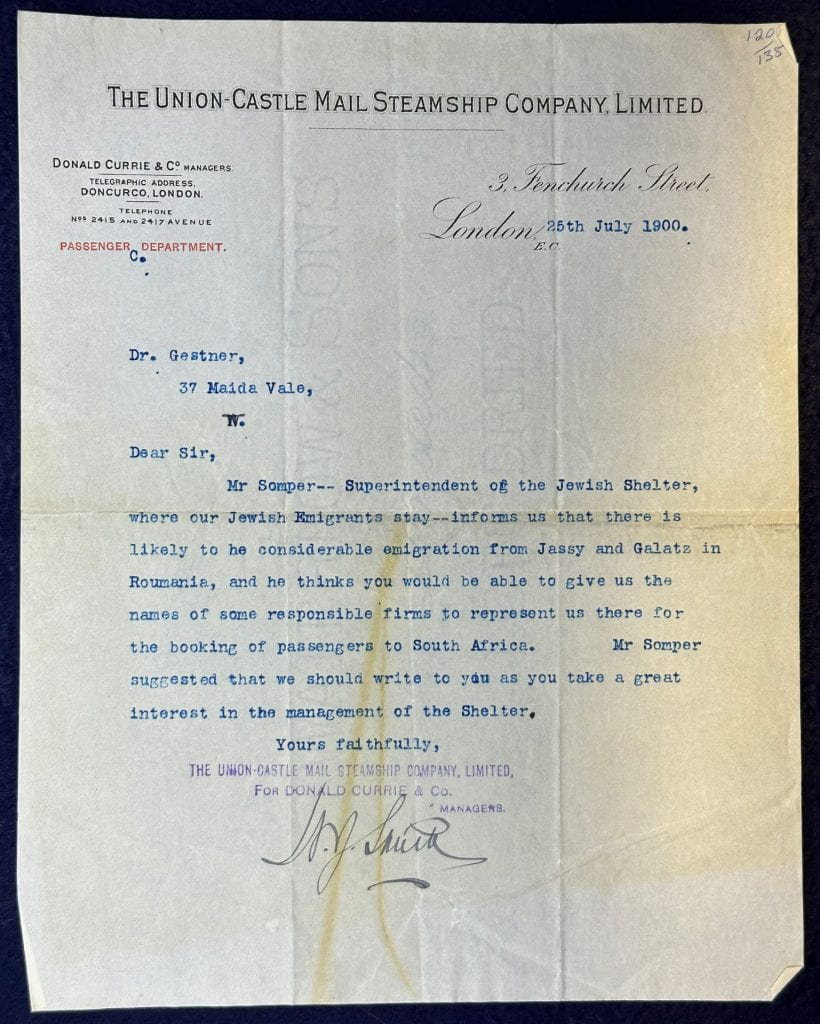
UCL Special Collections, Gaster Archive. GASTER/9/1 [formerly file 135/20]
The Vine Court Synagogue:
The Vine Court Synagogue was a congregation of Eastern European Jews, in the Whitechapel section of London’s East End. As noted, the East End was the first place of settlement for many Eastern European Jews. Thus, this congregation would have had particular sympathy for the Romanian Jews, as did Gaster, who was a Romanian Jew, and who received many charity appeals from the community of his origin. Gaster’s relationship with the Eastern European immigrant Jews of the East End came to good use in his finding the best ways to help his Romanian brethren.
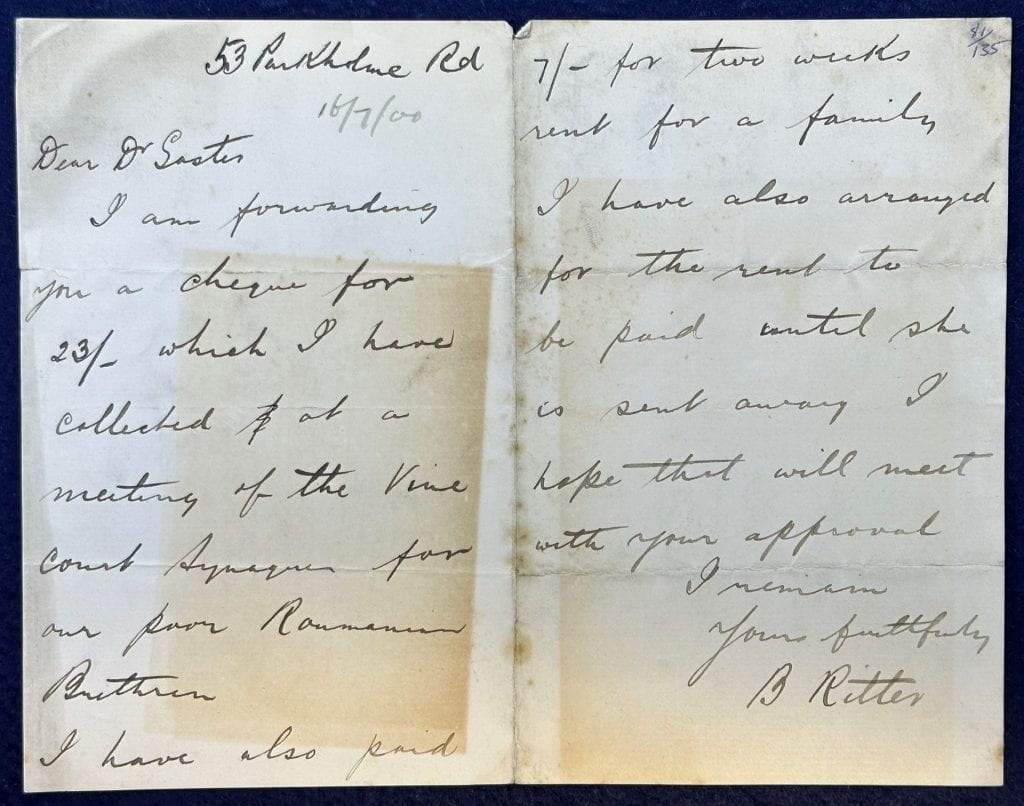
UCL Special Collections, Gaster Archive, GASTER/9/1 [formerly file 135/81]
Dear Dr Gaster
I am forwarding you a cheque for 23/- which I have collected at a meeting of the Vine Court Synagogue for our poor Roumanian Brethren. I have also paid 7/- for two weeks rent for a family. I have also arranged for the rent to be paid until she is sent away. I hope that will meet with your approval.
I remain
Yours faithfully
B Ritter
The Blaustein (Bluestein) Family and their Relocation from Romania to London:
Another Romanian Jewish party helped through Gaster’s efforts is the Blaustein (Bluestein) family. (The surname seems to have been anglicised from Blaustein to Bluestein.) While it would take further research to try to discover the source of the funds Gaster used to help them, and to piece together this family’s full story and the relationship between all the family members, the partial story that emerges from the documents below is worthwhile in and of itself.
Mrs. Ch. Bluestein was a Romanian Jewish widow. One of her sons had a disability. Gaster had helped the family, and now they were established in London. The son with the disability was gainfully employed. Another son, who was to be married, ‘also earns a nice living’. Mrs Bluestein writes to invite the Gasters to the wedding, and to express her gratitude to Moses Gaster.
![Image of Personal Letter of Gratitude to Gaster, Accompanied by a Wedding Invitation (file 131, item 58)]](https://blogs.ucl.ac.uk/special-collections/files/2023/09/IMG_2932-893x1024.jpg)
UCL Special Collections. Gaster Archive, GASTER/9/1 [fomerly file 131/58]
Lower Chapman Str.
Commercail [sic] Rd E
London March 20 1900
Reverand [sic] Sir
I beg to enclose your invite for my son’s wedding. I hope you will come, as you was always a good friend to me when in need so I am happy to let you know of my joy thank God my son is doing a respectable match – and I hope you will live to see joy by your dear children in happiness with your dear wife I am the widow whom you helped to bring over the crippled son from Bucherst, he is grateful to you as he thank God earns £2 – 0 – – weekly – and is quite happy – and my son that is to be married also earns a nice living. We often bless you for everything & I am pleased to tell you of my joy as well as I did my trouble. With best respect, yours gratefully,
Mrs Bluestein
Printed Wedding Invitation Addressed to the Gasters, Sent by Mrs Ch. Bluestein. The Hebrew line at the top is from the prophecy of restoration in Jerimiah 33:11, and is used in the Jewish wedding liturgy: ‘A voice of joy and a voice of gladness, a groom’s voice and a bride’s voice’.
In Summary
Gaster was heavily involved in charity work, on a scale that required communal funding. Although the Board of Guardians of the Poor of the Spanish and Portuguese Synagogue, Gaster’s congregation, provided funding for those beyond their own community, they were too financially limited to finance the full scope of Gaster’s work. Thus, we see that Gaster raised charity funds elsewhere, too. One example of this is Gaster’s ad hoc fundraising network on behalf of Romanian Jewry, which at the turn from the nineteenth to the twentieth century was undergoing strong persecution. We see how Gaster met this challenge, and we see the sweet fruit of his labour.
Blog post by Israel M. Sandman
Galton Laboratory Records
By Sarah Pipkin, on 7 September 2023
Leah Johnston, Cataloguing Archivist (Records), shares details of the Galton Laboratory archive.
Content warning: This blog includes details of records and objects that relate to racist, ableist and classist beliefs. The ideas within this material do not reflect the current views of UCL.
The Galton Laboratory Records form a collection of archives recording parts of the laboratory’s history, from its creation in 1904, up to the late 1990s. Much of the material was donated to UCL Special Collections in 2011, with some smaller accessions added since then. Over the past year the collection has been fully catalogued and is now all available to view online.
The origins of the Galton Laboratory at UCL can be traced back to 1904 when Francis Galton established the Eugenics Record Office in Gower Street, Bloomsbury. Although the laboratory was not officially part of the university at that time, a connection was formed with Galton endowing UCL with an annual £500 Fellowship of National Eugenics. In 1906 Professor Karl Pearson took over Directorship of the Eugenics Record Office, while still informally working alongside Galton. After Galton’s death in 1911, the residue of his estate was bequeathed to the university, under the condition that it was used to establish a Chair of Eugenics, whose role would be to direct research into ‘those causes under social control that may improve or impair the racial qualities of future generations either physically or morally’.
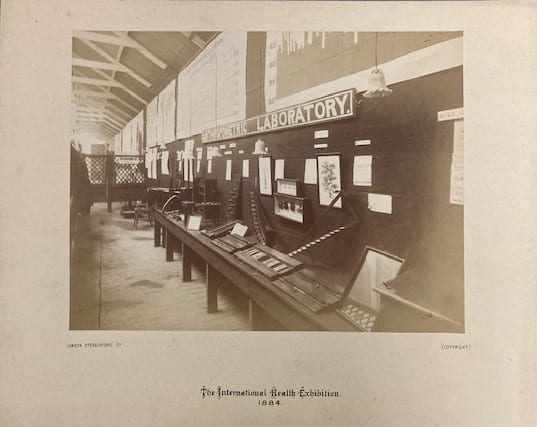
GALTON LABORATORY/4/1/8 – Photograph of the Anthropometric Laboratory, South Kensington, 1884.
This early history of the laboratory is recorded in a series of administrative papers within the collection. Included is early correspondence between Galton, Pearson and P J Hartog (the then Academic Registrar), regarding their proposed scheme for a laboratory at the university, plus copies of Galton’s will and related planning for the establishment of a Chair of Eugenics. While these files include high level planning, other papers record more practical decisions, such as plans for the proposed new building. Below is an estimate for blinds to be supplied by James Shoolbred & Co. Ltd, including a small sample of green cloth.

GALTON LABORATORY/1/6/3 – Estimate for blinds from James Shoolbred and Co., including a sample of fabric, 1921.
Other series include papers accumulated by the laboratory, records of laboratory publications (such as the Annals of Eugenics, The Treasury of Human Inheritance and Eugenics Laboratory Memoirs), and research working papers.
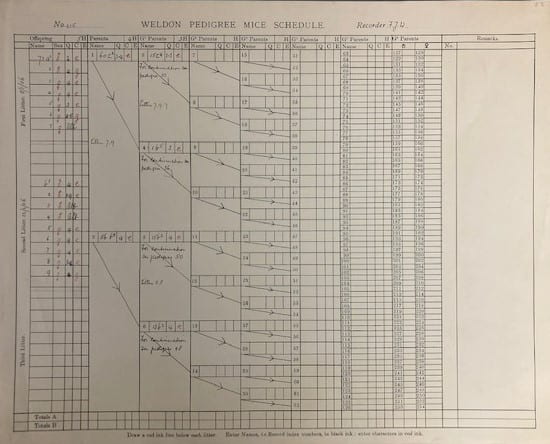
GALTON LABORATORY/2/3/3 – Weldon pedigree mice schedule, 1905-1906.
The remaining series consist of photographs, artwork, audio-visual material, and objects.
Artwork in the collection includes portraits of individuals connected either to Galton, or to the laboratory, alongside early watercolours of scientific specimens and samples. It appears from related annotations that they were either displayed in the laboratory or were used in their publications.

GALTON LABORATORY/4/2/6 – Watercolour illustrations of human eyes, 1915.
A series of photographs are similarly varied and were also used in publications, displayed in the laboratory, or kept as reference material. Included below is an image of Francis Galton seated on his porch, with his servant standing behind him and holding his pet Pekingese puppy.

GALTON LABORATORY/4/1/19 – Photograph of Francis Galton seated on his porch, with his servant Alfred Gifi, who is holding Galton’s Pekingese puppy, Wee Ling, c.1910.
This is contrasted against a more recent addition to the collection, which is one of three photographs showing women working in the laboratory in the early 1900s.

GALTON LABORATORY/4/1/17 – Women working in laboratory, early 20th century.
Alongside other UCL Library and Culture collections, the Galton Laboratory Records help to form a fuller record of the history of the laboratory and in turn, its legacy at UCL. If you would like to further explore the collection it can now be viewed on our online archives catalogue and by typing ‘Galton Laboratory Records’ into the search bar.
To make an appointment to view the records, or for any queries regarding the collection or the catalogue, please contact us at spec.coll@ucl.ac.uk.
Public History group projects 2023: Small Press, Big World – exploring the world of Wikipedia
By Joanna C Baines, on 14 August 2023
Jo:
Special Collections has been supporting the new MA in Public History since September 2022. As part of our support, we lead two group projects in Term 2 for Critical Public History, which is the core module all students take. These projects aim to equip students with real-world scenarios and experience, where they deliver an outcome to a client (in this case, Special Collections). Anna Fineman leads the other Special Collections project, which this year focused on creating an informal archive for the new UCL East campus.
My project involved putting information about our Small Press collections – which can be challenging to digitise due to the fact that they’re often still in copyright – online via Wikipedia. Small Press publications contain a wealth of work by artists, writers and publishers often collaborating to make independent works. This year our students James and Yuxuan worked on the 1960s art magazine 0 to 9, creating a brand new page for the title which includes a complete list of contributors to each issue. The page at present is in review stage, having initially been declined in April, so links will be updated on this post when it hopefully gets approved! You can still read the page whilst it is waiting for approval.
Huge thanks to James and Yuxuan who were an absolute dream team to work with this year!
James and Yuxuan:
For this short blog post, we will showcase the benefits of Wikipedia for information creation with student collaboration. We will also highlight some key strengths and pitfalls that come alongside Wikipedia development through the lens of working with the Small Press collection: 0 To 9 Magazine. Almost everyone has used Wikipedia for access to information, but to help ensure its continuation, it needs the support of contributors to help develop new articles.
Wikipedia is an encyclopedia with free content anyone can use, edit, and distribute. It is developed to have a neutral point of view. There are no firm rules, but contributors to Wikipedia must treat each other with respect and civility. For new users, Wikipedia also provides tutorials to help teach the basics. On creating a new page, various templates can aid your creation/development of an article!
Useful features to utilise when creating your Wikipedia page would be your sandbox, which allows you to play around with Wikipedia’s features in a less formal environment. Standardised elements include headings, citations, references and an infobox template.
Note: Although anyone can edit on Wikipedia, on published pages, people will check and edit what you post: Make sure to base your work on reliable sources. You can see a baseline of what reliable sources are from this Wikipedia page.
For our Wikipedia page, we included a brief description of what 0 To 9 Magazine was, some background behind the creators of the magazine, the production of the magazine, and the themes expressed by the contributors to the magazine. We then proceeded to list all the issues of 0 To 9 and more specifics about each issue.
At the bottom of the page, you can find further information about the impacts of 0 To 9 through the Supplements, Impact and Legacy subheadings and the various references.
As we worked on our Wikipedia page, we tried to focus on the magazine’s materiality of language and the distinction between visual art that it defies. We have also created a short video for this blog post, giving more details about the magazine, which you can watch below.
Winners of the 2023 Anthony Davis Student Book Collecting Prize
By Erika Delbecque, on 4 July 2023
We are delighted to announce the winners of this year’s Anthony Davis Book Collecting Prize, which is open to students from any London universities. The prize is intended to encourage students who collect books, printed and manuscript materials. We received over thirty submissions from a total of nine institutions, with collections ranging from manuals on insect collecting, Penguin editions and books on the Tudors to 1890’s London and theatre programmes.
Results
Because of the high standard of the finalists’ presentations and collections, the panel decided to split the award between the two top-scoring candidates. Emma Treleaven, a PhD candidate at the London College of Fashion, is this year’s winner. Her collection, entitled My Own Two Hands: Books and Ephemera About Making Dress and Textiles Before 1975, focuses on learning materials on making clothes and textiles in domestic settings. Her collection is a way of preserving skills that are at risk of being lost, and she uses her collection to teach herself to make clothing in ways that aren’t taught anywhere outside of these historical printed materials. As the winner of this year’s competition, Emma will represent London at the ABA National Book Collecting Prize 2023.

Items from Emma’s collection on making dress and textiles before 1975

Items from Ben’s collection on the artistic and literary networks of Fitzrovia between 1920-1948
The runner-up candidate is Ben Baker, whose collection Artistic and Literary Networks of Fitzrovia: 1920-1948 impressed the panel with its ambition and clear focus. His collection explores the eclectic concentration of the so-called bohemian authors and artists who lived and worked in the region surrounding Fitzroy Square in London in the interwar period. Benjamin is studying for a BA Classics at UCL.
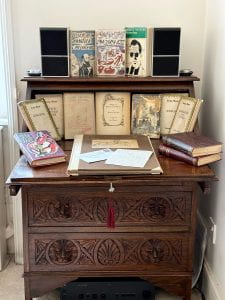
Items from Ben’s collection on the artistic and literary networks of Fitzrovia between 1920-1948
Tessa Roynon, a MA Library and Information Studies student at UCL, received a special mention for her collection The Formations of Toni Morrison, 1955-1980, which focuses on the pre-celebrity work of the African American Nobel Laureate.
The other finalists were:
- Grant, Jenny – ‘Read this – and tell others’: Inscriptions and the gifting of Polish books to British friends by the Polish Armed Forces, 1939-45
- Gray, Victoria – Prized Possessions: a collection of 19th- and 20th-century school prize books
- Mitra, Sudipto – Barefoot Ballers: Books on Football in India
- Shanker, Louis – My library, after David
Meet the finalists and see their collections
All seven candidates will be presenting their collections to the public in our UCL Rare-Books Club series over the next few weeks.
On Wednesday 5 July, Victoria, Jenny and Ben will present their collections in person at the UCL Bloomsbury campus. Book your place on Eventbrite and drop in any time between 12.30pm and 2pm.
On Wednesday 16th August, Sudipto, Emma, Tessa and Louis will present their collections. This is likely to be a hybrid event, which you can either join in person at the UCL Bloomsbury campus or online on Zoom. Book your place on Eventbrite and drop in any time between 12.30pm and 2pm.
In addition, Anthony Davis, the benefactor of the award, will be presenting his collection of fine bindings on Wednesday 19th July. He will talk about how he started collecting and show a selection of his book bindings, alongside bindings from UCL. This event is taking place in person at the UCL Bloomsbury campus. Book your place on Eventbrite and drop in any time between 12.30pm and 2pm.
We would like to thank all the applicants and wish them good luck and many years of joy in their future collecting. Our thanks also go to the judges for generously giving their time and, most of all, to the benefactor of the award, Anthony Davis, for helping nurture the collectors of the future with his encouragement, expertise and enthusiasm.
MS Mocatta 20: Taking a closer look at fragments of a 14th century Quran
By Sarah Pipkin, on 30 June 2023
Over the course of Spring 2023 we worked with our UCL Library Services’ colleague Abida S. to take a closer look at MS Mocatta 20: Fragments from the Holy Quran.
I am grateful to have been given this opportunity to take part in a fun project with UCL’s Special Collections team to showcase a 14th century Quran manuscript on the library social media account. The Quran is the holy book for Muslims. To be able to witness first- hand a Quran manuscript from the 14th Century was a special moment. I had this overwhelming feeling of awe and fascination when viewing a piece of history that has been preserved so well for centuries and I was able to read this Quranic Arabic text that is written in an intricate “muhaqqaq” script. This is the same Quranic words that is read today, unchanged.

MS Mocatta 20. Photo by Abida S.
The Holy Quran is the sacred religious book of Islam. In Islam, the Quran is God communicating with mankind. Reciting the Quran is a religious duty for Muslims, especially during Ramadan. It allows you to connect with the Quran’s message and is a rewarding spiritual practice.
UCL’s manuscript, MS Mocatta 20, is thought to date from the 14th and 15th Century and was previously owned by the historian Fredrick David Mocatta. Upon his death in 1905, the Jewish Historical Society of England deposited his collection with UCL. It is unknown how this Arabic manuscript ended up in Mocatta’s collection, but he may have acquired it as part of his historical research.
The manuscript is written in an intricate “muhaqqaq” script in black ink. This majestic type of script was considered one of the most beautiful, as well as one of the most difficult to execute well. A distinct characteristic of this script is that it’s descending strokes end in a straight, sharp point rather than turning upwards in a hook.
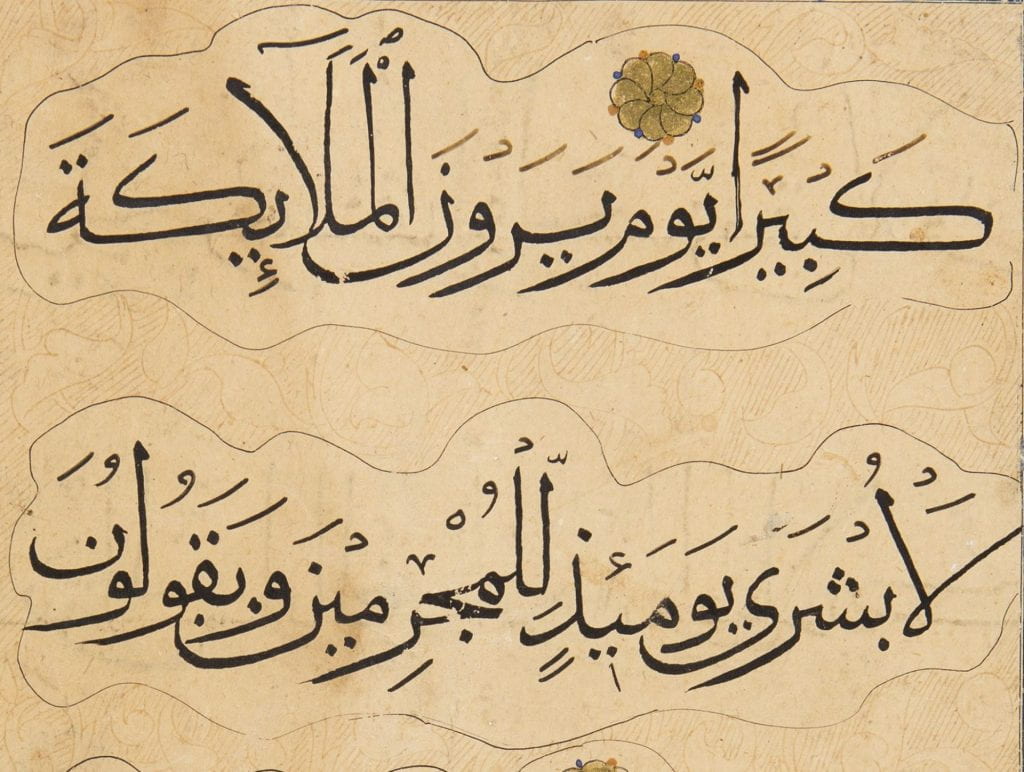
First two lines of leaf 2r of MS Mocatta 20
UCL’s fragments include juz’ 19 of the Quran, Surah 25 titled “Al-Furqan, The Criterion”. It is the 42nd Surah to be revealed in the Quran. This juz’, which means part, contains verses 21 to the beginning of verse 62 from Surah Al-Furqan. These particular verses deal with themes of prophethood and resurrection on the Final day of Judgement and the believers’ place in Heaven.

A large, elaborate roundel
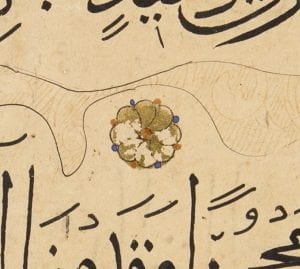
A smaller roundel showing signs of wear
There are small roundels on the pages which are used to mark the beginning of each verse. Verse 21 has a decorative page which indicates the start of the juz’ 19 in this surah. These pages are part 19 of the 30 sections of the Quran. This manuscript fragments are written in ink on paper, with colored symbols and gold leaf detailing. It is unknown why these particular pages did not arrive as part of the complete Quran. However, the condition of this manuscript and signs of wear suggest it was regularly read and transported around.

First page of MS Mocatta 20. Photo by Abida S.
I appreciate how I was given access to a Special Collections archive of a 14th Century Quran manuscript. It not only allowed me to interact with a historical, significant religious holy book that is key to my Muslim identity; but it also introduced me to the traditional format of manuscripts from the past and the physical material and finish of one. Access to Quran manuscripts from the past is so important to keep awareness of traditional manuscripts and religion alive and to appreciate and understand the culture of religious manuscripts.
Thank you again to Abida for her research into MS Mocatta 20! Portions of the juz’ have been digitised, and our collections are open to anyone to come and view. For details on how to make an appointment to view items in our collection such as MS Mocatta 20, check out our “visiting us” page.
Brenda Salkeld and Eleanor Jacques: the lost letters of George Orwell
By Sarah Aitchison, on 28 June 2023

More than a decade ago, the family of Eleanor Jacques discovered a cache of papers hidden in a handbag in a garden shed. On the envelope was written ‘Letters to be destroyed’ and upon opening them, they found handwritten letters to Eleanor from George Orwell, who had been her next-door neighbour in Southwold, Suffolk.
At an event in 2018 to celebrate the discovery of these letters, another sensation was created when an audience member announced that she had at home letters from Orwell to her aunt, Brenda Salkeld, also a Southwold neighbour.

There had long been rumours of the existence of these letters amongst Orwell scholars, who hoped to uncover more correspondence with these long-standing female friends. Through serendipity, both sets emerged with a year and were purchased by Richard Blair, Orwell’s son. The letters have now been placed in the Orwell Archive in UCL Special Collections, catalogued and digitised for public access, with the kind permission of the Orwell Literary Estate.
What is so special about the letters?
The letters span a long range of time, 1931-1949, and continue throughout both of Orwell’s marriages – to Eileen in 1936 and Sonia in 1949. They reveal new details about Orwell’s life in the 1930s – including his overlapping romances, his love of ice skating, and his struggle to write and publish his first novels. They also show that the two women, whom he met while staying with his parents in Southwold, had a profound importance in his life lasting long after his romances with them appear to have ended. Eleanor would go on to marry one of Orwell’s best friends, Dennis Collings.
In a letter to Brenda in 1940, four years into his marriage with his first wife, Eileen O’Shaughnessy, and as a German invasion appeared imminent, he wrote: “It’s a pity … we never made love properly. We could have been so happy. If things are really collapsing I shall try and see you. Or perhaps you wouldn’t want to?” Orwell also wrote to Brenda from his hospital bed (at University College Hospital), sending his last letter four months before his death in 1950, just as he was about to marry his second wife, Sonia Brownell.
The letters also reveal something of Orwell’s writing practice. D.J. Taylor, who helped to track down the letters and has just published an updated biography of Orwell, said:
“In terms of improving our understanding of Orwell’s work, I have a strong suspicion that his letters to Eleanor reminiscing about their country walks at Southwold may have inspired similar passages describing Winston’s affair with Julia in Nineteen Eighty-Four.”
The collection is also notable for the playful drawings Orwell added in the margins of his letters to Brenda, something that is rarely found in his other correspondence. They include images of Billingsgate Fish Market, windmills and the infamous ice rink.
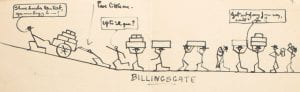
The bulk of the letters have not been publicly available before.
The George Orwell collections at UCL
The George Orwell Archive has been a cornerstone of UCL Special Collections for over 60 years. Deposited by his widow in 1960 and built up over subsequent decades, it is the main resource for Orwell scholars around the world. Comprising manuscripts and typescripts, diaries, notebooks, letters, photographs and family material, including the papers of his two wives, Eileen and Sonia. UCL also holds substantial book collections relating to Orwell, including books owned by him and rare editions of his works.

New Short Film Celebrates Successful Collaboration with the Orwell Youth Prize
By Vicky A Price, on 26 June 2023
The last year has seen Special Collections’ Outreach programme go from strength to strength. We have welcomed school and community groups to a wide range of activities, especially at our new campus at UCL East, and exciting plans are afoot for next academic year. That said, it is always beneficial to look back at triumphs and celebrate them when you can. The upcoming anniversary of George Orwell’s birthday (120 years!) is a great opportunity for us to celebrate something that took place last summer at UCL’s Bloomsbury campus with a very special delivery partner, The Orwell Youth Prize. This new short film does just that:
Delivering a Summer School to Year 12 students from around London is always a brilliant way to explore our collection at UCL Special Collections, as it gives us the chance to spend quality time with young learners and offer them an extended opportunity to engage with the collection. This was a particularly special project, as The Orwell Youth Prize had worked with us to bring in professional, trailblazing journalists, who could share contemporary experiences and advice on becoming a journalist. Alongside this, we were able to present Orwell’s experiences (as represented in the UNESCO registered Orwell Archive), make meaningful comparisons with our guest speakers’ experiences and find present-day applications of Orwell’s principles and journalistic outlook.

Participants interrogate a manuscript from the George Orwell Archive
Finding the right partners to collaborate with, who share similar goals and who can offer something unique to our programming, is often an essential part of our work in the Outreach team. While this way of working can require careful planning and meticulous, consistent communication, the success of this summer school is testament to the huge potential rewards.
Tabby Hayward (Orwell Youth Prize Programme Coordinator) also recognises the benefits that Special Collections brought to their programme; “We were delighted to work with UCL Special Collections on this Summer School, for so many reasons. At the Orwell Youth Prize, we’re always trying to find new ways to get young people excited and inspired by the life and work of George Orwell, and his profound continuing relevance today. Special Collections provided the fantastic opportunity to share the Orwell Archive with the Summer School participants, allowing them to get up close and personal, exploring manuscripts, diaries and photographs. This direct experience really helped the participants to develop a deeper understanding of Orwell as a man and a writer, and we felt very lucky to be able to offer this. We were also so pleased that some of the Summer School participants went on to enter the Orwell Youth Prize this year, bringing everything together. It felt like a really fruitful and productive partnership and we’re looking forward to more collaborations in future!”
One very special output from this Summer School was participants’ writing. We are delighted to share some excerpts with you from three participants’ pieces in this blog. We asked our Year 12 cohort to find a topic that they were passionate about and to write a persuasive, argumentative piece that spot lit their own voice, using Orwell’s principles of clarity, directness and language economy:
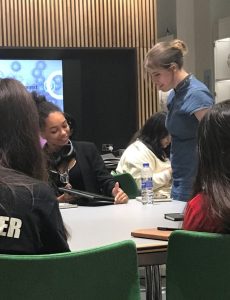
A participant speaks with Marianna Spring, the BBC’s Disinformation and Social Media Correspondent and guest speaker at the Summer School.
Never Again by Jafa Bin-Faisal (a piece about the persecution of the Uyghur people in China)
After hearing about the immense economic influence of China, it’s perfectly understandable to feel hopelessly underpowered against a country with the second highest GDP in the world. But remember, a fire that engulfs a whole forest begins with a small spark, and it is our efforts right now that will provide the fuel for this spark to begin. We need to pressure our government into taking real action against the CCP, and this can be done through two main avenues: petition and protest.
Petitions are a great way to get issues being discussed in parliament, and it tells the government that the British people care about the welfare of the Uyghurs. In this age of social media, it’s easier than ever to increase awareness and gain signatures for these online petitions. Protests are another impactful way to visually show and physically impose pressure on the government, as it shows that we the people are willing to use our free time and use it to speak out against this injustice. Protests are already being organised, and just by marching, you are strengthening the legitimacy and impact of the message and movement.
CHAD AND STACY: THE PARADOX OF INCELS by Zara Hossain (a piece about misogyny and the internet’s power to amplify it)
The pitfall to such circles [online Incel forums] begins on mainstream sites like Youtube; the algorithm may begin with simple, innocent videos like “how to be more attractive to women,” or “dating tips,” or “how to be more masculine”, but these titles quickly open the door for more extreme content which is blatantly misogynistic. These videos tend to encourage men to embrace masculinity to an extreme degree, such as by asserting their power over women, refusing to be a “beta”, a term used to describe a man who is cowardly, especially in situations which involve approaching women. These videos depict a power imbalance between man and woman, as the man is urged to always be in control of the situation, to never let emotions cloud judgement and to never show signs of weakness. In contrast, women are portrayed as a homogeneous identity where every woman is only attracted to men who are strong, unemotional, in control, or “alpha.” In this “alpha” dynamic, the man is urged to be the leader of his pack and to me a role model for other men; thus in itself isn’t a bad thing; many such circles focus on men’s fitness and confidence, and can be healthy spaces for personal growth; but too often than not, these spiral into internalising extreme perceptions of gender roles, and lead them even deeper into the rabbit hole.
Is Colonisation Still Relevant? by Aya Mohamed (a piece about the importance of recognising the history of colonisation across the world and its influence on modern life)
Finally, why is it so important we acknowledge the relevance of colonisation and for that matter, history as a whole? In 1984, Ingsoc (the government of Oceania) was able to retain control over its citizens by rewriting history to fit its own narrative. “Who controls the past, controls the present.” Without knowledge of our past, we’re unable to make valuable judgments about our present. Those in power who manipulate information are able to not only influence what we do and what we say, but also what we think. It’s vital we never forget our roots, so that we can shape the branches of our future.
The Summer School also acted as a spring board for the creation of our first free digital education resources that feature the George Orwell Archive. Check out our film and written resource, intended for Year 12 and 13 students.
Hidden in Plain Sight: LGBT+ Histories
By Sarah Pipkin, on 23 June 2023
The following was adapted from text written by Erika Delbecque and Tabitha Tuckett for the 2023 exhibition catalogue Hidden in Plain Sight: Liberating our Library Collections. The Main Library exhibition Hidden in Plain Sight is open until December 2023 and is open to the public. For more information, visit UCL Library’s Exhibition page.
Since 2021, we’ve run the Liberating the Collections volunteer project. Volunteers search our catalogues for Rare Books related to marginalised voices, including examples of historical LGBT+ writers in our collections. The items identified by our volunteers illustrate diversity of sexuality and gender identities present in our collections, while also highlighting the difficulty of applying modern notions of LGBT+ identites to authors who predate them.
One example is Katherine Philips (1632-63). She was one of the first female poets whose work was published during her lifetime. We have several editions of her poetry in our collections, including the 1669 edition of Poems by the most deservedly admired Mrs Katherine Philips.

Author portrait from Poems by the most deservedly admired Mrs Katherine Philips, 1669.
Philips wrote vivid poems about friendships between women, interpreted by some critics as examples of lesbian poetry. One of her poems, “To my Lucasia, in defence of declared Friendship.” begins:
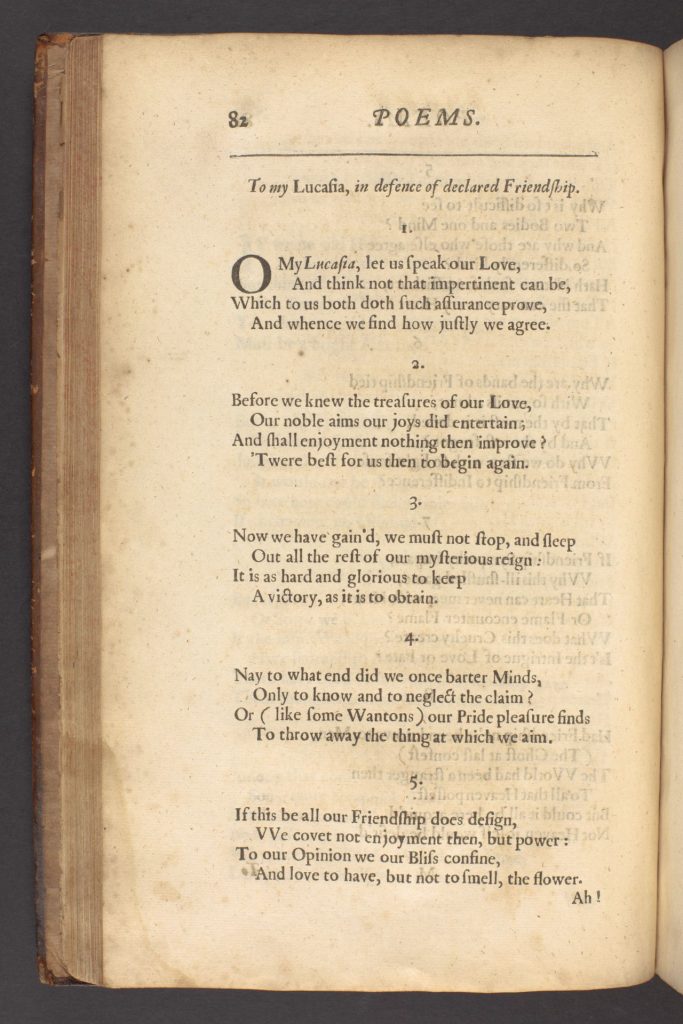
First page of “To my Lucasia”
1.
O My Lucasia, let us speak of our Love,
And think not that impertinent can be,
Which to us both doth such assurance prove,
And whence we find how justly we agree.
2.
Before we knew the treasures of our Love,
Our noble aims our joys did entertain;
And shall enjoyment nothing then improve?
‘Twere best for us then to begin again.
The debate on whether Philips’s work should be read as such points to the difficulty of applying modern notions of sexuality and sexual identity to historical authors.

Author portrait from A narrative of the life of Mrs Charlotte Charke.
Charlotte Charke (1713–60) lived and worked as a man for much of her life, defying some of the career limitations for women in eighteenth-century England. Her autobiography A narrative of the life of Mrs Charlotte Charke … Her adventures in men’s cloaths records her experiences. To contemporaries she was notorious, but her works in our collections have received little attention until recently.
We use she/her pronouns when describing her as those are the pronouns she used to describe herself.

Title page of Charke’s autobiography “Written by Herself”.
Charke acted on the stage in male roles, ran a puppet theatre staging political satire and worked in the traditionally male jobs of a gentleman’s valet and a farmer. Unfortunately she paid a price for doing so: frequently short of money, she was estranged from her father and two husbands, against whose affairs and gambling debts she rebelled. Only towards the end of her life, as a writer, did she find success with this book, an early example of a published autobiography written by a woman. We might be tempted to apply anachronistic terms of gender identity to Charke, but the survival of her autobiography at least enables us to read about her life in her own words.
During the eighteenth century, English guidebooks claiming to describe the dangerous temptations of London life to the innocent and respectable reader became popular. They enabled a vicarious exploration of illicit or unconventional sexual behaviour and gender that did not endanger either author or reader. The midnight spy … exhibiting .. bagnios, jelly houses .. and other places of midnight resort, focusing on London’s nightlife, includes an account of jelly houses and bagnios – restaurants and bathhouses that served as brothels where men could pick up both women and other men for sex, although the text does not clarify whether it describes homosexual or heterosexual activity.
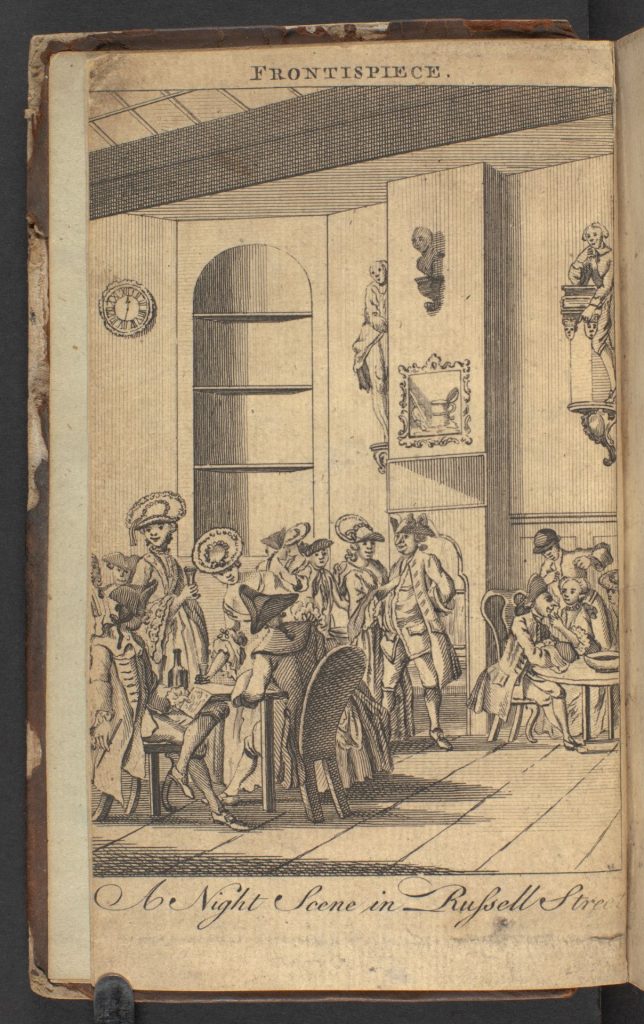
Frontispiece of The Midnight Spy
Publications of this sort sold well and critical reviews from 1766 mention that passages of this book had been re-used from previous similar titles. Such comments suggest that this may not have been the most up-to-date account of London nightlife during time of rapid change in the capital as the Industrial Revolution began.
These items were indentified by Isobel Goodman (2021 Liberating the Collections volunteer), Chris Fripp (Liberating the
Collections pilot-project researcher 2019–20), and Michael Niedzwiecki (2022 Liberating the Collections volunteer). Thanks to their work, we can highlight these items and ensure they are no longer hidden on our shelves and in our catalogue.
If you would like to see these items for yourself, they are on display in the Main Library until December 2023.
Anthony Davis Book Collecting Prize: Interview with LSE Library
By Ching Laam Mok, on 24 May 2023
At UCL Special Collections, we look after collections that, as a whole, tell a larger story about our shared history and culture. Some items may have a high monetary value, but many like the 1970s workbooks preserved in our Baines Archive, collectively help us understand the history of education.
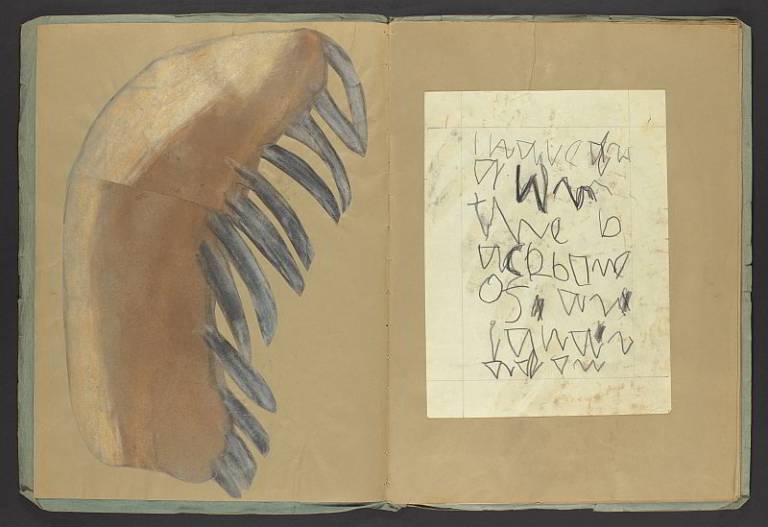
‘Book of Bones’ from our Baines Archive.
Preserving history doesn’t depend on past collectors. Student Book Collectors play an important role in capturing a snapshot of history. Collections like the 2020 winner “Books that Built a Zoo” allow us to understand the intersection between children’s literature and animal conservation. “Read my Genders: A Trans for Trans Collection” captures the voices of modern-day transgender writers and advocates.
But you don’t just have to take our word for it. Chelsea Collison, Learning and Engagement Officer at LSE Library, has written about her favourite collection and how it helps her better understand history.
Tell us a bit about yourself!
I’m the Learning and Engagement Officer at the London School of Economics Library where I work closely with the curators to tell the stories of the collections to a wider audience. I do this via workshops schools and public events for university students and beyond. I specialise in using learning outside of the classroom to increase public awareness, appreciation, and curiosity for heritage, history, and nature.
Outside of work, I enjoy exploring the outdoors whether in the urban parks within London or further afield during travels outside the city. Growing up in Florida, I spent my formative years playing in the waves on the eastern coast, hiking through swamps and tree canopies, or paddling around the crystal blue springs. These memories along with an early job as an educator at a natural history museum have developed a deep feeling of awe and wonder for nature in all its forms.

Chelsea Collison, Learning and Engagement Officer at LSE Library is looking at collection items.
If you were applying for the Anthony Davis Book Collection, what would you submit?
If I were applying for the Anthony Davis Book Collection the theme would be women in natural history. In what has historically been a male dominated field, it’s important to learn about the women who have contributed to biodiversity sciences despite the many social and cultural barriers they were up against. Examples includes works by Mary Anning, Rachel Carson, and Maria Sibylla Merian (to name just a few!). I have a particular interest in scientific illustration as I’m always impressed by the level of observation skills and detail required for creating something that is scientifically accurate and not just pretty. Of course, I also enjoy these works because they are also beautiful and serve as inspiration for my own artwork! Although natural history is not something that is a specialty for LSE, there are still some gems on this topic to be found within The Women’s Library collections! Some other examples can be found on the Biodiversity Heritage Library Flickr page.

Chelsea would submit a collection of women in natural history if she was applying for the book collecting prize.
How do you choose what to add to your collection?
I would want to build a collection that would represent a wide range of ecological biodiversity within the books and illustrations (botany, mycology, entomology, etc.) but also a diversity of the women represented. I would place special interest in books that highlight geographical areas that are special to me including Florida, and now England, which have both experienced high levels of environmental degradation meaning many of species represented in older books and illustrations may now be extinct.

One of the items Chelsea picked.
What does this collection mean to you?
To me, this collection would tell two hidden stories, one of people and one of place. The story of people would highlight the often forgotten or unknown women of science and their important contributions to the field. The story of place would highlight impacts of environmental degradation and climate change by showcasing illustrations of species that no longer exist in these places we have come to call home.
Thank you very much to Chelsea for talking to us! If you’d like to learn more about LSE’s Library collection, visit their website.
If you have a collection of books, postcards, leaflets or other print items that tells an important story to you or a subject your passionate about, consider applying for the Anthony Davis Book Prize! Details of how to apply, and more examples of other books collections, are available on our blog.
Royal History: A close look at George VI’s Coronation Programme
By Sarah Pipkin, on 5 May 2023
Colin Penman, Head of UCL Records, writes about a newly uncovered item in the UCL Records collection.
In the timely way that these things can happen, I recently came across an official souvenir programme for the coronation of King George VI and Queen Elizabeth in May 1937:

As this is the last time there was a coronation of a king and a queen consort –Charles III’s grandfather and grandmother – it has been interesting to compare the occasion with Saturday’s event. The procession and liturgy are very similar, these things changing little over time. There will be new music and prayers, and the much-publicised ‘Homage of the People’. But some elements of the ceremony date back to before the Norman Conquest, for example the Presentation, when the king is ‘presented’ to the four points of the compass.
The programme itself is quite a lovely thing, a lavish 36 page quarto booklet with decorative embossed card covers, glassine protective sheets, and nice watered-silk end papers. It seems to be bound with cord rather than staples – you can see it here at the centre pages, which show the route of the procession:

Interestingly, on the right hand side, just above the compass, is the ‘Site of New Waterloo Bridge’, not completed until the middle of the Second World War, largely with women’s labour. We can compare this route with a London Transport map which can be found in the Gaitskell papers in Special Collections, showing the route of Queen Elizabeth II’s procession in 1953:
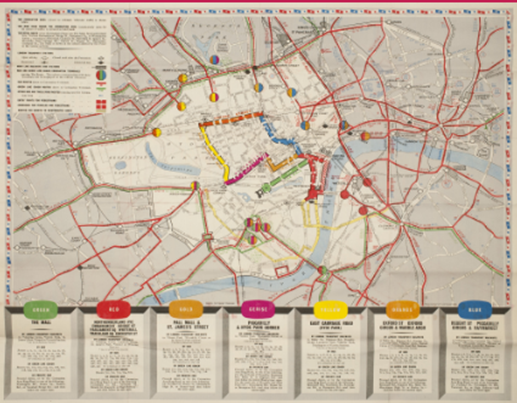
GAITSKELL/G/MISCELLANEOUS PAMPHLETS AND OTHER PAPERS
Not much between them. King Charles, on the other hand, will simply travel up Whitehall and down the Mall to get back to Buckingham Palace:

Image from gov.uk
The programme for George VI’s coronation includes a coloured, embossed title page:

and another showing the emblems of the king’s Dominions, which definitely wouldn’t look so crowded in today’s equivalent:
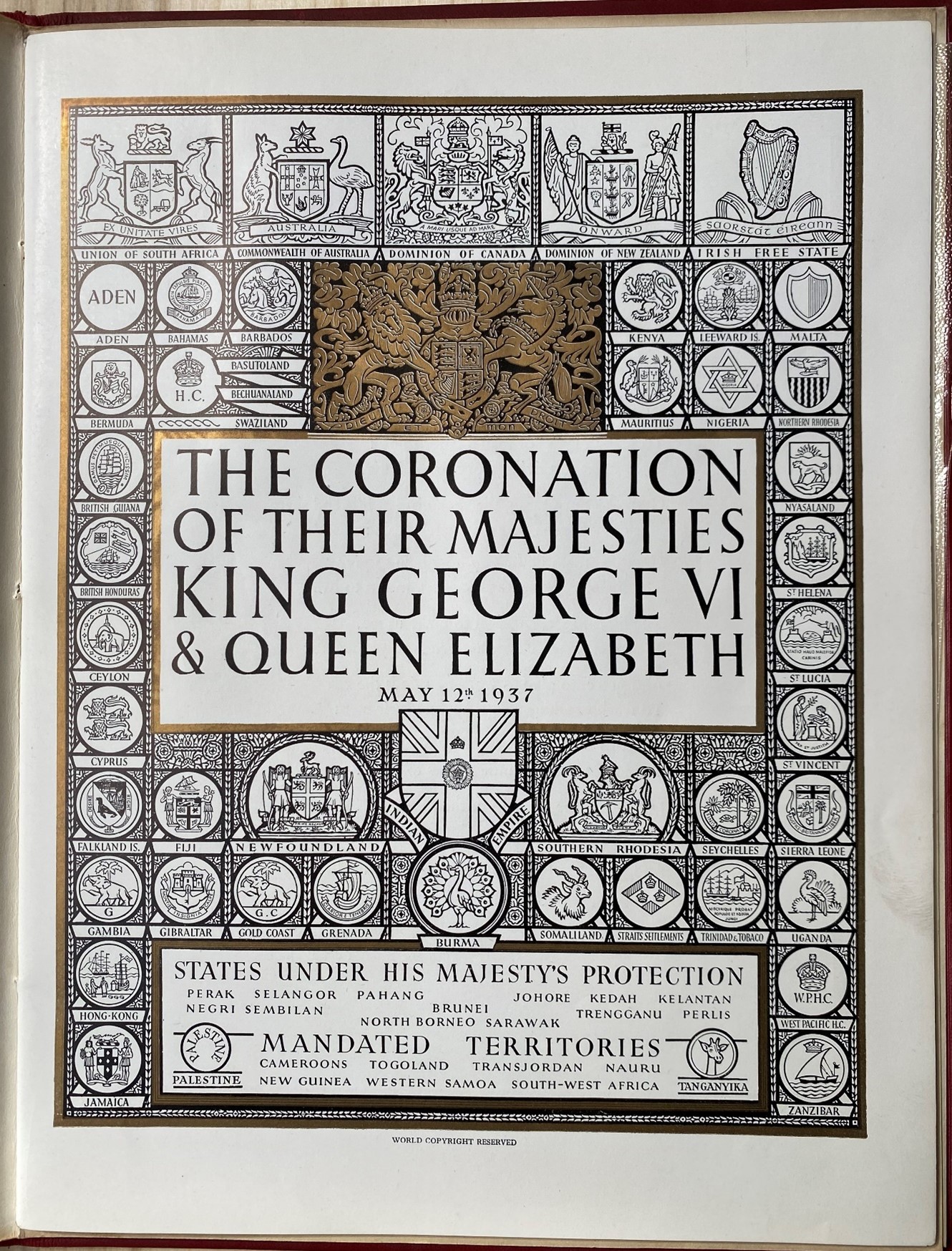
This is followed by a poem by the Poet Laureate, John Masefield, very much of its time: ‘Make wise the councils of the men who sway / The Britain here, the Britains far away’. There is also an interesting essay on the ceremony itself by the Garter King of Arms, the full order of service, and a genealogical table showing the king’s descent from William the Conqueror. The latter can’t compete for splendour with UCL’s own MS ANGL/3, a giant 15th century roll, 10 feet long, showing the supposed lineage of the kings of England all the way back to Adam – you can see a video about MS ANGL/3 online. However, the lineage in George VI’s programme is presumably more accurate.
I don’t know how or why we ended up with this item. It was found in a box of uncatalogued College archive material, where it obviously doesn’t belong. It’s accompanied by a card from the Vicar of St Peter, Vere Street, and a copy of his sermon, so perhaps there’s a clue there:
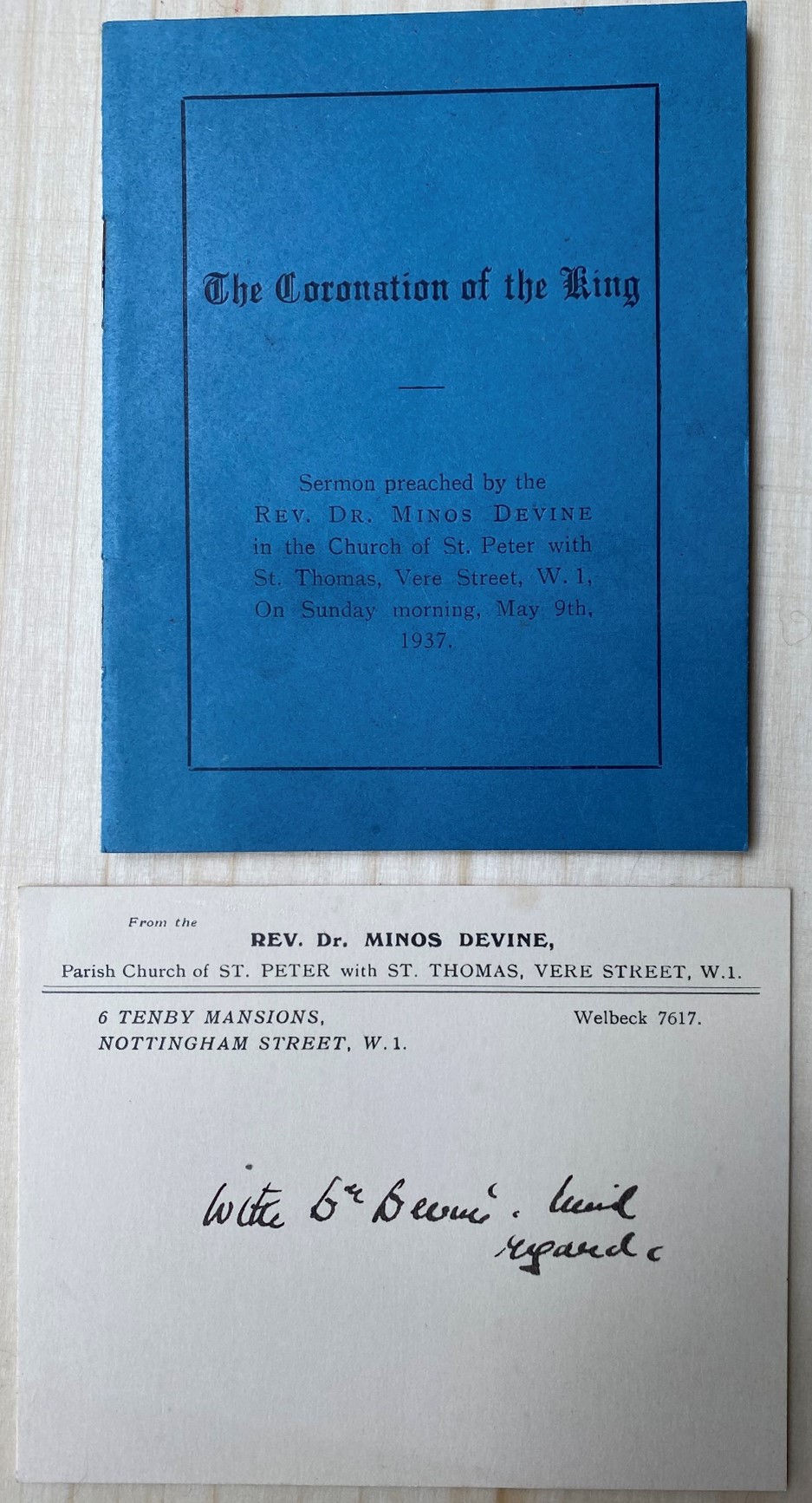
I have no information so far on Minos Devine, but hope to find a connection to one of our existing collections. If not, this will be an interesting addition to our London History collection.
Call for Papers: Creative Responses to the History of Covid-19
By Nazlin Bhimani, on 26 April 2023
UCL Press’s Paper Trails: The Social Life of Archives and Collections and the University of Stirling’s Oral History of the Pandemic Project are pleased to invite contributions on the broad theme of Creative Responses to the History of Covid-19. Since 2021, researchers at Stirling have been interviewing the University’s staff and students about their experiences of the Covid-19 pandemic. Inspired by the playful approaches of ‘creative history’, the researchers at Stirling have now produced a highly innovative history based on their oral interviews. Co-produced by academics, archival staff, curators, and students, with creative input from artists and musicians from the Royal Conservatoire of Scotland, this history will be presented on Paper Trails in the form of written text, film, animation, and music.
The editors of Paper Trails – a collaborative, peer-reviewed, open-access BOOC – now invite researchers from across the higher education, archive, and museum sectors to submit new proposals for additional contributions to a special edition on Creative Responses to the History of Covid-19. In addition to the Stirling history, this edition will showcase the diverse ways in which these sectors experienced, recorded, and interpreted the early stages of the Covid-19 pandemic.
The deadline for proposals is 19th June 2023, and the deadline for submissions will be 20th October 2023. Contributions may be submitted to the following streams and can be in a variety of formats and lengths:
- Research Stories: full-length research articles.
- Co-Production: outputs from projects in which non-academic, undergraduate, and postgraduate audiences collaborate with others to create new work based on research collections.
- Collection Profiles: shorter, descriptive or narrative pieces that highlight collections of interest.
- Engagement: Reflective pieces that focus on a broad range of engagement activities.
Paper Trails is edited by Andrew Smith, Director of Liberal Arts, Queen Mary University of London, a.w.m.smith@qmul.ac.uk. The University of Stirling Oral History of the Pandemic Project team is led by Stephen Bowman (Lecturer in History, stephen.bowman@stir.ac.uk), Rosie Al-Mulla (Archivist, rosie.al-mulla@stir.ac.uk), and Sarah Bromage (Head of University of Stirling Collections, sarah.bromage@stir.ac.uk).


Hidden in Plain Sight: Why Liberating our Collections matters
By Sarah Pipkin, on 20 April 2023
The following is by Rozz Evans, Head of Collection Strategy and co-chair of the Library Liberating the Collections Steering Group. It was originally published in the introduction to our 2023 Exhibition Catalogue “Hidden in Plain Sight: Liberating our Library Collections” and has been slightly edited for the purposes of the blog.
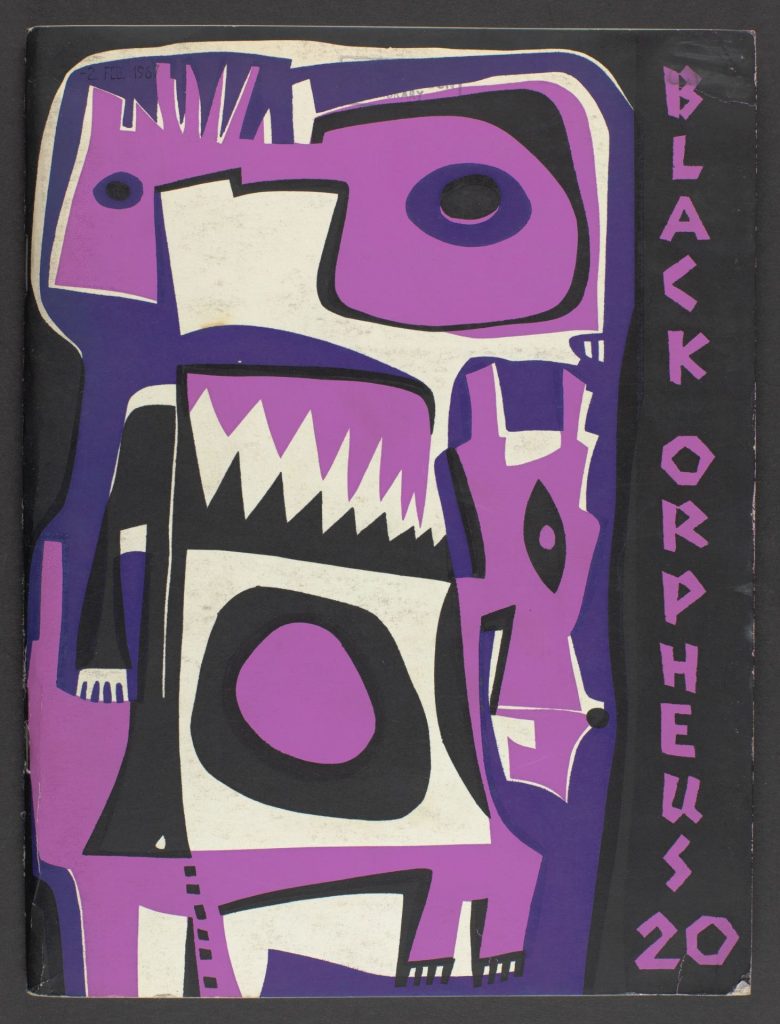
Black Orpehus 20, part of the 2023 Main Library Exhibition
UCL Library Services holds a rich and diverse range of collections containing almost two million printed items (alongside an extensive digital library). These collections comprise both Special Collections (a term that we use broadly to describe our rare books, archives and records) and Teaching Collections. As Head of Collection Strategy, I work closely with our Head of Special Collections, Sarah Aitchison. We are responsible not only for the development, care and curation of our collections, but also for ensuring that we prioritise our effort and resources in the form of money, staff and space. An important aspect of this is our commitment to uncovering the hugely diverse material within our existing collections, enabling us to give a voice to those who have been historically less visible.
As an institution, UCL has been very public about its commitment to addressing issues around Equality, Diversity and Inclusion (EDI) for some years. Arguably the most high-profile work has been around eugenics, UCL’s part in its history and its enduring impact.
However, institutional effort goes far wider than this. For example, UCL was one of the first institutions in the UK to set up its Liberating the Curriculum project in 2016 to improve the inclusivity and diversity of its reading lists. One of the outcomes of this was a community of practice, bringing together colleagues from across the university who are working in this area; this now has a broader remit than the original project.

“Early Efforts by the Misses Moss”
It is this group that inspired the name of our Library Liberating the Collections Steering Group (LLTC), which we set up in July 2020 to plan, monitor and oversee our work in this area. We have developed an action plan based around three key themes of Description and Visibility, Collection Policy and Communication and Engagement.
‘Liberating’ is a term that already has currency in UCL and beyond. It conveys an active approach to this work and its broadness demonstrates how this group is working to uncover, identify and promote a more inclusive collection in relation to all under-represented voices. This means that although there will be specific projects in the realm of decolonisation, for example, the remit is broader than race and racism. We feel strongly that it is important not to use terminology such as decolonisation as a shorthand for wider issues around diversity and inclusion.
UCL Library Services’ collections were initially built from departmental libraries, gifts, donations and bequests, supplemented by some purchases. In the library’s earliest accessions registers it is clear that the focus was on generating teaching collections and filling shelves. This meant that there was no strategic approach to developing a collection, and therefore was primarily reflective of the status of donors. This is very different to how we acquire material today. This involves a much more selective, considered and proactive process, governed by clear and transparent collection policies that are available on our website.

Our newly reclassified copy of “The New Tribe”
This also means that in some cases – particularly in our older material – our collections tend to reflect historic bias and structural inequalities in the university and in the society of the time. These include a normalisation of white, male, Western-centric theories, views, experiences and opinions. This certainly does not mean that we do not hold material which relates to under-represented authors and communities. However, it has become apparent that many of the systems and processes traditionally used by libraries in the curation, management and description of the collections serve to perpetuate systemic bias and can make it difficult to discover this material. For example, the widespread adoption of international cataloguing standards, such as Library of Congress Subject Headings, makes it difficult to challenge or change the use of outdated or discriminatory language in catalogue records.
We are also aware that our collections include content that is now considered discriminatory or harmful, and we must be explicit that its existence in our collections does not represent UCL’s current views.
Traditionally libraries have hidden behind ‘neutrality’ as a way of preserving objectionable content without proper contextualisation, regardless of the harm it can cause to our academic and cultural understanding of these items. However, their historical importance means that we cannot simply remove or delete such items from our collections. Instead we are looking at how we can contextualise such material, acknowledging where necessary the harm these items might do to some of our users and alerting them to problematic content where we can. Pairing re-contextualisation with a celebration of previously ignored voices allows us to have a fuller understanding of our history and culture.
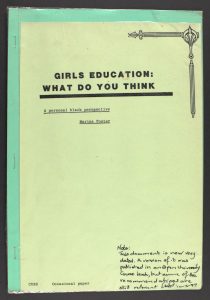
“Girls Education: What do you think?”, part of the Mariana Foster archives collection
Working in this space tends to require a lot of background research and reflection before any work can begin, much less before the books and other materials are made available for use. “Hidden in Plain Sight” does not represent a finished project, but sets the scene for ongoing investigation, discovery and promotion. Staff and volunteers have been working for many months or years, and this will continue to be the case. In the next few years we hope that more of our collections – already full of interesting stories, diverse voices and differing perspectives on colonialism – will be accessible to students, staff and researchers. “Hidden in Plain Sight” is thus a teaser of things to come.
We hope that this exhibition also embodies a spirit of hope and excitement, as well as an ongoing commitment to ensuring that UCL Library’s collections are truly reflective of the richness and diversity of our shared history.
