 Close
Close


Seven swans a-swimming
By Christopher J Fripp, on 13 December 2018
Seven swans a-swimming: well just about, with the assistance of ultra-high-tech imaging trickery. Eleazar Albin’s A Natural History of Birds appearing once again.
STRONG ROOM E QUARTO 920 A5 (1)/1-2

Six geese a-laying
By Christopher J Fripp, on 11 December 2018
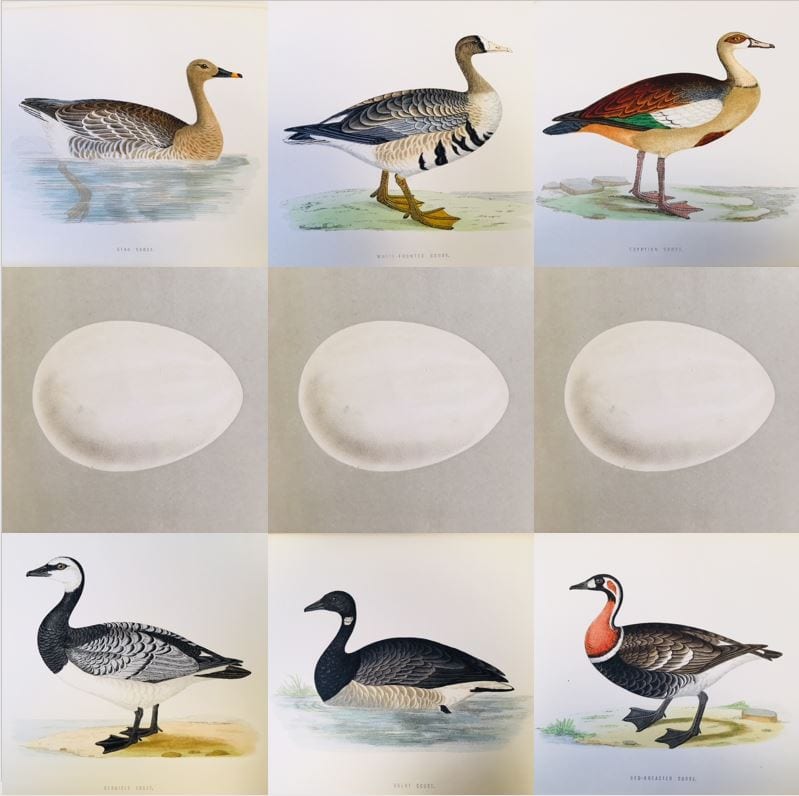
Six geese a-laying: bean, white-fronted, Egyptian, barnacle, brant, red-breasted (with some of their eggs to tie things together), all courtesy of 19-century ornithologist, Francis Orpen Morris.
Five gold rings
By Christopher J Fripp, on 9 December 2018
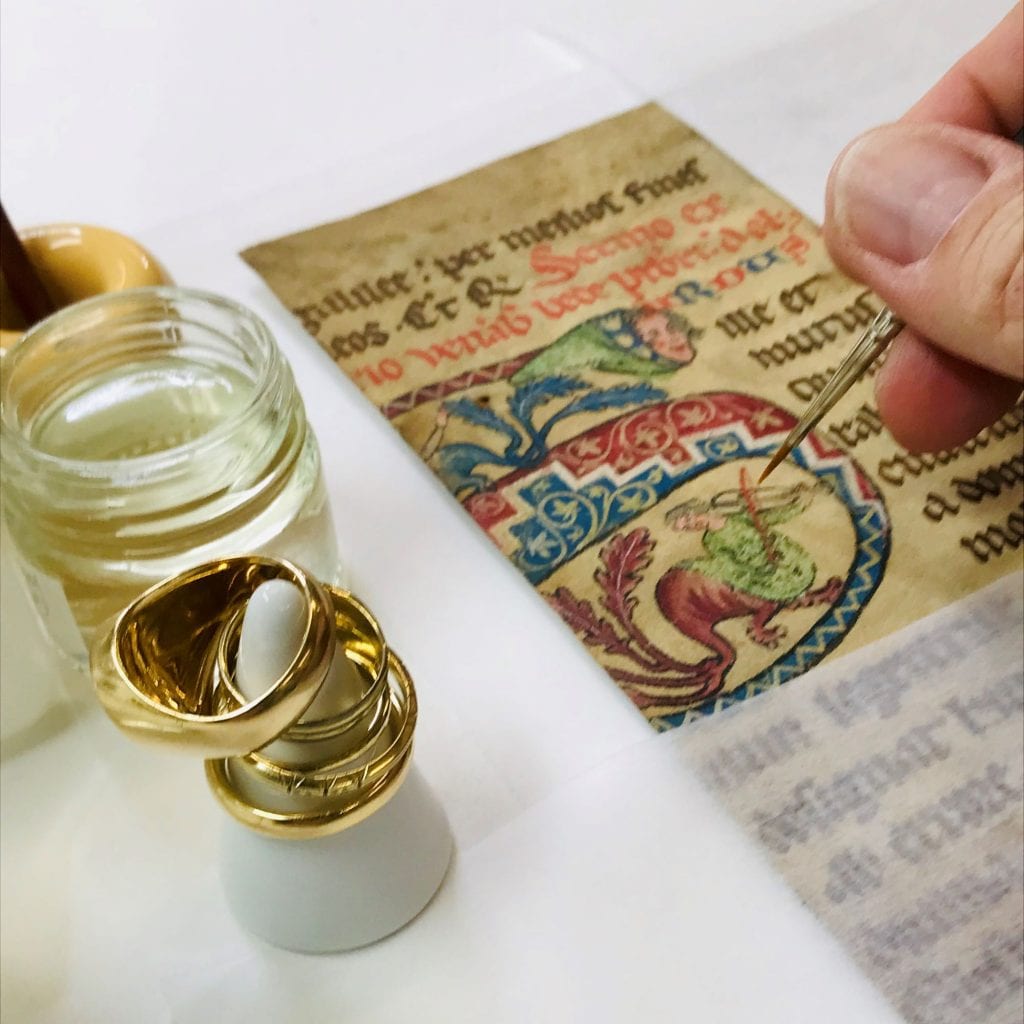
Five gold rings: back in the conservation studio, certain precautions should be taken before a pigment consolidation job . . .
Four calling birds
By Christopher J Fripp, on 7 December 2018
Four calling birds: and their song in musical notation (‘to to toto to to!’), from Athanasius Kircher’s Musurgia universalis (1650). The parrot, imitating human speech, is saying hello in Greek instead . . .
STRONG ROOM OGDEN A QUARTO 449

dav
Three French hens
By Christopher J Fripp, on 5 December 2018
Not quite three French hens, but one French lesson, at the Open Air School in Regent’s Park, c1919. Schools like this were opened to promote better health in children – all lessons took place outdoors whatever the weather, to give students maximum exposure to fresh air.
IOE Archives, reference LFB/24

Two turtle doves
By Christopher J Fripp, on 3 December 2018
Two turtle doves: one from India, one from Jamaica, both from Eleazar Albin’s A Natural History of Birds (the first English book on birds with colour illustrations).
STRONG ROOM E QUARTO 920 A5 (1)/1-2

UCL Special Collections Advent Calendar 2018
By Christopher J Fripp, on 1 December 2018
It’s the first day of December. Time to launch our Advent calendar. This year’s theme is based on the seasonal carol, ‘The Twelve Days of Christmas’. Throughout the month we’ll be posting Special Collections-inspired images/blogs for each of the 12 days, beginning with a partridge in a pear tree. We wanted to take a bold, experimental, and daring approach, so we hope you’ll forgive our decision to start Twelvetide a bit earlier than usual. Happy Christmas!
A partridge in a pear tree: in the conservation studio, the use of non-acid-free paper is best kept for tea breaks . . .
STRONG ROOM HNHS FOLIO 1583 D6

2019 UCL Special Collections Visiting Fellowship
By Erika Delbecque, on 23 November 2018
We are pleased to invite applications for a Special Collections Visiting Fellowship, which offers a researcher the opportunity to visit UCL to conduct research on our fascinating collections. Its aims are to raise awareness of the collections amongst the research community, to facilitate new research into UCL Special Collections, and to disseminate the research outcomes to academic and non-academic audiences.
 UCL Special Collections holds one of the foremost university collections of manuscripts, archives and rare books in the UK. They include fine collections of medieval manuscripts and early printed books as well as highly important 19th and 20th century collections of personal papers, archival material, and literature, covering a vast range of subject areas. The core strengths of our collections are:
- Language, literature and poetry and 20th and 21st century small-press publishing
 Politics and social policy, especially 19th and 20th century reform movements
- History of science, especially medical sciences and genetics
- Mathematics
- History of the medieval and early modern book
- Latin American history and economics
- Hebraica and Judaica
- History of education, especially 20th century
- History of London, especially 19th and 20th century
- Speech sciences and conversational data
The successful candidate will spend up to six weeks, or the part-time equivalent, at UCL researching the collections. The Visiting Fellow will receive a grant of £3,500 to cover travel, accommodation and living expenses. The deadline for applications is 10 am on 1 February 2019.
See our website for further details and an application form.
Cataloguing Mysteries: Engravings of the Electors of Bavaria
By Harriet S, on 15 November 2018
Retrospective cataloguing can be a great way of unearthing treasures in UCL’s extensive collections. Few other librarians will be so systematically working through a subject or donation from many years ago, and many of the texts are hidden until cataloguing, with only the bare bones of an online record or in some cases nothing at all.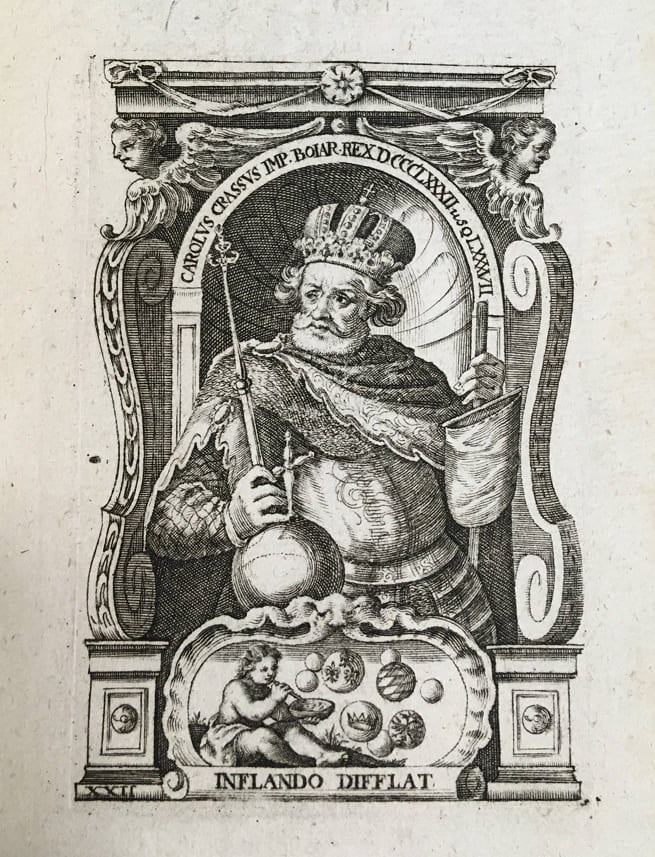
The most recent mystery comes from the unlikely source of 20th century art books being catalogued for storage. Amongst the unremarkable, modern volumes was a small book of engravings. The only text included in the book is instructions from the bookbinder in German (“An den Buchbinder”), and nothing about the text gives much of an idea of its publication or provenance.
An afternoon with UCL’s conservators revealed some probable dates, as the book uses rag pulp paper so would likely have been produced before the widespread adoption of wood-pulp paper (circa 1837), and the binding has many 18th century features such as red bole edges and French Style laced boards, alongside some more recent elements. Already the book was looking to be much older than its shelf-mates.
Perhaps the most unique identifier at this stage was a watermark of the coat of arms of Bavaria, and a letter (M? W?) visible below it. The database of watermarks at Memory of Paper described a similar watermark on a music manuscript at Bayerische Staatsbibliothek but without any image available, the only option to verify the watermark was to contact the library directly and request one.
By some coincidence, the Bayerische Staatsbibliothek was conducting watermark research at the time and were kind enough to send an image, verifying that this was indeed by the same paper-maker: Matthias Weitenauer, active 1763-1773. However, as the final engraving is of Karl Theodor, who only became Elector in 1777, the book as a whole would have had to come together after Weitenauer’s presumed working period. So, other than the knowledge the book was not created before the paper it’s printed on, an exact date was still not forthcoming.
 To get a more concrete date, the priority was to identify the engravers. 2 out of the 62 engravings were signed: Weissenhahn Sc[ulpsit], likely to be Georg Michael Weissenhahn (1741-1795) who engraved portraits in this period, although none of this book’s portraits seem to be discoverable online. It is likely that the other 3 engravings in a similar style are also by Weissenhahn, which left a mere 57 unaccounted for!
Searching for specific engravers of these very popular subjects is no mean feat, and it wasn’t until a Google Image matching search on the engraving of Carolus Crassus (“Charles the Fat”!) that the rest of the portraits could be reasonably ascertained to be by German 17th century engraver Wolfgang Kilian. Once identified, his engravings could be found in a number of works, including Excubiae Tutelares Serenissimi Principis Ferdinandi Mariae Francisci Ignatii VVolfgangi (Monachii : Leysser, 1637) and Ain und sechtzig Königen und Hertzogen auß Bayern Bildnussen (Munich : Johann Wagner, 1655). None of these also contained the Weissenhahn engravings, however.
An exhaustive search for both engravers, and a trawl through sales records of books finally led to the book itself: Geschichte von Baiern: (zum Gebrauch des gemeinen Bürgers, und der bürgerlichen Schulen) by Lorenz von Westenrieder, 1786. The instructions to the bookbinder appear to tally with the plates’ location in the text, and all plates from both engravers are accounted for. Again the Bayerische Staatsbibliothek is conspicuous as the only public institution holding another copy of the work.
 The provenance of the book was also initially unclear – presented “by two old students to commemorate their association with the college” it seemed to give no indication of who these students actually were. Only by examining other books with the same label could the donors be discovered to be Adolf and Nellie Wohlgemuth, early 20th century psychology students at UCL (and Adolf, later, a lecturer).
To go from no information at all to knowing both the plates’ origin and the book’s most recent provenance feels like a huge achievement. Yet on some level the book remains a mystery. Why did this particular group of plates never reconcile with the text? How did Adolf Wohlgemuth, born in 1868, come across this 1786 volume? Maybe Wohlgemuth or his family only ever purchased the plates. Or perhaps a former owner decided to get text and plates bound separately, but if so the text volume has never been found at UCL.
The BFE/SCEA: A short illustrated history
By utnvwom, on 16 October 2018
The IOE holds the archive of the British Forces Education Service/Service Children’s Education Association. The BFES/SCE provided education for the children of British Forces personnel initially in Germany, but later worldwide. The Association was established to enable BFES/SCE teachers to keep in touch. The collection contains papers from countries all over the world including Germany, Belize and Hong Kong. With the withdrawal of British troops from Germany over the past few years we have received many new items for the archive. I recently created an exhibition on the history of the organisation for the Assocation’s reunion dinner and thought it would be good to share a short version of it here.
Beginnings
On 9 February 1946 a meeting was called at the War Office where a working party was established to investigate the how to create a Central Education Authority to work under the Control Commission for Germany and Austria. At this point, the question of whether the families of British Service personnel serving in Germany should join them, had not been decided upon. A survey was undertaken by the Chairman of the Working Party, Lieutenant Colonel F J Downs and Mr W A B Hamilton, Assistant Secretary at the Ministry of Education.
The results showed that the total number of children aged between 0 and 15 in these families would be about 6000. The greatest requirement would be for primary education. In June 1946 the Cabinet agreed that families should join serving personnel as long as the education the children received was ‘at least equal to’ that they would have received in the UK. At this point the British Families Education Service was established by the Foreign Office.
Local Education Authorities were asked to co-operate to help recruit teachers to work in the schools in the British Zone of Germany. It was estimated that the number needed would be 200. Two thousand applied and the first teachers arrived in Germany in November 1946. British families started arriving from August 1946 onwards and small informal schools were set up in some areas before official BFES schools opened. The first official BFES schools opened in early 1947.

From issue number one of the BFES Gazette, 6th August 1947. BFE/C/3/1
Expansion
Although the BFES originally provided education for the children of British Forces families in Germany, in the following years BFES/SCE schools were opened in countries across the world including Hong Kong, Cyprus, Malaysia and Mauritius.

The staff of Minden Road School Hong Kong, 1957. BFE/B/5/7

School magazine, and school theatre production programme for Bourne School, Malaysia [then Malaya], c1960. Donated by Janet Methley. BFE/B/6/8
A change of hands
In the winter of 1951-1952 the Service was taken over by the Army and became Service Childrens’ Education Authority (SCEA). In around 1989 a new administration was introduced and in the short-term the organisation was named Service Children’s Schools (SCS) before adopting its current name Service Children Education (SCE).

SCEA Bulletin Number 2, BFE/A/3/1/2
The Association
The BFES Association was founded in 1967 to enable BFES teachers to keep in touch. In the 1980s it merged with the Service Childrens’ Education Association (SCEA), which had changed its name to SCE, to become the BFES/SCE Association.
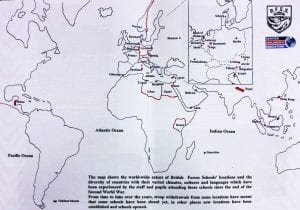
Map of locations of British Forces Schools in 2007. BFE/A/2/5
The Archive at the UCL Institute of Education
While the collection documents the history of the organisation very effectively, its richness comes from it being mostly collected by teachers who worked for the BFES/SCE. This aspect of the archive gives researchers an insight into the lives of those who were part of an incredible organisation.
The collection comprises:
- Administrative papers of the BFES/SCE Association including minutes of meetings, papers regarding events and publications;
- Recollections, diaries, photographs and school publications of former BFES/SCE teachers working in Belgium, Cyprus, Germany (West Berlin and West Germany), Egypt, Hong Kong, Malaysia, Mauritius, Sri Lanka and Yemen;
- Records of the BFES/SCE itself including teaching resources, information for staff and families living abroad, and publications. Most of these papers have been donated by members of the BFES/SCE Association but relate more generally to the work of the BFES/SCE rather than the work of individual schools.
- A small number of publications issued by the British Forces and community
Researchers can arrange to access the collection at our reading room at the UCL IOE.
ioe.arch-enquiries@ucl.ac.uk
It’s alive! Or the Cuteness of Paper Memory.
By Angela Warren-Thomas, on 28 September 2018
Written by Laurent Cruveillier
UCL Special Collections possesses a collection of medieval and early modern fragments, including 157 manuscripts and nine early prints.
Most were recovered from bindings of other manuscripts or early printed books, where they had been used as spine linings, paste-downs or covering material.
The conservation process of the printed paper fragments is now nearing completion, and more will be shared on the theme, but along the way, one particular set of four 16th century, probably Italian, fragments of Aristotle’s “Ethica Nichomachea” (PRINT FRAG/4) behaved in such an endearing way that it inspired one of the involved conservators to produce a short clip.
In this film, one sees how providing the tiniest amount of moisture helps the paper fibres finding their original position, in an almost organic and live motion, as if they had kept the memory of how they were laid, centuries ago.
Witnessing their movement was such a thrill that we wanted to share it with you.
Learn more about the collection:
http://www.ucl.ac.uk/library/digital-collections/collections/msfrag
Improving access to our Latin American archives
By utnvweb, on 20 August 2018
Posted on behalf of Adersh Gill – a UCL student volunteer with Special Collections
Volunteering with UCL Archives over the last year has been really enjoyable. I was given the opportunity to improve the archive catalogue on the Santa Rosa Milling Company, a British owned milling company that operated in South American in the late 19th and 20th Centuries. The goal of the project was to make it easier for researchers, whose likely focus is on the economic history and development of South America, to gauge whether learning about the Santa Rosa Company’s history would be useful for their work.
The Santa Rosa Milling Company kept extensive documentation and I was asked to improve the archive description for the company’s minute books. The minute books recorded the monthly meetings of the company’s directors. This particular project required someone to be able to summarise the minute books with enough detail to be useful to researchers but not too much that it would take too long to read. Perhaps the main challenge was being able to decipher the hand-writing of the various secretaries recording the meetings, fortunately the archives team were always happy and willing to help whenever I ran into trouble.
The project offered a rare way for a student to learn about the history of South America particularly Chile, using the Santa Rosa Company’s history to gain an insight into the development of the regions. The Santa Rosa Milling Company also offers a case study about an early form of globalization, the company was headquartered in London whilst the majority of company activity occurred in South America; in addition one can learn about the less obvious impacts and ripple effects from the defining historical events of the period through the company’s response to them. The processing of reading through the minute books was in itself a learning experience for me. In particular the company’s post WWII history provides a valuable example of how global companies operated under the Bretton Woods era, when capital flows and currency exchanges were much more tightly regulated. Going through the minute book and seeing how a company on a day-to-day basis had to interact with various regulatory agencies provided a deeper level of understanding for a financial regulatory system which can seem quite abstract when described in a textbook.
Overall the project far exceeded my expectations both in what I expected to learn from it and how enjoyable I found the cataloguing, not to mention how welcoming and nice it was to work with the archives team. This is definitely an activity I would recommend to curious students.
You can find out more about the collection on our online catalogue – search for SANTA ROSA. For more information about using our collections, please see our webpages.
Summer School a Success!
By Vicky A Price, on 15 August 2018
Last week saw UCL Special Collections hold its first Widening Participation Summer School. For four days, a group of twelve 17 year olds from in and around London explored archives, rare books and manuscripts here at UCL, guided by colleagues within Special Collections.
We had brilliant time, and were impressed with the students’ ability to link collection items to areas of their own knowledge and contextual understanding. We also spent a day at The National Archives, visiting their current exhibition, Suffragettes vs. The State, and discussing the notion of authenticity in relation to exhibition interpretation. The participants then got to work researching collection items from UCL Special Collections, developing interpretation for a public exhibition on the final day.
You can see examples of their work in this video:
We would like to thank everyone at Library Services for accommodating the group, whether that be in the Science Library or the Institute of Education Library, and for Special Collections colleagues who offered their time and expertise.
An eminent female academic at the IOE: Clotilde von Wyss (1871-1938)
By Nazlin Bhimani, on 10 August 2018
In my research on teacher training at the London Day Training College (LDTC), which became the Institute of Education (IOE) in 1932, I have found the relatively unknown Clotilde von Wyss to be one of the most intriguing female teacher trainers.[1] Von Wyss taught at the LDTC and IOE from 1903 to 1936. This post provides a brief overview of her contributions to teacher training in the interwar era.
As was typical in the late 19th century to the first half of the 20th century, most women became qualified teachers to have professional careers, and many women remained unmarried to retain their independence. Some women teachers progressed in their careers by taking up headships and others, mainly the ‘intellectually gifted women’ from the middle classes, went into teaching in higher education.[2] Von Wyss followed this latter path and trained as a teacher at Maria Grey College, Brondesbury and gained a distinction in her Cambridge Teachers’ Certificate. Before her appointment at the London Day Training College (LDTC), von Wyss taught at various schools including St. George’s High School in Edinburgh from 1894 to 1897. During this time, she was also an external student at the Heriot-Watt College where she took classes with the distinguished naturalist Sir Arthur Thomson.
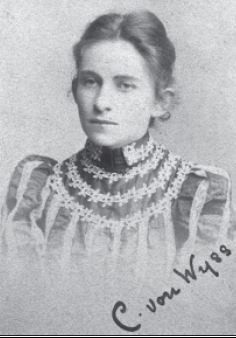
Clotilde von Wyss (1871-1938)
From 1897 to 1900 she taught biology at her old school, North London Collegiate, after which she took up a lectureship at the Cambridge Training College. In 1903, she began to work on a part-time basis at the London Day Training College (LDTC) where she taught biology, hygiene, nature study, art and handicraft. Von Wyss was soon appointed as a full-time member of staff supporting the Mistress of Method and Vice-Principal, Margaret Punnett (another eminent female academic), with the welfare of the women students.[3]
Von Wyss’s pedagogical contributions are significant. The 1929 issue of the student magazine, The Londinian, reviews the annual biological exhibition which von Wyss organised and provides evidence of novel teaching methods including the use of visual illustrations, objects, story-telling and peer-learning to communicate complex concepts. Her students presented these concepts to other students using the items on display, which included a dissected cat, the digestive organs of a rabbit, and a frog which was used to detect a heartbeat. There was also a section where the students learnt about amoeba and another which focused on genetics or the ‘principles of heredity’ and the role played by chromosomes:
Miss Gascoyne … was demonstrating the principles of heredity by means of charts…[and the] story of the black gentleman cat who married a sandy lady cat was touching in the extreme. How he longed for his little boys to be tortoiseshell, something like him and his dear wife! But they never could. That distinction was confined to the girls of the family. And all because of a wretched chromosome with a hook in it![4]
She was a progressive educationalist and expected trainee teachers to demonstrate aspects of child-centred learning in their teaching practice. Her written comments on her observations of student teachers’ classroom teaching practice are held in the IOE’s archive. They describe her child-centred approach and what she believed to be the essential qualities of a teacher and ‘good’ teaching. Of utmost importance, for her, was that teachers understand the world of the child so that they could see things from the child’s perspective. Teaching children to observe would, she emphasised, enable the child to ‘come alive’.[5] She was critical of students who simply derived teaching material from textbooks and imparted it mechanically.
Von Wyss was known outside of the LDTC and IOE. Her lessons for the BBC’s Broadcasts to Schools in the late 1920s made a profound influence on science teachers throughout the country. In the 1930s, ‘her ants’, which she had nurtured for the students to observe, were featured in the documentary film ‘Wood Ant’ as two letters from the mid-1930s confirm. She made arrangements to show the documentary at the Autumn meeting of the School Nature Study Union at County Hall and later to the students at the LDTC.[6]
Von Wyss had also established herself as a formidable naturalist. This was recognised by teachers and by the officials at the London County Council. Many teachers used her biology and nature studies textbooks which contain her own illustrations, and as a member of the textbook selection Committee at the London County Council Committee, she assessed nature study and hygiene courses at other teaching colleges.[7] As editor of the School Nature Study Journal, she was known for highlighting the educational benefits of nature study, providing a course outline for the subject, and sharing the most effective teaching methods. In this, she had the backing of such influential people as L.C. Miall who was a Professor of biology at a Yorkshire College (later part of the University of Leeds), J. Arthur Thompson, the renowned naturalist under whom von Wyss studied in Edinburgh, the writer H. G. Wells, C. W. Kimmins who was the Chief Inspector of the London County Council, and Sir Percy Nunn who was director of the LDTC and IOE during von Wyss’s tenure. (Nunn was also involved in the Nature Study movement for he chaired the Union from 1905 to 1910).[8] They were all eugenicists, as was von Wyss.
Her contributions to the study of science were acknowledged publicly when, in 1914, she was appointed Fellow of the prestigious Linnean Society. [9] Her obituary in Nature describes her as a ‘brilliant and inspiring teacher’ whose students ‘went out to teach with a feeling of power and confidence’ and ‘teachers of many years standing still remember her with affection and gratitude’. She ‘never lost sight of the interdependences of theory and practice’ and ‘like all true teachers, she was also continually a learner’. [10]
REFERENCES
[1] Apart from E. W. Jenkins’ work on The Nature Study Movement(1981) in which he introduces von Wyss’ contributions to nature study and Richard Aldrich’s biographical introduction to her in the Centenary History of the Institute of Education(2002), there is little on von Wyss’ pedagogical innovations.
[2] Fernanda Perrone, ‘Women Academics in England, 1870–1930’, History of Universities12 (1993): 339, 347.
[3] Richard Aldrich, ‘The Training of Teachers and Educational Studies: The London Day Training College, 1902–1932’, Paedagogica Historica40, no. 5–6 (October 2004): 624.
[4] ‘Harold’, ‘The Biological Exhibition’, The Londinian, no. Summer (1929): 15.
[5] Correspondence with Gaumont-British Instructional Ltd dated 20th March (1935?) and 7th October 1935. ‘Von Wyss Staff Records (1909-1949)’.
[6] Diploma Report dated 29/05/22. In: Clotilde von Wyss, ‘Diploma Reports 1922 Women Students’ (London Day Training College, 1922), IE/STU/A/7, UCL Institute of Education Archives.
[7] British Broadcasting Corporation, ‘Notes on the Courses: Nature Study with Clotilde von Wyss’, in Broadcast to Schools (January to June 1929)(London: British Broadcasting Corporation, 1929), 17.
[8] E. W. Jenkins, ‘Science, Sentimentalism or Social Control? The Nature Study Movement in England and Wales, 1899‐1914’, History of Education10, no. 1 (March 1981): 39.
[9] ‘Societies’, The Athenaeum, no. 4542 (14 November 1914): 512.
[10] R. F. S., ‘Obituary: Miss Clotilde von Wyss’, Nature142 (26 November 1938): 944–45.
Special Collections welcome first Summer School at UCL
By Vicky A Price, on 27 July 2018
We are excited to announce UCL Special Collections’ newest addition to the outreach and education programme – our first Summer School programme, in August 2018!
We will be offering 14 Year 12 students a chance to learn about all things special collections – from what we keep, why we keep it, how we keep it and how our collections can be significant to an array of audiences.
Funded by Widening Participation, the four day programme will make good use of our wonderful host city; we will explore how special collections items are interpreted and displayed at The National Archives (at their exciting current exhibition Suffragettes vs.The City) and The British Library.
Our team of specialists will offer guidance and advice as participants explore the notion of authenticity in interpretation, and participants will experiment with applying what they have learnt to some chosen manuscripts, rare books and archival items at UCL.
The final result will be an exhibition that presents students’ own responses, in a variety of formats and genres, alongside the items themselves. The exhibition will take place in UCL’s South Junction Reading Room on August 9th from 2pm to 4pm – it will be free and open to the public, so please come along!*

*Visitors are invited to pop in at any time between 2pm and 4pm. Should the room become full we might ask you to wait a short while before entry, due to space restrictions.
