X Close

UCL Special Collections

Home

Updates from one of the foremost university collections of manuscripts, archives and rare books in the UK

Menu

Archive for the 'Student work' Category

What’s in a Textbook? Exploring the IOE’s Special Collections

By Nazlin Bhimani, on 12 December 2025

Earlier this week, I had the opportunity to introduce the IOE Library’s Special Collections to visitors from the Royal Historical Society, colleagues from the London School of Hygiene and Tropical Medicine, and members of the Institute. In this short presentation, I focused on showcasing the collections I most often use in my teaching, which also informs the historical inquiry work I do with doctoral researchers. This post expands on that introduction, and draws attention to some of the research outcomes that have emerged from scholars using these collections.

Images of illustrations from a sample of textbooks held in the IOE's Special Collections

The Institute was founded in 1902 as the London Day Training College and became the Institute of Education in 1932, by which time it was regarded as the Empire’s most important educational institution. The library began with just a few books in the Principal’s office, and as the Institute expanded, these collections grew into a recognised flagship collection, one that supports teaching and research and is of national and international significance. The Special Collections, which evolved from the Institute’s working library and expanded through generous donations over the years, are actively used by staff, students and independent researchers from around the world.

But what unites the diverse holdings of the IOE Special Collections? A deceptively simple object: the textbook. As John Issitt (2004) notes, textbooks are ‘vehicles of pedagogy’ that contain the ‘received knowledge’ of their time, yet they are often dismissed as having little intrinsic value. Textbooks are, in fact, rich cultural artefacts. They reveal not only what was taught in schools, but also how teachers were trained, which knowledge was valued, the ideologies shaping generations of teachers and learners, and where silences appear. Thus, far from being neutral transmitters of facts, they reveal changing teaching methods, social and political priorities, prevailing attitudes towards class, race and gender, and provide insights into everyday life. A key figure in recognising textbooks as worthy objects of scholarly inquiry was Ian Michael, Deputy Director of the IOE in 1973. He established the Textbook Colloquium and founded the journal Paradigm, legitimising textbook research in the 1980s as a recognised area of study. His personal library now forms part of the Special Collections.

One of the collections that most clearly illustrates the significance of textbook research is the Historical Textbooks Collection. It grew out of the National Textbooks Research Library, established in the 1960s to allow teachers to browse materials before purchasing for their schools. It includes a wide range of school textbooks spanning all subjects and levels until the introduction of the National Curriculum. History and geography textbooks, the latter forming a discrete collection, demonstrate how Empire and colonised peoples were portrayed in educational materials. The collection also reflects pedagogical developments over time, from rote learning to more differentiated and child-centred approaches, and offers insights into the history of publishing and school material culture.

The History of Education Collection adds further depth, containing textbooks used for teacher training, including works by early educational thinkers such as John Locke and John Dewey, as well as texts produced by the Institute’s own principals and directors. The collection also includes teachers’ manuals and handbooks, including those by the prolific children’s author Enid Blyton, whose works were frequently endorsed by the Institute’s second director, T. Percy Nunn, as they shared the same educational ideals. These manuals not only provide insight into classroom methods, but also reflect the growing standardisation of teaching practice. This standardisation was part of the wider move towards professionalising teaching. In addition, the collection has some historic gems, including the first illustrated children’s book, Orbis Pictus by the Moravian educator, John Amos Comenius, published in 1658, and the 1740 edition of Dilworth’s A New Guide to the English Tongue, one of the most widely used textbooks of its day. It is referenced in Charles Dickens’s Sketches by Boz, and is said to have helped Abraham Lincoln learn to read. 

Textbooks also appear throughout our subject-specific collections. The Rainbow Collection focuses on music education, whilst the Baines Collection contains 18th and 19th-century children’s books and encyclopaedias. Our various Comparative and International education collections reveal how pedagogical ideas travelled between nations, reflecting in particular the institution’s wider influence on colonial education. The personal libraries of His Majesty’s Inspectors (HMI) are particularly revealing, illustrating the intersections of pedagogy and policy. For example, HMI Captain Grenfell’s collection on physical education anticipated the subject’s compulsory status amid concerns about national efficiency, whilst HMI F. H. Hayward’s materials on moral education and responsible citizenship reveal links with the Eugenics Education Society, which sought to promote ‘moral hygiene’ or sex education, steering youth away from vice and toward ‘fit’ marriage partners.

Beyond print, we have the BBC Broadcasts for Schools (1926 to 1979), which by 1930 were used in approximately 5,000 schools. The ‘wireless lessons’ were, in essence, ‘textbooks of the air’, and they pioneered audio and then audio-visual learning. These broadcasts had a sustained influence on education for fifty years, teaching children ‘Received Pronunciation’, promoting aesthetics education and reinforcing British cultural heritage. Connected to all of these collections is the School Examination Papers Collection, which dates back to the late nineteenth century. It represents educational policy and practice, linking the textbook to the broader question of what was deemed worth knowing and assessing.

Then we have the 1960s MACOS (Man: A Course of Study) Collection, which exemplifies ongoing transnational influences in education. This multimedia social studies curriculum attempted to teach cultural diversity through studying the Netsilik Inuit and was adopted in schools across the United States and Britain. However, it faced intense conservative and religious opposition, which ultimately led to funding cuts and the programme’s decline in 1975. The ILEA Collection of publications tells a parallel story. This progressive education authority, active from the 1960s, produced materials that were often controversial, particularly around issues of race and sexuality. The authority was abolished by the Conservative government in 1990.

These collections are far from static. They actively support teaching, research, and curatorial work across UCL and beyond, with students and researchers engaging with original materials in ways that develop critical analytical skills while uncovering new historical insights. Funded research projects, such as the ‘Literacy Attainment’ study (now published as a monograph by Professor Gemma Moss), as well as ongoing work on the Empire, Migration and Belonging project, illustrate the breadth of scholarly engagement. Students have explored constructions of class, gender, and race, conducting close textual analysis to trace how social hierarchies were naturalised through everyday classroom materials. For example, one student examined illustrations in a textbook to reveal how Chinese people were visually portrayed, showing that racial stereotyping was embedded in educational resources. Her work will appear in Paper Trails, the BOOC published by UCL Press. Beyond the IOE, other historians, including independent scholars, often consult IOE’s collections, sometimes in conjunction with materials from the IOE’s archives. A recent example is the 2024 publication by independent researcher Daniel O’Neill, whose book This Excellent Man: Derbyshire Architect G. H. Widdows and English School Design, 1904-1936 draws extensively on both rare books and archival collections, making a significant contribution to our understanding of pedagogy and school architecture.

The IOE’s Special Collections — and I have only touched the tip of the iceberg among the catalogued collections — remain invaluable for studying how knowledge has been constructed, transmitted and contested. They document not just what was taught, but the ideological frameworks that shaped education, the networks through which pedagogical ideas circulated, and the evolution of teaching practices across centuries. The seemingly simple textbook opens complex questions about power, knowledge, and whose voices were centred or silenced. As we continue to catalogue, preserve, and make these materials accessible, we invite researchers to engage critically with this history to understand not just what education was, but what it might become.

We would also like to invite researchers to respond to our call for papers for a special issue of Paper Trails on ‘Difficult Collections’, or to consider applying for one of our Research Institute for Collections Visiting Fellowships. These opportunities offer a chance to engage directly with our rich historical collections. 

2025 Anthony Davis Book Collecting Prize Winners announced!

By Kaja Marczewska, on 29 August 2025

We are delighted to announce the winners of this year’s Anthony Davis Book Collecting Prize. The annual Prize, generously funded by Mr Anthony Davis, encourages student book collectors at any London university. 

Following a highly competitive selection process, the Prize was awarded to Aisling Twomey for her collection of lockdown zines. In recognition of the strength and originality of this year’s submissions, the award was divided between the two strongest candidates, with Penny James named the runner-up for her collection of stamp books.  

 “I am drawn to zines,” Aisling wrote in her application, “because they are a product of love.” Her collection is both an excellent example of rapid response collecting in practice, and a highly personal reflection on the disparate zine communities’ experience of the pandemic. Aisling bought her first zine in April 2020, drawn to its message about pen pals. That zine introduced her to the world of Postcrossing which became a subsequent source of community, and zines! Today, the collection offers an important glimpse into the world of DIY publishing as it was shaped by the pandemic internationally. But it does more than that. As Aisling put it, it is “a small contribution to the collective memory of a global community in crisis.” 

A selection of zines and postcards from Aisling’s collection.

Like Aisling’s, Penny’s collection grew out of a chance encounter. She has come across her first stamp album in a charity shop. She didn’t buy it then but has been looking for a copy ever since! Penny collects used stamp albums, focusing on the bound albums rather than the more expensive variants which typically include interchangeable leaves. “In part,” Penny explains, she focuses on that format “because the printed covers of a mid-twentieth century album is what initially caught my attention, but also because of the way the binding fixes the album as a static object. I enjoy exploring how original stamp collectors negotiated this material boundary.” That is, Penny doesn’t collect stamps themselves, only the volumes designed for their compilation (although many, inevitably, include stamps too). The collection then is, in Penny’s words, a collection of abandoned collections – a collection of collecting activity itself.  

A selection of stamp album covers from Penny’s collection

Pages from one of Penny’s stamp album, showcasing stamps from Ukraine, Vatican City, and the USA


Congratulations to the winners!  


Interested in submitting your collection to the Anthony Davis Book Collecting Prize? The competition runs annually, with next round of submissions planned for spring 2026 (dates TBC). Updates on the 2026 competition will be posted on this blog.


Student Reflection on the BA Education Studies Placement, Pt. 2

By Sarah Pipkin, on 2 May 2025

The Special Collections Outreach Team has been fortunate to host two students on a placement from the IOE’s BA in Education Studies. As their time comes to a close with us, they’ve written a blog post about their experiences. In this post, Joann Zhang reflects on her experience.


As part of my placement module this term, my colleague Elena Yu and I had the opportunity to work closely with the Outreach team at UCL Special Collections. This experience not only deepened my understanding of how the collections operate behind the scenes but also gave me a new perspective on how historical resources can be used for educational purposes.

This wasn’t my first time engaging with the UCL Special Collections. In Year 1, during the module The Worlds of UCL, Professor Georgina Brewis introduced us to various selected materials from the collection as part of our classwork. As a BA Education Studies student, I also often wonder how these resources could be used in school teaching. So, I was very excited when I knew that I was allocated to the Special Collections team—and even more so when I found out we would be developing a series of GCSE History learning materials.

Selection of imgaes. Image 1 is of a document on a table. Image 2 is of several pamphlets and images in an exhibitions case. Image 3 is of a gloved hand holding an item over a box of several small, packed items

Selection of photographs from the Worlds of UCL seminar

However, using collection items in a taught class and actually working as part of the team that selects and prepares those materials are very different experiences. In classes, items are pre-selected, but the process behind this is far more complex. First, our topic this year focused on Commonwealth immigration—something I had very little prior knowledge of. Also, I was unfamiliar with archive search engines and didn’t know how to begin locating relevant materials. In total, everything felt new to me at the beginning.

Luckily, with the support of Vicky Price and Sarah Pipkin, Elena and I were able to start with a presentation on the history of Commonwealth immigration, which gave us a basic understanding and helped us set a direction for our research. We then learned how to navigate UCL Library Services and use the archive catalogue to search for materials. Finally, we booked the Reading Room to check items in person and arrange our findings into a spreadsheet.

Two photographs of collection items laid out on a table

Viewing items in the IOE and SJRR Reading Rooms

Throughout this process, I was impressed by the diversity of items held in the collection. Beyond published rare books, there were small press materials like magazines and newspaper clippings, as well as personal letters and ephemera. My favourite item among all my findings was a videotape called Motherland, found in the Marina Foster collection. It was a play created by a group of female students at Vauxhall Manor School, based on the real-life stories of 23 Caribbean women who migrated to the UK in the 1950s. It might be particularly inspiring for GCSE students to learn about what students of the same age were creating more than 40 years ago.

Photograph of a pink VHS box and of someone loading the VHS into a VHS player connected to a computer

Watching the Motherland VHS

This research experience felt like a treasure hunt: starting with almost no knowledge and slowly digging deeper to uncover hidden gems with teamwork and guidance from our supervisors. There were times of disappointment, especially when items didn’t quite match what I was looking for. But there were also rewarding moments brought by unexpected findings. Over the last four months, I was glad to see my confidence grow with each visit to the Reading Room, and I have developed new research skills that I can apply in other contexts.

At the end, I would like to express my sincere appreciation to Amy Howe, Becky Sims, Chelsie Mok, Colin Penman, Liz Lawes, Sarah Pipkin, and Vicky Price, who supported me throughout the placement with patience and kindness. I’m truly grateful for this opportunity and hope to see you in the future, both in and beyond the Special Collections.

Thank you so much to Joann for her hard work and her reflection on her placement!

Student Reflection on the BA Education Studies Placement, Pt. 1

By Sarah Pipkin, on 1 May 2025

The Special Collections Outreach Team has been fortunate to host two students on a placement from the IOE’s BA in Education Studies. As their time comes to a close with us, they’ve written a blog post about their experiences. In this post, Elena Yu reflects on her experience.


Introduction

I chose the Education Placement Module this term, and it is so lucky for me to spend 50 wonderful hours with warm-hearted staff members in UCL Special Collection team and my classmate Joann Zhang, working on a project around the topic of “Commonwealth Migration”. We hope that our research and work will offer some help for GCSE students’ history study. Our placement started in late January with an initial online meeting with Vicky Price and Sarah Pipkin. Over the following weeks, Joann and I gained insight into the various aspects of the team’s work — including archiving, cataloguing, digitisation, and the outreach efforts related to the collection.

Working as a team   

A book open to its marbled endpages is strapped down to a board. A camera is positioned above the book.

Illustration of shooting an ancient book in the digitization process

While working through the archives, a number of staff members generously shared their expertise, guidance, and advice—all of which greatly inspired me and contributed to the development of my research. Colin Penman from the UCL Records suggested several useful items from the Records collection. Becky Sims, Liz Lawes, and Chelsie Mok kindly offered valuable advice on locating materials, and Amy Howe patiently demonstrated the digitization process (as shown in the photo). Their support was instrumental in deepening my understanding of archival work and contextualizing it within the scope of my research. 

The most exciting collection item  

Several colourful leaflets spread out on a table

Material reference number: GA/9/2/4

After keyword searching in the catalogues of online library and looking at them in the UCL Special Collections Reading Room, GA/9/2/4 is a part of most intriguing material that I found. These colourful leaflets and booklets are from 1970-1987, and perfectly show activities that were done by the Commonwealth Institute to provide better service to both immigrants’ lives. Leaflets included multiple types of activities offered, such as school visits to exhibition art galleries, educational services, quiz pamphlets featuring fun facts or knowledge of commonwealth nations’ culture, teaching packs, workshops and library services. The content of the activities covered wide range of commonwealth nations and communities. They are suitable for assisting students with GCSE History learning, as they used harmless language with easy vocabularies, with interesting illustrations and contents created for children in similar age groups.  

What I have learned   

This placement has provided me with not only practical work skills but also meaningful life experience. As a student who began with little background knowledge in either archival work or the topic of Commonwealth migration, I initially felt overwhelmed and uncertain. Thanks to the helping hands from Vicky, Sarah, and Joann, I gradually developed a clearer understanding of the research topic, along with the ability to navigate specific catalogues to find relevant materials, and it is truly cheerful when I can see my progress. I still remember Vicky’s words: It’s human instinct to push away from daunting tasks but give yourself the courage to climb over the mountain and take the first step. That’s the hardest part of the process—once you’ve made that move, you’re already making progress.” Her encouragement stayed with me throughout the journey and continued to motivate me whenever I felt discouraged.  


Thank you so much to Elena for her hard work and her reflection on her placement!


Student Reflections – IOE’s BA Education Studies

By Vicky A Price, on 21 May 2024

The Outreach team in UCL Special Collections recently hosted two students from the IOE BA Education Studies course.  Tasked with creating a pitch for a new after school club, Jiayi and Yunrui spent time getting to know the collections, learning about the Outreach programme and devising an original idea to present to staff at the end of their placement.  It was a pleasure to host them, and we hope to implement their project ideas in the next academic year.  This blog is written by Jiayi and Yunrui, and shares some of their reflections and learning at the end of their time with us.

Ella Zhang

After completing our Education Placement at UCL Special Collections, Yunrui and I are thrilled to reflect on the enriching experiences we had during our time here.

Throughout the placement, we developed a general understanding of UCL Special Collections. We had the privilege of engaging with key staff members, embarking on tours to Special Collection places on UCL Bloomsbury Campus. We were also introduced to key collection items and delved into stories behind them. Under the guidance of Daniel Dickins, we honed our skills in online collection search, catalogue navigation, and item viewing, equipping ourselves with invaluable tools for future studies.

We were introduced to the Outreach Programme in Special Collections under the supervision of Vicky Price, and the standout highlight in the placement for me was our participation in the after-school club Illustrate!, a part of the Outreach Programme at Special Collections. I visited Stratford School Academy, where I saw pupils enjoying perspective drawing in the workshop. Yunrui and I then visited UCL East with an authentic opportunity to observe collection items with pupils from Stratford School Academy. This firsthand experience in the after-school club, witnessing how children immersed themselves in the exploration of collection items, made me reflect on the learning process. As an education student, I was then led to the philosophical debate of the relationship between learning and fun – are the two elements separate or could they be mutual–facilitating? To me, real learning experiences are so closely intertwined with ‘fun’. The after-school club facilitated by Special Collections managed to achieve this – Illustrate! provides pupils with a well-balanced educational experience as it supports pupils’ learning with collection items while stimulating the intrinsic curiosity of pupils.

Inspired by our experiences, Yunrui and I seized the opportunity to design our own after-school club – Poetry Lab. Motivated by our fascination with the poetry store, we envisioned a space where Key Stage 3 pupils could discover poetry beyond its stereotypical image. This was inspired by Liz Lawes, when we were introduced to the small press collections. Through sessions focused on concrete, visual, object, and sound poetry, we wanted to encourage pupils to understand poetry as a way of creative expression. We also designed creative activities in each session. These activities would allow kids to construct different forms of poetry by themselves, aiming to help them develop a deeper appreciation of poetry and language. This experience gave us a real taste of programme development including collection use and resource preparation.

To sum up, Yunrui and I have both really enjoyed this placement in the lovely working environment in Special Collections. Our collaboration has been particularly rewarding, with our shared enthusiasm and teamwork spirit. Throughout our placement, we had the pleasure of meeting great people and developing new skills. We sincerely hope there will be future opportunities for us to work with Special Collections again!

A white box with an image of paper scultures on it - this is the front cover of Heinz Gappmayr – 5 Papierskulpturen (1962).

The front cover of UCL Special Collections’ edition of Heinz Gappmayr – 5 Papierskulpturen (1962).

Some paper sculptures in various 3D shapes.

The sculptures assembled.

Yunrui Zhang

This term, as a part of Education Placement Module, my course mate Ella and I have been assigned to have a 50-hour placement with UCL Special Collections and worked with the outreach team on the after-school workshop. The placement started at late January and mostly finished at late March. Before this placement, I knew nothing about UCL Special Collections. Through this placement, I gained some relevant knowledge. This includes what archives, rare books and manuscripts are, how to quickly search items in Special Collection’s catalogue and how to use these items in after-school workshops in the Outreach programme.

Our final task was to design an after-school workshop for the outreach programme, using collection items from UCL Special Collections. This required us to have clear knowledge and become relatively familiar with some of the collections. Initially, I thought it would be quite challenging to familiarise ourselves with the collections and develop a suitable workshop topic within the 50-hour placement. However, the supportive environment at UCL Special Collections and the guidance we received, including weekly explorations of different collections, have made the process more manageable. One particularly memorable experience was our visit to the poetry store with Liz Lawes. We were fascinated by the diverse ways in which poetry can be presented. With Liz’s guidance, we deepened our understanding of different forms of poetry and ultimately decided on the topic of our after-school workshop: “the poetry lab”.

Beyond visiting and exploring various collections, we also had the opportunity to observe after-school workshops in person. These experiences taught us a lot about the ideal format for such workshops. Unlike traditional school classes, after-school workshops should integrate fun and interactive activities into the learning process to ensure an enjoyable experience.

These insights have also inspired the design of our own after-school workshop. We’ve structured it into 5 sessions, each focusing on a different form of poetry. This allows students to learn and understand the different forms of poetic expression during the workshop. We have designed different activities for each session to encourage active participation and deeper understanding. For example, one of our sessions is focusing on object poetry. The activity we designed for this session involves students making their own object poetry and sharing their thinking with the class. This hands-on approach can facilitate their understanding on how object works as a metaphor to help people better visualize and understand the poem.

In fact, my learning journey has already begun when I started learning about the Outreach programme. Over the two months of the placement, as I gradually deepened my understanding of the Outreach programme, I gained some new insights about the role of universities in society. I realized that universities could have profound impact beyond their traditional academic roles to foster a more interconnected and supportive society. UCL Special Collections can be a good example that extends the university’s reach beyond its immediate academic community by providing assistance and resources to schools and individuals, actively contributing to broader societal well-being.

Throughout the whole placement, I also learned a lot from my course mate Ella, including her outstanding communication skills and her ability to learn new things. It was a great pleasure to work with her on our after-school workshop proposal. At the same time, I am also very grateful to Vicky Price and Daniel Dickins and everyone else in UCL Special Collections for their help and support during the placement. This experience will be a treasure for my future, and I am very lucky to be able to spend these two months with UCL Special Collections.

A small cardboard box containing a seemingly incomplete puzzle that features a landscape image.

Moschatel Press’ Pastoral Fragments, held at UCL Special Collections.

Public History group projects 2023: Small Press, Big World – exploring the world of Wikipedia

By Joanna C Baines, on 14 August 2023

Jo: 

Special Collections has been supporting the new MA in Public History since September 2022. As part of our support, we lead two group projects in Term 2 for Critical Public History, which is the core module all students take. These projects aim to equip students with real-world scenarios and experience, where they deliver an outcome to a client (in this case, Special Collections). Anna Fineman leads the other Special Collections project, which this year focused on creating an informal archive for the new UCL East campus.

My project involved putting information about our Small Press collections – which can be challenging to digitise due to the fact that they’re often still in copyright – online via Wikipedia. Small Press publications contain a wealth of work by artists, writers and publishers often collaborating to make independent works. This year our students James and Yuxuan worked on the 1960s art magazine 0 to 9, creating a brand new page for the title which includes a complete list of contributors to each issue. The page at present is in review stage, having initially been declined in April, so links will be updated on this post when it hopefully gets approved! You can still read the page whilst it is waiting for approval.

Huge thanks to James and Yuxuan who were an absolute dream team to work with this year!

James and Yuxuan:

For this short blog post, we will showcase the benefits of Wikipedia for information creation with student collaboration. We will also highlight some key strengths and pitfalls that come alongside Wikipedia development through the lens of working with the Small Press collection: 0 To 9 Magazine. Almost everyone has used Wikipedia for access to information, but to help ensure its continuation, it needs the support of contributors to help develop new articles.

Wikipedia is an encyclopedia with free content anyone can use, edit, and distribute. It is developed to have a neutral point of view. There are no firm rules, but contributors to Wikipedia must treat each other with respect and civility. For new users, Wikipedia also provides tutorials to help teach the basics. On creating a new page, various templates can aid your creation/development of an article! 

Useful features to utilise when creating your Wikipedia page would be your sandbox, which allows you to play around with Wikipedia’s features in a less formal environment. Standardised elements include headings, citations, references and an infobox template.

Note: Although anyone can edit on Wikipedia, on published pages, people will check and edit what you post: Make sure to base your work on reliable sources. You can see a baseline of what reliable sources are from this Wikipedia page.

For our Wikipedia page, we included a brief description of what 0 To 9 Magazine was, some background behind the creators of the magazine, the production of the magazine, and the themes expressed by the contributors to the magazine. We then proceeded to list all the issues of 0 To 9 and more specifics about each issue. 

At the bottom of the page, you can find further information about the impacts of 0 To 9 through the Supplements, Impact and Legacy subheadings and the various references.

As we worked on our Wikipedia page, we tried to focus on the magazine’s materiality of language and the distinction between visual art that it defies. We have also created a short video for this blog post, giving more details about the magazine, which you can watch below.

Kaladlit Okalluktualliait (Greenlandic Folktales): Contentious histories of preserving indigenous oral traditions

By Erika Delbecque, on 17 May 2021

This blog post was written by UCL student Sae Matsuno (MA Library & Information Studies) as part of a two-week work placement at UCL Special Collections. Sae’s Twitter handle is @O_Aspirations. 

19th-century folklore books that travelled from Greenland to UCL

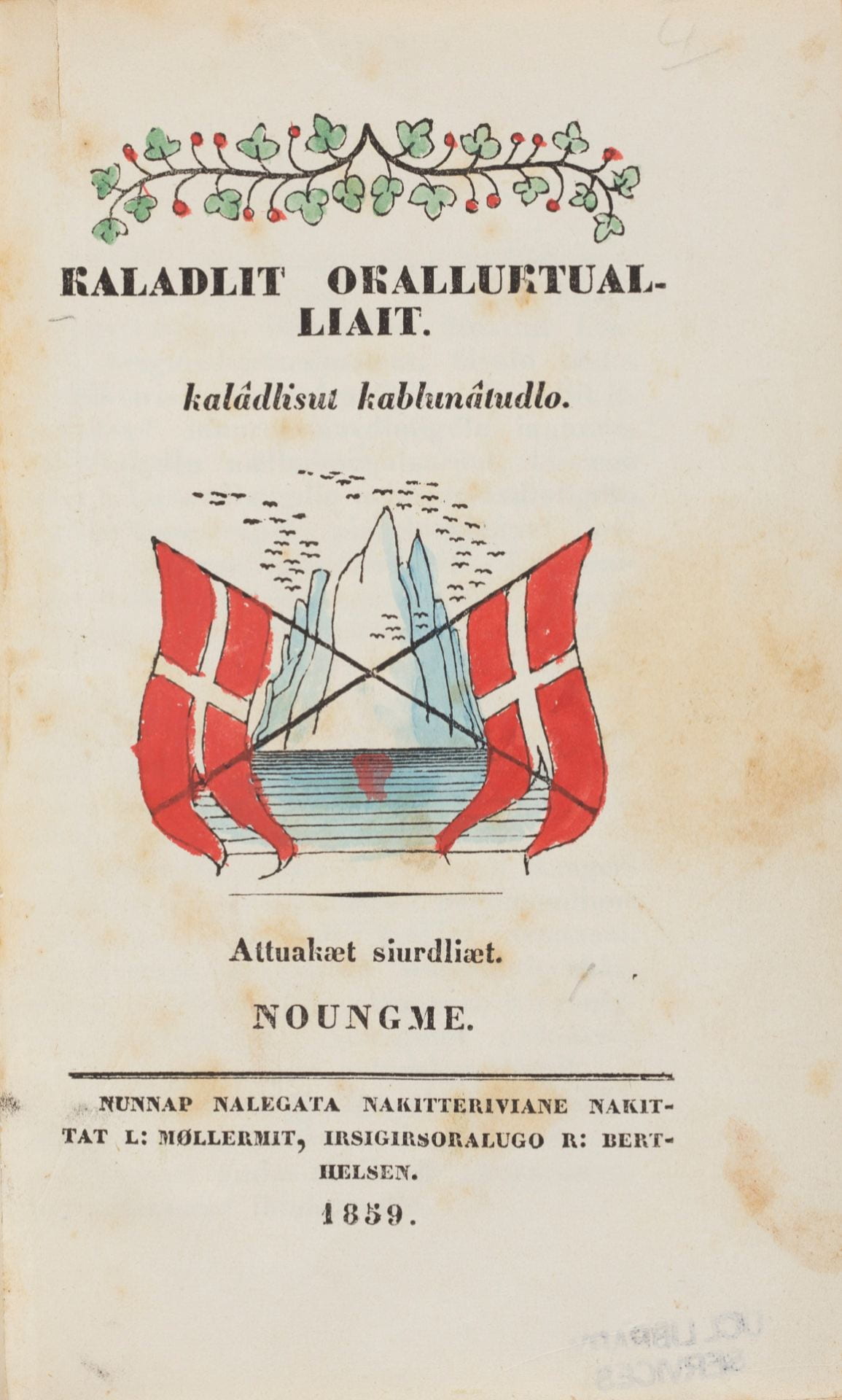
Rasmus Berthelsen, title page of Kaladlit Okalluktualliait, Godthåb, 1859-1863. © UCL Special Collections.

Kaladlit Okalluktualliait (1859-1863) is a multi-part work (four volumes) of Greenlandic oral folklore collected, written, illustrated, published and preserved. The organiser of this large-scale preservation project was a Danish geologist/colonial official Hinrich Rink (1819-1893). As Inspector of South Greenland, Rink requested all Greenlanders to record in writing their local legends and poems. He worked with native artists/catechists to illustrate the stories and translate the texts into Danish. Among them, Âlut Kangermio – better-known as Aron of Kangeq (1822-1869), Rasmus Berthelsen (1827-1901) and Lars Møller (1842-1924) are notable figures.

The three volumes housed in UCL Special Collections were originally owned by the Peckovers, a leading Quaker family in Wisbech, England; and donated in 1967 to Library Services by the UCL emeritus professor L. S. Penrose (1806-1974). For the last few years, the item has drawn more attention through the National Trust exhibition at Peckover House (2019), publication in Art History (Hatt, 2020) and the Liberating the Collections project at UCL Special Collections (2021).

Voices, languages and tensions in colonial Greenland

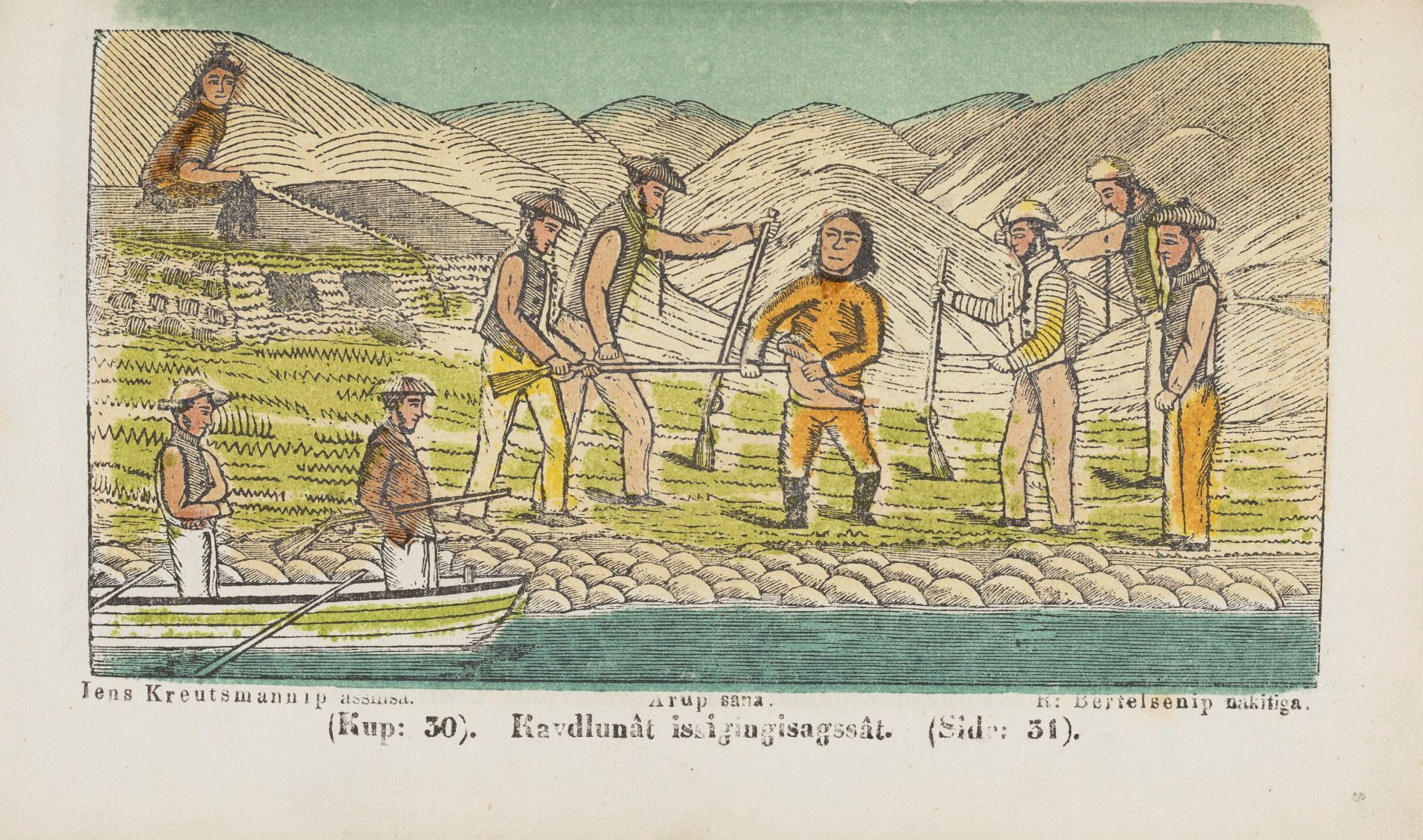
Kaladlit Okalluktualliait is a finely executed print work, including woodcut plates, many of which were hand-coloured. One example is an illustration for “The Man Not to Be Looked at by the Europeans”. In this story, an Inuk was made by his mother’s charm unbearable for European sailors to see. As no Europeans dared to look at him, the man had the freedom to steal from them. Angry sailors came to attack the man, but no one could shoot him even when he challenged them to do so.

An illustration for “The Man Not to Be Looked at by the Europeans”. Kaladlit Okalluktualliait, Godthåb, 1859-1863. © UCL Special Collections.

Winter house (Rink, Tales and Traditions of the Eskimo, 1875). Courtesy of HathiTrust.

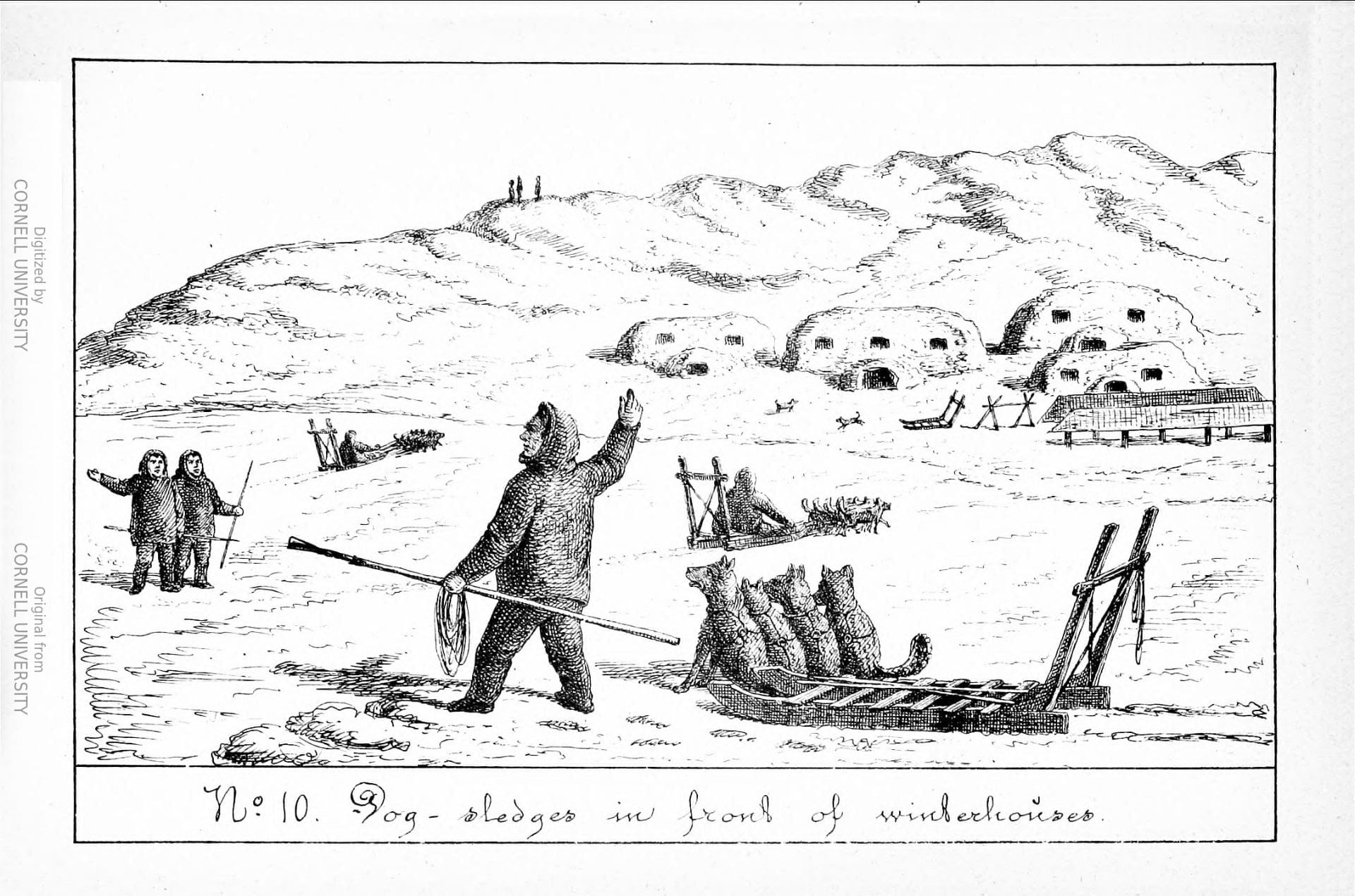
In the history of printing, Kaladlit Okalluktualliait is considered as one of early milestones of the print culture in Greenland. (Oldendow, 1953; Thisted, 2001) Rink continued to collect folktales and translated them into other languages. Among them, Danish (Eskimoiske Eventyr og Sagn, 1866) and English (Tales and Traditions of the Eskimo, 1875) editions, of which copies are also held at UCL Special Collections, can be accessed via HathiTrust Digital Library. Tales and Traditions and Danish Greenland (1877) – written also by Rink – are of note, as they were richly illustrated by Âlut, Berthelsen and other indigenous artists.

Dog sledges in front of winter houses (Rink, Danish Greenland, 1877). Courtesy of HathiTrust.

Rink certainly played a central role in promoting Greenlandic cultures (see the chapter “The Greenlanders Sketched by Themselves” in Danish Greenland). However, I hesitate to call their relationships “collaboration” because of the power imbalances between Denmark and colonial Greenland. In this context, many questions arise. Who decided which folktales were to be included in the volumes? Were the artists allowed to create their works in their own ways, or did they follow Rink’s instructions? Who chose illustrations that accompanied the texts? What have been the benefits of this project for the Inuit?

As I read the relevant literature (see below for references), it becomes more clear that there are complex ambiguities between preservation and exploitation, sounds and pictures, as well as between spoken and written languages.

For instance, Hatt characterises the production of Kaladlit Okalluktualliait as a process where “[t]radition was eroded”. (2020: 313) His article helps us to critically think about:

1) transforming indigenous oral traditions to texts and images, as a result of which the stories may lose their orality (e.g. accents and vocal expressions) and get detached from the local storytelling practice;
2) translating those texts into other languages, through which cultural values and nuances may not be fully expressed or understood;
3) publishing and selling the intangible heritage of indigenous peoples as collectibles, while Inuit communities can be excluded from the life cycle of collections.

Interdisciplinary potential

As much as we appreciate the artistry of Kaladlit Okalluktualliait, we should also put these historical and ongoing tensions at the centre of our attention. By doing so, the print work can be used as a gateway to engage with indigenous oral traditions, as well as to explore and better understand how these traditions function (or stopped functioning) in Inuit societies. This item can be a meaningful part of interdisciplinary teaching, learning and research across Indigenous Studies, Postcolonial Studies, History, Literature, Arts and more.

References:

Hatt, M. (2020) ‘Picturing and counter-picturing in mid-nineteenth-century colonial Greenland’. Art History, 43(2), pp.308–335. Available at: https://onlinelibrary.wiley.com/doi/full/10.1111/1467-8365.12498 [Accessed 4 May 2021]

Hauser, M. (1993) ‘Folk music research and folk music collecting in Greenland’, Yearbook for Traditional Music, 25, pp.136–147. Available at: https://www.jstor.org/stable/768690?seq=1#metadata_info_tab_contents [Accessed 30 April 2021]

Kahn, L. and Valijarvi, R. (2020) ‘The linguistic landscape of Nuuk, Greenland’, Linguistic Landscape, 6 (3), pp. 266-295. Available at: https://discovery.ucl.ac.uk/id/eprint/10094235/1/Kahn_linguistic_landscape_nuuk__centrevsperiphery_final.pdf [Accessed on 30 April 2021].

McDermott, N. K. (2015) Unikkaaqtuat: traditional Inuit stories. PhD dissertation. Queen’s University. Available at: https://qspace.library.queensu.ca/bitstream/handle/1974/12806/McDermott_Noel_K_20154_PhD.pdf.pdf?sequence=3&isAllowed=y [Accessed on 30 April 2021].

Montenyohl, E. L. (1993) ‘Strategies for the presentation of oral traditions in print’, Oral Tradition, 8(1), pp.159–186. Available at: https://core.ac.uk/download/pdf/160495057.pdf [Accessed on 30 April 2021].

Oldendow, K. (1958) ‘Printing in Greenland’, Libri, 8(3-4), pp.223-262.

Petterson, C. (2012) ‘Colonialism, Racism and exceptionalism’, in: Loftsdóttir, K. and Jensen, L. (eds.) Whiteness and postcolonialism in the Nordic region: exceptionalism, migrant others and national identities. Farnham, Surrey, England: Ashgate, pp.29-41.

Thisted, K. (2001) ‘On narrative expectations: Greenlandic oral traditions about the cultural encounter between Inuit and Norsemen’, Scandinavian Studies, 73(3), pp.253–296. Available at: https://www.jstor.org/stable/40920318?seq=1#metadata_info_tab_contents [Accessed 30 April 2021].

Social Media Rants from the Past

By Erika Delbecque, on 5 July 2019

This blog post was written by Patricia Jager, an MA student at the Institute of Archaeology who is currently volunteering with UCL Special Collections. She is compiling a list of our 1914-18 collection, with the aim of making this uncatalogued material available for teaching, events and research.

Today we have become used to annoyed social media posts popping up on our feeds from friends, family and random people we once met on holiday. They cover a wide range of political issues and pet peeves that can be funny, inspiring or infuriating depending on which side of the issue you are on. From the perspective of future archaeologists and cultural heritage managers, the internet offers an unprecedented window into current issues on a global level.

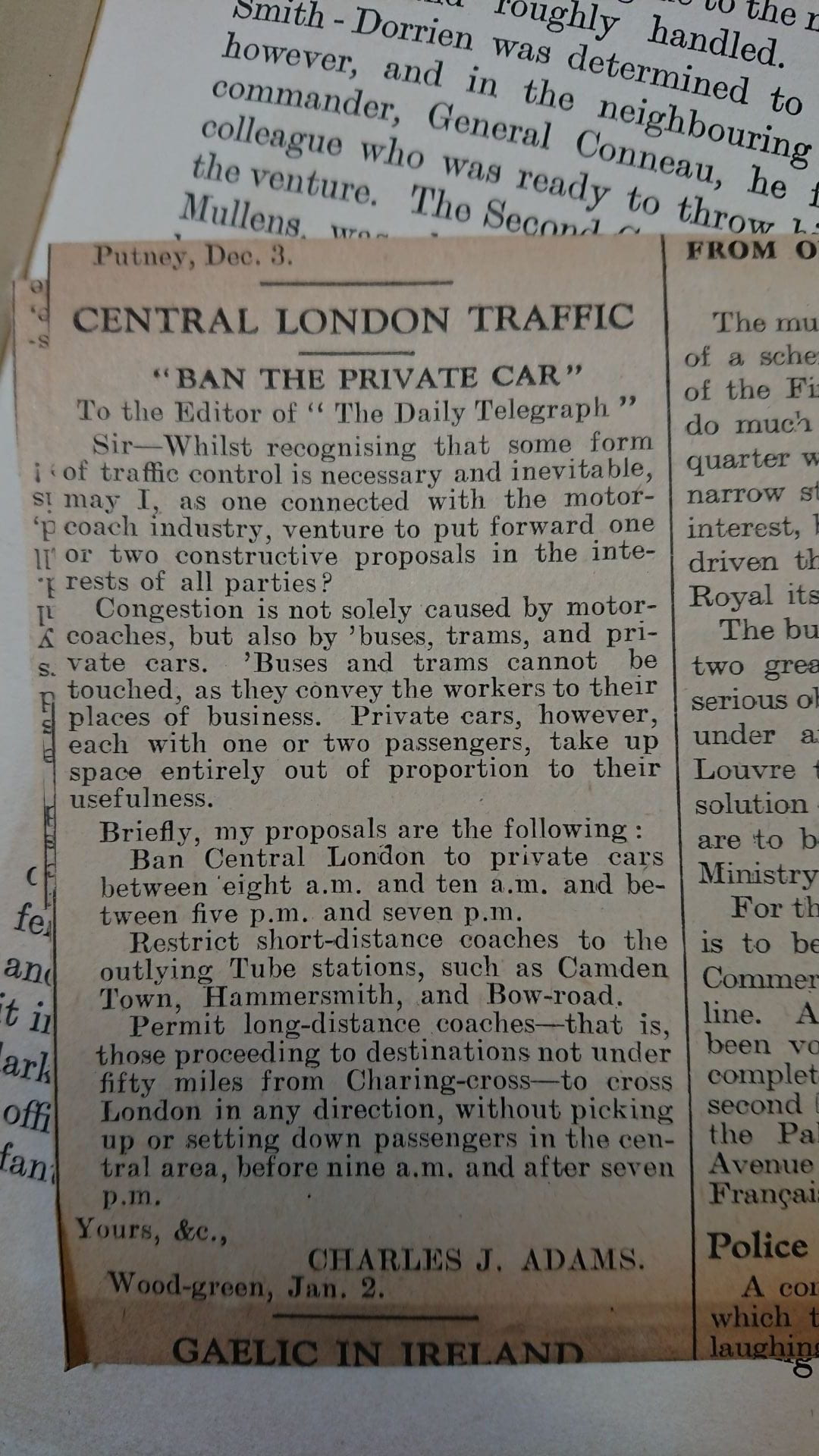
However, venting one’s frustration on media platforms does not seem to be an entirely contemporary concept. While listing ‘The British campaign in France and Flanders 1914’ by Arthur Conan Doyle from the 1914-18 collection at UCL Special Collections, I stumbled across a newspaper cut-out from January 5th, 1931 that one of the previous owners must have left behind. While this excerpt was doubtlessly chosen for the main article, it accidentally helped some letters to the editor survive.

They caught my eye because one of them regarded Central London traffic, which apparently was already horrible more than 80 years ago. When comparing the original letter to most of the digital commentary I encounter on social media every day, I was struck by its polite tone that is definitely a thing of the past. If one would use such a comparison to infer the difference between past and current populations, one would believe that our manners had progressively deteriorated over time.

The actual difference between past and modern, however, might be the result of biases. The internet allows us all to act simultaneously as authors and publishers of our written work. Letters to the editor, on the other hand, are selected by the newspaper agency and must abide by certain standards. Anyone, no matter their background, social status or level of education can leave commentary on social media platforms meaning a true variety of opinions are represented and available to future historians. However, how all this data could be archived, catalogued and studied is a question that cannot yet be fully answered, and I doubt that most of us consider what researchers might think about the opinions we share online in a hundred years’ time.

Probably, Charles J. Adams, the author of the letter I found by sheer accident would never have imagined his work published in a completely new medium nearly a hundred years later, especially because it seems like no politician ever read or implemented his sensible proposal. Consequently, letters to the editor and social media rants have at least one thing in common: they are being perpetually ignored by those in charge.

The Flaxman Manuscripts – a volunteer’s experience

By utnvweb, on 20 July 2018

Posted on behalf of Euan Guckian, a UCL student volunteer with Special Collections.

During the final term of this year I have had the opportunity to work with a couple of John Flaxman’s journals and notebooks for the UCL Special Collections team. Flaxman (who most reading this will recognise from his works in UCL’s main library) was a famous sculptor, and leading figure of the neoclassical movement, in the late 18th and early 19th centuries.

The collection was split into two books. The first comprised Flaxman’s journal from his time spent in Naples in 1788 and was filled with sketches and watercolours, as well as brief descriptions, of the various sculptures he saw and ruins he explored while there. The second contained notes on lectures he gave on the role, features, principles and history of sculpture, and was also interspersed with quick yet still interesting pencil sketches. My main role centred on summarising each page so that a visitor to the collection could quickly find whatever topic most interested them, either paraphrasing Flaxman’s notes or lifting them straight from the page.

Never having studied sculpture, or even art more generally, it was fascinating to see the thoughts and considerations of a master of the craft. Of particular interest to me were his lecture notes on how art underpinned the entire “circle of Human Knowledge” which to Flaxman included everything from astronomy to philosophy and religion. Beyond this there is loads that would be appeal to those with an interest in art both classical and neoclassical, but also in the life and thought of an artist so central to UCL’s identity and history.

You can find out more about the collection on our online catalogue – search for MS FLAXMAN. For more information about using our collections, please see our webpages.

‘The Lover’s Confession’: students research Confessio Amantis fragment

By Helen Biggs, on 23 April 2018

This post contributed by Calum Cockburn and Lauren Rozenberg.

On the 8th and 9th December 2017, UCL Special Collections hosted the third workshop in the Digital Editing and the Medieval Manuscript Fragment series (DEMMF), organised and taught jointly by UCL and Yale postgraduates students to twelve graduate students (the majority of whom are UCL-based).

The workshop began with a lecture on UCL’s manuscript fragment collection and a handling session held at the Institute of Education library led by Katy Makin (UCL Library Services). A huge variety of materials was on on display, including a leaf from a music manuscript, once thought to have been used as a binding for an Early Modern book; a thirteenth-century breviary with a charming inhabited initial; a Hebrew papyrus from the Book of Genesis; and a tiny piece of parchment with lines from Euripides’ Medea. Examining these materials, the participants were introduced to the unique and complex challenges literary scholars and digital editors face in creating literary editions from medieval manuscript fragments, fragments that often vary considerably in size and shape, in the legibility of their scripts and hands, in the nature of their decoration and layout, and the amount of damage they have sustained during their different lifetimes.

The students examining the the Confessio Amantis fragment.

The ultimate aim of this workshop was the collaborative transcription, encoding and publishing of a digital edition of a four-leaf fragment of the Confessio Amantis ‘the Lover’s Confession’ (MS FRAG / ANGL / 1), dated from the fifteenth-century and now housed in UCL Special Collections. This poem is a 33,000-line Middle English work by John Gower (d. 1408), a contemporary of Chaucer (d. 1400), whose compositions were particularly popular during the late medieval period. This text alone survives in 59 copies, one of the most copied manuscripts that survives to us, alongside the Canterbury Tales and Piers Plowman, written by William Langland (d. 1386). The Confessio uses the confession by an ageing love to the chaplain of Venus as the framework for a long series of shorter narrative poems, linked thematically by each of the ‘Seven Deadly Sins’. UCL’s fragment is unique in the collection in that its four leaves were given their own brand new binding at the turn of the twentieth century. It originates from Book V of the poem, concerning Avarice.


Two details from MS FRAG / ANGL / 1

To aid them in the creation of their edition of this text, the graduate students took part in a series of discussions and exercises concerning the palaeography and codicology of fragments, digital editing and TEI markup, the use of XML editing tools, most notably oXygen software, and project-based collaboration in the digital arena. Subsequent sessions across the two-day event focused on the teaching of common markup languages and the Text Encoding Initiative.
Subsequently, this expertise was used to mark-up and encode UCL Special Collections’ Confessio Amantis. The fragment itself reflects issues frequently encountered by digital editors of manuscripts and fragments. Most significantly, the fragment’s leaves are actually bound in the wrong order, an observation unrecorded in the manuscript catalogue itself.

Students and instructors examining the Confessio Amantis fragment and discussing its features.

The first folio ranges from lines 775 to 966 of Bk. V while the second one jumps to line 1735 continuing to 1926, before returning to lines 1159 to 1541 over the last two folios. Additionally, the fragment includes numerous small illuminated initials and marginal Latin glosses, separate from the main body of the text, and this raised questions across the weekend as to what the workshop participants should mark up and thus include in their edition itself. Such issues prompted the students to think about the nature of the text and the materiality of medieval manuscripts, and to consider fragments as objects rather than simply illustrated books.

Special Collections provided invaluable high definition images of the fragments. This helped students to prepare their own transcriptions of each manuscript page, and in addition better grasp the necessity for scholars of medieval manuscripts in the digital age. Digital reproductions can indeed alter our experience of the text in different and unforeseen ways. The finished digital edition of our own fragment will be published online at the end of this year, accompanying an edition of another item in Special Collections, a medical manuscript (MS / Lat / 7), transcribed and encoded during a similar workshop that took place during the summer.

The December workshop was made possible thanks to the support of UCL Doctoral School, the Octagon Small Grant Fund, the UCL English Department and Yale Beinecke Rare Book & Music Library. We’re especially grateful to Katy Makin (UCL Special Collections Archivist), for allowing us access to the fragment collection and assembling these materials on the day, and to Dr. Alex Lee (UCL SELCS), for all her palaeographic expertise and help in the transcription of the document itself.

The DEMMF workshop was coordinated by Dana Kovarik (UCL PGR English). The team of instructors included Ph.D. students from a number of different departments and institutions. From UCL’s Arts & Humanities and Social & Historical Sciences faculties: Calum Cockburn (UCL PGR English), Lauren Rozenberg (UCL PGR History of Art), Agata Zielinska (UCL PGR History). From Yale University: Gina Marie Hurley (Yale PGR Medieval Studies) and Mireille Pardon (Yale PGR) as well as Stephanie Azzarello from Cambridge University (Pembroke College, History of Art).

Slade Small Press Project, 9-11 March

By Tabitha Tuckett, on 8 March 2018

This Friday, Saturday and Sunday, the Slade Small Press Project is opening its work to the public, alongside an exhibition on Friday afternoon from UCL Library Special Collections’ Small Press Collections. Events will take place at the Slade Research Centre, top floor, 16 Woburn Square, WC1H 0AB.

Staff and students from the Slade School of Fine Art, alongside invited artists, have created works on the theme of sound inspired by the material from Special Collections, as part of a term-long research project supporting UCL’s Connected Curriculum.

Participants in the project have seen and heard material from UCL’s collections by experimental and avant-garde writers, poets, artists, photographers, dancers and composers. These include graphic musical scores (to learn more about these, see for example this blogpost), and works by John Cage, Cornelius Cardew, Henri Chopin and performance poets. On Friday you might even pick up a specially-pressed vinyl record of the students’ work made in response to our collections.

Recordings from the avant-garde poet and musician, Henri Chopin UCL SMALL PRESS COLLECTIONS

Friday 9 March, 2-4.30pm, includes not only the library exhibition and listening booths, but talks from an artist, a poet, a film-maker and an art critic, discussing lullabies, the connection or not between grime music and concrete poetry, Daphne Oram (co-founder of the pioneering BBC Radiophonic Workshop), and dance notations by Jennifer Pike (held in Special Collections). 4.30pm till late will see the launch of an exhibition of work created during the Project, the launch of the students’ specially pressed vinyl record, and a specially editioned print in honour of the late Mark E Smith and his inspiration, Blast (copies of which are held in Special Collections). The evening programme also includes a series of live performances by Slade staff and students and invited artists. The Project exhibition and listening booths continue on Saturday 10 March, 1-5pm and Sunday 11 March, 1-4pm, with a further programme of live performances on the Saturday.

Events are free and open to the public. Full details in the Project brochure below or here.

Read more about the Subject Liaison Librarian Liz Lawes’ experience of running the project in Tabitha Tuckett and Elizabeth Lawes, ‘Object literacy at University College London Library Services’ in Art Libraries Journal vol.42 issue 2 (April 2017) pp.99-106.

UCL SMALL PRESS COLLECTIONS

********************************

The Small Press Project 2018
Slade Research Centre, Woburn Square
Friday 9th March

The Small Press Collections held by UCL Library Services Special Collections are a globally significant collection of Little Magazines, literary pamphlets, and counter-cultural newspapers produced as a result of the independent publishing scene of the mid 20th century to the present.

From the late 1950s experimental poets and visual artists took advantage of newly accessible printing techniques to self-publish, and distribute their work outside of mainstream literary journals or established gallery spaces. The collections focus on experimental text and image, visual and concrete poetry, the documentation of performance and sound poetry, and text works by artists.

The theme of Sound is in evidence throughout the collections in various manifestations: actual sound recordings, the visual scores of experimental composers, sound and performance poets, poetry and other texts to be read aloud. This year’s Small Press Project seeks to illuminate all these aspects.

The Small Press Project Event, also includes an exhibition of works and recordings made by the staff and students at the Slade School of Fine Art.

Schedule

2.10        Hannah Dargavel-Leafe

Introductions and welcome

2.15      Aura Satz

Aura Satz’ practice encompasses film, sound, performance and sculpture. She has made a body of works that look at key female figures largely excluded from mainstream historical discourse, in an ongoing engagement with the question of women’s contributions to labour, technology, scientific knowledge and electronic music. In her presentation she will give an overview of 3 projects made about women composers, including ‘Oramics’, an artist’s film made in homage to Daphne Oram.

2.45       Holly Pester

Holly Pester will present ‘A short talk on the process of recording lullabies and composing lines from an archive of efforts.’ As well as the talk (and possibly short reading of one of the poems), she will play extracts from her record Common Rest.

3.15 – 3.30     Tea & Coffee

3.30      Holly Antrum

For her presentation, Holly Antrum will introduce an artistic interest in the original items and materials that went into Computer Dances by artist Jennifer Pike (1919 – 2016), as a subsequent tool for inter-generational collaboration and intervention. Jennifer Pike produced the ‘Computer Dances’ and other works within and around a productive, shared domestic studio, printing and publishing space wherein she was the oft-collaborator, and also marriage partner of Bob Cobbing (1920-2002). Computer Dances compiles Pike’s abstract notations for dance and performance: they were made in her 70’s, and she created them stepping into digital working, through scans and digital drawing using a simple early Sketch-Up programme. Holly will explore how arriving at these drawings occurred through being in Pike’s home and studio and how this sonically entered her 16mm/HD film, titled Catalogue (2012-14). Excerpts will screened from the film (19 minutes).

4.00    Jonathan P Watts

Jonathan P Watts will present ‘g, g, g, grime & kon kon kon konkrete poetry’

There is no actual relation between concrete poetry and grime, but the mix and blend might open up affinities. For example, by concentrating on the physical substance of language, concrete poetry can, to echo Bob Cobbing, help us consider how the microphone and the tape recorder extends the human voice, teaching the human new tricks of rhythm and tone, power and subtlety’. Grime, the Lewisham MC Novelist recently explained, is ‘an unorthodox, rebellious sound that represents madness from the hood, the streets’. Concrete poetry is now mostly in the academies, but it was unorthodox in its time. As grime has formalised into a mainstream genre so, arguably, its unorthodox, experimental beginnings have been forgotten. Wiley, writing in his recent autobiography, Eskiboy, reminds us: ‘I’ve got a lot of songs that I’ve never released which are just trying different things with the mic, very experimental kind of stuff. I’ve had ideas for whole songs just using the mic, my voice and nothing else.’ From Flirta D’s ‘splatterisms’ to Flow Dan’s New Age Synchronised Avengers, D Double E’s ‘blukuuus’ to God’s Gift’s rhyming gunshots, this talk will not place grime in the service of concrete poetry.

4.30 – 8.00     Private View for the Small Press Project Exhibition

The evening will feature live performances, curated by Hannah Dargavel-Leafe, Honorary Research Associate, by invited artists and students and staff from Slade School of Fine Art. We will also launch a special edition and a 10” vinyl publication produced by students as part of the project.

Biographies

Holly Antrum (b. London 1983) is an artist filmmaker based in London, and a current participant of the Acme Fire Station Work-Live residency in Bow. She works with 16mm, paper and digital mediums, and often in collaborative processes and study of practice with other artists and writers. She is interested in the moment of our accustomisation to celluloid-as-digital-material, and in a material moment of being at once archived and removed from the original and native aesthetic. Through her films she utilises the poetics of layered film processes, presence, communication and templates of speech, memory and in-situ sound. Recent projects include EIDOLON(2017) a film commissioned by International Literature Showcase with poetry by Sandeep Parmar. The new work was screened alongside artist-selected archival works within the Cinenova collection at The Showroom (February 2018). Solo gallery installations include Catalogue at Edinburgh Sculpture Workshop, Edinburgh (2016) and A Diffuse Citizen at Grand Union, Birmingham (2014). Her work has also been screened in galleries internationally. Holly Antrum earned her Masters in Printmaking at the Royal College of Art, London (2011), and her BA Fine Art Painting at Wimbledon School of Art, London (2005). A copy of Computer Dances (first published by Writer’s Forum in 1995) is also held in the UCL Special Collections.

Jonathan P. Watts is a contemporary art critic and occasional curator. He is a visiting lecturer in Critical and Historical Studies at the Royal College of Art, London. Writing by Jonathan has appeared in frieze, Art Monthly and Artforum. His review of Wiley’s recent autobiography Eskiboy appeared in the Times Literary Supplement this week. As ‘helter helter’, he makes performances that respond to aspects of instrumental grime music.

Holly Pester is a poet and Lecturer in Poetry and Performance at University of Essex. Her work has been situated as recordings, print, sound installation and live readings at international venues and esoteric spaces. Her most recent work, Common Rest was an album of collaborative Sound Poetry and accompanying poetry pamphlet. More info can be found at hollypester.com 

Aura Satz has performed, exhibited and screened her work nationally and internationally, including Tate Modern, Tate Britain, the Hayward Gallery, Barbican Art Gallery, ICA, the Wellcome Collection, BFI Southbank, Whitechapel Gallery, (London); Oberhausen Short Film Festival (Oberhausen); the Rotterdam Film Festival (Rotterdam); the New York Film Festival (NY); Anthology Film Archives (NY); Gertrude Contemporary (Melbourne); De Appel Art Centre (Amsterdam); AV festival (Newcastle); Baltic Centre for Contemporary Art (Gateshead); Irish Museum of Modern Art (Dublin); InterCommunication Centre (Tokyo); Lentos Museum (Linz); and The Sydney Biennale (Sydney). Recent solo shows include John Hansard Gallery (Southampton); Dallas Contemporary (Texas); Gallery 44 (Toronto); Tyneside Cinema Gallery (Newcastle); George Eastman House (Rochester NY); Fridman Gallery (NY). In 2012, she was shortlisted for the Samsung Art+ Award and the Jarman Award. She is a Reader and Tutor at the Royal College of Art, London. www.iamanagram.com

Hannah Dargavel-Leafe (born 1987, London) graduated with an MA from the Slade School of Fine Art in 2016 and Manchester School of Art with a BA in 2010. She has exhibited at The International 3 in Manchester, Bluecoat in Liverpool, and at ICA London. In 2016 she was in residence at the East Tower at Television Centre, White City and worked collaboratively with the artist Jack West. She was a featured artist in Ambit Magazine.
Dargavel-Leafe runs The Loop, an ongoing research project through symposiums, exhibitions and publishing. She is an associate artist with The International 3.

Small Press Project is organised by:

Liz Lawes, Subject Liaison Librarian for Fine Art, UCL Library Services

Lesley Sharpe, Holding Page & Teaching Fellow, Slade School of Fine Art;

Hannah Dargavel-Leafe, Honorary Research Associate, Slade School of Fine Art;

Sarah Pickering, artist & Teaching Fellow, Slade School of Fine Art

The Small Press Project is generously supported by the Teaching Initiatve Fund, IAS and the Dean’s Strategic Award.

**********************