X Close

Open@UCL Blog

Home

Menu

Open Science and Scholarship at UCL: A Year in Review

By Naomi, on 24 October 2025

Each year during Open Access Week, we like to share an update about what’s been happening in the past year across the various teams supporting Open Science and Scholarship at UCL and beyond.

A collection of logos from different collaborators in the first London Open Science Festival, including UCL Open Science, UCL Press, The Francis Crick Institute, LSE Press and LSE Library This year, the Office for Open Science & Scholarship and UCL Press partnered with colleagues at The London School of Economics and The Francis Crick Institute to launch an inaugural London-based Open Science Festival, instead of our usual annual conference. Taking place from 2nd – 6th June, there were a range of online sessions, as well as in-person sessions hosted at UCL and LSE, covering subjects such as Authorship and AI, Open Access in an Age of Populism, and Creativity in Research and Engagement.

Browse the full programme, read write-ups and watch recordings in this summary blog post.

We are delighted to share that planning has already begun for next year’s festival, with more London institutions joining to put together a programme with even wider reach. Watch this space!

Back in November 2024, the Office for Open Science and Scholarship fully committed to Bluesky, where our activity and following has increased over the last 12 months. From just over 200 followers at the end of October 2024, to a current total of 1,762 followers, it is fantastic to connect with a wide community engaging with Open Science. Our LinkedIn audience has also grown from 600 followers to over 1000, and it has been great to see more UCL students and staff engaging with our content on there.

Find us on LinkedIn and Bluesky if you’ve not connected with us yet!

Open Access

Over the past 12 months, the Open Access Team has facilitated the Gold open access publication of over 3,500 papers across 40 transformative agreements with publishers. UCL Discovery has continued to go from strength to strength, with over 62 million downloads, reaching the 60 million milestone in July which we celebrated in this dedicated blog post. The publications repository now boasts over 196,000 open access items, including 26,100 theses, with over 11,500 uploads over the last year.

Find out more about UCL’s Research Publications Service and how to make your publications open access.

UCL Press

Photo by Mat Wright, UCL Digital Media

This summer, UCL Press celebrated its 10th anniversary! To mark this significant milestone, an open access monograph panel event took place in person and online on 10th June, featuring speakers from universities and the publishing sector. UCL Press was launched in line with UCL’s commitment to open science and scholarship, and as the UK’s first fully open access university press, has to date published 423 books and 15 journals, surpassed 26 million open access downloads, and reached 242 countries and territories.

Discover how to publish your book, journal or journal article with UCL Press.

Copyright

It has been a busy year for the Copyright Team. In 2024-2025 we ran 36 sessions for UCL students and staff on a range of topics, including copyright for theses, publications, data, images, publishing contracts, and GenAI, continuing this year with a similar programme and offering bespoke sessions, too.

New resources included our Copyright and AI Libguide, our Getting Started with Copyright webpage, and the launch of our Copyright for Humans game: an engaging, playful and critical approach to copyright, which can be played in person or online.

A cartoon image of a copyright symbol, with blue hands and feet, blue circle and a pink and orange C in the middle and eyes and a mouth in the centre. It is wearing a mortarboard with a tassel.

AI-generated in Copilot with prompts by Christine Daoutis

As the new mascot, Colin the Copyright Literacy Nerd, will tell you, copyright education is much more than knowing about what the Copyright Act says or what a licence allows you to do. In April we launched the UCL Copyright Literacy Strategy 2024-2027, which sets out a vision and a plan of action to develop copyright confidence and understanding across UCL. One outcome of the strategy is our growing Copyright Literacy Community, which offers UCL staff and students opportunities to discuss copyright issues, share questions and best practice, and participate in collaborative projects.

For more information, contact the copyright team.

Citizen Science

Two people stand behind a desk on which is a variety of pens, papers and a badge maker. On of them is holding something which they are both looking at, it seems to be a badge that they have either just made or are about to make.

Photo by Sheetal Saujani at this year’s Open Science Festival

This year marked a major milestone for Citizen Science at UCL, with our first community event bringing together UCL staff and students to exchange ideas and explore participatory research.  In addition, we expanded our UCL Citizen Science Community on MS Teams to over 120 members and introduced the UCL Citizen Science Support Resources Hub, a collection of articles, tools, and guidance on different aspects of citizen science projects. The Office continues to support new UCL Citizen Science Academy training programmes leading to the UCL Citizen Science Certificate, ensuring consistently high standards across different cohorts. We have also very recently set up a UK-wide Citizen Science Enablers Network, a new initiative supporting groups and individuals interested in enabling Citizen Science at their own higher education institutions.

We’re committed to developing our support service for Citizen Science at UCL – one that empowers staff and students to run impactful projects and strengthens UCL’s position in Citizen Science.

Join our community and talk to us about your ideas and projects!

Research Data Management

In the world of Research Data Management at UCL, the past year has been significant as the Research Data Repository surpassed the 1 million mark for both views and downloads, with the figures currently 1.3 million for views and 1.2 million for downloads. A fantastic achievement from the UCL Research Community. These views and downloads took place in over 190 countries and territories across the world, which demonstrates the wide-reaching impact of the Research Data Repository. There is currently an impressive total of over 1000 items published on the repository which we hope will continue to increase, along with the total views and downloads.

Find out more in the newly published RDR user guide.

The UCL DMP template has also been updated this year, and you can find more information on managing your research data across the research lifecycle on our webpages.

Bibliometrics

Photo by Lukas Blazek on Unsplash

The Bibliometrics team ran a full calendar of 12 scheduled training sessions in the Library Skills program as well as a large number of smaller individual sessions, including developing training and support for new tools such as OpenAlex and emerging citation analysis tools. A major theme this year was advising on using the new Overton service, which offers researchers a way to discover grey literature as well as to identify new impacts of their research. We also assisted a wide range of teams at UCL in their work to measure and report on UCL’s research activity and impact.

It’s been a fantastic year, and we’re looking forward to what the next one has in store – read along on this blog, sign up to our newsletter, and follow us on LinkedIn and Bluesky to keep up to date!


alt=""

The UCL Office for Open Science and Scholarship invites you to contribute to the open science and scholarship movement. Stay connected for updates, events, and opportunities.

Follow us on Bluesky, LinkedIn, and join our mailing list to be part of the conversation!

Share this post on Bluesky

UCL Discovery reaches 60 million downloads!

By Naomi, on 27 August 2025

Guest Post by Dominic Allington-Smith (Open Access Publications Manager)

Two fireworks in full explosion of red, pink, and silver colour against the backdrop of a black night sky.

Maryam Khan, CC BY-SA 4.0, via Wikimedia Commons

UCL Discovery, UCL’s institutional repository, has hit another milestone! UCL Publications Board and the Open Access Team are excited to share that on Friday 18 July, the number of downloads reached the 60 million mark. UCL Discovery is UCL’s open access repository, showcasing and providing access to UCL research outputs from all UCL disciplines. UCL authors currently deposit around 1,100 outputs in the repository every month (average figure for the current academic year).

The 60 millionth download was of the interim report ‘Young people & coastal communities: Local policymaker and practitioner perspectives’ produced by the UCL Coastal Youth Life Chances project led by Professor Avril Keating.  This research project examines how growing up in coastal communities in England impacts the life chances of young people. The report arises from the project team’s A screenshot of the landing page for the publication titled 'Young people & coastal communities: Local policymaker and practitioner perspectives' which was the 60 millionth downloaded title from UCL Discoveryconversations with 50 policymakers and practitioners from around England about their perspectives on the challenges facing young adults aged 15-20.

At the time of writing, UCL Discovery hosts over 193,200 open access publications, comprising mostly self-archived copies of research outputs, but also including doctoral and research master’s theses (contemporary submissions and historic digitisations), and books published by UCL Press.  Since the 50 million downloads milestone in June 2024, the following titles are the highest-downloaded publications for each UCL Faculty, Institute or School. This list continues to reflect the diversity across UCL research:

* These publications are also the highest-downloaded of all time.

Hitting 60 million downloads highlights the reach and potential which comes from sharing research through UCL Discovery. There are a number of ways you can do this, primarily through sharing your Screenshot of the UCL Profiles homepage which has the UCL logo in the top left-hand corner, an image of the UCL portico in the background and 'Explore the UCL community' written in bold in the centre, under which is a search bar. research publications via UCL RPS and Profiles. You might also want to consider sharing other types of outputs such as data, code and software to further enhance the visibility and reproducibility of your work. UCL’s Research Data Management team maintain a guide on best practice for software sustainability, preservation and sharing, and can give further support to UCL researchers as required.

Another year of sharing research, and another incredible milestone – congratulations to everyone involved! Let’s keep it up and continue pursuing open access at UCL to ensure we are reaching the widest audience and having the greatest impact.


alt=""

Get Involved!

The UCL Office for Open Science and Scholarship invites you to contribute to the open science and scholarship movement. Stay connected for updates, events, and opportunities.

Follow us on Bluesky, LinkedIn, and join our mailing list to be part of the conversation!

Share this post on Bluesky

UCL Research Data Repository: Celebrating over 1million views!

By Naomi, on 10 June 2025

Guest post by Dr Christiana McMahon, Research Data Support Officer

Since launching in June 2019, the UCL Research Data Repository has now received over 1million views from over 190 countries and territories across the world! Plus, we have published over 1000 items and facilitated over 800,000 downloads!

This is a huge milestone and demonstrates how far reaching the Research Data Repository has become.


To date, the:

  • most viewed record is:

Heenan, Thomas; Jnawali, Anmol; Kok, Matt; Tranter, Thomas; Tan, Chun; Dimitrijevic,  Alexander; et al. (2020). Lithium-ion Battery INR18650 MJ1 Data: 400 Electrochemical Cycles (EIL-015). University College London. Dataset. https://doi.org/10.5522/04/12159462.v1

  • most downloaded record is:

Steinmetz, Nicholas A; Zatka-Haas, Peter; Carandini, Matteo; Harris, Kenneth (2019). Distributed coding of choice, action, and engagement across the mouse brain. University College London. Dataset. https://doi.org/10.5522/04/9970907.v1

  • most cited record is:

Pérez-García, Fernando; Rodionov, Roman; Alim-Marvasti, Ali; Sparks, Rachel; Duncan, John; Ourselin, Sebastien (2020). EPISURG: a dataset of postoperative magnetic resonance images (MRI) for quantitative analysis of resection neurosurgery for refractory epilepsy. University College London. Dataset. https://doi.org/10.5522/04/9996158.v1

What is the UCL Research Data Repository?

From the Research Publications Service for published manuscripts and theses, to MediaCentral for all things media, UCL staff and students can access different places to store their research outputs – and the UCL Research Data Repository is a perfect place for research data, posters, presentations, software, workflows, data management plans, figures and models.

Key features:

  • Available to all current staff and research students
  • Supports almost all file types
  • All published items can have a full data citation including a DOI (unique persistent identifier)
  • Items can be embargoed where necessary
  • Helps provide access and data sharing
  • Preserves and curates outputs for 10+ years
  • Facilitates discovery of research outputs
  • Helps researchers to meet UCL / funders’ requirements for FAIR data

More information about the service can be found on our website.

Access our user guide.

Why use the Research Data Repository?

With communities across UCL being actively encouraged to engage with the FAIR principles, it was important to give staff and research students even greater means to do so. The FAIR principles: Findable, Accessible, Interoperable and Reusable, refer to a set of attributes research outputs should have to enable secondary researchers to find, understand, repurpose and reuse these without major technical barriers​. Subsequently, there are many advantages to having FAIR research outputs including:

  • Greater accessibility of research outputs
  • Enhanced transparency of the research process
  • Greater potential to replicate studies and verify findings
  • Enhanced potential for greater citation and collaboration
  • Encourages members of the public to become involved in research projects and become citizen scientists
  • Maximises research potential of existing research resources by reusing and repurposing them

Hence, we developed and launched the Research Data Repository to support staff and research students wanting to further engage with the FAIR principles here at UCL.

Collaboration is key

The Research Data Management team in Library Services and the Research Data Stewardship team from the Centre for Advanced Research Computing, collaborate to provide both administrative and technical support – helping users to upload, publish and archive their research outputs.

You can reach us using researchdatarepository@ucl.ac.uk or join us at one of our online or in-person drop-in sessions.

What does the future hold?

Over the past year, the Research Data Repository team participated in a series of workshops as part of the FAIR-IMPACT Coordination and Support Action  funded by the European Union. This work was led by Dr Socrates Varakliotis and supported by Dr Christiana McMahon, Kirsty Wallis, Dr James Wilson and Daniel Delargy.

The aims of these workshops were to:

  • firstly, enhance the trustworthiness of the repository; and
  • secondly, to enhance the semantic metadata (documentation) made publicly available online

During the first project, we conducted a thorough self-assessment of the information we provide about the repository service with a view to highlighting how we demonstrate trustworthiness. Consequently, we made a series of improvements to our documentation including the publishing of a new, more accessible website.

Over the course of the second project, we focused on improving the standardised metadata we make available to search engines indexing repository information globally. In this project, we were able to demonstrate how having validated metadata is important to supporting the trustworthiness of repository services.

The next step is to further explore how the repository’s trustworthiness may be enhanced even further to formally meet international standards and expectations.

Final thoughts

Having over 1million views truly is a fantastic achievement and testament to the hard work and dedication of those working behind the scenes to provide this brilliant service, and the wonderful users across UCL who have published with us.

Next stop, 2million views – and until then…

Get involved!

The UCL Office for Open Science and Scholarship invites you to contribute to the open science and scholarship movement. Stay connected for updates, events, and opportunities. Follow us on Bluesky, and join our mailing list to be part of the conversation!

From Seed to Blossom: Reflecting on Nearly 5 Years of the UCL Research Data Repository

By Rafael, on 13 March 2024

Guest post by Dr Christiana McMahon,  Research Data Support Officer

In June 2019, the Research Data Management team from Library Services and the Research Data Group from the Centre for Advanced Research Computing embarked on an exciting journey: the launch of the UCL Research Data Repository. As we approach our fifth anniversary, we find ourselves reflecting on the progress we’ve made, what we’ve achieved and what could be improved. To better understand the impact and gather insights from our UCL community, we invite you to complete this survey here. Join us in celebrating this important milestone!

Since its inception, the Research Data Repository has been a pivotal tool for openness and accessibility, offering UCL staff and research students a platform to archive, publish, and share their research outputs as widely and openly as possible. From datasets to figures, presentations to software, the repository has become a hub of scholarly exchange and collaboration. The journey thus far has been marked by significant milestones. Since 2019, we’ve seen over 385,000 downloads and 610,000 views, underscoring the repository’s impact and reach within the academic community.

A bar graph showing total number of items published using the Research Data Repository, displaying the distribution of various types of items published from June 2019 to March 2024. The graph includes the following categories and corresponding numbers of items:Data Management Plan: 5 Dataset: 544 Figure: 39 Media: 59 Model: 23 Poster: 17 Presentation: 34 Software: 35 Workflow: 16

Figure 1 Graph to show total number of items published using the Research Data Repository

The Research Data Repository enables users to:

  • archive and preserve research outputs on a longer-term basis at UCL;
  • facilitate the discovery and sharing of work by publishing metadata records;
  • assign a digital object identifier (DOI) to permanently link to and identify a record in the online catalogue as part of a full data citation enabling others to reference published works;
  • comply with the UCL Research Data policy and other applicable research policies.

Three highlights from the Research Data Repository:

The most viewed record is: Silvester, Christopher; Hillson, Simon (2019). Photographs used for Structure from Motion 3D Dental model generation Part 2. University College London. Figure. https://doi.org/10.5522/04/9939419

The most downloaded record is: Acton, Sophie; Kriston-Vizi, Janos; Singh, Tanya; Martinez, Victor (2019). RNA seq – PDPN/CLEC-2 transcription in FRCs. University College London. Dataset. https://doi.org/10.5522/04/9976112.v1

The most cited record is: Manescu, Petru; Shaw, Mike; Elmi, Muna; Zajiczek, Lydia; Claveau, Remy; Pawar, Vijay; et al. (2020). Giemsa Stained Thick Blood Films for Clinical Microscopy Malaria Diagnosis with Deep Neural Networks Dataset.. University College London. Dataset. https://doi.org/10.5522/04/12173568.v1

These milestones demonstrate the repository’s impact and reach within the academic community, serving as a testament to the collaborative efforts of our dedicated researchers and staff.

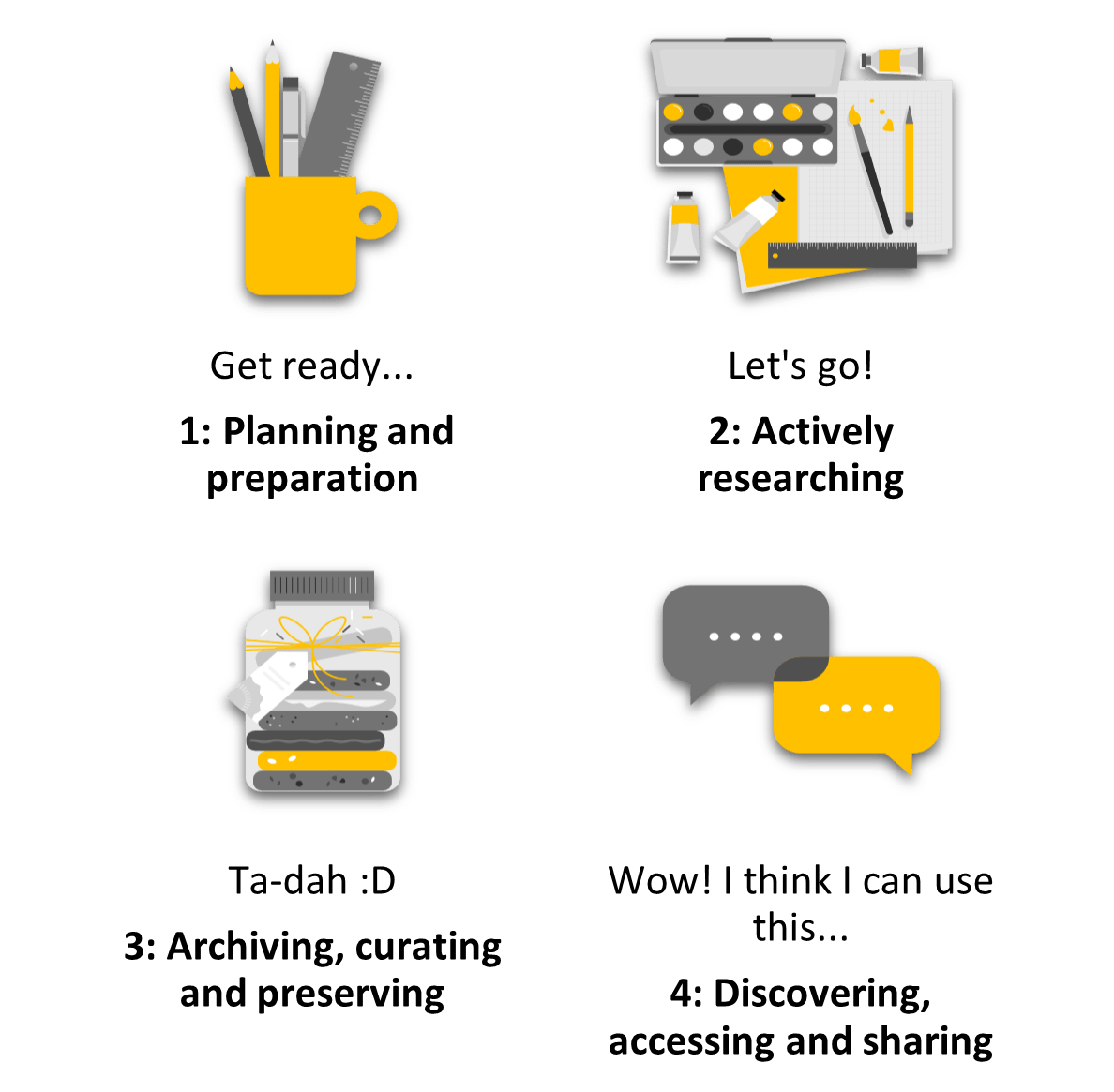
The infographic illustrates 4 stages of research data lifecycle. 1. Planning and Preparation; 2: Actively Researching, 3: Archiving, curating and preserving, 4: Discovering, accessing and sharing.

Figure 2: Stages of Research Data Lifecycle

Why is the Research Data Repository essential to supporting academic communities across UCL?

It mostly stems from wanting researchers to manage and share their outputs in line with the FAIR principles (Findable, Accessible, Interoperable and Reusable)  and embrace open science and scholarship practices. Essentially, by depositing outputs into the Research Data Repository and creating associated metadata records, other researchers and members of the public are better placed to find, understand, combine, and reuse the outputs of our research without major technical barriers. In turn, this can help to enhance transparency of the research process, promote enhanced research integrity, and ultimately maximise the value of research findings.

Going forward:

To continue building and developing the service, we are asking staff and research students to tell us what they think. What works well? What could be improved? Which functionalities would you like to see added or enhanced?

"We invite you to share your insights on the UCL Research Repository and help us improve our service! Take just 5-10 mins to complete a brief internal survey. Thank you! [Link: https://buff.ly/3Tg1Fna] Image: A figure with blue & green clothing with a speech bubble reading 'tell us what you think'.


The survey closes on Friday, March 22nd, so get in touch and tell us what you think!

Survey link: https://forms.microsoft.com/e/U20yJPAi0W

More information about the Research Data Repository can be found in Open Science & Research Support dedicated webpage.

Any questions or queries about the Research Data Repository can be sent to: researchdatarepository@ucl.ac.uk.

General research data management queries can be sent to: lib-researchsupport@ucl.ac.uk.

Any questions or queries about open science can be directed to: openscience@ucl.ac.uk.


Get involved!

alt=""The UCL Office for Open Science and Scholarship invites you to contribute to the open science and scholarship movement. Stay connected for updates, events, and opportunities. Follow us on X, formerly Twitter, and join our mailing list to be part of the conversation!

UCL Research Data Repository: Publishing research outputs for staff and PhD students across in 2022

By Harry, on 17 February 2023

Dr Christiana McMahon & Christine Buckley – Research Data Support Officers

At UCL, we have a dedicated Research Data Repository. This can be used by staff and research students to archive and preserve research outputs. This can be anything from your datasets to a poster you presented at a conference.

What have we published?

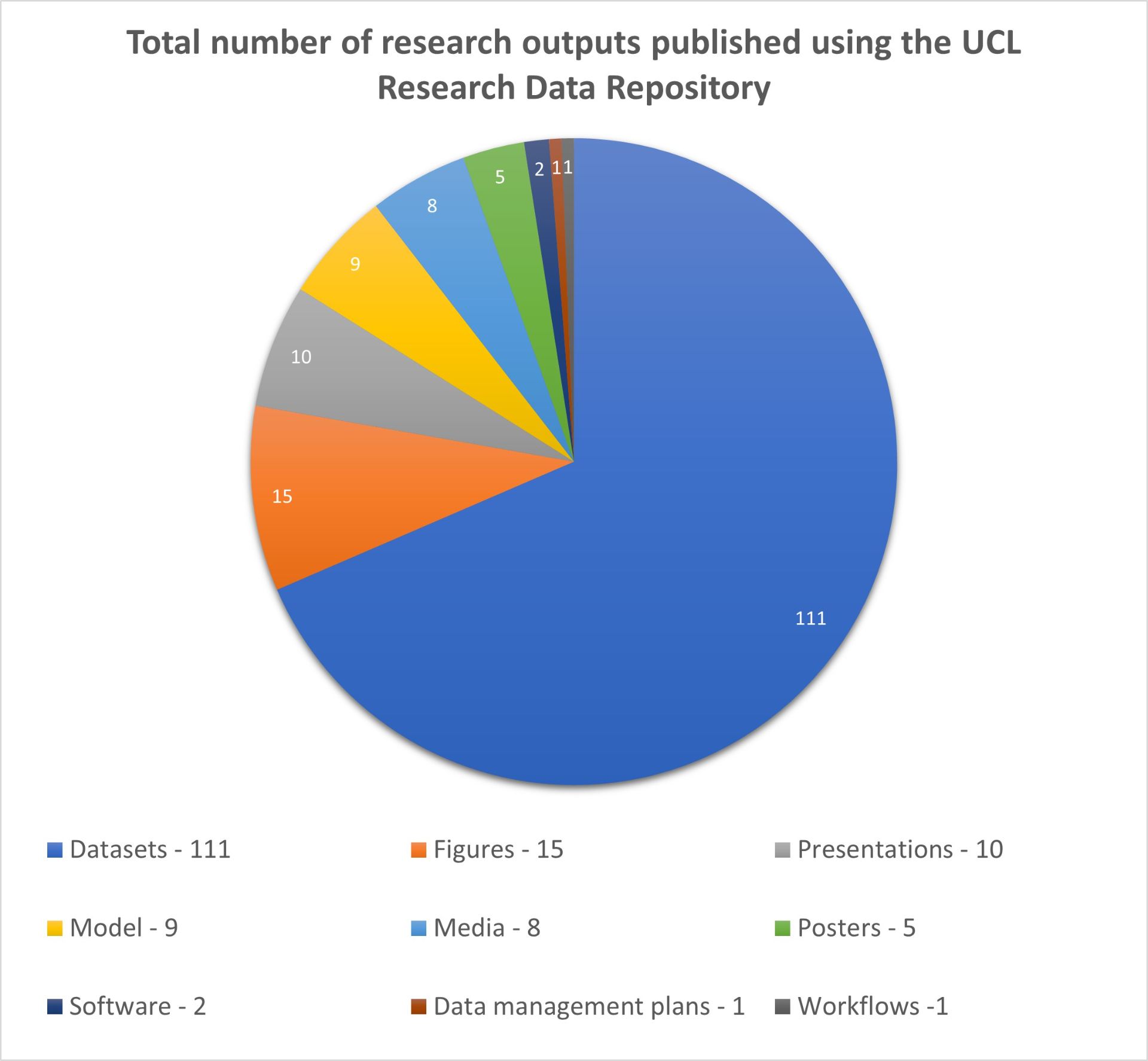
In total, we published 162 items!

Total number of views in 2022: 172059

Total number of downloads in 2022: 117830