X Close

Open@UCL Blog

Home

Menu

Celebrating Open Science & Scholarship at UCL: Highlights from the Third Annual Awards Ceremony!

By Naomi, on 29 October 2025

Two rows of four people stand facing the camera, in front of a red wall. They are smiling and holding framed certificates.

Photo by Kirsty Wallis

On the afternoon of 22nd October 2025, 40 people gathered in Bentham House to celebrate the winners and honourable mentions of this year’s UCL Open Science and Scholarship Awards.

Sandy Schumann and Jessie Baldwin, the UKRN Local Network Leads at UCL, hosted the ceremony and awards were presented by David Shanks, UCL’s UKRN Institutional Lead. Sandy began by congratulating this year’s cohort – 69 applications were submitted for consideration this year, so the competition was fierce! She also thanked the judges, as well as UCL Press for sponsoring the event.

There were five categories in total, and after the awards were presented, the overall winner of each category showcased their project.

A classroom with three rows of white desks and several people sitting at these desks looking towards the front of the room where someone is standing and giving a presentation. There is a large screen on which a PowerPoint presentation is displayed with a slide reading 'Open Research Training Programme and Practice Community'

Photo by Kirsty Wallis

The first category was, ‘Activities Led By Non-Academic Staff’, won by Vassilis Sideropoulos (Senior Research Technical Professional, Department of Psychology and Human Development, IOE) for his work establishing an open research training programme and practice community within the IOE. Vassilis saw the need to make open research practical and relevant, and created a programme with modular training covering topics such as Data Management and Pre-Registration. Following feedback on the initial training programme delivered between 2019-2023, he spent 18 months considering how to improve it, which led to a revamped programme with more applicable guidance. Alongside this, he recognised that researchers were seeking a community, a place where they could reach out to someone who could train them and respond to their questions, which led him to establish an open research practice community.

To encourage engagement with the practice of open science, an understanding of what researchers need is vital. By listening and responding to feedback, Vassilis recognised this and has created a programme that has transformed the ways in which IOE researchers engage with and understand open science.

A person is standing at the front of a classroom giving a presentation. On a large screen, a powerpoint slide is displayed with a screenshot of an interactive map of the UK with different criteria along the left-hand side which can be changed to decide where is best to plant which trees across the country.

Photo by Kirsty Wallis

The winner of the second category, ‘Activities by academic staff (including post-docs) or PhD students: Open-source software/analytical tools’, was Deyu Ming (Lecturer in Mathematics and Data Analytics, School of Management, Faculty of Engineering) for the development of the open-source package ‘DGPSI’, which allows for scalable surrogate modelling of expensive computer models and model networks. In his showcase, Deyu took us on the journey of this project. From the origins of the idea in 2019, to translating it into something that others could use and publishing it on GitHub in 2020, to it subsequently appearing on the python package index and on CONDA in 2022. But it didn’t stop there. In 2023, the package started making considerable impact through the UKRI-funded projects Net Zero Plus and ADD-TREES, which support AI-enhanced tree-planting decision tools used by DEFRA, Forest Research, the National Trust, and other stakeholders to advance the UK’s Net Zero 2050 goals.

Since 2021, there have been 19 releases of the software, and it is now 60x faster than the original. As creator, lead developer, and sole maintainer of ‘DGPSI’, Deyu has worked incredibly hard on this open-source software, and with already over 100,000 downloads, it will no doubt continue to make a resounding and long-lasting impact.

Three people stand at the front of a classroom delivering a presentation. One appears to be speaking into a microphone whilst the other two stand listening. On the screen is a PowerPoint slide reading 'Open Peer Review System for Statistical Science Undergraduate Coding Assignments'

Photo by Kirsty Wallis

The award for ‘Activities led by undergraduate or postgraduate students’ went to Yinan Chen, Eric Chen and Adelina Xie (undergraduate students at the Department of Statistical Science, Faculty of Mathematical and Physical Sciences) for developing an open peer-review system for statistical science undergraduate coding assignments as part of a UCL ChangeMakers project. The problem they set out to address was the limitation in Moodle (the learning platform used at UCL) with regard to peer review, as students could only receive general feedback on coding assignments. Since Moodle only supports the review of PDF outputs and not raw R code, there was no option for line-by-line code reviews, and they felt that collaborative learning opportunities were being missed. Their solution: GitHub and Moodle integration. This innovative hybrid approach, with GitHub’s powerful code review system and Moodle’s familiar interface, has led to a practical, accessible and scalable tool designed for students, by students.

This is a recently concluded pilot project, but it is already having significant impact. A paper is being written on it for the Journal of Open-Source Education, and it has attracted interest for presentation at the Royal Statistical Society’s education conference, which shows its potential for nation-wide statistical education – testament to Yinan, Eric and Adelina’s hard work and dedication. Alongside this, their commitment to the practice of open science at such an early stage in their academic career was inspiring to see.

A man is giving a presentation at the front of a classroom. He is pointing to the large screen on which is a screenshot of the homepage of Programming Historian website.

Photo by Kirsty Wallis

For the category ‘Activities led by academic staff (including post-docs) or PhD students: Open publishing’, the award was presented to Adam Crymble (Lecturer of Digital Humanities, Department of Information Studies, Faculty of Arts and Humanities), for the open publishing initiative ‘Programming Historian’ which he co-founded. Programming Historian offers over 250 peer-reviewed tutorials for digital humanities in English, Spanish, French, and Portuguese. Adam explained how a gap in digital skills amongst humanities professionals was the motivation for the project, and from its humble beginnings as a blog, it has become a financially self-sustaining open publisher. By offering practical applications and case studies in each tutorial, as well as ensuring translations are culturally adapted, this project has had far-reaching influence and continues to do so.

Since the outset, community and collaboration have been vital in the development of Programming Historian, and Adam has worked hard to expand the project’s global community and to ensure inclusivity. This approach, alongside the use of open peer review and the promotion of open data and open-source tools, epitomises the principles of open science and was fantastic to hear about.

A man is presenting at the front of a classroom, behind him is a large screen on which is written '3DForEcoTech' in large letters, under which is an image of a forest.

Photo by Kirsty Wallis

The final category was ‘Activities by academic staff (including post-docs) or PhD students: Enhancing open science and reproducibility capacity in the academic community’, won by Martin Mokros (Lecturer in Earth Observation, Department of Geography, Faculty of Social and Historical Sciences) for his COST Action 3DForEcoTech project. Four years ago, Martin noticed the issue of scientists undertaking similar forest ecosystem research but not talking to each other about it. He wanted to standardise laser scanning technologies for forest ecology and inventory to allow for collaboration, and so launched COST Action 3DForEcoTech – the first global open-science network focused on ground-based 3D forest monitoring. With over 600 members from 50+ countries, the reach is impressive, and it is an innovative approach to scientific practice. Open science was a key motivation for the project, and it incorporates fully accessible datasets, algorithms and benchmarks results, as well as open-source software and an algorithm library.

Alongside the provision of open data and tools, this project has engaged with open science by creating equitable access to knowledge and opportunities through supporting ECRs, enforcing gender balance and ensuring participation from underrepresented regions. The idea of equitable access underpins the entire concept of open science, and by making it a central tenet to the COST Action 3DForEcoTech project, Martin has provided an excellent example of how this can be done.

Each of these award winners have advocated for, harnessed and showcased open science in various fields of research and study, and we are delighted that they have received recognition with a UCL Open Science & Scholarship Award.

We are looking forward to hearing about these projects’ ongoing impact and wonder what new initiatives they might inspire!

alt=""

The UCL Office for Open Science and Scholarship invites you to contribute to the open science and scholarship movement. Stay connected for updates, events, and opportunities.

Follow us on Bluesky, LinkedIn, and join our mailing list to be part of the conversation!

Share this post on Bluesky

Reflections on the UCL Citizen Science Community Event

By Kirsty, on 11 December 2024

Post provided by Sheetal Saujani, Citizen Science Support Officer.
Image taken from among the audience of a presentation looking towards the screen. The text on the screen is unreadable but the audience look attentive and some are taking notes. Professor Muki Haklay can be seen standing at a lectern to the left of the screen.

This week’s UCL Citizen Science Community Event brought researchers, academics, students and staff from across UCL together to celebrate citizen science and participatory research. The slides and programme are available online so that everyone can follow up with the references.

The morning was packed with engaging talks and workshops, highlighting unique perspectives and approaches to citizen science. From discussions about an innovative mapping tool and the role of the UCL Urban Room in preserving local memories to hands-on workshops that sparked new ideas, the event demonstrated the diversity and potential of citizen-led research. One highlight was seeing the genuine passion from the presenters, whose enthusiasm was contagious.

At the start of the event, the Citizen Science team at the Office for Science and Scholarship and the UCL Co-Production and Public Engagement teams showcased their services and support including training, resources and advice. Their dedication to supporting citizen science and public engagement left everyone excited and ready to get involved. Both teams are eager to hear from the UCL community about their projects and the support they may need, so they encourage everyone to get in touch.

We also heard from Marcos Moreu and Fabien Moustard from the Extreme Citizen Science Research Group (ExCites) about a new tool called Kapta that they have been involved in the design for, allowing mapping data to be collected simply using WhatsApp, allowing small or remote communities to collect data without extensive knowledge or additional training. More information can be found by looking at the slides above or on Kapta.earth.

Professor Muki Haklay delved into the topic of skills and competencies in citizen science, exploring how competency frameworks define the skills, knowledge, and values needed for success in this field. His talk highlighted frameworks like the UCL Academic Careers Framework, Vitae’s Researcher Development Framework, and ECS Academy’s Research Competencies framework, which outline progression paths, accreditation standards, and expectations at foundational to expert levels. These frameworks not only codify what individuals need to know but also guide learning, recruitment, and career development. A live Mentimeter poll engaged attendees, inviting their perspectives on key skills, competencies and areas for development, sparking conversations about advancing expertise in citizen science.

A group of people photographed from behind. The people are looking towards groupings of coloured post-it notes on a wall. The woman closest to the camera is wearing a dark jumper and scratching her head.Dr Izzy Bishop led an interactive session where participants contributed their thoughts on the various elements required to include citizen science in a project proposal. The flipchart became a dynamic map, highlighting key areas such as co-design, engagement, training, communications, technology, volunteer management, data analysis, and impact. Each participant helped to identify UCL’s expertise and interest in these areas, promoting collaboration and a shared understanding.

We also discussed strategies for applying for and sustaining project funding, with a focus on Horizon Europe opportunities. Professor Muki Haklay provided valuable insights on successfully navigating the application process and securing support for citizen science initiatives.

Hearing Jo Baines discuss UCL’s Urban Room, and the innovative Memory Workshop was truly inspiring. These projects showcase the power of engaging communities, including underrepresented groups, to explore shared histories and reimagine urban spaces. The Memory Workshop and Memory Bike demonstrate citizen science in action, amplifying diverse voices, and uncovering new insights through creative, participatory research. By equipping participants with skills and tools that extend beyond the projects, they highlight how citizen science connects people and ideas to drive meaningful change.

We were captivated by voices from two remarkable projects Flotilla by Melanie Manchot and Breaking Waves, which highlight the power of art and storytelling to link communities and preserve collective memory. Both reflect the spirit of citizen science by fostering connections and inspiring new perspectives. The links to experience these projects for yourself are available in the slides linked above.

Before the event closed, there was a fun and relaxed speed networking session. The vibrant spirit of session encouraged meaningful conversations and connections, reminding us of the value of sharing knowledge and experiences across disciplines and communities!

A huge thank you to all the speakers, workshop leaders, and participants who made the event so worthwhile. We hope everyone left as inspired as we did to continue championing citizen science!

Community over Commercialisation?

By Kirsty, on 21 October 2024

Today marks the start of International Open Access Week 2024! Throughout the week, we’ll be sharing insights from UCL staff on how open access is shaping research, collaboration, and scholarship across the university. To kick off the series, Kirsty Wallis explores the significance of this year’s theme and the challenges and opportunities of balancing openness with commercialisation in ways that benefit both research and society.


Promotional image from the International Open Access Week committee. A person holds an orange door hanger with a circular cut-out, partially covering their face. The sign reads, "Ask me about Open Access. International Open Access Week," with the Open Access logo at the bottom.The theme for this year’s International Open Access Week (OA Week), “Community over Commercialisation,” intends to provide a starting point for us to reflect on the importance of community in the work that we do relating to Openness, rather than letting financial or commercial interests take focus.

This is the second year focusing on this theme, which shows its significance in Open Science and Scholarship and the growing interest in these discussions.

The UNESCO Recommendations on Open Science highlight the issues of groups profiting from publicly funded research and advocate for non-commercial, collaborative publishing models.

This year’s OA Week invites reflection on critical questions around commercialisation, corporate control of knowledge and what we can do to encourage a shift towards more open practices. This post will focus on the progress in opening up research worldwide, but also bring to the fore some areas where commercialisation may be able to serve the public interest. Can commercialising research ever be for public good?

Last year in support of the theme, we launched our Citizen Science Community! It was the culmination of a lot of work from the team in the Office for Open Science and Scholarship. Our approach to Citizen Science at UCL foregrounds the need to prioritise community interests and aiming to make everything we do as inclusive as possible and integrate as many subject areas as we can.

We also explored how Creative Commons (CC) licences promote open, reusable research, making scholarly outputs accessible to a wider audience—from researchers to the general public.

International Open Access Week has created a list of profiles of global institutions showcasing how Open Science communities are embedding principles of shared knowledge and equitable access into their practices: visit the International Open Access Week list of Theme Profiles.

Continuing the Discussion in 2024:

As we move forward, OA Week 2024 offers the opportunity to build on the 2023 theme and further explore how community-based approaches can coexist with commercial interests in ways that serve both the research community and the public. Turning this dialogue into concrete action is essential for achieving the goals of Open Science—making knowledge accessible and equitable for everyone.

So, is there ever a scenario where commercialisation of research can work for community? After all, it is possible to share the outputs of research openly while also selling them as a product, for example in software. It is possible and even fairly common in some areas to make the underlying code open source but sell access to supported versions or additional features that can be used by companies and businesses that are unable to support products themselves. There are many examples of this, from the underlying code supporting Android phones and Chrome browsers to the Linux operating system and, also the ePrints repository software that we use here at UCL.

As another example, this time from within UCL itself is the Ventura CPAP Machine developed during 2020 at the height of the pandemic. The designs for the machine were made available free of charge via the UCLB licensing system. This enabled limitations to be put in place for who could use the designs, preventing companies from profiteering from the design while making it available to hospitals and other charitable organisations to build and test their own free of charge. It has always been UCL’s position that profit is not the end game, going back as far as Jeremy Bentham, the spiritual founder of UCL, who believed that education should be more widely available, a core underpinning value of UCL and the Office for Open Science and Scholarship today.

This year’s Open Access Week theme aligns with some of the behind-the-scenes work we’re doing to explore the relationship between openness and commercialisation and investigate scenarios where they may not be as much in conflict as the theme suggests. Keep an eye out for the report and recommendations coming later this academic year!

Citizen science community at UCL – a discussion and call to contribute

By Kirsty, on 27 October 2023

Community over Commercialization was the theme for this year’s International Open Access Week. The organisers aim for this theme was to encourage a candid conversation about which approaches to openness prioritise the best interests of the public and the academic community—and which do not.

This is related to the UNESCO Recommendation on Open Science, which highlights the need to prioritize community in its calls for the prevention of “inequitable extraction of profit from publicly funded scientific activities” and support for “non-commercial publishing models and collaborative publishing models with no article processing charges.” By focusing on these areas, we can achieve the original vision outlined when open access was first defined: “an old tradition and a new technology have converged to make possible an unprecedented public good.”

-adapted from openaccessweek.org

This week, in support of this theme we have launched our Citizen Science community for anyone at UCL that wants to get involved, staff, students, anyone! It’s the culmination of a lot of work from the team in the Office for Open Science and Scholarship and I wanted to close out the week with a discussion of how we have been approaching Citizen Science at UCL and what we are going to be doing next.

One of the core values of the Office for Open Science & Scholarship, and therefore the team behind the Citizen Science community, is to make everything we do as inclusive as possible of as many of the UCL subject areas as we can.

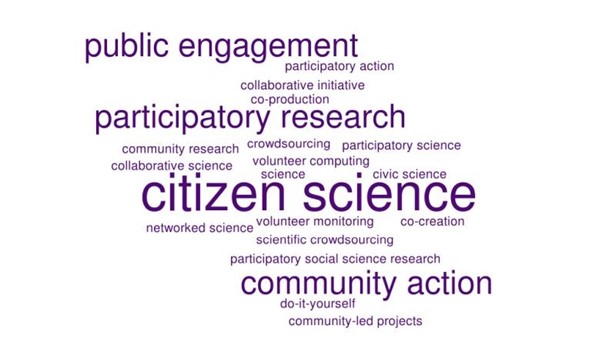
We use Citizen Science as a title, because it is a commonly used and recognised term, but as we want to create a broad community we have worked hard to create a unifying definition that we want to work to, and this is where this word cloud comes in! This is a work in progress where we are trying to collect as many terms for what we would consider to be a part of Citizen Science as possible and we are hoping that the new community will help us to develop this more and make it as comprehensive as possible!

So, what else have we been doing and what are we working on?

As well as the launch of the UCL Citizen Science Academy, over the past year or so, the team has been talking to a number of colleagues that have been working on citizen science projects to get insights into the projects happening at UCL (which we have added to our website), but also the skills and support that people would recommend for new starters. This will all feed into us recommending, commissioning or developing training and support for you, our community. The aim is to keep building up our existing citizen science related community and enable new, interested parties to get involved, supported by both us and the community as a whole.

We are always asking for information about new projects, feedback on how we can make our community more inclusive and looking for new words for our word cloud so please get in touch by email or by commenting below, we love to hear from you!

What might a Citizen Science approach in your research project look like?

By Harry, on 27 March 2023

Guest post by Sheetal Saujani, Citizen Science Coordinator

Have you thought about including members of the public in your research?  Would you like to connect and collaborate with the community around you? Alternatively, would you like to work with project leaders to answer real-world questions and gather data?

Broadly defined, citizen science is research undertaken by members of the public, often in collaboration with academic or research institutions or similar. Citizen science is a diverse practice involving various forms and aims of collaboration between academic and community researchers and a broad range of disciplines.

What are the great things about Citizen Science?

Working together as part of a community with professionals, citizen scientists can play an important part in genuine discovery, experiments, data collection and analysis. Through citizen science, any one of us can take part in extraordinary research!

We can improve our community whilst at the same time helping to provide answers to some of the big questions about the world we live in.  Whether we participate in projects that measure air quality, monitor damage from storms, or track where our rubbish is going, we can help solve problems and influence a better future for our society.

The Office for Open Science and Scholarship advocates a broad approach to citizen science, so whether you call it citizen science, participatory research, community action, co-production, public engagement, or anything else, we’re all working together to strengthen UCL activities in this area!

What do Citizen Science projects look like?

Take a look at some of the exciting citizen science projects at UCL run by various research groups and departments at UCL. Some of these projects have now been completed.

And below are a few newer ones (this list is not exhaustive):

Also, if you’re interested, there are many platforms and projects happening outside of UCL (below are just a few):

  • Thousands of people across the country take part in the Natural History Museum’s crowdsourced science projects.
  • On the SciStarter website you can join and contribute to science through thousands of amazing research projects and events.
  • With more than one million volunteers, Zooniverse is one of the biggest citizen science platforms in the UK.
  • If you’re interested in Biology, Ecology or Earth Science, check out the citizen science projects run by the National Geographic Society.
  • The InSPIRES Open Platform is an online collaborative and crowdsourced database featuring many citizen-led participatory research and innovation projects.
  • Patientslikeme is an online platform where patients can share and learn from real-time, outcome-based health data and contribute to the scientific conversation surrounding thousands of diseases.
  • The Globe at Night project aims to raise awareness about light pollution and its impacts on communities. You can report your night sky brightness observations daily.

What is UCL doing around Citizen Science?

Our Office is working to raise awareness of citizen science approaches and activities, with the aim of building a support service and a community around citizen science.  The plan is to bring together colleagues who’ve run or are currently running citizen science or participatory research projects to share good practices and experiences with each other and support and encourage others to do the same!

If you are interested in citizen science, we would really like to hear from you, so please get in touch with us via email at openscience@ucl.ac.uk and tell us what you need.