X Close

Open@UCL Blog

Home

Menu

Archive for the 'UCL Discovery' Category

‘Who Owns Our Knowledge?’ Retaining Authors’ Rights through UCL’s updated Publications Policy

By Naomi, on 22 October 2025

Guest post by Catherine Sharp, Head of Open Access Services at UCL

A graphic divided into two halves, on the left is a starry night sky with the silhouette of a person looking up at it in wonder, and against the backdrop of the sky is a large version of the International Open Access Week logo which looks like an open padlock. On the right is a dark purple background with the text 'International Open Access Week' at the top with the logo, and 'Open Access Week 2025' near the bottom, below which is written 'October 20-26, 2025, #OAWeek'

Graphic from openaccessweek.org, photo by Greg Rakozy

“Who Owns Our Knowledge?”, the theme of this year’s International Open Access Week, asks how “communities can reassert control over the knowledge they produce”. With commercial publishers continuing to monetise academic content through ever-increasing subscription and open access fees – the costs of so-called “transformative” agreements to UK HEIs is around £140m – and to report substantial and growing profit margins, while at the same time attempting to restrict authors’ rights in their own work, this remains a challenge for all HEIs. Against this background, the UK’s rights retention movement is a vital tool in the effort to free academic research and empower authors to use and share their knowledge.

UCL’s Intellectual Property (IP) Policy has long enshrined the principle that UCL staff own the copyright in their own scholarly materials, and that UCL has the right to use them for academic and research purposes. This year, with the introduction of an updated Publications Policy, UCL has joined a number of other universities, including Oxford, Cambridge, Imperial and Manchester, in taking action to assert this right. This is known as rights retention.

In practical terms, this means that from 2026, having notified publishers of UCL’s pre-existing licence, UCL will make the accepted manuscripts of scholarly articles by UCL staff open access without an embargo in UCL Discovery, UCL’s open access repository, under the Creative Commons Attribution licence (CC BY) (unless an alternative licence or exemption is requested). The CC BY licence allows widespread re-use and sharing, and is the licence that research funders, including Wellcome, UKRI, NIHR and EC funders, require.

Photograph of bookshelves taken from an angle. The bookshelves contain various journals in different colours.

Photo by Mary Hinckley, UCL Digital Media, ISD-LTMS

While UCL will continue to provide opportunities for authors to publish Gold open access through transformative agreements and in fully open access journals, articles that are not Gold open access will also benefit from immediate open access, on publication, in UCL Discovery. This will allow all UCL authors to meet their funders’ (including REF) open access requirements while continuing to publish in their journals of choice, and to benefit from open access through higher impact, increased citations and more collaborations.

Three rolls of paper lie on a shelf, the camera lens captures the end of the rolls as they disappear into a blurred background.

Photo by Mary Hinkley, UCL Digital Media

The policy also benefits co-authors, and UCL authors are encouraged to let their co-authors know about it and to take advantage of it. Aside from that, authors do not need to take any action other than to upload their accepted manuscripts to RPS, on publication.

We are looking forward to seeing the practical effects of the policy as more UCL research is made available, more freely, than ever before.


alt=""

The UCL Office for Open Science and Scholarship invites you to contribute to the open science and scholarship movement. Stay connected for updates, events, and opportunities.

Follow us on Bluesky, LinkedIn, and join our mailing list to be part of the conversation!

Share this post on Bluesky

UCL Discovery reaches 60 million downloads!

By Naomi, on 27 August 2025

Guest Post by Dominic Allington-Smith (Open Access Publications Manager)

Two fireworks in full explosion of red, pink, and silver colour against the backdrop of a black night sky.

Maryam Khan, CC BY-SA 4.0, via Wikimedia Commons

UCL Discovery, UCL’s institutional repository, has hit another milestone! UCL Publications Board and the Open Access Team are excited to share that on Friday 18 July, the number of downloads reached the 60 million mark. UCL Discovery is UCL’s open access repository, showcasing and providing access to UCL research outputs from all UCL disciplines. UCL authors currently deposit around 1,100 outputs in the repository every month (average figure for the current academic year).

The 60 millionth download was of the interim report ‘Young people & coastal communities: Local policymaker and practitioner perspectives’ produced by the UCL Coastal Youth Life Chances project led by Professor Avril Keating.  This research project examines how growing up in coastal communities in England impacts the life chances of young people. The report arises from the project team’s A screenshot of the landing page for the publication titled 'Young people & coastal communities: Local policymaker and practitioner perspectives' which was the 60 millionth downloaded title from UCL Discoveryconversations with 50 policymakers and practitioners from around England about their perspectives on the challenges facing young adults aged 15-20.

At the time of writing, UCL Discovery hosts over 193,200 open access publications, comprising mostly self-archived copies of research outputs, but also including doctoral and research master’s theses (contemporary submissions and historic digitisations), and books published by UCL Press.  Since the 50 million downloads milestone in June 2024, the following titles are the highest-downloaded publications for each UCL Faculty, Institute or School. This list continues to reflect the diversity across UCL research:

* These publications are also the highest-downloaded of all time.

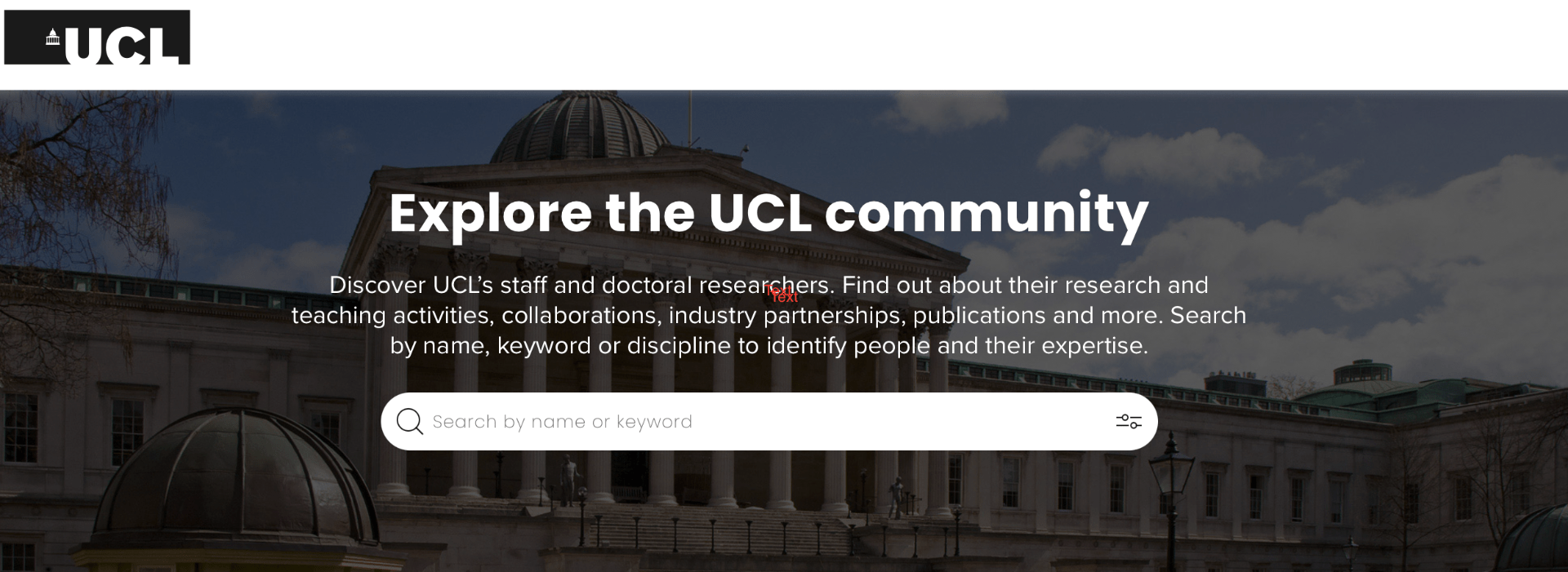
Hitting 60 million downloads highlights the reach and potential which comes from sharing research through UCL Discovery. There are a number of ways you can do this, primarily through sharing your Screenshot of the UCL Profiles homepage which has the UCL logo in the top left-hand corner, an image of the UCL portico in the background and 'Explore the UCL community' written in bold in the centre, under which is a search bar. research publications via UCL RPS and Profiles. You might also want to consider sharing other types of outputs such as data, code and software to further enhance the visibility and reproducibility of your work. UCL’s Research Data Management team maintain a guide on best practice for software sustainability, preservation and sharing, and can give further support to UCL researchers as required.

Another year of sharing research, and another incredible milestone – congratulations to everyone involved! Let’s keep it up and continue pursuing open access at UCL to ensure we are reaching the widest audience and having the greatest impact.


alt=""

Get Involved!

The UCL Office for Open Science and Scholarship invites you to contribute to the open science and scholarship movement. Stay connected for updates, events, and opportunities.

Follow us on Bluesky, LinkedIn, and join our mailing list to be part of the conversation!

Share this post on Bluesky

OOSS Review of the Year

By Kirsty, on 14 January 2025

Here in the Office for Open Science & Scholarship we like to start every new year by taking a look back over the last and sharing our highlights with you.

In 2024 the Open Access Team facilitated the Gold open access publication of 3,963 papers. UCL Discovery continued to go from strength to strength, with over 53 million downloads. The publications repository now boasts over 185,000 open access items, including 24,900 theses, with over 15,500 uploads in the preceding twelve months.

The Research Data Management Team has had an equally productive year, publishing over 230 items in the data repository which has now exceeded 230,000 views and a similar number of downloads. They have reviewed over 30 data management plans and held classes for over 70 people, both online and in person. There are still seats available for term 2 that can be booked online.

Updates and publications

Across all of the teams that make up the Office we have published a whole host of documents and updates such as:

Our blog highlights

The blog has been super busy throughout the year with one of our personal highlights being the brilliant series of posts by Christine Daoutis, UCL’s Copyright Officer that looked at a range of issues around copyright in open science including a deep dive across three posts into Copyright and AI, how copyright exceptions can support your research and how copyright applies to Text and Data mining.

We also had some great events throughout the year that you can catch up on, from our annual Open Science Conference, the second annual Open Science & Scholarship Awards, and our first ever Citizen Science Community Event.

We also had a great time working with the UCL Digital Accessibility team throughout the year, they have been a great support in improving the accessibility of everything we do. We were able to highlight their work in one of our Newsletters and we also interviewed Ben Watson, Head of Digital Accessibility, who was a great sport and is an overall inspirational guy!

Upcoming in 2025

by Ray Hennessy on Unsplash https://unsplash.com/photos/gdTxVSAE5sk

We have a great year ahead in 2025, we have the imminent publication of our next Operational plan, designed to push the team to bigger and better things for the office. We are hoping to get that out in the first quarter of the year, its just going through various stages of internal feedback before we can get it out there! We will be continuing to grow our newest social media channels LinkedIn and BlueSky, and if you don’t subscribe to our newsletter, now’s your chance!

We will also be challenging ourself to bigger and better things when it comes to our conference. You all know that we like to change it up and this year we are reaching out to friends and colleagues to change our conference into our first festival!

We will also be continuing the brilliant series with Ilan Kelman on the Risks and Opportunities of Open Science. We have already shared the first two parts but keep an eye out for the last three parts coming soon!

UCL Discovery reaches 50 million downloads!

By Rafael, on 27 June 2024

Guest Post by Dominic Allington-Smith (Open Access Publications Manager)

Decorative image displaying fireworks filling the night sky with bursts of red, orange, and blue lights. Sparkling circles of light create a festive and celebratory atmosphere.

Photo by Erwan Hesry on Unsplash

UCL Publications Board and the Open Access Team are delighted to announce that on Monday 24 June, UCL’s institutional repository, UCL Discovery, reached the milestone of 50 million downloads! UCL Discovery is UCL’s open access repository, showcasing and providing access to UCL research outputs from all UCL disciplines. UCL authors currently deposit around 1,675 outputs in the repository every month (average figure for the current academic year).

The 50 millionth download was of the paper ‘Replenishing IRAK-M expression in retinal pigment epithelium attenuates outer retinal degeneration’ originally published in Science Translational Medicine by a team of researchers including UCL co-lead author Professor Andrew Dick.  This paper found that increasing the levels of a key protein in the cells at the back of the eye could help protect against the age-related macular degeneration, the leading cause of vision loss among older adults.

UCL Discovery hosts over 178,500 open access publications at the time of writing, comprising mostly self-archived copies of research outputs published elsewhere to bypass publisher paywalls, but also including doctoral and research master’s theses (contemporary submissions and historic digitisations), and books published by UCL Press.  This variety of resources is displayed when viewing the highest-downloaded publication within the UCL hierarchy:

This amazing milestone shows the scope and reach that sharing research through UCL Discovery has. There are a number of ways you can share your research at UCL, and we encourage you to continue sharing your research publications via UCL RPS and Profiles. Additionally, consider sharing other types of outputs such as data, code and software to further enhance the visibility and reproducibility of your work. The Research Data Management team maintain a guide on best practice for software sustainability, preservation and sharing, and can give further support to UCL researchers as required.

Congratulations to everyone involved in reaching this incredible milestone, and let’s continue to push the boundaries of open access and research sharing at UCL!

Get involved!

alt=""The UCL Office for Open Science and Scholarship invites you to contribute to the open science and scholarship movement. Stay connected for updates, events, and opportunities. Follow us on X, formerly Twitter, LinkedIn, and join our mailing list to be part of the conversation!


OOSS Annual Recap 2023

By Rafael, on 17 January 2024

As we step into a new year, let’s reflect on the collective achievements and milestones of the UCL Office for Open Science & Scholarship (OOSS) and our associated teams in 2023. This year witnessed the growth and integration of OOSS within the institutional culture of UCL, offering pivotal support to academic staff, researchers, and students. From the successful return to in-person events with our annual conference to pioneering initiatives and awards, let’s revisit the highlights that shaped our work last year!

Annual Conference & Open Access Celebrations

Poster for the Open Science Conference: 'The Case for Social Justice'

In April 2023, we successfully organized our annual conference, marking our first return to in-person events. Themed Open Science and the Case for Social Justice, the conference fostered important discussions on sustainability in research practices, addressing critical issues such as gender, language, authorship, and geographical disparities. Recordings of these insightful discussions are available. Notably, a workshop during the conference addressed equity in authorship, contributing to a forthcoming UCL statement on Authorship. Additionally, October saw the celebration of our Open Access week, themed Community over Commercialisation. This included a series of blog posts, activities, and discussions, emphasizing equitable access to a wide range of works.

Honouring Excellence: Inaugural Open Science and Scholarship Awards:Group photo of the 12 Winners of the inaugural Open Science and Scholarship Awards standing together in front of a white wall.

Another highlight was the inaugural Open Science and Scholarship Awards at UCL in collaboration with the UK Reproducibility Network. These awards aimed to recognize and celebrate the efforts of UCL students and staff who champion open science practices. Learn more about the winners and their innovative work!

Open Access: Profiles & Transformative Agreements

alt=""

The Open Access Team played a pivotal role in ensuring the open availability of UCL academics’ research outputs throughout 2023. A major achievement was the successful introduction of the new Profiles platform, replacing the outdated IRIS. Profiles acts as UCL’s public search and discovery tool, significantly improving the visibility of academic profiles, publication lists, research and teaching activities, and collaborations with UCL colleagues. The team also facilitated the Gold open access publication of 3,383 papers in 2023, contributing to the thriving UCL Discovery with over 44 million downloads. The repository now boasts over 166,000 open access items, including 23,400 theses, with over 18,500 uploads in the preceding twelve months.

Aligned with the UKRI and Wellcome open access policies, the Open Access Team provided robust support for UCL researchers. This included facilitating compliance through publishing in fully open access journals, making use of transformative agreements with publishers encompassing over 12,000 journals, and using funders’ language to secure the right to make accepted manuscripts freely accessible upon publication under the CC BY license.

Research Data: Enhancing Support to Researchers

The Research Data team introduced a more user-friendly version of the UCL Research Data Repository, incorporating enhanced features and a comprehensive user manual. The repository saw a significant influx of 193 new items, including data sets, media items, and software applications. Engaging with researchers, the team provided substantial assistance, reviewing 32 data management plans and conducting successful training sessions for 61 researchers. Additionally, the team expanded and refined frequently asked questions (FAQs) for better user support.

Citizen Science: New website and initiatives

Word cloud image featuring key terms related to citizen science

The Citizen Science Team expanded its reach and impact in 2023 through new Citizen Science website pages and an enhanced list of citizen science projects at UCL, fostering a greater understanding of the breadth of such initiatives across the university. The creation of a unifying definition of citizen science at UCL, accompanied by an inclusive word cloud, provided clarity on the diverse subject areas and disciplines covered by citizen science projects.

The development of the UCL Citizen Science Certificate, in collaboration with the UCL Citizen Science Academy, marked a significant milestone and underscored our commitment to fostering collaborative initiatives. A new Citizen Science community on MS Teams was launched, providing a dedicated space for discussions and updates. Get involved!

Bibliometrics: Measuring Research Impact

The Bibliometrics Team, in collaboration with the Open Access Team, played a crucial role in implementing the new Profiles system. Their research confirmed the citation advantage associated with open access practices. After a detailed analysis of UCL publications over recent years, the study demonstrated that open access materials are utilised and cited more extensively, and confirmed the place of the institution as leading organisation in making material available in open access.

Additionally, the team introduced new courses, including an introduction to altmetrics and the Overton database, aiming to assess the broader impact of published research in the wider world and cover policy documents and official documents. Another training provided an overview of understanding and demonstrating research impact, further supporting UCL’s researchers. The Bibliometrics Team’s dedication to understanding and demonstrating research impact through various courses and collaborations reinforced UCL’s position as a leader in research output accessibility.

Stay connected and Informed

alt=""

The combined efforts of OOSS teams in 2023 exemplify UCL’s commitment to open and accessible research practices across diverse disciplines. As we move forward, the OOSS remains dedicated to fostering an inclusive culture of open science and scholarship, shaping a transformative academic environment at UCL.

Join us in 2024 for updates and insights, and follow us on X, formerly Twitter, to find out more about open science and scholarship at UCL!

Open Access Week: A year in review

By Kirsty, on 25 October 2023

It has become somewhat of a tradition now for there to be a post during Open Access Week that reviews the previous year. While the middle of October may seem like a strange time to take stock, it is after all the anniversary of the Launch of the Office for Open Science & Scholarship and we like to stop and celebrate another year.

This year we celebrated another successful conference and our first back in person for us! We also had another first with a workshop taking place simultaneously online and in person on the topic of equity in authorship. This work has been fed into a UCL statement on Authorship that will be released in the coming months.

We also released a brand new page bringing together all of the training and support information across all the Open Science affiliated teams to make it easier to navigate and get your questions answered.

In the past year all of the teams that form part of the office have worked hard on developing new services and making improvements to existing ones.

The Open Access team have been working hard updating RPS and the new Profiles tool to replace IRIS. They also support both Gold and Green Open Access Activity across the university.

Over 18,500 items have been uploaded to UCL Discovery in the last 12 months, bringing the total to over 166,000! Of these, there are over 23,000 theses to be explored. They have also made 3,383 papers Gold OA, 2,700 of which were using our transformative agreements with publishers.

The Research Data Management team have been working hard behind the scenes doing an overhaul of their support materials, testing new materials for training and supporting the ever-growing Research Data Repository.

In the past 12 months we have had over 1000 new datasets from 226 users. Quite notably, we have had over 200,000 downloads which just goes to show the value of sharing your data as well as your other research outputs!

The Citizen Science support service has moved on in leaps and bounds since this time last year, creating content, liaising with colleagues across the university, collaborating to launch the UCL Citizen Science Academy and this week we were able to launch the brand new Citizen Science online community.

Hopefully that gives you a taste of what we have been up to and the numbers of the last year, scroll back through the blog for more information and to get an idea of the detail of what we have been up to. It’s been a great year and here’s to the next!

Happy Open Access Week!

What is Open Access?: new video for UCL researchers

By Kirsty, on 26 October 2022

This Open Access Week, we’re delighted to be launching a new video designed to help new UCL staff and students understand some of the key ideas in open access. With so many different open access routes, including fully OA, transformative agreements and Green, and myriad open access policies – including UKRI, Wellcome, NIHR, CRUK, Horizon Europe/ERC and REF – unfortunately open access is often more complex than we would like. We cover all the detail on our webpages, but we’re hoping that this short video, the first of a pair, will be a helpful introduction for new UCL staff and early career researchers, and a handy reference for other researchers. In just two-and-a-half minutes, it covers:

  1. What open access is and why it is important
  2. Green/Gold open access
  3. Fully open access/hybrid journals
  4. Transformative agreements

The eagle-eyed will spot a small spoiler about a second video, which will explain what UCL authors need to do about open access. We’re working on that now, and it should be available in the next few months.

Departments may like to add links to our videos to their induction materials. Here are the videos available at the moment:

  • What is Open Access?
  • What is RPS?, Claiming and adding publication in RPS, Uploading a manuscript to RPS

We hope you enjoy these new resources.

Welcome to Open Access Week – Review of the year 2021-22

By Kirsty, on 24 October 2022

Another year has passed and another Open Access Week is upon us! Since the foundation of the UCL Office for Open Science & Scholarship, it has become traditional for us to start Open Access week with a review of the last year.

It has been a busy year in the Office and in all of the teams that support Open in various guises across the university. Instead of a dull report from me about facts and figures, the LCCOS communications team have created a fun, snappy video with all the highlights!

In the past year UCL Press has released numerous new books, and their e-textbooks project is coming on in leaps and bounds. The team at the office have released new resources, and the Open Access team has a huge range of new Transformative deals as well as video content in the pipeline to help simplify the complicated world of Open Access for you – one is even coming out later this week!

We hope you enjoy Open Access week – and here’s to another great year!

Technical update: RPS and UCL Discovery

By Kirsty, on 1 February 2022

UCL researchers manage their publications and upload papers in the Research Publications Service (RPS).  The uploaded papers are made available in our open-access repository, UCL Discovery, in accordance with the publishers’ copyright conditions.  The connection between these two distinct systems has recently been updated; this blog post summarises the minor differences in behaviour that RPS users may notice as a result.

The upgrade provides immediate improvements to the back-end, technical management of RPS and UCL Discovery by ISD and the provider of the RPS platform, lays the foundations for future improvements in publications management and display, and ensures the ongoing robustness of the systems as open-access policies and mandates continue to develop.

UCL Discovery as a data source

The connection between RPS and UCL Discovery previously allowed the deposit (upload of files) of publications from RPS to UCL Discovery only.  The upgrade activates the harvest of bibliographic information, or metadata, from the UCL Discovery record back to RPS.

This means that all RPS records for which the full text has been uploaded now contain a UCL Discovery data source, alongside the existing data sources that have been created manually or harvested from external databases, such as Crossref, PubMed, Scopus, and Web of Science.  As with all data sources, the UCL Discovery data source can be set as the “preferred record” in RPS in order for its metadata to display publicly in IRIS.

No file reupload possible in RPS

Every RPS publication record includes a “full text” window where the full text file, if one has been uploaded, and its status in UCL Discovery is displayed.  It was previously possible to access this area after the upload and to “remove the licence from the repository”, upload a new file, and even to delete the existing file.  However, none of these actions had a direct effect on the existing UCL Discovery record: for instance, a file deleted through RPS would still be accessible in UCL Discovery without further intervention by the Open Access Team.

A change in system behaviour as part of the upgrade has resulted in this functionality no longer being present: if a file that has been uploaded in RPS needs to be replaced or removed, for any reason, please therefore contact the Open Access Team, who will be able to carry out the necessary actions in UCL Discovery.

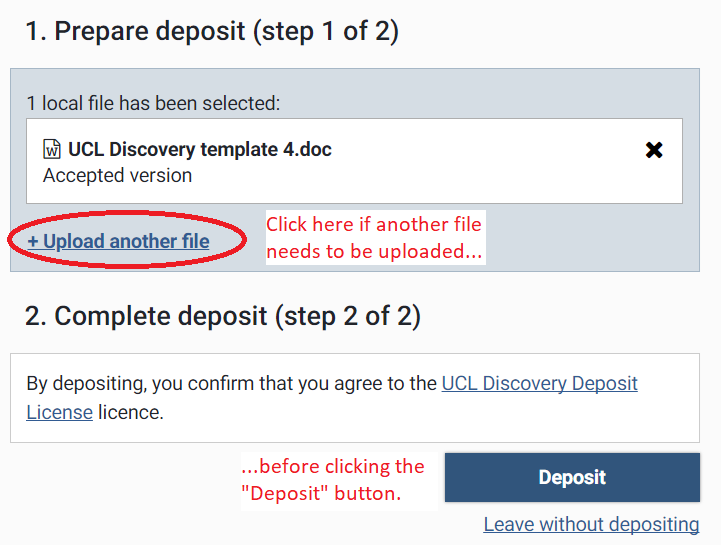
The Open Access Team is aware that some publication uploads consist of multiple files, for example if there is a supplementary file in addition to the file containing the main text of the research output, or if the accepted manuscript version of the output consists of figure and table files that are separate from the main text.  Uploading multiple files within a single publication record is still possible, as the screenshot below demonstrates:

Please direct questions about managing publications in RPS and UCL Discovery to the Open Access Team.

UCL Discovery reaches 30 million downloads!

By Kirsty, on 22 November 2021

UCL Publications Board and the Open Access Team are delighted to announce that on Friday 19 November UCL’s institutional repository, UCL Discovery, reached the milestone of 30 million downloads! UCL Discovery is UCL’s open access repository, showcasing and providing access to UCL research outputs from all UCL disciplines. UCL authors currently deposit around 1,750 outputs in the repository every month (average figure January-October 2021).

by Ray Hennessy on Unsplash https://unsplash.com/photos/gdTxVSAE5sk

Our 30 millionth download was of a journal article:
Huber, LR; Poser, BA; Bandettini, PA; Arora, K; Wagstyl, K; Cho, S; Goense, J; Nothnagel, N; Morgan, AT; van den Hurk, J; Müller, AK; Reynolds, RC; Glen, DR; Goebel, R; Gulban, OF; (2021) LayNii: A software suite for layer-fMRI. NeuroImage, 237, Article 118091. 10.1016/j.neuroimage.2021.118091.

This article introduces a new software suite, LayNii, to support layer-specific functional magnetic resonance imaging: the measurement of brain activity by detecting changes associated with blood flow. The software itself, which is compatible with Linux, Windows and MacOS, is also open source via Zenodo, DockerHub, and GitHub. The authors also made a preprint version of the article available via BioRxiv in advance of formal publication in NeuroImage. This demonstrates the combined value of open source software and open access to research publications.

The author of the article based at UCL, Dr Konrad Wagstyl, deposited the article in UCL Discovery in May 2021. Dr Wagstyl is a Sir Henry Wellcome Research Fellow at the Wellcome Centre for Human Neuroimaging, UCL, and co-leads the Multicentre Epilepsy Lesion Detection project, an open science collaboration to develop machine learning algorithms to automatically subtle focal cortical dysplasias – areas of abnormal brain cell development which can cause epilepsy and seizures – in patients round the world.

The UCL Office for Open Science and Scholarship recommends that researchers make any software or code they use available to aid others in reproducing their research. The Research Data Management team maintain a guide on best practice for software sustainability, preservation and sharing, and can give further support to UCL researchers as required.