X Close

Digital Education team blog

Home

Ideas and reflections from UCL's Digital Education team

Menu

Archive for the 'Distance Learning' Category

Workshop series: designing and managing online learning- synchronously and asynchronously

By Alexandra Mihai, on 2 November 2020

To support faculty in designing and teaching their online courses in the next terms, learning designers Alexandra Mihai and Heather Serdar from the Online Education team are offering in the next months a series of four new workshops aimed at providing practical guidance for designing and managing learning activities using both synchronous and asynchronous modalities.

The workshops have been designed as stand-alone 90-minute sessions but attending all four of them provides a 360 degrees perspective on the online teaching experience- from design to delivery, including a curated selection of resources and customisable templates.

Synchronous online teaching

Orchestrating synchronous interactions in the virtual classroom needs to be more intentionally planned than in a face-to-face environment. Setting clear goals and understanding where live sessions can bring the most added value to the learning experience is an important starting point. A well-managed live online teaching session can create opportunities for engagement and conversation.

The session on Designing synchronous learning activities provides practical guidance on how to design synchronous online learning sessions, including creating a variety of learning activities to engage students throughout the session, deciding what interaction channels to use and setting up effective mechanism for moderation and time management.

To complement it, the session on Teaching synchronous classes focuses on creating a community of practice, setting learner expectations of synchronous learning and teaching and managing groups in synchronous sessions.

Asynchronous online teaching

The online space can provide a flexible learning environment, without space and time constraints. Learning takes place also beyond the virtual classroom. In order to make sure students are motivated and engaged, asynchronous learning activities have to be carefully designed and managed.

The session on Designing asynchronous learning activities offers practical guidance on designing and sequencing asynchronous learning activities. Participants will have the opportunity to zoom into the actual activity design process and discuss how to create different individual and group learning activities, how to communicate them clearly to students and how to embed them into the overall course.

Moving on to the more practical aspects, the fourth session of the series, Teaching with asynchronous learning activities provides the opportunity to discuss communities of learning, learn about different activities that are appropriate for various subject areas and identify functions in Moodle that support asynchronous learning.

Here is the schedule of the new workshops. You can register here.

Wednesday, 4 November

Wednesday, 9 December

12:00- 13:30 Designing synchronous learning activities
Tuesday, 10 November 13:00- 14:30 Teaching synchronous classes
Tuesday, 24 November 14:00- 15:30 Designing asynchronous learning activities
Wednesday, 2 December 12:00- 13:30 Teaching with asynchronous learning activities

In addition to the new workshops, Heather and Alexandra will still run two 60-minutes sessions of the Designing Connected Learning Lectures this year, on Wednesday, 18 November, 12:00 and Wednesday, 16 December, 12:00.

We look forward to welcoming you to the workshops and supporting you in designing and teaching your courses.

Connected Learning Essentials – now open to teaching staff outside of UCL

By Jo Stroud, on 7 October 2020

In Term 1 of 2020/21, UCL’s core teaching is taking place online. There has been significant planning and an extensive amount of work from across the institution to support this transition, including a range of centrally-organised opportunities for staff to learn more about online teaching and learning.

The Connected Learning Essentials programme

One such opportunity is Connected Learning Essentials, an online course that was swiftly developed by Digital Education, the Arena Centre for Research-Based Education, Library, and colleagues based in academic departments, and run in multiple two-week-long cohorts from June to September 2020. The course was developed with recognition of the challenges facing staff and what could be achieved in a short period of time, and introduced some of the most urgent and important aspects of positive and active online teaching. Programme sections include:

  • Taking a Connected Learning Approach
  • Securing student engagement
  • Ensuring a consistent learning environment for students
  • Assessment
  • Designing for students’ active learning
  • Curating and making resources
  • Knowing students are engaging and learning.

It is important to note that the course only covers the basics, and was supplemented with a range of further opportunities to broaden the scope of course topics, including a series of live sessions and localised support within departments and faculties to support distinct pedagogic approaches.

Enrol on Connected Learning Essentials

The course is now open to anyone who might like to use it, regardless of where you work. You don’t need to progress through everything in order, either. You can dip in-and-out of specific sections depending on what you need or interests you most. If you find you need to move your teaching online very quickly, you might focus on sections 2, 3, and 5, and return to others later. While some UCL-specific content has been removed or genericised for other contexts, there will be occasions upon which guidance refers to UCL policies, practice, or platforms.

To access the course:

  • Navigate to Connected Learning Essentials (open) and click the Login link
  • If you don’t have a UCLeXtend account already, click ‘Create new account’ and complete the sign up process. If you do, sign in and you should be directed to the course
  • In the ‘Self enrol’ field, enter the enrolment key: ‘CLEUCL’.

Reusing material from Connected Learning Essentials

Material and activities from Connected Learning Essentials are available to download in Word format as part of the course and are licensed under CC BY-NC 2.0. Alternatively, if you work in digital education, educational development, or a similar role at another institution and would like to reuse and adapt the course on your own platform this may be possible via a course export. If you have any questions about this please contact extend@ucl.ac.uk.

Futurelearn How To Teach Online: Providing Continuity for Students (Join us!)

By Clive Young, on 20 March 2020

A new Futurelearn MOOC is starting on Monday 23 March designed in response to the COVID-19 pandemic.

The three-week course will explore practical ways to teach and support your students online.

Members of the UCL Digital Education team will be participating on this course and we hope the MOOC will stimulate ‘next step’ ideas for supporting our students..

To supplement the Futurelearn forums we have set up a UCL-specific Teams channel. Teams will be a place to discuss the ideas of the course from a UCL context and add a practical localisation to the UCL toolset. We hope you can join us.

To join the Futurelern MOOC, go to https://www.futurelearn.com/courses/teach-online/

To join in the UCL Teams discussion go to How To Teach Online (FutureLearn MOOC) – UCL community

Event overview: “Mapping unbundling in the HE terrain: South Africa and the UK”

By Jo Stroud, on 14 November 2019

In this seminar, hosted by the UCL Knowledge Lab Learning Technologies Unit, Dr Bronwen Swinnerton presented outputs from the UnbundledHE project: “The Unbundled University: Researching emerging models in an unequal landscape”, a cross-institutional study conducted by the University of Cape Town and University of Leeds.

The project considers the intersection of marketisation, unbundling, and digital technology and its effects on educational inequalities in South Africa and the United Kingdom. The following blog post summarises some of the issues surrounding the concept of educational unbundling and the project’s report into the current state of unbundled provision in both countries.

Marketisation

Recent years have seen a growth in demand for HE internationally but this has occurred alongside global economic shocks, such as the 2007 recession. The economic downturn has seen greater pressure placed on universities to report on the impact of central government funding streams and a resurgence of debates surrounding education as a public versus private good. This debate has tended to foreground the benefits of higher education to private individuals and consequently prompted a shift towards funding by the individual, leading to increases in fees and application of exogenous market principles to the HE environment. Such pressures have led HEIs to look to generate third stream revenue and reach new or alternative markets to fill funding gaps.

Digital technology

Digital technology is now ubiquitous in everyday life and HE, with all universities making use of technology in teaching and learning to some extent. Alongside the need to reach new audiences many have also begun to engage with online education, which has seen dramatic growth since the introduction of MOOCs. These courses have been in great demand from non-traditional audiences, such as adult professionals, with platform providers and university partners now pivoting toward the use of short online courses to deliver CPD and widening access initiatives, enhance teaching quality, and promote ‘massification’ or scalable learning opportunities. It is agreed that while universities can undoubtedly reach more prospective learners with online education it is no longer a ‘second best’ or indeed cheaper delivery method.

Unbundling

Unbundling is explained by McCowan (2017) as being either ‘disaggregation’, where what was sold together is now sold separately, e.g. tracks from an album, or ‘no frills’, a basic version of a product, e.g. budget airlines. There now exists a definitive application to HE, with the project defining unbundling as a disaggregation of educational provision, e.g. degree programmes, into component parts, e.g. modules, for delivery by and to multiple stakeholders. This is often achieved using digital approaches, and is manifesting itself through alternative digital credentials, or microcredentials, often delivered via what were MOOC platforms.

Rationale for offering unbundled educational opportunities can be multifarious and their production and delivery at odds with existing or longstanding institutional processes. The approach is typically: 

  • Internal, whereby HEIs choose how and when to break apart existing provision and offer content to learners directly;
  • In collaboration with service or platform providers, in which an HEI procures services to support specific stages of the course lifecycle;
  • By working with online programme management companies (OPMs), frequently with full service or white-labelled delivery and revenue share arrangements.

The unbundling landscape in SA and the UK

Dr Swinnerton highlighted key findings from the project, including the outcomes of interviews with policy makers, HE leaders, edtech developers, and private company CEOs. Mapping information (delivered via kumu.io software) was drawn from publicly available data, such as university, private company, and online and distance education websites, press releases, and other media. 

Interactive mapping of the HE landscape in SA and the UK demonstrated HEIs, suppliers, and OPMs and the relationships between them across provision of unbundled online education. The maps could be filtered according to league table strata, and what was immediately apparent across both contexts was disparity in coverage, with partnership opportunities broadly unavailable to lower-ranked institutions. Private companies in this space, notably OPMs, chiefly target elite institutions with established brands to drive profit-making business models. This was particularly clear in SA, with historically disadvantaged universities having little to no opportunity to engage in the online education space with support from private sector organisations, and with the suggestion that this had the potential to propagate stark inequalities already inherent within the SA HE system. Similar issues were present in the UK context, but with acknowledgement that educational inequalities and the digital divide are not quite so strong outside the context of online delivery.

See also

Dr Bronwen J Swinnerton, Senior Research Fellow in Digital Education at the University of Leeds

McCowan, T. 2017. Higher education, unbundling, and the end of the university as we know it. Oxford Review of Education 43(6); pp.733-748.

Swinnerton, B , Ivancheva, M, Coop, T et al. (6 more authors). 2018. The Unbundled University: Researching emerging models in an unequal landscape. Preliminary findings from fieldwork in South Africa. In: Bajić, M, Dohn, NB, de Laat, M, Jandrić, P and Ryberg, T, (eds.) Proceedings of the 11th International Conference on Networked Learning 2018. Networked Learning 2018, 14-16 May 2018, Zagreb, Croatia; pp. 218-226.

Alternative presentation delivered by UCT’s Sukaina Walji at WCOL19 with an increased focus on OPM relationships. “Degrees of (un)ease: Emerging relationships between OPMs and University Stakeholders in an unbundling landscape”

UCLeXtend platform migration

By Jo Stroud, on 25 October 2019

In recent months staff from Digital Education have been engaged in a project to migrate the public-facing short courses platform, UCLeXtend, to a new hosting provider. As part of this process the platform will be upgraded to a version of Moodle that offers several GDPR compliant features in addition to an updated interface.

A change of theme

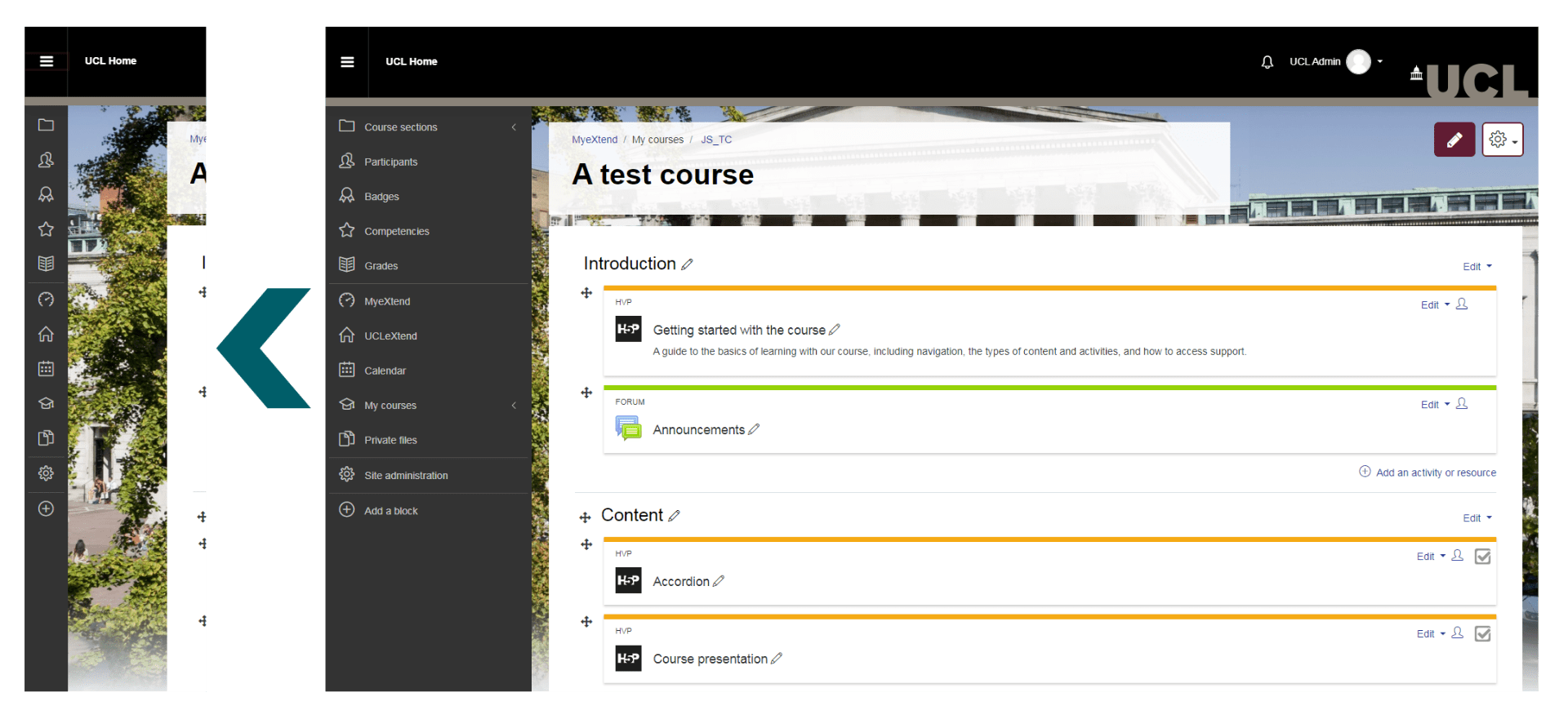
As part of the migration we are also taking the opportunity to refresh the platform’s aesthetic, or ‘theme’, which in recent years has required continued investment to remain functional. This change will mean that the platform’s existing courses look different, although underlying functionality will remain the same and the content and activities present will not be changed. Course layouts will bear greater similarity to the internal UCL Moodle platform and course teams will have more choice over how their courses are structured and presented. 

The new site theme’s primary differences are as follows.

At site level

  • The UCLeXtend homepage will be refreshed with a change in colours and imagery, in addition to separate buttons for UCL and non-UCL logins (see work-in-progress screenshot below); 
  • Upon login, learners and staff will be presented with a dashboard of their courses. This dashboard can be controlled by individual users, giving the opportunity to highlight recently visited courses and ‘favourite’ or hide courses.

Screenshot of updated UCLeXtend homepage, with photograph of UCL Portico in background and log in buttons visible

At course level

  • Section navigation will move from the top of the page to the left-hand side. The left-hand navigation panel can be expanded or collapsed by the user; 
  • There will be greater control over the layout of each course with course formats; 
  • Courses can feature an illustrative image that is presented on both the course dashboard and as a background upon entry (see work-in-progress screenshot below).

Screenshot of new course layout with expanded and collapsed navigation bar shown

Key information

The migration is anticipated to be completed in the week commencing 18th November 2019 (updated: 13/11). A notice will be applied to the front page of the platform as to the precise date and time and it should be unavailable for a few hours at most. Teams with live courses during this period will be contacted separately with further information about how to manage the transition.

If you have any questions please get in touch with the Digital Education team at extend@ucl.ac.uk.

ABC LD – the next steps

By Natasa Perovic, on 13 July 2018

UCL Digital Education has been awarded two year Erasmus+ funding to develop their well-known ABC learning design workshop with a 12 European universities. Since its inception at UCL only three years ago this unique ‘rapid-development’ approach to help academics develop high tech student-focused modules and programmes has had an unprecedented impact on the sector. Dr Clive Young, the originator of ABC alongside his Digital Education colleague Nataša Perović, gives the reasons for its success, “Most universities have aspirational strategies to develop future-looking digitally rich and blended courses, but few teachers have the skills, knowledge and time to redesign their programmes”. ABC is UCL’s response, a light touch team-based approach which co-creates a visual storyboard for a module in just 90 minutes. Over 75 workshops have been run at UCL with nearly 500 academics (and students) redesigning around 200 modules. The participant response has been overwhelmingly positive and ABC was soon picked up beyond UCL, and is now used at 20 other universities in the UK alone. The Erasmus project builds a strategic partnership between UCL, six other universities from the League of European Universities (Amsterdam, Helsinki, Leuven, Milan and the Sorbonne, with Oxford as an associate) and six innovative universities from Belgium, Denmark, Croatia, Estonia, Ireland and Romania. The partnership will develop ABC as a downloadable toolkit that can be used globally by any institution in the sector.  More information…

Follow the project progress via twitter @ABCtoVLE @ABC_LD.