X Close

Researchers in Museums

Home

Engaging the public with research & collections

Menu

Archive for January, 2018

What do Kids ask Scientists?

By ucbtch1, on 26 January 2018

Science is exciting, science is fascinating, and with science you never get bored — this is what I want to communicate to children when I give talks about my research. As I work with brains, lasers and 3D printing, that’s easy enough. When I talk about neuroscience and what I do in the lab as a PhD student, kids are always interested even if the younger ones don’t even know what a brain does. When I show them pictures of my research (see below), which involves working with brain cells and dissecting brains, there’s always an eww sound — because the brain is “slimy”.


A pig’s brain, which — according to kids — is gross because it’s slimy. (Image: Author’s own photo)
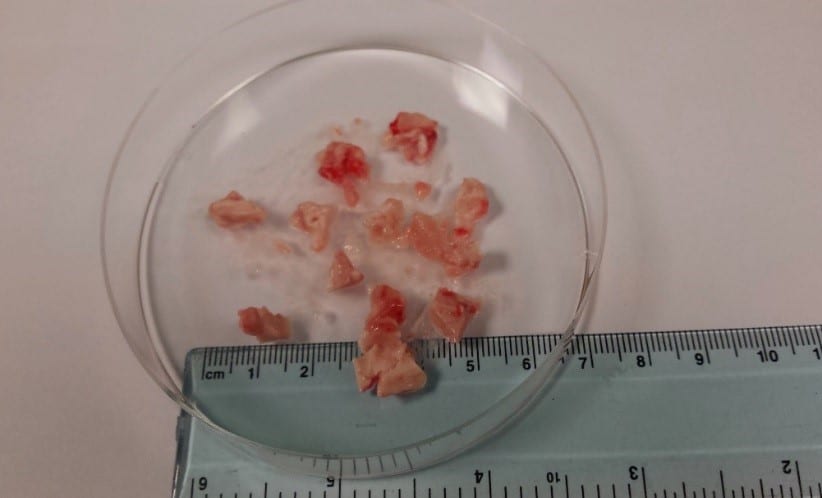


The same brain cut into pieces. (Image: Author’s own photo)


After my talk, with just a couple of minutes left and a lot of hands raised, I get a lightning round of questions. They range from all aspects of life, not just science as they assume that scientists know everything about everything in the universe. This would be cool, but it’s definitely not the case. Anyhow, I always have a blast answering their unique questions, so I’ve decided to share a couple of my favourites and some of the trickier ones here. Here is a taster of them, followed by my inner dialogue (ID) and what I actually answered (A). As you will see, my inner dialogue can be quite different from the answer, which just shows how difficult it can be to answer unexpected questions. Remember, as I always tell the kids, there are no stupid questions.


Q: Can you make little animals?

ID: Other than little humans in my uterus, no.

A: Scientist are trying to make organs in the lab by growing cells in a specific way, but we can’t grow a full animal yet.


Q: Why do you die?

ID: Because our bodies can’t cope with so much wisdom.

A: It’s a big scientific question, trying to answer why we age and ultimately die. Our bodies grow older and our cells don’t regenerate as much as they used to, but ultimately we don’t know exactly why this happens.


Q: How much do you make?

ID: Not enough.

A: Enough.


Q: Is it true that when you die your heart explodes?

ID: Yes, if you die in an explosion.

A: No, when you die your heart just stops beating.


Q: Can we even get to fully understand the brain if it’s always evolving?

Now, this one really impressed me because: 1) she knows about evolution and understands that not only we as a species evolved but we are still evolving and so are our brains; 2) she knows that we don’t know everything about the brain; and 3) it’s just a really interesting question coming from a 10-year-old!

ID: Wow, yeah that’s true, can we?

A: That’s a very good question. Yes, we don’t know fully how the brain works but there are breakthroughs in science every day and new tools and techniques will allow us to one day fully understand the brain, even if it’s still evolving.


Q: My friend told me that he saw a ghost and… (After a long story about his friend seeing a ghost, the teacher was a little fed up with his not very scientific question and the rest of the class was giggling).

ID: I’m also giggling.

A: Just because your friend said so that doesn’t mean it’s real. You have to question him and ask him to show you evidence of what he claims is true. Remember to always question everything and look for evidence.


Q: What’s the most interesting thing you’ve discovered?

ID: How resilient I can be when facing relentless adversity, demonstrated by how my numerous failed experiments and negative results have broken my spirit yet have not killed my wandering scientific mind. Oh, wait, you mean like in science?

A: How cool neurons look down a microscope.


Q: Why do you like gross stuff?

ID: What are you talking about? Brains are not gross, they’re amazing!

A: What are you talking about? Brains are not gross, they’re amazing!


Q: How old is the universe?

ID: Oh god, try to remember, you know this.

A: Around 14 billion years.

Q: How much is that?

A: A lot!


So there you have it: kids and their questions. I wish to thank the schools that invited us PhD students, as well as the children for listening to me and asking such stimulating questions. Keep your curiosity alive!
 

We’re Hiring Student Engagers!

By Arendse I Lund, on 24 January 2018

Are you a UCL student and excited to share your PhD research with the world? Can you find connections between your research and museum collections? Come join our Student Engager team!

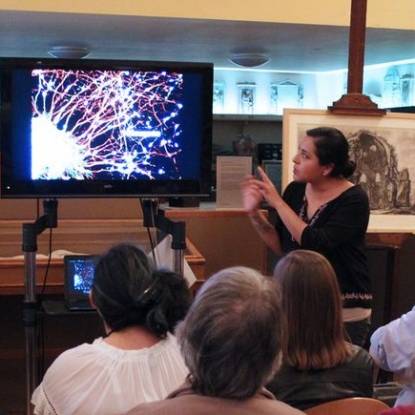
Citlali Helenes Gonzalez presents during the Materials & Objects event in the UCL Art Museum last spring.


Who We Are

We’re a interdisciplinary team of PhD students from across UCL who are interested in public engagement and sharing our doctoral research with the world. We come from different backgrounds and departments and study everything from medieval law to neuroscience to the Dark Web. You might spot us in the UCL Art Museum, Grant Museum of Zoology, or Petrie Museum of Egyptian Archaeology any day of the week talking about our research and how it relates to the museum collections.

We love talking to people, sharing expertise, and making new connections that benefit both the public and our own research. Sometimes we also host events such as Foreign Bodies, LandSCAPE, Stress: Approaches to the First World War, and Materials & Objects.


Are You the One?

We’re hiring! If you’re a first or second-year PhD student interested in working in the three UCL museums, sharing your knowledge, engaging the public in dialogue, and enhancing visitors’ experiences of UCL, then we want to hear from you. We think this is the best gig ever and we want equally enthusiastic people to come join us. We’ve also written extensively on this blog about what the Student Engager experience is like and highly recommend you take a look around if you’re interested in joining us.

For the practical side, here’s a full job description (PDF); you should email your CV and cover letter to Celine West (celine.west@ucl.ac.uk) by 16 February.

If you have any questions, tweet us or find us in one of the UCL museums.

Is Burial a Modern Human Behaviour?

By Josie Mills, on 16 January 2018

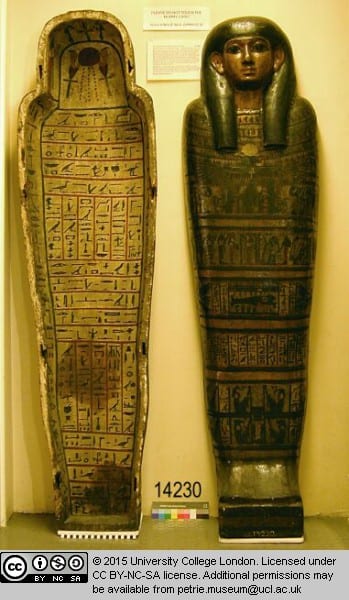
Both the Grant and the Petrie Museums contain regular reminders of death, burial, and what comes after. The animals and skeletons preserved in the Grant continue to contribute to studies of comparative anatomy, education, and public outreach in the museum. In the Petrie, there are many examples of how Ancient Egyptians treated death and the afterlife, including the wooden coffin of Nairetisetnefer on display at the back of the main room (figure 1).

Figure 1: The wooden coffin of Egyptian woman Nairetisetnefer, which is covered in gesso and painted with religious scenes and inscriptions. It was found in the Besenmut family burial(s) at Thebes. Petrie accession number: UC14230

Burial and mourning have long been associated with human-ness. Historically, we’ve thought of the process of understanding death, and what may come after, as something that can only be conceptualised by Homo sapiens. However recent observations of mammals (like the elephant) suggest that mourning, or observation and reaction to death, are not unique to humans as a species.

From an archaeological perspective, burial is generally classed within the suite of ‘advanced’ behaviours (alongside personal adornment, symbolic behaviour etc.) that appear in the archaeological record around 40,000 years ago, coinciding with the widespread dispersal of anatomically modern humans (aka H. sapiens). The timing and proliferation of these burials means that they are generally associated with a period called the Upper Palaeolithic.

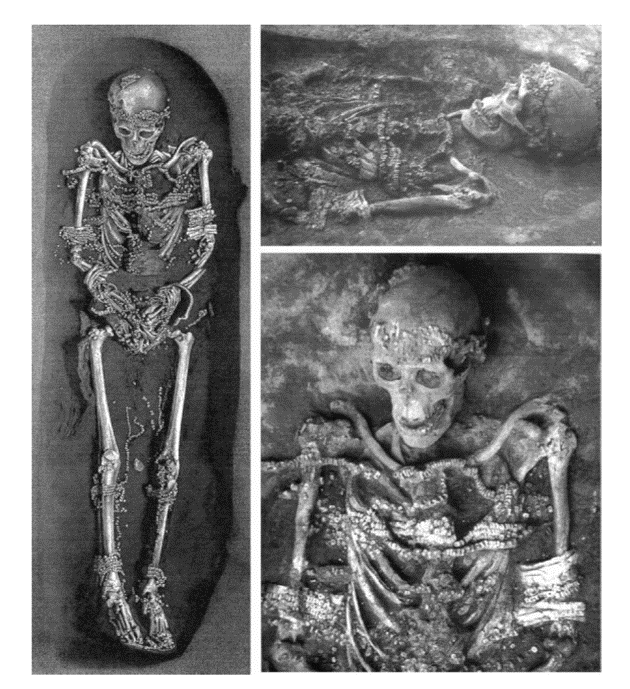
Some Upper Palaeolithic burials are easy to recognise in the archaeological record as the individual(s) is interred in a well-cut grave alongside grave goods, like the burials found at Sungir in Russia (figure 2). These well-known burials are probably not representative of widespread mortuary practice instead representing high-status individuals. Types of burial varied substantially across the Upper Palaeolithic world, for an overview of the diversity of burials in Eurasia check out Riel-Salvatore and Gravel-Miguel (2013).

Figure 2: These images show the burial of a male individual known as Sungir 1. The skeleton is incredibly well preserved and although the outfit the individual was buried in has not survived you can see the mammoth ivory beads that would have adorned it. Image credit: Trinkhaus, E., Buzhilova, A. P. 2012. “The Death and Burial of Sunghir 1.” International Journal of Osteoarchaeology. 22: 665-666

Did other hominins further back into the past practice burial? One of the most important things to consider is what the word ‘burial’ means. In a way, it can be a loaded term indicating direct intention to preserve or honour an individual, hinting at aspects of the deceased’s relationship with the living and perhaps thoughts for their journey into something like an afterlife. This process demonstrates a whole lot of complex thoughts and ideas. However, from a practical perspective the idea of burial also encompasses things like the removal of deceased from occupation sites, thereby minimising the risk of disease and attraction of dangerous carnivores, a behaviour Pettit (2013) calls ‘funerary caching’. This would make some burials in the past a slightly more practical option.


Figure 3: This reconstructed skull belongs to a Neanderthal child known as Dederiyeh 1, who was around two years old. I think one of the most striking features of this skull is the presence of so many teeth! Image credit: http://humanorigins.si.edu/evidence/human-fossils/fossils/dederiyeh-1

In an archaeological (particularly a Palaeolithic context) how do you tell when somebody has been deliberately buried?

  • Bones in the skeleton remaining in the correct anatomical location and still being attached to one another indicating a high degree of skeletal articulation, which suggests that the deceased was interred relatively rapidly after death and was not disturbed post-mortem. The preservation state of the bones can also hint at deliberate burial as they are less likely to be broken by disturbance if the individual has been protected by a grave-like structure or set aside in a specific place. This is seen in the articulated burial of a two-year-old child Neanderthal child (Dedriyeh 1) in Syria (Pettit 2013; figure 3).
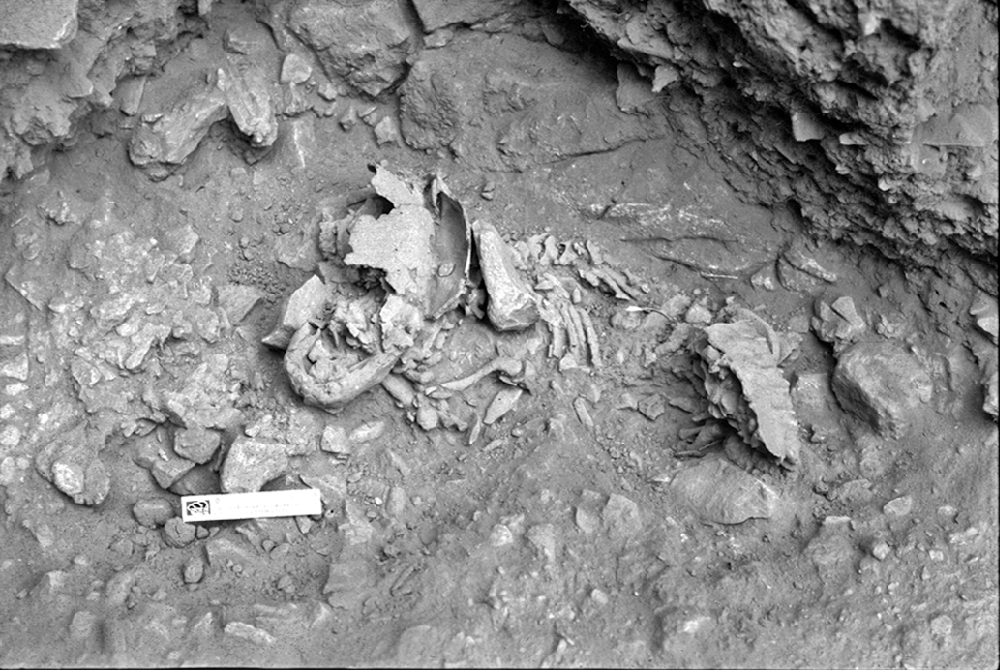
  • Association of grave goods with burials, such as flint arrowheads or inclusion of animal remains, like the red deer maxilla associated with Amud 7 Neanderthal burial (Pettit 2012). These items are particularly important if they are unusual or uncommon in the surrounding excavated area, making it more likely that they were placed with the deceased on purpose.
  • Looking for some sort of grave-like depression, a hollow dug into the ground or an area to the side of a cave where a body is placed under a rock or in a natural shelf.


Figure 4: This image shows the burial of a Neanderthal child known as Amud 7, excavated from Amud Cave in Israel. Although it is relatively difficult to see from the photo the skeleton was found alongside several items that have been interpreted as grave goods, for example flint tools and a red deer bone. Image credit: Hovers, E., Ullman, M., & Rak, Y. (2017). Palaeolithic Occupations in Nahal Amud. In Y. Enzel & O. Bar-Yosef (Eds.), Quaternary of the Levant: Environments, Climate Change, and Humans (pp. 255-266). Cambridge: Cambridge University Press. doi:10.1017/9781316106754.029

I study Neanderthals and have written in the past about how they are often given a tough time in popular media for being brutish, unintelligent and lacking in the advanced behaviours of modern humans. The burials mentioned above were made by Neanderthals, however all post-date 70,000 years ago meaning they occurred relatively late in the Middle Palaeolithic (the time when Neanderthals were around); they are also not found consistently across the Neanderthal world (Pettit 2013). From the available evidence, it seems that burial was not a ubiquitous behaviour; however, a preservation bias probably exists because the further you get into the past the more likely archaeological remains are disturbed. Equally Neanderthals were highly mobile hunter gatherers so the chance of finding and excavating their occupation and burial sites is rare and finds are generally seen in cave systems. This is both due to the shelter from environmental processes provided by caves and their recognised potential as archaeological sites, meaning they are excavated more often than open-air sites.

Neanderthal burial is a controversial topic and some of burials are contested, particularly if the term is defined by modern human standards, e.g. the deceased is found interred in a dug grave alongside grave goods. It’s likely that the origin of burial, as suggest by Pettit (2013) who has written in detail about the subject, is in the Palaeolithic but it is improbable that somebody somewhere in the past woke up and invented the concept of burial as we understand it today. It is more plausible that mortuary practice evolved in various places at separate times and has some roots in the practicalities of death for living populations.

For a final thought, although excavated burials generally post-date around 70,000 years ago (late in Neanderthal evolution), new discoveries like the structures in Bruniquel Cave (Jaubert et al. 2016), which have been reliably dated to 170,000 years ago, reveal a deepening complexity in observed Neanderthal behaviour; alongside finds like this, it doesn’t seem out of this world to think that some form of mortuary behaviour was seen earlier in the human record.

Incidentally there’s also rather a lot of evidence for excarnation by Neanderthals and Anatomically Modern Humans, but that’s for another blogpost!

References:

Jaubert, J., Verheyden, D., Genty, D., Michel, Soulier., Cheng, H., Blamart, D., Burlet, C., Camus, H., Delaby, S., Deldicque, D., Edwards, R. E., Ferrier, C., Lacrampe-Cuyaubère, F., Lévêque, F., Maksud, F., Mora, P., Muth, X., Régnier., E., Rouzaud, J., Santos, F. 2016. Early Neanderthal constructions deep in Bruniquel Cave in southwestern France. Nature 534:111–114

Pettitt, P. (2013). The Palaeolithic origins of human burial. Routledge.


I spy with my little eye… Micrarium Top 5

By tcrnkl0, on 9 January 2018

Want a tour through the Grant Museum’s iconic display of the tiny creatures that populate our world? Well unfortunately, it’s much too small for that! However, here I’ll tell you about five of my favourite slides to be on the lookout for when you visit.

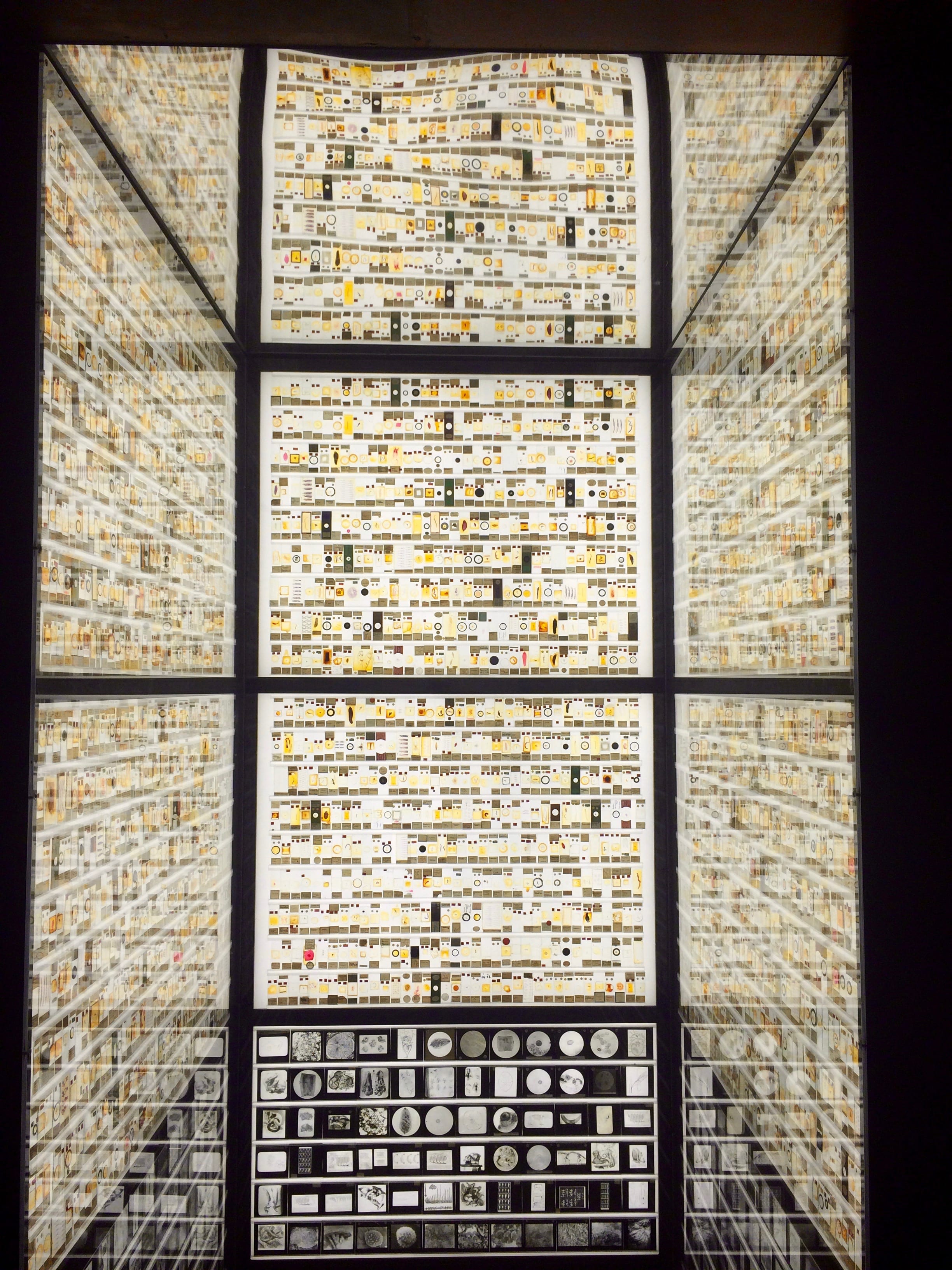
The Micrarium. Photo by author.

The Micrarium’s floor-to-ceiling lightboxes illuminate 2323 microscope slides featuring insects, sea creatures, and more, with another 252 lantern slides underneath. While this sounds like a lot of slides, it’s only around 10% of what the museum holds. Natural history museums often find it difficult to display their slide collections, but the diminutive creatures often featured on them make up most of our planet’s biodiversity.

I start most of my conversations with visitors during Student Engager shifts here – the Micrarium provides a clear illustration of my PhD research about how challenging aspects of diversity (of all kinds) are integrated into existing collections. It’s also an ideal place within the museum to try to pause people in the flow of their visit – it’s hard to resist stopping to snap a selfie or two.

Selfie by author.

The soft glow of the Micrarium’s backlit walls often draws people into the space without realising the enormity (or tininess!) of what they’re looking at. Over time, I’ve cultivated a number of favourites that I point out  in order to share the variety, strangeness, and poetry of the individual slides.

Small and mighty

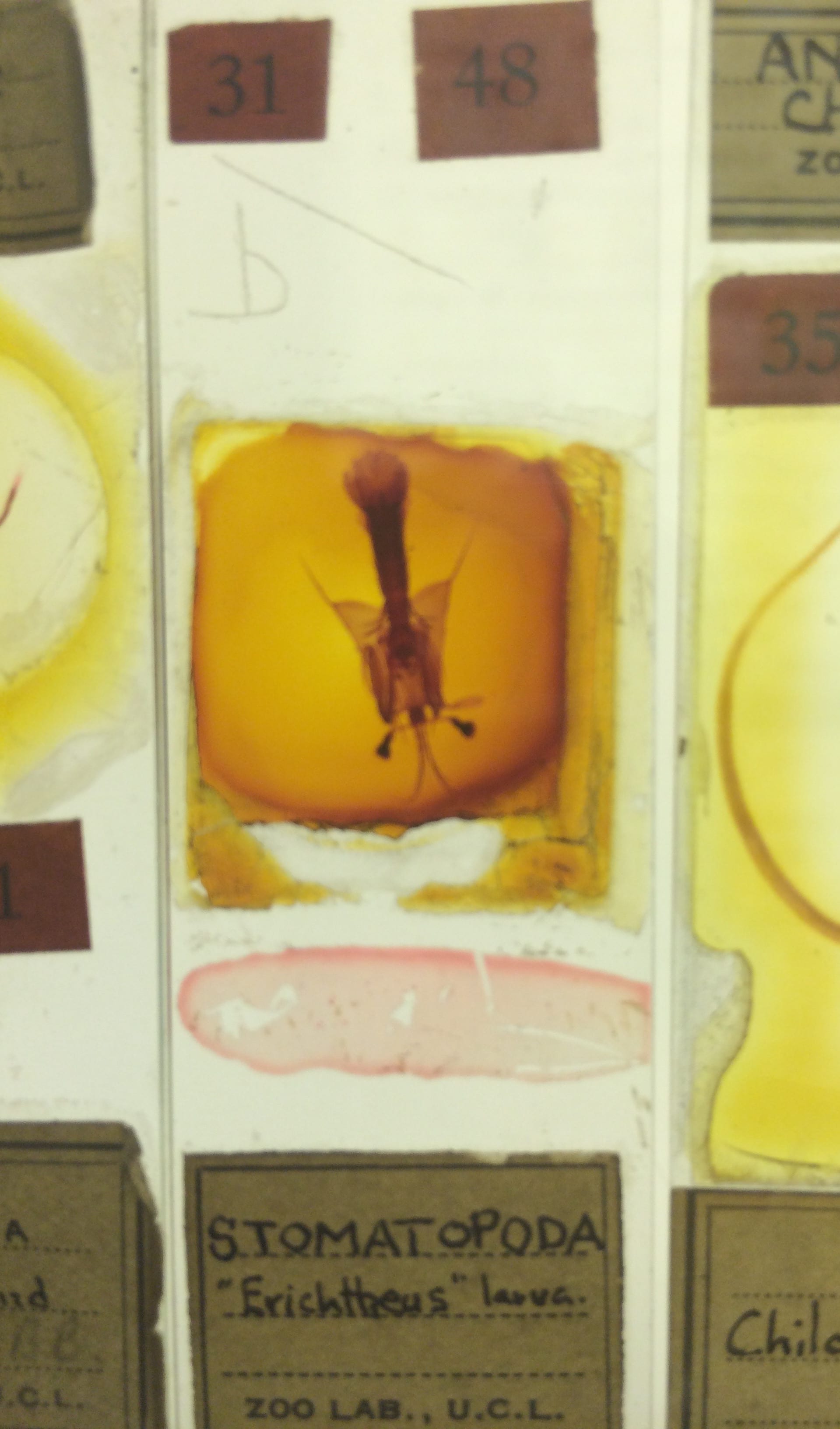
‘Stomatopoda “Erichtheus” larva’. Photo by author.

I was attracted to this slide because at first I thought it looked like a little flying squirrel. In actuality, it’s the larvae of a mantis shrimp.

The mantis shrimp is an incredible animal. To start, they have the most complex eyes of any animal, seeing a spectrum of colour ten times richer than our own. Its two ‘raptorial’ appendages can strike prey with an amount of force and speed, causing the water around them to boil and producing shockwaves and light that stun, smash and generally decimate their prey.

For more, check out this comic by The Oatmeal that illustrates just how impressive mantis shrimp are.

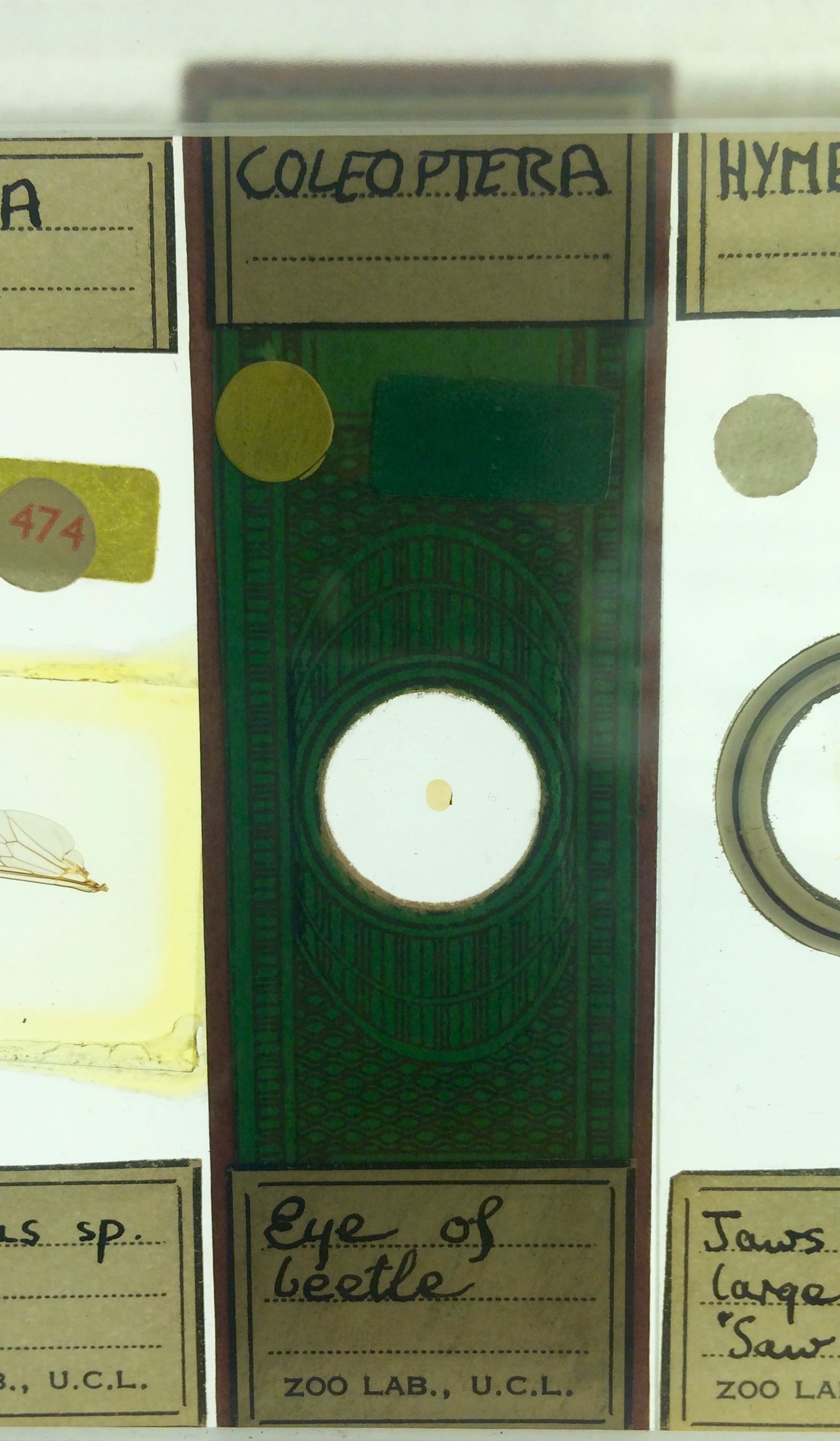
‘and toe of frog, wool of bat, and tongue of dog’

‘Eye of beetle’. Photo by author.

This is one of my favourite labels in the collection – was a zoologist also dabbling in witchcraft ingredients?  Probably not. But, I’d love to know what the slide was originally used for.

The slide itself also looks unusual due to its decorative paper wrapping. These wrappings were common to slides from the mid-19th century, which were produced and sold by slide preparers for others to study.

Many of the slides in the Micrarium were for teaching students who could check out slides like library books. So, perhaps it illustrated some general principles about beetle eyes rather than being used for specialist research.

Cat and Mouse

Fetal cat head (L). Embryonic mouse head (R). Photo by author.

One of the secrets of the Micrarium is that there are bits of larger animals hidden among all of the tiny ones. I like how the mice look surprisingly cheerful, all things considered. Bonus: see if you can also find the fetal cat paws!

Seeing stars

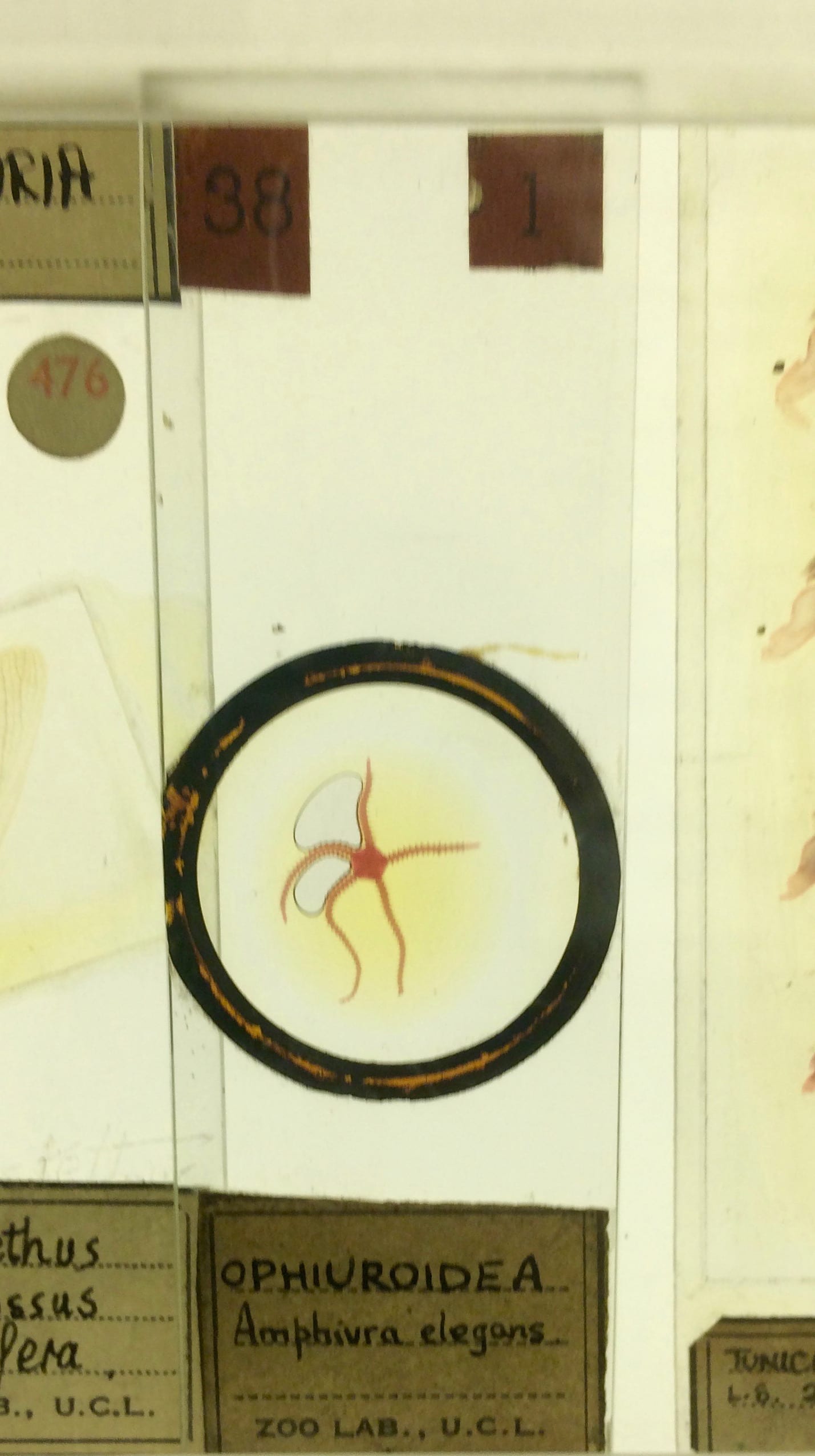
‘OPHIUROIDEA Amphiura elegens’. Photo by author.

This is a young brittle star, which in the largest species can have arms extending out to 60cm. Brittle stars are a distinct group from starfish; most tend to live in much deeper depths than starfish venture. They also move much faster than starfish, and their scientific name ‘Ophiuroidea’, refers to the slithery, snake-like way their arms move.

This slide can be found at child height, and it’s nice to show kids something they’re likely to recognise.

And finally:

Have you seen the bees’ tongue?

‘Apis (Latin for bee) tongue’ Photo by author.

Showing visitors this slide of the bee’s tongue almost always elicits surprise and fascination. Surprise at the seemingly strange choice to look at just the tongue of something so small and fascination at how complex it is.

We don’t normally think of insects having something so animal-sounding as a tongue (more like stabby spear bits to sting or bite us with!). But, bee tongues are sensitive and impressive tools: scientists have observed bee tongues rapidly evolving alongside climate change.

Good luck finding these…or your own Top 5! Share any of your favourites in the comments.

The Grant Museum blog did a similar post five years ago when the Micrarium opened. These don’t overalp with my Top 5 (which is easy to avoid when there are 2323 slides), so you should also check that out.