X Close

Open@UCL Blog

Home

Menu

Shaping Tomorrow’s Healthcare: Unlocking the Power of Open-Source AI and Robotics

By Naomi, on 17 September 2025

Guest post by Miguel Xochicale, Senior Research Engineer at UCL, leading work on open-source technologies from robotics to AI tools designed to improve healthcare.

In this blog, I would like to reflect on the journey so far, the challenges and rewards of trying to build something meaningful with modest means, and to look ahead with ambition to explore how open-source AI and robotics can help shape the next generation of healthcare.

In October 2023, I was honoured to receive the UCL Open Science & Scholarship Award in the category ‘Professional Services Staff Activities’. This was in recognition of initiating a half-day workshop titled ‘Open-source software for surgical technologies’. I had the privilege of hosting seven distinguished speakers, with an audience of around twenty participants. Hence, that first workshop became the springboard for subsequent events in 2024 and 2025, each growing gradually in terms of co-organisers, speakers, activities, and participants. What started as a small gathering with limited resources and time has begun to take shape as the early foundations of a community that we would like to keep building.

A group of about 30 people stand on a stage, posing for the photo, in front of a large screen on which is written “Healing Through Collaboration: Open-Source Software in Surgical, Biomedical and AI Technologies”.

The 2025 workshop took place at the 17th Hamlyn Symposium on Medical Robotics, organised by the Hamlyn Centre for Robotic Surgery at Imperial College London and held at the Royal Geographical Society, London, UK.

The workshop has grown steadily across 2023, 2024 and 2025. 2023: A half-day workshop with 7 speakers from software engineering and academia, 25 participants, and 4 organisers. 2024: A full-day workshop featuring 10 speakers from academia and industry, 6 posters archived on zenodo, 30 participants, and 3 co-organisers. 2025: A full-day workshop with 13 speakers and 7 panellists from academia, industry and regulatory backgrounds. It included 6 posters, each with a two-page abstract, supported by 6 organisers and 2 volunteers. The event sold out, with all 52 seats filled.

The challenges of leading such workshops require careful planning well in advance, ideally starting a year beforehand. This includes checking the availability and interest of co-organisers, aligning the agenda, and building relationships with new speakers and collaborators from different institutions and industries, thinking that such relationships should extend beyond purely scientific or engineering goals, fostering an environment where people also enjoy working together. In organising such workshops, we were always careful to balance responsibilities so that no one felt overwhelmed.

However, despite these considerations, our most recent workshop was scheduled too tightly, leaving little space for meaningful conversations or questions. From this, we learnt the value of tailoring the workshop to the audience, setting clear aims for the community, and creating win–win situations for everyone involved.

We also recognised that funding and sponsorship are essential. They can help cover costs such as materials (souvenirs, t-shirts, stickers), support for guest speakers, and sponsorship for students from around the world. Just as importantly, they would allow us to be compensated for the time we dedicate to organising these events.

What started as a half-day workshop in 2023 on open-source software for surgical technologies has quickly grown into a movement. By 2024 and 2025, it had developed into full-day workshops, “Healing Through Collaboration: Open-Source Software in Surgical, Biomedical, and AI Technologies”, bringing together co-organisers, speakers, and volunteers dedicated to shaping the future of healthcare with open-source AI and robotics. Each year, the community grows, the insights deepen, and the vision becomes sharper. We are now looking for like-minded collaborators, sponsors, and co-organisers to help drive this effort forward. The momentum is here, together, we can redefine what’s possible for open-source innovation in healthcare. By pooling our skills, resources, and passion, we have the chance not just to advance technology, but to transform patient outcomes and make healthcare more open, accessible, and equitable worldwide.

Get Involved!

Help us continue building a vibrant community, by following our GitHub organisation, starring our repositories including the website for workshops, creating issues or pull requests to improve materials, or contributing to the writing of our white-paper in its GitHub repository.

We are always looking for like-minded people who share our vision of open-source software, hardware and technologies benefiting everyone, everywhere. If you are interested in driving healthcare forward with open source, please get in touch with me or join our Discord server for networking, discussions, and event updates. Recorded talks will also be available on the symposium’s YouTube channel. Many more opportunities to get involved are on the way.

Author Biography:

Miguel Xochicale specialises in medical imaging, MedTech, SurgTech, biomechanics, and clinical translation, and is currently exploring physical AI and embodied AI, with a strong focus on open, accessible innovation. Miguel aims to turn cutting-edge research into real-world solutions with lasting impact. Key areas of his work include: End-to-end real-time AI workflows for surgery; Eye movement analysis for neurological disorders; AI-assisted echocardiography; Sensor fusion combining wearables, EEG devices, and medical imaging; Generative AI for fetal ultrasound scans; Human–robot and child–robot interaction in healthcare and low-resource settings; Physical and embodied AI with multimodal data. He is committed to transforming healthcare through safe, scalable, and open AI solutions. If you are interested in collaborating, whether in research, academic-industry partnerships, or developing AI-powered healthcare software, let’s connect.


alt=""

The UCL Office for Open Science and Scholarship invites you to contribute to the open science and scholarship movement. Stay connected for updates, events, and opportunities.

Follow us on Bluesky, LinkedIn, and join our mailing list to be part of the conversation!

Share this post on Bluesky

The benefits and barriers to code sharing as an Early Career Researcher

By Kirsty, on 14 September 2021

Guest post by Louise Mc Grath-Lone, Research Fellow (UCL Institute of Health Informatics), Rachel Pearson, Research Assistant (UCL Institute of Child Health) and Ania Zylbersztejn, Research Fellow (UCL Institute of Child Health)

In July 2021, we held a session on code sharing as part of the UCL Festival of Code and were thrilled to have almost 90 attendees from 9 out of UCL’s 11 faculties – highlighting that researchers from across a wide range of disciplines are interested in sharing their code.

The aims of the session were to highlight the benefits of code sharing, to explore some of the barriers to code sharing that Early Carly Researchers may experience, and to offer some practical advice about establishing, maintaining and contributing to a code repository.

In this blog, we summarise the benefits and barriers to code sharing we discussed in the session taking into account the views that participants shared.

What is code sharing and what are the benefits?

Code sharing covers a range of activities, including sharing code privately (e.g., with your colleagues as part of internal code review) or publicly (e.g., as part of a journal article submission).

For Early Career Researchers in academia, there are many benefits to sharing code including:

Reducing duplication of effort: For activities such as data cleaning and preparation, code sharing is an important method of reducing duplication of effort among the research community.

Capturing the work you put into data management: The processes of managing large datasets are time-consuming, but this effort is often not apparent in traditional research outputs (such as journal articles). Sharing code is one way of demonstrating the work that goes into data management activities.

Improving the transparency and reproducibility of your work: Code sharing allows others to understand, validate and extend what you did in your research.

Enabling the continuity of your work: Many researchers spend the early years of their career on fixed-term contracts. Code sharing is a way to enable the continuity of your work after you’ve moved on by allowing others to build on it. This increases the chances of it reaching the publication stage and your efforts and inputs being recognised in the form of a journal article.

Building your reputation and networks: Code sharing is a way to build your reputation and grow your networks which can lead to opportunities for collaboration.

Providing opportunities for teaching and learning: By sharing code and by looking at code that others have shared, Early Career Researchers have opportunities to both teach and learn.

Demonstrating a commitment to Open Science principles: Code sharing is increasingly valued by research funders (e.g. the Wellcome Trust) and is a tangible way to show your commitment to Open Science principles which are part of UCL’s Academic Framework and important for career progression.

Despite the clear benefits to code sharing, at the start of our session just 1 in 4 participants (26%) said that they often or always share code. However, by the end of the session, almost all participants (90%) said that they definitely or probably will share their code in the future.

What are the barriers to code sharing as an Early Career Researcher and how we can overcome them?

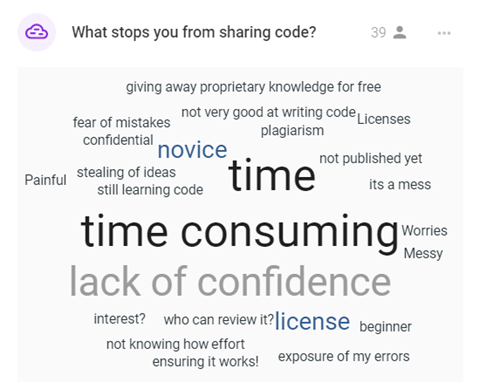
We asked participants what has put them off sharing their code in the past. The most common responses were:

The time and effort required: Ideally, you would write perfectly formatted and commented code on the first go – however, in reality, it often does not work out like this. As you update code and encounter bugs, code can often become messy and considerable time/effort needed to get it to point it can be understood by someone outside the research project. We discussed the importance shifting your perception of ‘shareable’ code. Sharing any code, even if messy, is far more helpful than sharing nothing at all.

Lack of confidence and concerns about criticism: Many researchers who write code as part of their work have very little (or no!) formal training. This means that sharing code can be daunting. For example, researchers may be worried about others finding errors in their code; however, sharing code can help to catch bugs in code early on and can bolster your confidence and reassure you that your code is correct. In the session, we also discussed how getting involved with online coding communities that emphasize inclusivity and support (e.g., R Ladies, Tidy Tuesday or one of the UCL Coding Clubs) can help grow confidence and provide a kinder environment in which to share code publicly.

Not knowing how to share or who to share with: A lack of formal training means that many researchers are unsure about where or how to share code, including not knowing which license to use to enable appropriate reuse of code. We discussed the need for more training opportunities, encouraged setting up your own code review groups (like a journal club, but for sharing and discussing code).

Worry that code will be reused without permission: Some participants were worried about plagiarism and their hard work being re-used without their knowledge or permission. However, hosting your code in a repository like GitHub allows you to choose suitable licence for re-use of your code to prevent undesired use while still supporting open science! You can also see how many people have accessed your code.

How can Early Career Researchers get started with code sharing?

Preparing code to share can take time and, as they work to secure their future within academia, many Early Career Researchers may already feel overloaded and pulled in different directions (e.g., teaching, institutional citizenship, engagement work, producing publications, attending conferences, research management, etc.). However, code sharing is hugely beneficial for a career in academia and so we would encourage all Early Career Researchers to try to find the time to share code by viewing it as an opportunity to invest in your future self. For example, you could:

  • Adopt a coding style guide to help produce clear and uniform code with good comments from the outset. This will reduce effort end when you come to share code (and help your future self when you look at your code many years later and have inevitably forgotten what it all does!
  • Join a UCL Coding Clubs or online community to learn tips from others about coding and sharing code.
  • Learn to use a code repository like GitHub. As part of our session, we delivered an introductory tutorial on how to use GitHub with links to other useful resources (available here).

How can UCL support Early Career Researchers to share code?

We ended the session by asking the participants how UCL could better support them to share their code. Some of the ideas suggested by Early Career Researchers were:

More training on writing and sharing code: For example, one suggestion was that UCL could create a Moodle training course for code sharing. Training about best practice in coding (across several languages) to help Early Career Researchers to write code right the first time would also be helpful.

Simple, accessible guidance about code sharing: This might include checklists or 1-to-1 advice sessions, in particular, to help Early Career Researchers to select the right licenses.

Embed code sharing as best practice at all levels: Encouraging and supporting senior researchers to share code so that it becomes embedded as good practice at all levels would provide a good example for and encourage more junior members of staff. It would also help to ensure that the time and training required to prepare code for sharing is built into grant applications.

Knowledge sharing opportunities: More events and opportunities to discuss how research groups share code to share best practice across faculties throughout UCL.


We would like to thank everyone who attended our session – “Code sharing for Early Career Researchers: the good the bad and the ugly!” – at the UCL Festival of Code for their time and contributions to the lively discussions. All the materials from the session are available here, including an introductory tutorial to getting started with code sharing using GitHub. We would also like to thank the organisers of the UCL Festival of Code for their help and support.