X Close

Emerging Subjects Blog

Home

Emerging Subjects of the New Economy: Tracing Economic Growth in Mongolia

Menu

Archive for the 'Bank and Credit Market' Category

Tsagaan Sar Gift Index — 2016

By ucsaar0, on 8 March 2016

Members of the Emerging Subjects project at UCL and the National University of Mongolia contributed to this post.


What does focusing on gifts given and received during Tsagaan Sar tell us about the general economy? Last year we posted our first Tsagaan Sar Gift Index (TSGI) and found that the slowing economy shaped how people celebrated the holiday, with people confining the celebrations to fewer days and opting for more useful gifts (like socks) that support Mongolian businesses.

This year, the economy has been shaken further with pressures of increasing public and private debt and the slowdown of commodity prices globally. We found that people bought less over-all in preparation for Tsagaan Sar. While prices have decreased (especially the price of meat), the cost of this year’s celebration was very straining.  This was especially true for those without a regular income, or dependent on the sale of meat for money.  The cost of preparing and sourcing goods was compounded by an already difficult time economically, and many pensioners used their pensions to take out loans, or purchased items through credit to fund the celebration.[1]

Based on comparison of our different cases, it seems typical for a lower-income household to spend less than 600,000 tögrög; a middle-income household to spend between 600,000-800,000 tögrög; and high-income over one million tögrög. If a household has elders or highly-respected individuals, such as a doctor or singer, they often have to spend well over one million to accommodate the large number of guests. Though households might receive a good amount of money in the form of cash gifts given by guests (around 100,000-400,000), this does not seem likely to off-set the cost of items like vodka, prime cuts of sheep meat, gifts for guests, and holiday outfits that are purchased in advance of the holiday.
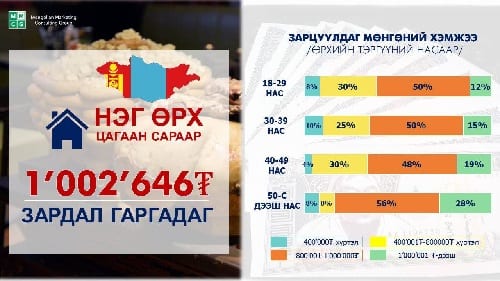
Average Tsagaan Sar expenditures based on age group. Courtesy of Mongolian Marketing Consultancy Group.


Alongside our reflections we have interspersed the text with statistics from the Mongolian Marketing Consultancy Group’s survey on people’s attitudes toward Tsagaan Sar (with kind permission from Bumerdene Dulam). Although these are based on very general reflections, they complement the individual experiences we recount.  They also reveal rising public interest in the high cost of the holiday.

Preparations

Based on her ongoing work with traders at Narantuul market, Hedwig noted that the market was, as usual, packed in the lead-up to the National holiday, and especially so in the last three days of the previous lunar year. The sellers were happy to be busy, but many remarked that over-all spending was much less than usual, and was characterized by ‘scattered’ and ‘irregular’ purchases (таaруу). In fact, the average trader made 30% less than last year selling goods for the national holiday

Those who sold household goods (ariun tsevriin hereglel) encountered a decrease in comparison to last year in spending of around 10 %, as people bought gifts like shampoo and soap from their shops, as well as products to clean their homes before the celebration started. Clothing shop traders (i.e. non ‘necessary’ goods) reported a loss in profits of between 30-50 % compared to previous years. Instead of purchasing new clothes, many reported using old material to make their New Year outfits, or simply reusing what they had. Others reported re-gifting items they had received, while also being strategic about whom they visited.

One of Rebekah’s friends stressed that:

‘Like all Mongolian holidays, Tsagaan Sar will not be skipped or overlooked. People are spending as much as they can to have a decent Lunar New Year. This year is the year of the Monkey, a year that bears the title of the “mischievous faced-one”. A mid-ranking family can expect to spend from 500,000 – 1,500,000 MNT, with food, drinks, gifts and cash tokens all included.’

According to him, the prices of things were not that high, compared to last year. Instead, he explained:

‘The value of the tögrög dropped to a level where prices do seem high and people’s wallets are thinner this year. One US dollar now is trading at 2005-2010 tögrög in the commercial banks. Experts warn that it could reach 2200 if proper measurements are not taken.’

Many spoke of giving smaller gifts, such as phone credits, 500-1000 tögrög in cash, or small sweets and treats for younger people. Another of Rebekah’s friends reported a disconnect between the generations as to how best to celebrate the occasion, with one person commenting:

‘I see young people wanting to celebrate in a simpler way with less gifts and less extra expenditures; however, elders wish to celebrate it as they used to, so many are in trouble [financially]. 70% of all retired elders are in debt by taking out their monthly pensions in advance.’

Another person described how one of her relative’s took out her monthly pension allowance in advance with her husband. ‘They took out all their monthly pensions until February 2017, and [they] still don’t have enough money to celebrate Tsagaan Sar,’ causing them to ask their family for more money. It is clear that while many are already in debt, they allowed themselves to get further into debt in order to celebrate the occasion in a way they had been used to before.
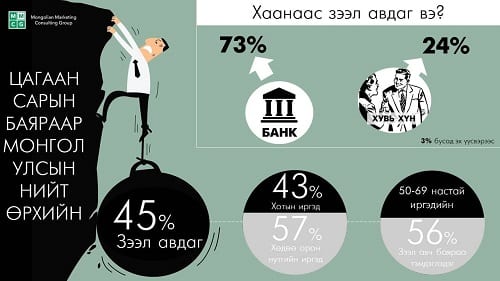
Loan for TS, 45% of total families take loans

45% of people take out loans for Tsagaan Sar. 73% obtain a loan from the bank, and 24% obtain a loan from individuals. Courtesy of Mongolian Marketing Consultancy Group.


One member of our research group was in charge of arranging Tsagaan Sar for her elderly grandmother, given that her mother and other older relatives were abroad during the holiday.  She was given a budget of 1 million tögrög ($490) to procure necessary food items and 100,000 tögrög ($49) broken into crisp, new 5,000 tögrög bills to give upon guests’ departure.

She was able to spend just under 1 million tögrög to purchase foodstuffs like meat, vegetables, pickles, eggs, mayonnaise, traditional dairy products, fruits, candies, ul boov (large foot-shaped cookies for an offering plate), wine, vodka, and juices.  She was able to save some money because she was directed to only serve ‘dal durvun undur’ – the long four ribs of sheep – on the table, instead of purchasing the expensive sheep back and fatty tail.  Many other people we talked with also remarked that they excluded this cut of the sheep, due to its expense.

Types of meat offering

Different types of meat offerings purchased for the holiday. 50% of households interviewed serve the fatty tail of the sheep, the most expensive cut.


Gift-giving

In terms of gifts, the researcher in charge of arranging her grandmother’s Tsagaan Sar prepared boxes of Merci-brand chocolates as well as candies, cough drops, and travel-sized lotions that her mother shipped to Mongolia from the United States.  For special guests, like the doctor treating her grandmother, she gave a bottle of high-end Mongolian vodka (Soyombo brand) and large boxed Merci chocolates.  Guests greeted her grandmother with brand new currency notes in the largest denominations.  In total, she received 150,000 tögrög ($73).

Another family associated with our research group, based in the countryside, roughly budgeted the amount of money they anticipated spending on gifts and food in preparation for Tsagaan Sar:

family budget

Anticipated Tsagaan Sar expenses for a household in rural Mongolia. Gifts make up a large part of the budget. Courtesy of G. Munkherdene.
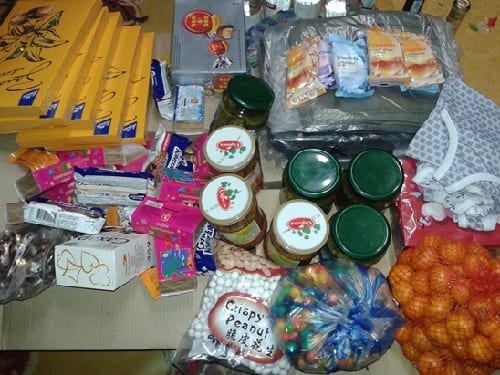
Gift prep

Tsagaan Sar preparations in rural Mongolia. Photo courtesy of G. Munkherdene.

Gift prep

Tsagaan Sar preparations in rural Mongolia. Photo courtesy of G. Munkherdene.
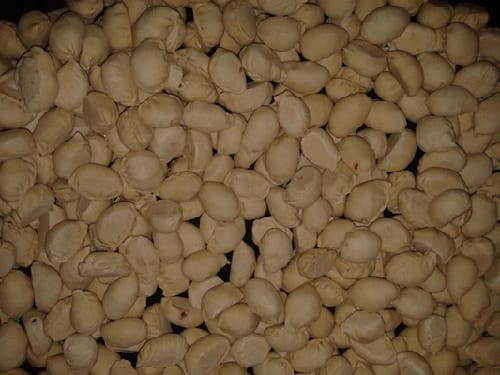
Gift prep

Tsagaan Sar preparations in rural Mongolia. Photo courtesy of G. Munkherdene.


A friend of Lauren’s, who participated in last year’s TSGI, shared that he is still most appreciative of the Mongolian-made gifts that he received.  In particular, he really liked receiving a shirt made by the Mongolian company, Oulen (see image below).  He was not particularly pleased, however, about receiving Russian-made gifts. One of the more interesting gifts that he received was a set of bowls made by the Russian-Mongolian ‘Ulaanbaatar Railway’ painted with socialist-era themed images.  He explained that the bowls used to be in many homes in Ulaanbaatar in the 1990s, thus they have a nostalgic appeal.

Like others we have spoken to, this man chose to visit fewer families than in past years, and also chose to only greet elderly people with money gifts.  According to his observations, other people appeared to be doing the same.


Gifts

Gifts received by a young man in Ulaanbaatar.  Photo courtesy of D. Javkaa.
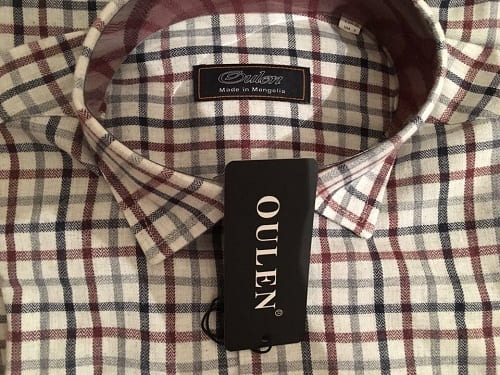
Gifts

Made in Mongolia shirt gift. Photo courtesy of D. Javkaa.

Gifts

Soviet-themed bowls. Photo courtesy of D. Javkaa.


Hedwig encountered further forms of strategizing to avoid paying for lavish gifts. For example, many younger people avoided visiting extended elder relatives in order to avoid having to give money. And while some found the cost of giving gifts straining, forms of conspicuous consumption were also prevalent. For example, while many said that they prefered gifts made-in-Mongolia, gifts from other countries were given as a form of status. One household that Hedwig visited, for instance, gave honey and tupperware and facemasks from South Korea, and another gifted British-made shampoo and shower gel. While made-in-Mongolia socks were prevalent gifts, many people commented that the gifts should be ‘useful’ (kheregtseetei / tokhiromjtoi), including objects like cup sets and gloves.

One research team member was surprised when she visited a well-to-do household serving non-traditional food offerings, such as egg-fried rice, fried mushrooms, and glass noodles with vegetables.  She found it to be a nice break from the traditional offering of Russian potato salad and dumplings.  When she left that household, she was given a gift bag of French-brand cosmetics, a luxurious gift that she heard other people received from wealthy families (other gifts of this nature include cashmere clothes and bed linens).
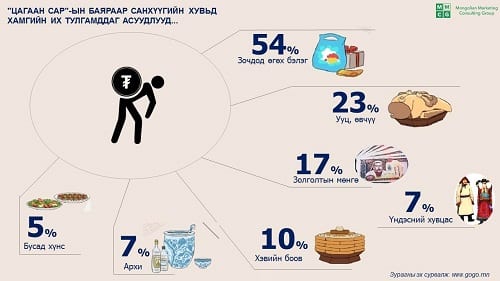
Most challenging tasks of TS

Most challenging expenses for Tsagaan Sar.  54% report gifts for guests, followed by the fatty tail of the sheep.  Courtesy of Mongolian Marketing Consultancy Group.
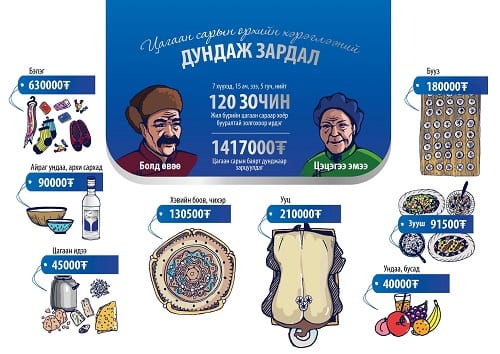
Average cost of Tsagaan Sar preparations

Average cost of Tsagaan Sar expenditures. Courtesy of Mongolian Marketing Consultancy Group.

Another of Lauren’s friends, a man 34 years of age in Ulaanbaatar who has a low salary in state-run office, multiple-side businesses, and a high mortgage that he can barely pay, reflected that he could not afford to visit many families this year and that many people are trying to take out bank loans to finance the situation. More ‘traditional’ forms of celebrating have been promoted, resulting in more conservative festivities, as a direct reflection of the economic downturn.

Indeed, the economic strain of this year’s celebration even prompted one man in Dalanzadgad, Omnogobi to write on their facebook profile: ‘Because of the financial crisis this year, [we will] make mantuun buuz for Tsagaan Sar.’  Unlike regular Tsagaan Sar dumplings, mantuun buuz are made with yeasted dough and usually contain less meat filling, thereby providing a less expensive way to fill-up the stomachs of guests.  While his comment was made in jest as a form of social critique, it suggests public concern about the affordability of the holiday in the current economic climate.
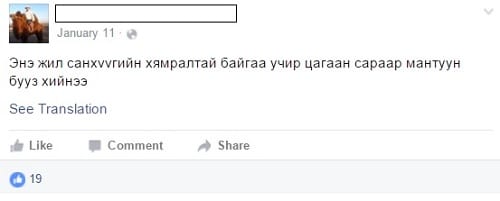
Mantuun buuz

‘Because of the financial crisis this year, [we will] make mantuun buuz for Tsagaan Sar.’


Comparisons to Past Years

One member of our research group heard from friends and family that this year’s Tsagaan Sar was particularly tiring for people, not just because of the economic situation. This year Tsagaan Sar fell on a Tuesday, meaning that people ended up taking almost the entire week off from work.  This meant that Tsagaan Sar lasted not just three days, as typical, but six days (Tuesday-Sunday).  For the first time, some families ‘ran out of buuz’ because they had so many visitors, and had to make trips to the shops to restock food items to offer guests, like juice and soda.

Many spoke of the great financial burden of the holiday this year with one friend from Hovd exclaiming, just after Tsagaan Sar:

‘We celebrated the Lunar New Year and worshipped well. No one had adequate cash to buy the things that were needed, so we got items through a bank loan, and through credit from stores.’

Tsagaan Sar seems to be a big financial burden for the elderly. The older you get the more people you receive to your home. The more prestige you are granted, the more of a financial burden you have to shoulder.

The kinds of gifts a family gives are also indicative of its economic standing and networks, and the kinds of gifts you are given indicate your closeness or distance to a particular family member.

The fact that some families can afford to engage in these displays of wealth while others cannot is well-recognized and perhaps epitomized in the phrase: ‘if you are rich in something, offer it to others’ (yougaar bayan tüügeeree dail).  Perhaps this holiday was as much about displaying wealth as it was about distributing wealth and sharing resources across generations and groups of friends.


[1] For other statistics and excellent diagrams, see the Mongolian Marketing & Consulting group and their facebook site.
 

Internalizing External Debt

By Lauren Bonilla, on 24 February 2016

This is the final blog post in our series about loans and debt.


“Did you read the news about Oyu Tolgoi?”, asked Ganzorig between sips of green tea.  Assuming that his question referred to the news announced the previous day that the Mongolian government signed a major financing agreement to begin development of the underground section of the Oyu Tolgoi copper-gold deposit in Omnogobi province, I replied, “Yes, it’s big news for Mongolia.”

Ganzorig exhaled sharply and shook his head, remarking in a dispirited tone, “It’s not so good for us.”  His negative response took me by surprise.  In the twelve years Ganzorig and I have been friends, he has had a consistently optimistic attitude towards Oyu Tolgoi and its contribution to his country’s development.  When I asked Ganzorig why the deal was not good, he clarified his sentiments:

It’s another loan.  It’s like 4 billion American dollars, right?  How can we repay this?  Uh, there are too many loans!

Later that day, I met with a former colleague working in the tourism industry who, like Ganzorig, brought up the news about Oyu Tolgoi and was quick to criticize it.  She lamented, “My country will pay more for loans than become rich from Oyu Tolgoi!”

These were offhand comments made by friends in casual conversations, yet I think they reveal something significant that is forming in the minds of many Mongolians around the rising indebtedness of their country.

A New Debt Landscape

In 2011 and 2012, when I conducted research on the growth of the mining industry, I heard little public discussion about debt and loans in relation to the mining industry and the national economy more broadly.  Of course, mining companies at the time were engaged in a wide range of official and unofficial lending practices to finance operations, and there were important discussions between companies (both foreign and domestic) and the government about who should bear the responsibility of financing mining projects and ancillary infrastructures.[1]  However, in interviews with a number of diverse Mongolians living in different regions of the country, I found that people were more interested in the then hot-topic of national equity ownership in mining projects like Oyu Tolgoi than about the loans required to make such projects possible.

When I returned to Mongolia in the fall, I observed how discussion about national-level debts filled evening news programs, came up in crowded jeep rides across the countryside, and figured into intimate conversations among family and friends.  Far from being an abstract issue for government and economic policy, ‘foreign debt’ (gadaad ör) and ‘national/state debt’ (ulsyn/töriin ör) appears to be becoming internalized in people’s lives as a new economic reality and a subject of collective concern.[2]

The Chinggis Bond Effect

Rising public awareness of national-level debts reveals how Mongolia’s relationship with debt has changed in recent years.  In 2012, the Mongolian government acquired its first sovereign bond, nicknamed the ‘Chinggis Bond’.  Sold as a five- and ten-year bond, it garnered US$1.5 billion, far more than was initially anticipated.  A year later, the Development Bank of Mongolia issued a ¥30 billion 10-year ‘Samurai Bond’ in Japan.  The word ‘bond’ has since become normalized in colloquial Mongolian, referring specifically to a loan financed by investors on international markets.  More generally, and perhaps significantly, bond is also used to refer to debt that Mongolia, as a nation, owes to foreigners.

The debts raised by the two sovereign bonds are small in comparison to the national debts of other nations – a point Mongolian politicians and economists commonly make.  Their significance, though, is compounded by other external debts acquired by the government and companies, especially miners.  The timing of this debt accumulation is significant, as it has occurred not in a period of growth but amid the slowdown of the Chinese economy and the global commodity cycle, two interrelated dynamics to which Mongolia is exceptionally exposed.  According to a report published in November by Fitch, Mongolia now has the second highest external debt to GDP ratio in the world at 129.8%, representing some $22 billion.[3]

Personal as National Debt

This amount of debt could feel distant to an individual, like how, as an American, the US national debt of $16.3 trillion feels to me.  However, I think that many Mongolians can relate to this debt because it reflects the indebtedness they feel in their own life, albeit on a much larger scale.

When Ganzorig expressed to me that there are “too many loans,” he was directly commenting on the large amount of foreign debt his country was accumulating.  Knowing Ganzorig well, I could also hear the words reflecting his frustration with living a life where he is constantly swapping one loan for the next, slowly building more and more debts in the process.

Ganzorig struggles to operate a small electrical business in Ulaanbaatar, often relying on small loans, barter, and gifts from friends to get projects done.  He could not get a business loan from a bank because he had no office property to serve as collateral.  He could not acquire an office because he is already plagued with stress and sleepless nights about how to pay a hefty monthly mortgage on an apartment he bought a couple years ago through the 8% mortgage scheme.  Additionally, following the government’s adoption of a new tax law last August to get tax revenues from businesses, Ganzorig has been under pressure to pay taxes he did not know he owed to a local municipality.

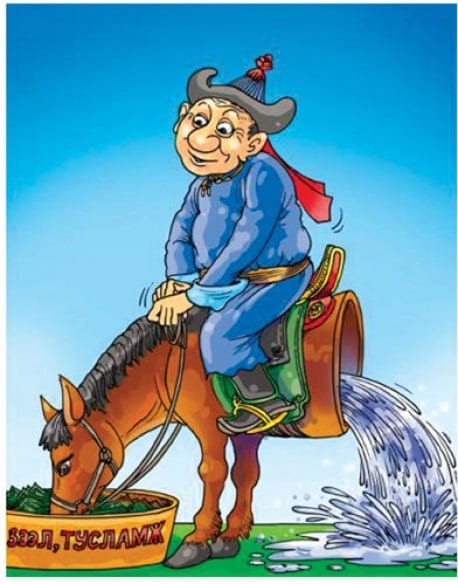
He described to me how any money coming to him feels like it goes “undigested” (shingeegüi): it runs right through him like his stomach was upset, thereby providing him no nutritional gain.  Any “profit” (ashig) goes “to the bank” through interest payments, allowing a small group of elites to “keep money in their pockets.”[4]

Moreover, for someone like Ganzorig whose everyday life is already shaped by chains of debt, national debt might feel like yet another link that weighs the chain down.  Yet it is a link that is not necessarily of one’s choosing, given that debt like the Chinggis Bond is classified as ‘public property‘ (ard tümnii ömch) to be repaid through taxes and the state budget.

Undigested Debt

Given the public ownership of bond monies, how the monies have been spent since 2012 has been a topic of controversy.  Originally, the bonds were meant to finance national development projects, like the construction of roads and bridges, the building of factories, the improvement in energy and electrical infrastructures, and the financing of small enterprises.  The government stated that it planned to use the Chinggis Bond to fund 888 projects, a number that my research partner, G. Munkherdene, explained to me, “Was chosen because of its spiritual importance…it was seen as lucky.”

Rumors and conspiracy theories abound about how the allocation of bond monies was based on political and business alliances and secret deals instead of transparent and egalitarian tender processes.  Indeed, when the majority of politicians are also involved in private businesses – a phenomenon Bum-Ochir Dulam explored in his post on the mortgage market – any government-backed economic project appears suspicious.

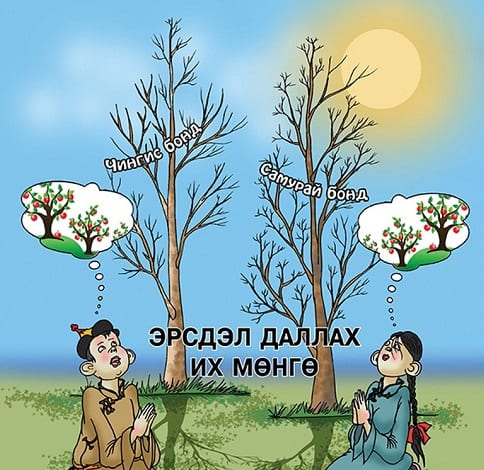
Bonds

‘Big Money Carries Big Risk’ (Ersdel Dallah Ih Möngö). The barren trees represent the Chinggis (left) and Samurai (right) bonds.  Source: www.mongolianeconomy.mn.


In Ulaanbaatar, my friends point out features of the urban landscape that they associate with the bonds: smiling faces painted on sewer covers, empty apartment buildings, new roads and bridges, and pedestrian cross walks.  In rural western Mongolia, people also pointed out similar new features in their district center that they thought were built with government-backed ‘projects’ (tösöl) funded by the Chinggis bond.  While these improvements seemed welcomed, people wondered about where the rest of the bond monies have disappeared and why long-term things that would make Mongolia more productive in the future (heregtei yum) – like better hospitals and schools, and more domestic industry and jobs – have not been developed.  A smiling face on a sewer cover does little to help someone pay their own debts, let alone the nation’s.

Undigested capital

A horse eats loan (zeel) and aid (tuslamj) money from a bowl, which goes undigested. Source: http://gereg.mn/news/9059/


#Hyamral #Hyamdral #Hyatad’

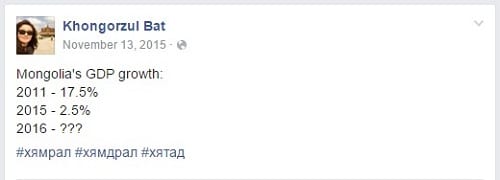
In November, Khongorzul Bat-Ireedui, a rising public figure in Mongolia, posted the following message to her many followers on Facebook and Twitter:

GDP

2016 GDP expectations: #Crisis #Discount #China (#Hyamral #Hyamdral #Hyatad). Source: www.facebook.com/khongorzul.batireedui https://twitter.com/khongorzulb


The message about GDP growth and the clever alliteration of words at the bottom, which can be translated as #crisis #sale #China, reflects the kind of grim expectations Mongolians have for 2016.

The IMF/World Bank warns that Mongolia is at risk of ‘debt distress’ because of its mounting external debts, declining foreign investment and revenues from mining, and looming debt repayments.  In 2017, $500 million from the Chinggis bond and a $580 million government-guaranteed bond through the Development Bank of Mongolia are owed to creditors. US$2.4 billion from a three-year currency swap with the People’s Bank of China is also due, though this is anticipated to be extended into the future.[5]  Given the widely discussed lack of liquidity in Mongolia, how these debt are to be repaid is contested and uncertain (see here and here).

Since Ch. Saihanbileg became Prime Minister in November 2014, the government has declared that there is now an ‘economic crisis’ (ediin zasgiin hyamral) in Mongolia that must be managed.  ‘Debt distress’ is part of the crisis, but there are also wider economic challenges that Mongolians are feeling in very tangible ways.  The value of the Mongolian tögrög is regularly hitting new historic lows, herders are selling animal meat and skins at the worst prices in memory, salaries have been cut or suspended across a number of sectors, and people have lost jobs amid the retreat of foreign investors.  If you get into a taxi cab in Ulaanbaatar and ask the driver about the economy – he or she will very likely describe it to you as hyamral, a crisis.

It seems, too, that the language of crisis has as much to do with future expectations as about the current condition.  Khongorzul may be suggesting this by flagging the words “discount” and “China”, given that there is widespread anticipation – and outright fear – that the Mongolian government will address its debt distress by giving away its mineral wealth to China for little or nothing in return for financial assistance.

National ‘Bonding’

These dynamics paint quite a negative picture for 2016.  Mongolian astrologers are calling this new lunar year of the fire monkey ‘evil faced’ (muu nüürt or nüür muut) because it is expected to bring low precipitation and poor forage for livestock, and an increase in political struggles and poverty, among other things.  The upcoming parliamentary election this summer also adds weight to the year, as election seasons are often times when much happens and is promised.

It will be important to watch how Mongolian politicians address the issue of debt this year.  There are some individuals who seek to make the looming debt repayments seem less severe and manageable, whereas others seek to increase public awareness about their size and significance.  Either way, it is a highly politicized field.

Moreover, how ordinary Mongolians negotiate national debt is perhaps an even more interesting question.  As my colleague, Bum-Ochir Dulam, put it while we chatted about this topic in our office at UCL:

We [Mongolians] are all socially bonded by the Chinggis Bond.  I have debt, our nation has debt, we all have debt.

It is not only that so many Mongolians carry personal debts, but that individuals feel that they share in the responsibility of repaying national debts.  This responsibility may take the form of austerity measures, like increased taxation, budget cuts, and job losses.  Or it may be more direct, such as the government calculating the amount of national debt to be allocated to every Mongolian, even newborn children – a scheme that is reputedly underway.  Mongolians are also concerned that they will be implicated in governmental actions that  they personally oppose and which might affect the fortune and future of their nation.  For instance, subsoil wealth, like the gold deposits near Noyon Uul, may be extracted not for development purposes, but to pay off debts to foreigners.

A Space for New Citizen Politics?

Our blog series has documented the pervasiveness of loans and debt in Mongolia.  While lending practices and debts are not necessarily seen as negative, and can even help build new forms of sociality and economic possibility, the cumulative impact of personal, business, and national debts is uncertain.

As seen in other places where rising national and personal debts have become touchstone issues, debt can be a galvanizing societal force that can lead to popular uprisings, movements, and regime changes.  In Mongolia, where the government has never had to be dependent on nor be accountable to citizens through public taxation, given its access to other revenue streams, the shared experience of being ‘collective owners’ of national debt may open the space for new forms of citizen politics.  Mongolians may question their entanglement in their nation’s debts – which they never asked for in the first place – and why they and perhaps future generations should bear the debt burden.

Conversations about debt with my research partners, Sh. Tuya and G. Munkherdene, contributed to this post.  


[1] Domestic and foreign companies commonly viewed the government as seeking to bear as little debt as possible.

[2] ‘Foreign debt’ and ‘national/state debt’ are sometimes used interchangeably in Mongolia.  Foreign debt can include both public and private debts obtained abroad.  National/state debt refers to monies which the government has borrowed (which, in the case of Mongolia, is primarily sourced abroad).  When the government borrows money externally through a bond, the debt is known as sovereign debt.  For simplicity and to reflect how Mongolians themselves commonly talk about national-level debts, I use ‘national debt’ in this blog post.

[3] It is difficult to find consistent figures of Mongolia’s total external debt.  Different entities in Mongolia like the Ministry of Finance, researchers, politicians, and the IMF/World Bank classify national debt using different metrics.  For instance, some calculate currency swaps as part of state debt, whereas others do not.  Mongolia revised its Debt Management Plan in 2015 in an attempt to clarify the issue.

[4] Someone who “keeps money in their pocket” is often seen in a negative light as ‘stingy’ (haramch).  Someone who redistributes personal monies through loans or gifts to friends and relatives is a characteristic of a ‘good person’ (sain hün).

[5] Data on the amount of this currency swap varies.  In a parliamentary meeting, the value was put at $1.9 billion.