X Close

Institute of Education Blog

Home

Expert opinion from IOE, UCL's Faculty of Education and Society

Menu

Archive for the 'Teacher education' Category

Creating a Decolonised and Liberated Curriculum Self-Assessment Tool (DeLCSAT)

By IOE Blog Editor, on 27 January 2026

Student with her phone sitting in the UCL Library.

Credit: Sam Robinson for UCL

27 January 2025

By Gideon Sappor and Eirini Gkouskou

This blog is dedicated to Richard Harrison, who was co-chair of the IOE Department of Leadership and Learning’s decolonising and liberating the curriculum working group, until his untimely death in the spring of 2025.

In higher education, the call to decolonise and liberate the curriculum is not just a trend, it’s a transformative movement aimed at fostering equity, inclusion and critical engagement (Meda, 2020). This is borne out of the principles of fairness, equity and justice in relation to diversity that have long occupied a prominent position within social and political discourse in the UK and beyond, not least within higher education. This sustained engagement reflects an enduring societal aspiration to construct an equitable and inclusive order in which structural inequalities are dismantled and individual life chances are not predetermined by immutable characteristics such as race, socio‑economic background or place of birth (Sappor & Franks, 2025). (more…)

Teaching controversial issues in schools – challenges and opportunities

By IOE Blog Editor, on 20 November 2025

Students sitting at their desks taking exams. Credit: Cavan for Adobe via Adobe Stock.

Credit: Cavan for Adobe via Adobe Stock.

20 November 2025

By Carol Vincent

Brexit, migration and the Israel/Palestine conflict are just three issues that have saturated public debate and generated polarised reactions in recent times. Meanwhile, young people in particular are increasingly receiving their news through social media (Internet Matters 2025), and research suggests that, although the relationship is complex, social media does play a role in aggravating ‘destructive’ polarisation (Esau et al 2024). (more…)

The urgent task of improving the working lives of teachers

By IOE Blog Editor, on 4 November 2025

Teacher leaning over to check on a student as they write at their desk.

Credit: WavebreakMediaMicro via Adobe Stock.

4 November 2025

By Mary Bousted, Honorary Professor, UCL

October saw the launch in the House of Lords of the Teaching Commission’s report Shaping the Future of Education. I presented the Commission’s analysis on the state of the teaching profession and proposals to improve the profession’s standing.

The teacher and leader members of the Commission, working alongside policy and research professionals brought the reality of the challenges facing teachers and school leaders into strong contact with the research evidence in a way that is highly illuminating and powerful. The report is the most comprehensive source of evidence on the state of the profession available. (more…)

A decolonised curriculum: principles and values

By IOE Blog Editor, on 28 January 2025

Back of students sitting on black chairs in classroom.

Credit: Sam Balye via Unsplash.

28 January 2025

By Sandra Leaton-Gray and David Scott, with Rita Chawla-Duggan, University of Bath

In many higher education institutions, best practice principles for curriculum design frequently reflect a model that perpetuates colonial assumptions about knowledge, learning, and assessment. These principles, ranging from “cutting-edge content” to “optimised engagement”, prioritise well-recognised measurable benchmarks and notions of corporate efficiency while failing to interrogate the power structures embedded in curricula. A decolonised curriculum, on the other hand, challenges these assumptions and offers a transformative approach to education. In this blog post we analyse what that means and how it might best be achieved, drawing on learning from other, interconnected parts of the education system. (more…)

Teacher education, research and practice: addressing the recruitment and retention crisis through the reassertion of professional judgement

By Blog Editor, IOE Digital, on 9 July 2024

Female teacher with a white bob haircut leans against a primary school classroom desk. Credit: Hero Images / Adobe Stock

Credit: Hero Images / Adobe Stock.

9 July 2024

By John Yandell

This commentary is adapted from John’s contribution to the ESRC Education Research Programme event, ‘Education after the election: Priorities for change’, which you can watch back, along with commentaries from speakers covering early years, schools, skills and higher education.

There is a crisis in teacher recruitment and retention in England. This is a long-term problem and there is no sign of it abating, or of any of the measures taken by the last government having had a long-term, meaningful impact in addressing it. In the current year, there is a significant projected under-recruitment of teachers in the primary sector and in the majority of secondary subject areas. Meanwhile, teacher attrition rates have risen back up to pre-pandemic levels. And there is worrying evidence that teaching has become less attractive because it conspicuously lacks the flexible working patterns that are available to graduates in most comparable jobs. (more…)

More young people are interested in teaching than we might think: we need action on both recruitment and diversification

By Blog Editor, IOE Digital, on 20 December 2023

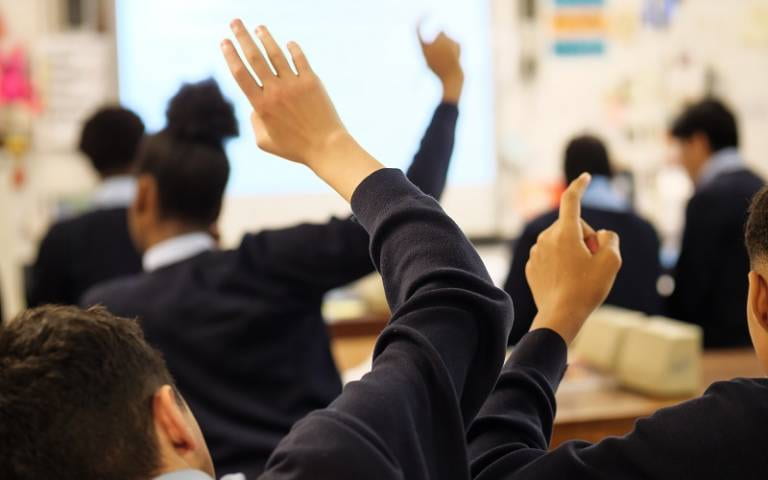
Secondary school students in dark blue uniform jumpers holding up hands in class.20 December 2023

By Emily MacLeod

Earlier this month, the Department for Education (DfE) posted its 2023/24 Initial Teacher Training Census, revealing that only half the required secondary postgraduate teachers needed were recruited into teacher education in the last year. This marks the tenth time in the last eleven years that England’s overall new teacher recruitment targets have been missed. These dire statistics on recruitment have made headlines and call into question the effectiveness of policies to address this problem.

So, do people really not want to become teachers? My doctoral research indicates that it’s not all doom and gloom. I found that many more young people are more open to pursuing teaching than is indicated in teacher recruitment data. However, as for the profile of the existing teacher workforce, those who think they might want to teach most often identify as White and as women. With this in mind, it seems that recruitment efforts should not only focus on increasing the number of teachers, but more work must be done to make teaching attractive and accessible to those who are underrepresented in the current workforce. (more…)

The climate crisis needs a whole-school approach, starting with teacher access to professional development

By Blog Editor, IOE Digital, on 13 July 2023

Female teacher points out to pupils outdoors

Credit: Hero Images / Adobe Stock

13 July 2023

By Kate Greer and Alison Kitson 

A new survey of teachers in England has found limited coverage of climate change and sustainability in both initial teacher education and continuing teacher professional development – and provides the impetus for change.

These findings, from UCL’s Centre for Climate Change and Sustainability Education (CCCSE) are set out in a new report, Teaching climate change and sustainability: A survey of teachers in England. Covering teachers’ practice, professional development and priorities for support, the findings will be of interest to teachers, teacher educators and organizations that support teachers to contribute to society’s transformation to sustainability, as well as to schools as they develop and implement climate change action plans. The findings are also informing CCCSE’s suite of free professional development resources – Teaching for Sustainable Futures – which are being designed for teachers of all subjects and age-phases.  The Geography and History modules, for primary and secondary teachers in each case, are ready to access now (see the joining instructions on CCCSE’s website). The next set of modules – English and mathematics – will be available in 2024. (more…)

The challenges of moving on from ‘teaching-as-telling’ (in higher education) – and some steps that can help convert new ideas into new practices

By Blog Editor, IOE Digital, on 15 June 2023

Lecturer moving in front of a university workshop class

Credit: Mat Wright for UCL IOE

15 June 2023

By Gwyneth Hughes

Even the most experienced teachers can struggle to innovate their teaching practice. But how well are we serving these tutors in realising that end point? My research highlighted the value of explicitly scaffolding teachers’ reflection on their practice with theories of teacher development and learners and learning – to support their development as teachers but also keep expectations in check and motivating.

There is an increased expectation that teachers in further and higher education should be trained in teaching, learning and assessment. The most common route to this end is a one-year Postgraduate Certificate in Higher Education programme. In general, there is evidence of broad benefit from such programmes, but their contribution to developing the teacher’s conception of teaching/learning such that it supports parallel changes to their actual teaching practice is not so well-established.

(more…)

The workforce crisis in schools: evidence isn’t enough

By Blog Editor, IOE Digital, on 3 April 2023

Teachers carrying NEU flags and placards reading "A wet paper and towel won't fix it"; "I don't want to be the next extinct species".

NEU demonstration in Norwich, February 2023. Credit: Roger Blackwell via Flickr (CC BY-NC 2.0).

3 April 2023

By Sal Riordan

Teachers are in the news, striking for better pay and working conditions. Whatever you think about the rights or wrongs of that—at the start of the action a slim majority of Brits supported it — it’s hard to ignore the country’s teacher workforce crisis. National Education Union (NEU) members have just rejected the government’s pay offer, triggering two further days of strikes. (more…)

IOE at 120: the mission to transform education and society continues, 2012–22 and into the future

By Blog Editor, IOE Digital, on 8 December 2022

8 December 2022

By Emma Wisby

This is the last in a series of 12 blogs exploring each decade in IOE’s history in the context of the education and society of the times. Find out more about our 120th anniversary celebrations on our website, and follow us on TwitterInstagramFacebook and LinkedIn to keep up with everything that’s happening.

It is important for an organization to have a sense of its history, to take opportunities to reflect on that journey as well as celebrate its contributions and achievements. That is what we have been doing this year at IOE, as it marks its 120th anniversary. It has been an opportunity to recognize the many individuals and organizations that have been a vital part of IOE’s impact. Central to this has been the IOE at 120 blog series, which in this piece we draw together and bring to the present day.

As the series has conveyed, organizationally IOE has taken many different forms:

  • from elementary teacher training college for London with just 58 students,
  • to the Area Training Organization for London, overseeing some 30 teacher education colleges,
  • and back to a single entity; from one of England’s esteemed ‘mono-technics’ or ‘specialist institutions’, alongside the likes of the London School of Hygiene and Tropical Medicine and Royal College of Art,
  • to a world-leading faculty within UCL.

In parallel, we see IOE’s influence on the field of education studies and then, over more recent decades, related areas of social science and the arts (more…)