X Close

UCL Culture Blog

Home

News and musings from the UCL Culture team

Menu

Archive for the 'Grant Museum of Zoology' Category

Look, draw, scan, invert, colour in. REPEAT.

By Jack Ashby, on 9 December 2015

This is a guest post from our artist in residence Eleanor Morgan. It is part of a series exploring the exhibition Glass Delusions at the Grant Museum of  Zoology.
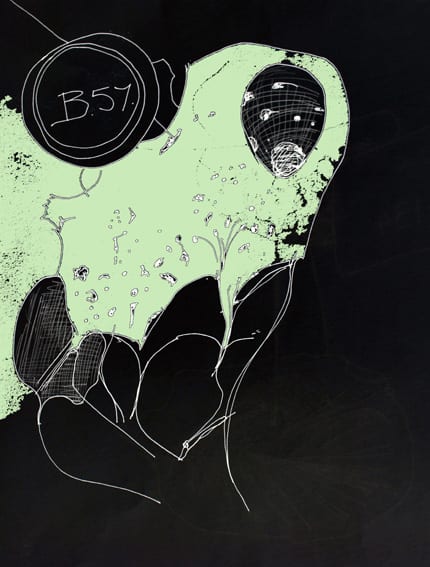
Sketch 3 (C) Eleanor Morgan

Sketch 3 (C) Eleanor Morgan

I have a pile of drawings and sketches of sponge specimens made during my residency at the Grant Museum, which aren’t exhibited in the Glass Delusions exhibition. Looking closely and following the lines of these animals with my eyes and hand was a way of getting to know them, particularly as I couldn’t touch them directly. They were also a way of thinking, of letting forms and ideas develop between the specimens and me. (more…)
Specimen of the Week 217: annotated green turtle half-skull

By ucwepwv, on 7 December 2015

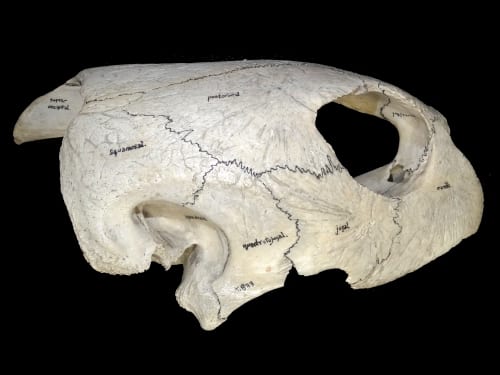
This week I’ve picked a specimen to talk about that is being used in comparative zoology practicals at the moment. I chose it because it has been helpfully labelled to show each of the bones which fit together to form the remarkable piece of biological architecture that is the skull. So this week’s Specimen of the Week is…

LDUCZ-X833 annotated green turtle skull

LDUCZ-X833 annotated green turtle skull

(more…)

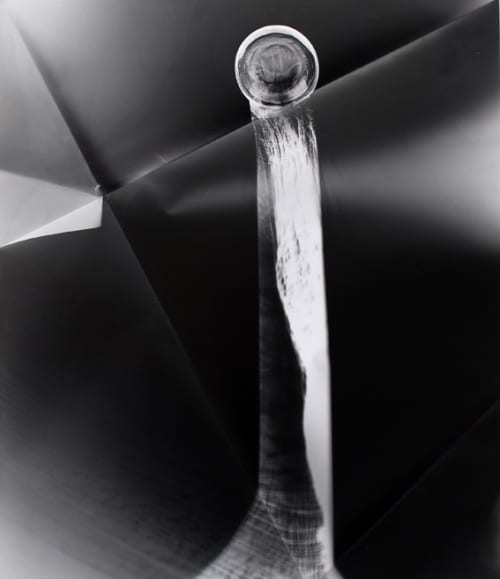
Letting things draw themselves

By Jack Ashby, on 4 December 2015

This is a guest post from our artist in residence Eleanor Morgan. It is part of a series exploring the exhibition Glass Delusions at the Grant Museum of  Zoology.

Emerging #5, Photogram, 2015 (C) Eleanor Morgan

Emerging #5, Photogram, 2015
(C) Eleanor Morgan

During my artist’s residency at the Grant Museum I wanted to record the way light travels through the glass jars and specimens that fill the space. My first thought was to try cyanotypes. This is a type of contact print in which an object is place on paper and exposed to light. Where the light hits, the resulting image is a deep blue colour. The astronomer John Herschel developed cyanotypes in the nineteenth century for creating blueprints of diagrams and notes, but it is the cyanotypes of his contemporary Anna Atkins that are particularly celebrated. By placing seaweeds and ferns on prepared paper, Atkins’ cyanotypes are beautifully detailed and create a sculptural effect on the paper.

(more…)

When your head is made of glass

By Jack Ashby, on 2 December 2015

This is a guest post from our artist in residence Eleanor Morgan. It is part of a series exploring the exhibition Glass Delusions at the Grant Museum of  Zoology.

The sponge man, 2015. Print on Ilford Galerie FB digital, mounted on MDF. (C) Eleanor Morgan

The sponge man, 2015. Print on Ilford Galerie FB digital, mounted on MDF.
(C) Eleanor Morgan

My current exhibition ‘Glass Delusions’ is about things transformed from living to non-living materials and back again. One of the ideas that particularly interested me was the history of humans believing that they were made of glass, a disorder known as the ‘glass delusion’ that I describe in a previous blog post. Those suffering from glass delusion believed that their heads were made of glass and could shatter at the slightest touch.

In the exhibition are various heads, glassy or shattered. On one wall is an antique fragment of leaded glass of a figure bending down. His hand is outstretched and he seems to stroke at the ground beneath his feet. The stained glass panel where his head should be is missing, only the lead outline remains. (more…)

Underwhelming Fossil Fish of the Month: November 2015

By Mark Carnall, on 30 November 2015

The sound of mince pies is in the air. People with awful moustaches are getting a free pass this month. This can mean one of only two things. Either the annual conference of British Pie Awards and The Handlebar Club have booked the same conference venue* or it’s November. Delete as appropriate. What this may mean is that it isn’t October anymore, so it’s time to welcome you to another underwhelming fossil fish of the month, our monthly foray into the world of uninspiring fossil fish. UK museums have thousands if not hundreds of thousands of fossil fish in their collections and they get a hard time. They aren’t used in exhibitions, they don’t feature on lunchboxes, they aren’t the subject of Hollywood films.

Well, normally that is. This month, due to a mix up at the email sorting office, I’ve been wired a rather interesting and semi-famous fossil fish. You’ll probably instantly recognise it from the photo below. It’s going to be hard to play this one down, this one has been featured on stamps. I know, I’m going to get letters for highering standards. (more…)

Specimen of the Week 216: European Plaice

By Dean W Veall, on 30 November 2015

Hello dear Specimen of the Week readers, Dean Veall here. This week I shall be bringing you a very fishy (again) Specimen of the Week, how can I possibly top the three toothed pufferfish you may be asking yourself? Well, I believe I have for two very good reasons. Firstly the fish I have chosen is one of the asymmetrical marvels of the natural world. Secondly, has one of the most curmudgeonly comical faces of all animals (I challenge you to find me an animal that beats this specimen). And finally, has recently featured in the events that have accompained our Glass Delusions exhibition. This week’s Specimen of the Week is…..

(more…)

Specimen of the week 215: the sparrowhawk taxidermy

By Will J Richard, on 23 November 2015

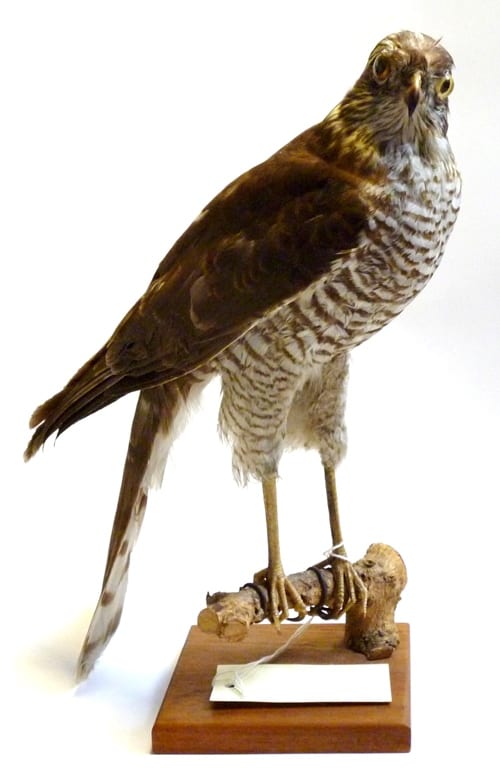
Hello zoo-fans. Will Richard here, throwing words at the page to bring you this specimen of the week. And what a specimen I’ve chosen. Graceful, elegant, deadly and now stuffed. Slightly wonkily. Case 17’s finest…

LDUCZ-Y1549 female sparrowhawk taxidermy

LDUCZ-Y1549 female sparrowhawk taxidermy

(more…)

Specimen of Week 214: Fossil Vertebrae

By Tannis Davidson, on 16 November 2015

LDUCZ-X1111 Dimetrodon vertebrae

LDUCZ-X1111 Dimetrodon sp.vertebrae

In the spotlight this week is a specimen that is currently experiencing it’s ‘busy season’. The Grant Museum collection is widely used in teaching at UCL and the Museum is home to many specimen-based practicals. For example, during term 1 in 2014, there were 34 practicals using over 600 specimens by 1400 students.

Amidst this flurry of activity, certain specimens catch the eye. Is it that they are finally freed from the safe-keeping of their fossil drawers and have their moment to shine? Could it be that they are used over and over and over again to illustrate a turning point in evolution so critical that repeat viewings are essential? Or is it that the specimen is quite simply, an attractive object in itself, perhaps a worthy contestant in a specimen beauty contest?

This week’s Specimen of the Week is… (more…)

Specimen of the Week 213: The Enigmatic Gibbon

By tcrnrh1, on 9 November 2015

Hello Grant Museum blog readers and zoology enthusiasts, it’s Rachel Bray here. You may be wondering who I am, unless you saw a Specimen of the Week blog by me back in May when I temporarily joined the Museum for my MA placement. I am very lucky to be back at the Grant until Christmas to work with the Museum’s wonderful learning and events programme. As part of my return I’m pleased to be getting back into the Specimen of the Week swing of things by researching this week’s candidate which is…

Photograph of the grey gibbon specimen

LDUCZ-Z475 Hylobates sp.

(more…)

Hello! I’m the new Grant Museum Curator

By ucwepwv, on 6 November 2015

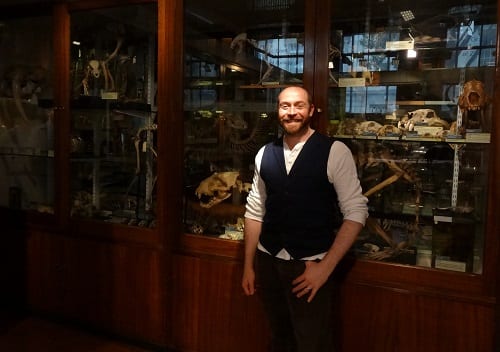
My name is Paolo Viscardi and I’m the new Curator of the Grant Museum of Zoology at UCL.

PV_Case19

I have a background in biomechanics and comparative anatomy, with a particular fondness for bones, which I’ve been writing about since July 2009 on my personal blog Zygoma. In my spare time I am Chair of the Natural Sciences Collections Association (NatSCA) and I run the science communication event Science in the Pub (or PubSci for short). My passion for communicating science also keeps me busy giving talks and getting involved in all sorts of events and performances, from immersive theatre to providing a scientist’s response to art. (more…)