Specimen of the Week 233: The mouse-deer skeleton
By Will J Richard, on 1 April 2016
Hello Grant-fans! Will Richard again, taking my turn to bring you specimen of the week. Here goes…
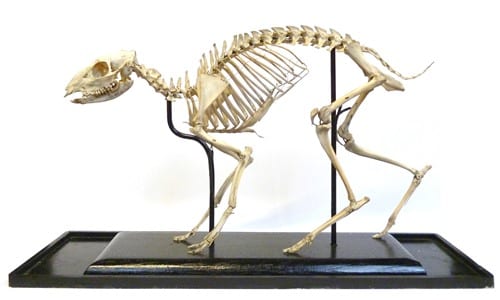
LDUCZ-Z523 mouse-deer skeleton
 Close
Close
News and musings from the UCL Culture team

By Will J Richard, on 1 April 2016
Hello Grant-fans! Will Richard again, taking my turn to bring you specimen of the week. Here goes…
LDUCZ-Z523 mouse-deer skeleton
By Tannis Davidson, on 25 March 2016
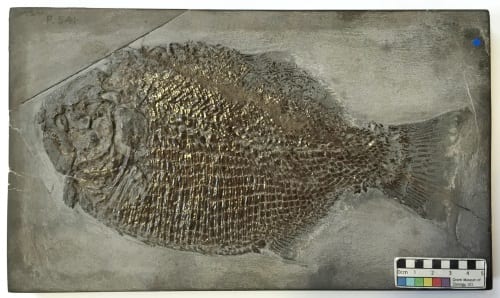
LDUCZ-V610a Dapedium pholidotum
There are quite a few posts on this blog regarding not-so-lovely fossil fish, which might possibly lead one to believe that the Grant Museum’s collection does not include fossil fish specimens of outstanding beauty. This is, however, definitely not the case. The Museum has many finely detailed, historically interesting, painstakingly prepared fossil fish – specimens that would, in fact, be described as anything but underwhelming.
This week’s Specimen of the Week is …
By Jack Ashby, on 22 March 2016
There is an underlying struggle in museum displays to fulfil two sets of needs. They have to do both to be successful:
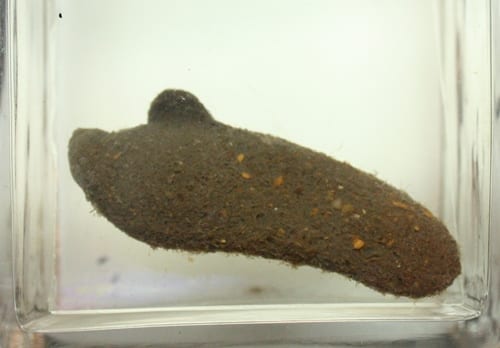
Too boring-looking to display? LDUCZ-T11
The struggle comes when a display meets one of these needs but not the other. This issue is the same in the worlds of politics and media – do we tell the people what they want to hear, or do we tell them what we want them to know?*
In natural history museums, we know that people like big animals, for example. Dinosaurs meet both needs above – people want to see them, and museums want to engage people in stories about them. (more…)
By tcrnrh1, on 18 March 2016
In case you haven’t heard, it’s UCL BAT WEEK! So it seems appropriate that this week’s Specimen of the Week is a small nocturnal friend of ours… the common pipistrelle (Pipistrellus pipistrellus).

POW! It’s not the famous crimefighter this time, it’s the common pipistrelle. LDUCZ-Z2603 Pipistrellus pipistrellus
By Jack Ashby, on 15 March 2016
Happy birthday to ewe
Guppy birthday to ewe
Guppy bird-jay deer Grant Museum
Guppy bird-jay shrew ewe.
On the 15th March 2011 the Grant Museum 2.0* opened its doors to a new era. It was the day we begun our lives in our current home on the corner of Gower and University Streets. Permit me to be a little sentimental, but it was the start of something wonderful. It’s been an amazing five years in which our little museum has really grown in stature to be a significant part of London’s cultural offer. Here’s what’s happened over the last year, which I think it’s fair to say has been our best ever! (more…)
By Jack Ashby, on 11 March 2016
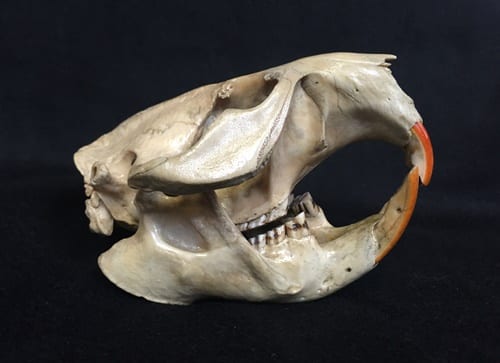
North American beaver skull. LDUCZ-Z2731
It is purely coincidence that Specimen of the Week 230 – the number most associated with going to the dentist [tooth hurty. Apologies.] – is an animal famous for the incredible feats of its teeth.
Beavers can cut down huge trees, owing to the superb adaptations of their skulls.
As members of the squirrel-like rodent group Sciuromorpha, beavers have massive, ever-growing, self-sharpening front teeth. Rodent incisors are often differently coloured on the front and back. The orange substance on the front side is super hard enamel, while the back is unusually exposed dentine (a softer material which fills the inside in most teeth). When rodents bite on hard material, or even by biting their top teeth against their bottom teeth, the dentine erodes away at a faster rate than the enamel, essentially sharping the “blade”. (more…)
By ucwepwv, on 4 March 2016
It’s time for my turn to do the new and streamlined Specimen of the Week – and this time I’m pleased to bring you something on an underwhelming par with certain fossil fish that regularly feature on the blog.

LDUCZ-X1077 Coprolite
In fact, it could be argued that this specimen is so underwhelming that it’s crap… literally. That’s right, I bring you… (more…)
By Jack Ashby, on 2 March 2016
The other day, two skulls were next to each other on the trolley – a capybara and a hyena. One is the world’s largest rodent, from the wetlands of South America, the other is a large carnivore from Sub-Saharan Africa, and as such are not often found together in museums.

Capybara and spotted hyena skulls, which are surprisingly the same size. (LDUCZ-Z180 and LDUCZ-Z2589)
I was amazed that they were the same size. This inspired me to find other bits of animals that are surprisingly the same size… (more…)
By Mark Carnall, on 26 February 2016
February 2016 won’t be remembered as the beginning of the end because nobody will be here to remember it. The plankton are a-shuffling, the seabirds are a-vanishing, the seas, they are arising and the Arctic is a-heating. Was it this bad growing up? It is getting worse and worse. Did we pass the point of no return already? Are we already in the Age of Stupid? Did our children volunteer for this? Can you honestly kiss them goodnight knowing that they’ll grow up with the same liberties and freedoms we enjoyed or will it be a fight for basic survival like so many already endure today?
[Note to editor. If the intro is ‘too real’ I could change it to something about croissants being straightened but that’s a harder segue.]
I tell you who won’t be fighting for survival anymore and that’s underwhelming fossil fish, the ‘stars’ of this monthly series, where we take a break from the harsh realities of life to focus on the uncelebratable fishy fragments of the Grant Museum fossil drawers. Why, you ask? Well. It passes the time if nothing else, the most precious resource you have. But who are you kidding? You got this far, you clearly don’t have much pressing on.
This month’s fossil fish is technically naked so I’d advise having a spreadsheet open in another window that you could Alt+Tab to, to save the blushes of passing colleagues. (more…)
By Dean W Veall, on 26 February 2016
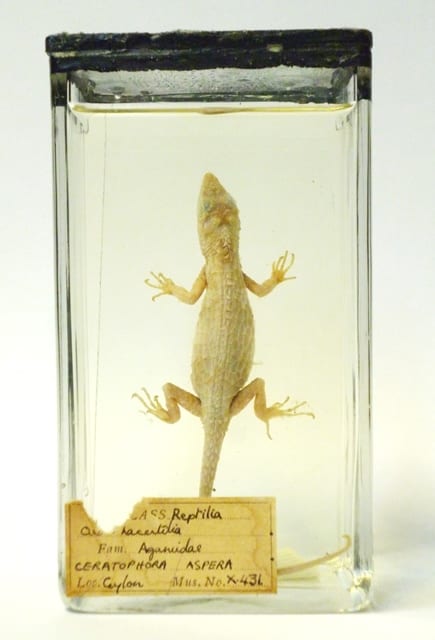
Rough-nosed lizard (Ceratophora aspera) LDUCZ-X431
Hello Specimen of the Week fans, Dean Veall here. We’re mixing it up with our weekly specimen blogs, publishing on Fridays and making them shorter and snappier. So here goes. My main motivation for choosing this specimen is the pure patriotism of a Welsh man exiled here in London. How, you may ask, does this small lizard indigineous to Sri Lanka invoke the land of my fathers, green valleys, cawl and industrial heritage? It be a dragon……