X Close

UCL Careers

Home

Find Your Future

Menu

Archive for the 'Labour Market Intelligence' Category

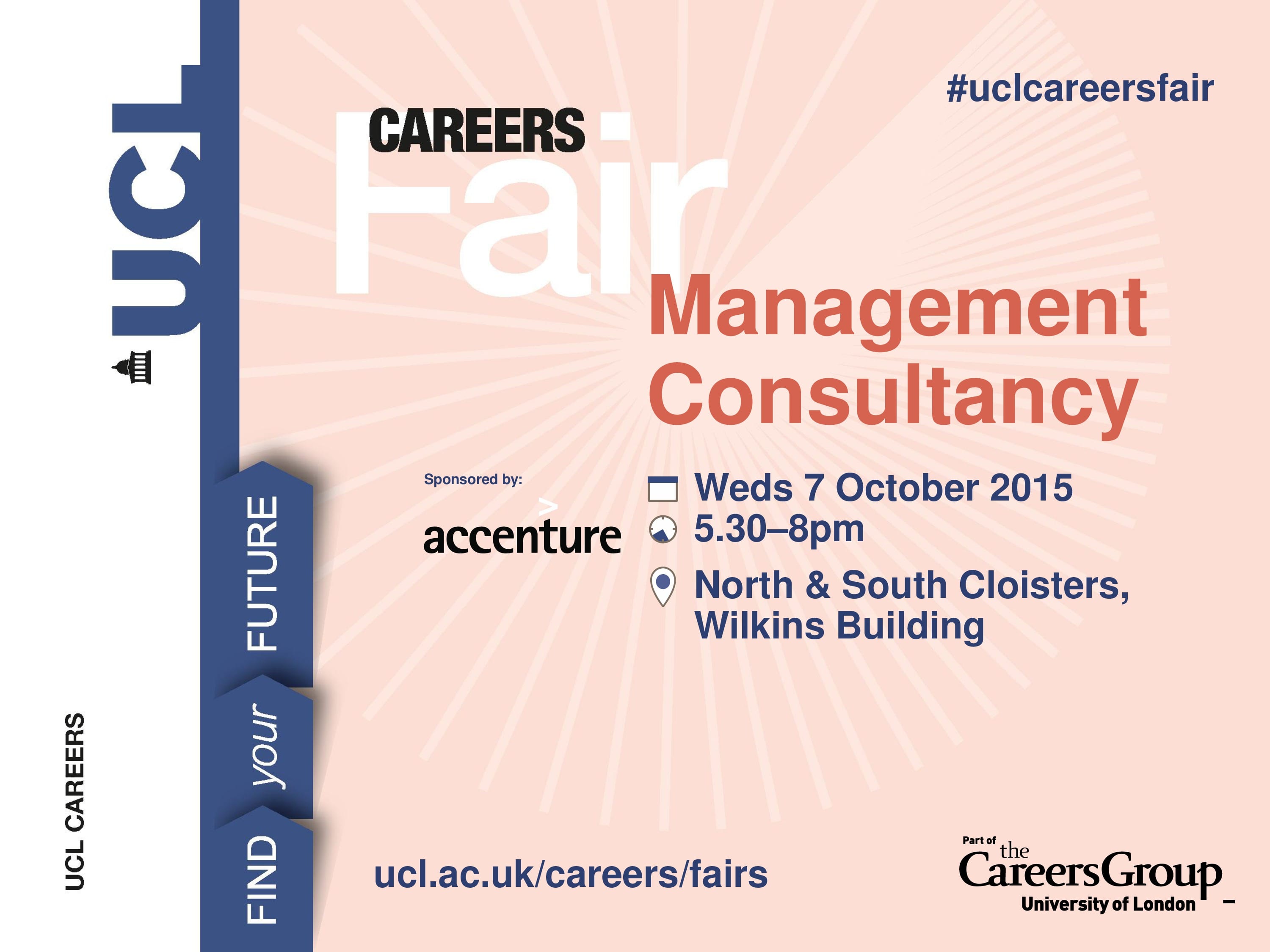
Our Management Consultancy Fair is coming…

By UCL Careers, on 30 September 2015

Considering a career in Management Consultancy?

The UCL Careers Management Consultancy Fair features some of the top employers from a wide variety of Consultancy sectors including Strategy, Financial, Brand, Technology and HR.

Employers will be hiring for permanent graduate positions and in some cases internships and placements.

Management Consultancy

The fair is mainly aimed at final year and penultimate year students. Other years are welcome to attend in order to research employers, but there may not be suitable structured programmes available.

When: Wednesday 7th October 2015 | 5:30pm – 8pm
Where: North and South Cloisters, Wilkins Building

Some employers attending include:
Accenture
The Boston Consulting Group
EY
IMS Consulting Group
Oliver Wyman

Plus many more!

You do not need to book to attend our Careers Fairs, but you must bring valid UCL ID to gain entry.

We will be holding Fair Prep sessions – keep an eye for an Alert about these!

For more information on about the fair and the employers attending, visit: www.ucl.ac.uk/careers/fairs | #UCLCareersFair | @UCLCareers

The Management Consultancy Fair 2015 is kindly sponsored by Accenture.

How to prepare for our Careers Fairs…

By UCL Careers, on 30 September 2015

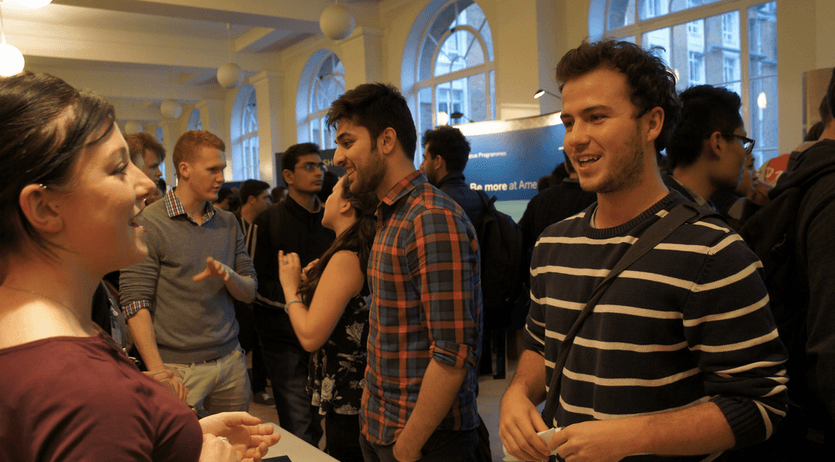
Every year UCL Careers holds a number of Careers Fairs to help you talk to employers and find out first hand what they are looking for. You will get more out of the Careers Fair if you spend a little time preparing…

Be aware that there will be a mixture of all kind of employers from many different sectors exhibiting each day and you might find an employer that you had never really considered before becoming a favourite for you. To help you prepare effectively we’ve put together some handy tips to get you started


UCL Careers Fair

Before the fair

> We strongly encourage you to do some research on the exhibitors before the fair: www.ucl.ac.uk/careers/fairs

> As well as reading the exhibitor profiles, click through to the organisation’s own website to find out more about them.

> After your research, decide which exhibitors you particularly want to talk to, and you will be able to ask more informed questions. It can be difficult to understand the difference between big companies within the same sector.  Often it is the cultural aspects that make a real difference in the working environment and this can only be appreciated through talking and interacting with representatives at the Careers Fairs.  Try to prepare some questions in advance and think about the main points that you would want an organisation to know about you – it can help you feel more confident.

> Come along to one of the preparation sessions organised by UCL Careers (starting w/c 5th October).

At the fair

> At the fair, each exhibiting organisation has a stand and their representatives are there to answer your questions about what the organisation does, what jobs they offer to final year students and graduates, what internships/placements they provide to earlier year students, and any other opportunities that they offer.

> Shows motivation in a competitive job market esp. if you refer to attendance in applications/ interviews

> Often particular insight re. staff experience relating to specific projects they’ve been involved in or training they’ve had can be used as ammunition that can be a real differentiator when answering motivation based questions – ie lots of first hand information not available on any website that other candidates might not be able to offer.

> Wherever possible, try to talk to someone on the stand instead of just picking up a brochure. Use the opportunity to ask your questions face-to-face.

> If you are feeling a bit nervous about approaching your first choice organisation, it can be a good idea to visit some other stands first to practise your technique.

> If you are given a business card, make a point soon afterwards of noting on it anything that it would be useful to remember. Have they suggested you email them with further questions? Did they give you advice on their recruitment process?

> Even if you have a ‘hit list’ of exhibitors, consider other organisations at the fair that are less well known. They might be offering just what you are looking for.

Remember to bring your UCL ID or GradClub ID card as you won’t be able to enter the fair without this!

Other hints and tips

> Remember that many of the opportunities are available to students of any discipline

> If you want to have a CV ready to hand over, arrange an appointment at UCL Careers before the Careers Fair to ask for some CV feedback

> The fair may be busy when you arrive – don’t be put off. People tend to congregate by the entrance, so head to another part of the fair where it will probably be quieter

> Avoid walking round the fair with a group of friends. The exhibitor may not realise that you are interested in them, and you could miss out because your friend happens to be more talkative than you!

> If you feel overwhelmed, and don’t know what to do or where to start, make sure you visit the UCL Careers for help.

> Staff on the exhibitor stands are often relatively recent graduates who can tell you what it is really like to work in their organization.  They may even refer to particular projects that they’ve been involved in or training that they’ve had –all of which is great information for you to use when you apply for a position at their company.  This insight is not available on any website and creates a unique impression when it is your time to apply.

> In a competitive job market, it can make a difference to refer to any interaction with employers during the application process

For further information about the fairs, please visit: www.ucl.ac.uk/careers/fairs


How my arts degree led to a career as a digital entrepreneur

By UCL Careers, on 16 September 2015

This guest post is from Zoe Amar, Director of Zoe Amar Communications
Zoe Amar headshot

Earlier this summer Forbes proclaimed that arts degrees were the hottest ticket for a career in tech. It reminded me of my own journey from a BA in English Literature at Warwick to running my own digital marketing agency, working with clients such as Charities Aid Foundation, The Commonwealth War Graves Commission and The School for Social Entrepreneurs. Careers in digital and communications are popular options for undergraduates, as is eschewing the conventional graduate scheme for life as an entrepreneur. UCL have asked me to share what I’ve learned along the way.

  1. Accept that any career path you choose may be circuitous and involve some risk. After graduating, I was an English teacher for a year before heading to law school then working in the City. But even though I did well in those jobs and learned a lot, there was always something missing. I quit my job as a lawyer and thought long and hard over what I wanted to do next, aided by John Lees’ invaluable book How to Get a Job You Love. It was a bit scary to walk away from a well paid job but without doing that I would never have ended up in a job I love so much. I took a placement doing marketing on a pro bono basis at a national charity which specialised in digital services.  Just a few weeks in they offered to create a new role for me as head of marketing, and after I’d been there for 5 years I left and set up my own agency. I’d say learn whatever you can from every job you have and follow your instincts about what is right for you.
  2. Digital doesn’t mean that ‘soft’ skills are redundant. As the Forbes article showed, digital is evolving rapidly and requires strong technical and analytical knowledge. Yet people skills such as being able to ‘read the room’ and nurture client relationships are necessary to capitalise on the benefits of digital. Much as I love it, digital is just a set of tools. It’s how you use them that counts.
  3. Being an entrepreneur is hard but rewarding. It might sound glamorous but running your own business means taking on a lot of risk and round the clock hard graft. The upside is that it stretches you and is incredibly empowering. It’s also offered me amazing experiences such as working with household names, giving a lecture on digital strategy at Cambridge,  and doing a bit of radio and TV. If you have the opportunity to work for yourself I urge you to take it. I’ve run my own business for the last couple of years and recently blogged about everything it has taught me.

I’d recommend that anyone starting out in their career is open minded and learns everything they can.  Work isn’t one linear path from university to the corner office anymore; it’s a journey. Enjoy it.

Zoe Amar is Director of Zoe Amar Communications. She also writes for The Guardian Voluntary Sector Network about how nonprofits use digital, and is a trustee of a national charity.

To discuss career options, book an appointment to see a Careers Consultant at UCL Careers.

Head of Specialist Factual, Reef Television : Inspire Me

By UCL Careers, on 26 August 2015

As part of our #UCLInspireMe series, Ben Weston, Head of Specialist Factual, Reef Television,  talks to us about how he got this role and shares some tips for UCL students who want to get into the sector.

How did you get your job?  After graduating with a BA in Music from Oxford University I tried but failed to get into television.  I was trying the route that everyone tried in those days – the BBC Production Training Scheme – but it was the most highly subscribed way to enter the business.  I ended up working in a PR agency for two years and then in arts administration for three years before getting onto Granada Television’s management training scheme aged 26 and relocating to Manchester.  I’ve worked in TV ever since.

How did you decide what you wanted to do?  I knew from my teens that television was something that really excited me.  I also knew that music was my biggest passion, so the dream job would be something that involved both.  But it took me many years to actually get to that point – by the age of 30 I was finally producing music on television and radio.  Better late than never!

How relevant is your degree to your job?  I don’t think any degrees are specifically that relevant to a successful career in television, but it’s still good to have a degree in something.  I’m a bit old-fashioned on this, so I’d also add that in my view a degree in a ‘real’ subject is more worthwhile than a degree in Media Studies.  The most important thing to work in the creative side of television is a sense of curiosity, and I think that’s better nurtured by the more traditional degree subjects such as English, Languages or Law.

What are your main work activities?  My job is fundamentally about coming up with great TV programme ideas, selling them to broadcasters and then overseeing their production and delivery.  Any one of those activities may be taking place on multiple projects at any one time so there’s a lot of juggling.

How do you use your degree in your job?  My degree in Music (insofar as I remember what I learnt!) is useful when I’m making programmes about music, but that’s not always the case.  I’ve made programmes about everything from nightclubs through to gardening and stately homes.  I think your degree becomes decreasingly relevant in your work as you begin to build on it with real work and life experience.

What are the most challenging parts of your job?  The long slog of pitching new ideas and the torrent of rejections one gets before winning a commission.  And the fickle nature of our industry which is riven with politics!

Career highlights/best moments?  I produced a film for BBC Two 10 years ago about the role music played in Auschwitz.  Making that film was without doubt one of the most extraordinary experiences of my life (let alone my career).  The film went on to win a hat-trick of a BAFTA, an Emmy and a Royal Television Society Award, so that has to go down as an abiding highlight.

Where do you hope to be in five years’ time?  To be running a creative and profitable organisation, making memorable output, staffed by happy productive people.  I think Reef Television can tick most of those boxes actually!

To find out more about careers within Television, visit Careers Tagged.

– Helen West, Careers Consultant, UCL Careers

PhD Archaeology Student/Tutor at The Brilliant Club: Inspire Me

By UCL Careers, on 7 July 2015

As part of our #UCLInspireMe series, Vana Orfanou, Brilliant Club tutor and PhD student in Archaeology, talks to us about how she got this role and shares some tips for UCL students who want to get into the academic sector. Vana Orfanou

How did you get into your role?

I am a PhD Archaeology student at my writing up stage and I also work as a Tutor in collaboration with The Brilliant Club. I first found out about this charity organisation through an email circulated by UCL calling PhD students to participate in a teaching programme focussing on non-selective state London schools and, then on, by visiting The Brilliant Club’s very well organised website.

The idea of conducting university-style tutorials to underprivileged pupils, and promoting their research and essay writing skills which would in turn raise their aspirations and increase their chances of getting accepted in one of the top UK universities seemed quite appealing from the beginning. What is more, teaching with The Brilliant Club provided me with the exciting opportunity of designing and delivering a course on a topic immediately relevant to my research focus.

What are the best things about working in your role?

The best thing about working with the Brilliant Club is the interaction with the pupils itself. Only too often I am struck by students’ perceptions and interpretations, while interaction with each group of pupils is a unique experience. The high-standard content taught also provides a challenging ground for some amazing discussions to take place. Watching the students producing their own, well-structured and justified arguments is probably one of the most rewarding moments. As I said to my students in my last placement, ‘my Brilliant Club day was the best of my week’.

What are the biggest challenges you face in your work?

Amongst the biggest challenges of being a Brilliant Club Tutor is communicating to pupils complex ideas by making them approachable at the same time. Keeping expectations high could prove a challenge as usually students have already enough on their plate.

What top tips would you pass on to a student interested in this type of work?

In becoming a Brilliant Club Tutor it is important that emphasis is put on teaching and creating knowledge rather than on merely presenting it. Excellent organisation and communication skills, and a drive to create opportunities for school students will definitely help!

To talk to a Careers Consultant for further information on applying for a PhD, visit: www.ucl.ac.uk/careers

Programme Manager: Inspire Me

By UCL Careers, on 2 July 2015

As part of our #UCLInspireMe series, Nicola Harwood, Programme Manager at the Prince’s Trust, talks to us about how she got this role and shares some tips for UCL students who want to get into the Third Sector.

“I have worked at the Trust for 3 years now, starting off supporting schools with excluded young people, and now managing a programme working with unemployed young people. I have always worked in the charity sector as I love having a job that makes a difference (as clichéd as it sounds). Seeing the difference our programmes make to young people every day makes it all worthwhile and I am not sure I could work in any other way. The best bit is seeing someone who’s struggled finding work and who’s struggled with things in the personal life, suddenly have that light bulb moment where it all comes together and they start to make positive steps forward in their life. The biggest challenge is that sometimes it’s hard to switch off. The job is so varied I can be writing a business plan for next year one minute, and supporting a young person with their personal issues the next. I love how varied it is, but sometimes it can be hard to balance my time between the two given they are both crucial parts of my role.

My advice to anyone who’s wanting to get into working in the third sector would be to volunteer. I have complimented my career with a whole  host of volunteering opportunities starting when I was at university and continuing it throughout my career. This has not only given me more experience with working with vulnerable people, but it’s also strengthened my applications for jobs. Also make sure you have some real office experience too. My first job after graduating involved a lot of photocopying like everyone’s but it also gave me vital office experience and skills, which alongside my volunteering really helped secure that first real job.”

To find out more about Charity roles, visit Careers Tagged. For Volunteering opportunities, visit the Volunteering Services Unit at UCLU


Senior Research Executive: Inspire Me

By UCL Careers, on 29 June 2015

As part of our #UCLInspireMe series, Matthew Colahan, Senior Research Executive at Ipsos MORI, talks to us about how he got this role and shares some tips for UCL students who want to get into Research.

How did you get into your role?Matt Colahan

At the beginning of 2012 I was writing up my PhD in social psychology and considering moving outside of academia.  I wanted to stay in research and use the skills I had developed so I looked for research companies who had a strong social research background.  Ipsos MORI looked ideal and so I sent the Head of Qualitative Research an email introducing myself along with a copy of my CV.  I openly acknowledged that this was a “shot in the dark”, but I asked if she would be willing to meet me and tell me more about the work that Ipsos MORI were doing.  Fortunately she agreed, and we had a fruitful discussion (like an informal interview) where we talked about my experience and the nature of the work at Ipsos MORI.  This paved the way for the formal interview process, and two weeks later I had completed two interviews and was offered a full-time permanent position.

What are the best things about working in your role?

The variety of the work – both in terms of the topics and the methodologies used.  I work in the ‘Public Affairs’ section of the Social Research Institute at Ipsos MORI and most of our work is commissioned by the Government.  Public Affairs is therefore split into teams which broadly map onto the different government departments.  I’m based in the ‘Employment, Welfare, and Skills’ team so I tend to work on large scale quantitative employer surveys for clients such as the Department for Business, Innovation and Skills, HM Revenue and Customs, and The Pension Regulator.  However, I have also worked with our ‘Health’ team for the NHS, and also our ‘Education, Children and Families’ team for the Department for Education.  In addition, I have undertaken lots of qualitative work and am also now involved in economic impact evaluation projects.  The opportunity is there to develop a huge range of skills and experience whilst working on projects that interest you.

What are the biggest challenges you face in your work?

 Never enough hours in the day!  Project timetables can be challenging and the job can be very stressful at times when you’re facing tight deadlines.  Developing project management skills is essential in order to juggle the competing demands of the different projects you’re working on – these could be from a client, your project Director, or from internal operations teams who need input from you.

What top tips would you pass on to a student interested in this type of work?

 > Working in research requires a good understanding of theory and So know you research methods theory well, but also have an appreciation of the practical side of doing research (even if you haven’t done much yet).  There are a lot of very practical (sometimes seemingly mundane) steps that need to be completed in order to collect and analyse data (e.g. if you want to speak to certain people, where will you get their contact details from?).

> Demonstrate times when you’ve displayed project management skills.  This could be from any part of your life – just a few examples where you have had to balance competing demands and systematically deal with them.

> Speak to people.  When I worked at University I always encouraged my students to approach employers directly.  It might feel daunting, and it might not necessarily lead to a job, but it could get your foot in the door, and demonstrate that you’ve carefully considered a company and really want to work there.

> Read some of the reports / publications that a research company has produced.  This is what you will be working on so show that you understand what they do.

For more information on becoming a Researcher, visit Careers Tagged


Writer and Blogger: Inspire Me

By UCL Careers, on 23 June 2015

As part of our #UCLInspireMe series, Nicola Twilley, Writer and Blogger, talks to us about how she got started and shares some tips for UCL students who want to become Writers.   

What do you do?

I live in Brooklyn, and I am a writer, so I have to have a few different jobs in order to have a hope of paying the bills. I run a small event space in lower Manhattan for Columbia University Graduate School of Architecture, Planning, and Preservation, which involves organising talks, conferences, exhibitions, workshops, and tours that fall within our mission of providing a platform for conversation about the future of the city. We’ve done smell walks, harbour dredging boat tours, talks about the design of abortion clinics, panel discussions on air rights, hologram workshops, and more. Then, the rest of the time, I write!

I just finished a long story for the New York Times Magazine that I travelled to China in January to report. As well as freelance assignments, I also maintain my own blog, and try to post there once a week, at least. I mostly cover stories related to agriculture, food, and design. Finally, I end up doing a lot of little paid gigs — to give you a sense, in the next month, I’ll be consulting with the Institute for the Future, working on a pavilion design for a UK trade expo, speaking at a MoMA event on slaughterhouse design, and lecturing at a university in Delft.

How did you get in to this role?

The question of how I got into any of these roles is a little trickier. I’m not quite sure myself. My BA is in English Lit. (Leeds) and then, just for added unemployability, I got a MA in Art History at the University of Chicago, which is where I met my American husband and ended up living over here. I wanted to be a writer always, but I wasn’t sure I had a novel in me (still not sure) and, when I was in University, it was pre-blogosphere, and you had to join your local paper and report about missing milk floats in order to get into journalism. I was much more shy then than I am now (this is what more than a decade of living in America will do for you!), so the thought of calling strangers for quotes made me have a panic attack. So, instead, I got into various random public programming jobs: organising stuff like a citywide autobiography competition to mark Ben Franklin’s 300th Birthday, etc.

As I got more experienced, I ended up putting together some things on my own, rather than doing them in a job — so, for example, a friend and I launched a multi-city event series called the Foodprint Project, and my husband and I created a 10 week workshop with artists, filmmakers, game designers, architects, and writers on the theme of quarantine, and then curated an exhibition of the resulting work at a gallery here in NYC. Those were fun, although finding funding is always a challenge. That sort of thing prepared me for the Columbia job, I suppose.

As far as writing goes, I started a blog. Pretty much all my freelance work has come out of that — sometimes editors read it and ask me to pitch them, and, at the very least, it’s a portfolio. The blog also ended up leading to all the other random stuff, like speaking gigs and making scratch-‘n-sniff maps of New York City, etc.

What are the best things about working in your role?

Well, right now I have a pretty great set-up, because I have a flexible job that gives me a reliable salary but also still gives me time to write and do all the other random things I like to do. The Columbia job has an expiry date, though, at which point I will end up looking for something to replace it — probably part-time, so I can still travel to report and write. I love so much about writing and reporting: researching odd things to find a story, interviewing fascinating people, having the chance to see things most people never see, whether it be a geologic tomb for nuclear waste or a dumpling factory in China, and even the writing part, as long as it’s going well! I also like curating events, although it is more frustrating — there’s always a couple of audience members I’d like to push off a cliff. But when a workshop or tour or panel conversation goes well, it’s brilliant — you’re learning and seeing new things, and you’re also on a high from seeing how enthusiastic and interested the audience is. Basically, the best part of both jobs is that I get to follow my curiosity and learn about all sorts of fantastically interesting things, all the time.

What are the biggest challenges you face in your work?

Earning a living. Without at least one steady, regular job to rely on, it’s hard to go from freelance gig to freelance gig. People take forever to pay, editors sit on stories for months, editors reject your pitches all the time, stories get killed because someone else just did something vaguely similar… and the gigs don’t even pay that well in the first place. There’s also wrestling with my extraordinary ability to procrastinate, and the inevitable panic attacks about whether my piece is any good or whether I just fluffed an interview with a really important person, etc. In short: lots of anxiety. And I have no work/life balance. Everything ends up being work or work-related, somehow.

Top tips

I would have said have a blog, but I don’t know — the world of online publishing is changing so fast. Single author blogs seem to be going extinct. Either way, write and publish as much as you can, and then make sure people can find all your writing on your own website. You have to write to be a writer, which sounds obvious, but took me a while….

On the programming side, it’s surprisingly easy to put things together if you don’t mind working for free and like a dog. Organise a mini-lecture series/quiz show in a pub back room. Curate an exhibition in a lift in your dorm. Lead walking tours of the chewing gum on London’s pavements. Etc. Oh — and the most important thing is to document these events. Make them look good, put the photos on your website, and it doesn’t matter that it was actually crap and everyone left after 10 minutes! This is cynical advice, but it really is worth thinking about your event in terms of how it’s going to look in photographs. A media outlet will cover a fizzle of an event based on amazing, weird photographs/video of people crouched on the pavement sniffing gum (or whatever), and not cover an amazing event that has dull or no images.

Two final things: You don’t have to study a specialised course for a thing to be able to do it. I didn’t go to journalism school, but learned how to write magazine pitches by looking it up on Google…. Also, who you know is really important (which I know is common wisdom), but you can find ways to get to know interesting people by sending them something that they might find useful or interviewing them for your blog or inviting them to speak at an event, etc. Just don’t invite them for coffee — have something concrete and appealing in mind. It’s more work, but it will work.

For more information on how to become a Writer, visit Careers Tagged.

Technology Consultant : UCL Alumni

By UCL Careers, on 22 June 2015

Alan Ying, MSc Technology Entrepreneurship 2009 alumnus, tells us why doing a Masters at UCL helped his career as an Senior IT Consultant at FDM Group.

“Growing up in the ‘dot com bubble’ and witnessing the growing potential of the digital world, committing to an IT career was a no-brainer since my childhood. Alan Ying -  FDM Group

I obtained my bachelor degree in Computer Science back in 2008, then moved on to extend my IT knowledge from a business perspective by doing a Master’s in Technology Entrepreneurship at UCL in 2009.  I chose this course because I wanted to broaden my understanding within the field of IT and I was particularly interested in the process from an idea to a product on the shelf.  The location of the University was perfect, especially as a business course, UCL attracts a fantastic mix of candidates from across the globe, and the all-important business and social events were right on our doorsteps! The course focused on the fundamental concepts of how to survive as a start-up.  We had in-depth discussions on business cases and analysed the reasons of success as well as the mistakes we shouldn’t make.  As well as learning a great deal on the course, the part I enjoyed the most was the combination of networking and industry insight at the Thursday night events. This involved a guest presentation with entrepreneurs and business aficionados, where they shared their experience and talked us through their ups and downs during their journey to success.  I’d also like to stress that the inspirational lead lecturer, Dr Chapman made the course ever so exciting and I much appreciate the time and effort he invested in my class.

I completed my Masters at a difficult time for the economy: for those who are young enough to remember, neither of these two years were ideal for employment, due to the economy meltdown and the bankruptcy of numerous leading financial firms. It was the most challenging time for job hunters in decades! FDM Group was one of the few IT consultancy firms that was still growing during the recession and they were looking for candidates who were bilingual and who held a computer-related degree; it was a perfect match. UCL have a fantastic network that was demonstrated by the career fairs that they organised. The ones that I attended opened my eyes to the possibility and opportunities out there and helped refine my career path after graduation

My 10-week training started immediately after I made it through the interview stages and was accepted onto the Graduate Programme. I was glad to be joining a company with top-notch training facilities, a global network and a market-driven strategy that suited client demands.

Upon completing my training in the Academy I obtained a professional IT qualification that became a game changer in terms of my future career: the ISTQB certificate for Software Testing. FDM Group arranged interviews for me with clients within the banking industry and after a successful interview with HSBC I was placed on site. My first assignment was to cover for a Senior Test Analyst on maternity leave!

No matter how technically talented you are, your first experience in a professional IT environment, especially in one of the biggest banks in the world, is never going to be easy. The amount of industrial and internal terminologies and abbreviations used on a daily basis is comparable to a whole new language; in my early days I kept a mini booklet in my pocket where I wrote down all the new ‘words’ I learnt every day and revised them at night. My FDM Trainer was absolutely spot on when he told me that IT is never a nine-to-five job. After only a few weeks on site I had earned the trust of the HSBC management and was given an opportunity to look after a small project on my own; this really helped my career development and further enhanced my skill-set, helping me to become a better IT Consultant for years to follow.

The second placement I took up through FDM Group was at BGL Group. They were the company behind CompareTheMarket.com and also provided services to create web-based insurance solutions to their co-operate partners and clients. I was brought on board to support the national QA team to protect the intense timelines across numerous projects.

I am now an E2E Test Manager of Barclays Mobile Banking Applications and have been working on various Barclays mobile projects since I was placed at Barclays 4 years ago. My chief responsibility is to amaze our customers by allowing them to experience next-generation digital mobile solutions provided by the Barclays IT Team. No two days are the same at the office and new challenges arise every day. It is important to keep up to date with the latest digital trends, embrace them and integrate them into your own knowledge in order to provide informed and sophisticated advice to customers and clients.

Throughout the years there were a few occasions where FDM Group clients wanted me to become their full time employee but I always ended up politely declining. Even now I appreciate how FDM provides professional training, adapts to the market needs and has an internal and external community with global reach – the exact same reasons I chose FDM Group in the first place.”

For more information, please visit www.fdmgroup.com or for further information about Technology Consultant Careers visit, Careers Tagged.

Fashion PR Manager: Inspire Me

By UCL Careers, on 5 June 2015

As part of our #UCLInspireMe series,Melissa Collins, PR Manager at River Island, talks to us about how she got this role and shares some tips for UCL students who want to get into Fashion PR.  Melissa Collins PR Manager River Island

How did you get into your role?

Before obtaining my current position at River Island, I gained a lot of experience working for other brands. I started my work experience at different magazines such as Bliss and Cosmo before I decided to pursue a career in PR. Then I secured an internship at Boxfresh for a year before going on to work for a range of brands such as Ralph Lauren, Warehouse and Arcadia where I moved from being a showroom assistant to a press assistant to press officer. In 2012, a senior press officer position came up at River Island and I jumped at the chance as I loved the brand and everything it stood for. After a year and a half, I was promoted to PR Manager and I’ve never looked back.

How important is it to have a degree in fashion to secure a job in the field?

A degree in fashion will start you off in a great position – if a CV was placed on my desk, one of the first things I look for is the candidate’s degree and the course they studied. However, work experience is also crucial when applying for jobs in PR and journalism, alongside having confidence, great presentation skills and knowing the industry you want to work in inside and out. If you’ve worked within the industry already and have that insider experience, it isn’t as essential to have a fashion-related degree but it certainly helps!

What are the best things about working in your role?

The best thing about working in fashion PR is that no two days are ever the same! I could be on a photo shoot one day, a breakfast meeting with journalists or in the press showroom the next. I love this industry, the buzz you get when you see your brand featured in the likes of Vogue, Sunday Times Style and other prestigious magazines is incredible. Also, the creativity is great, you get to put on some fantastic events, press days, product launches and many more. On a whole, the fast fashion industry is constantly changing and I’m excited to see where it goes in the next ten years.

What are the biggest challenges you face in your work?

Time! There are never enough hours in the day. The world of PR has changed a lot of the last few years. When I first started I was working with just magazine/paper/broadcast journalists, but now online plays a huge part, as well as bloggers. I feel like I have to spread myself more thinly across all the areas.

What advice do you have for students wanting to pursue a career in PR?

Fashion PR is fun, creative and very fast paced. It’s really important to gain as much experience as possible; I had to do a lot of work experience and internships to get that first break, but it will come, you just have to be patient. Communicate with as many people as you can, if you meet a lot of people along the way and make a good impression, chances are that they will remember you. During a work placement role, make sure you stand out from the other students and graduates by going above and beyond what is asked of you. That will make you first in mind when that dream role comes up!

 To find out more about PR or Fashion visit Careers Tagged