X Close

UCL Culture Blog

Home

News and musings from the UCL Culture team

Menu

Archive for the 'UCL Art Museum' Category

Open House – special Saturday opening and art book sale

By Krisztina Lackoi, on 19 September 2012

This Saturday UCL opens its doors to the public for the annual showcase of the capital’s architecture, Open House London. Guided tours every 30 minutes will feature the iconic main building designed by William Wilkins and will include Jeremy Bentham’s auto-icon, a visit to UCL’s Art Museum which be showing the One Day in the City exhibition and access to UCL’s Main Library, including seeing work in progress on the Flaxman Gallery.

UCL Art Museum will also be selling a selection of old auction house catalogues and art books so do come along with some loose change to hunt out some bargains!

Times: Saturday 22nd September, 9am-1.30pm

Please register for tours in UCL’s front quad.

Volunteer success

By Krisztina Lackoi, on 23 August 2012

August has been a great month for UCL Art Museum, with two of our volunteers securing prestigious internships. Susie Stirling (MA History of Art, UCL) has been volunteering with us for a year, working closely with artist Nadine Mahoney on her Portraits research project. Susie will go on to work at the White Cube Gallery in Shoreditch from September. Lucy Wheeler (MA History of Art, UCL) has been assisting with digitisation projects, research visits and classes, and will be taking up a paid internship at Jerwood Visual Arts in London, installing the latest Jerwood Drawing Prize exhibition. A big thank you to Susie and Lucy for all their hard work, dedication and enthusiasm over the past year, congratulations, and best of luck for the future from the whole team!


Guest post: Central Saint Martins at UCL Art Museum

By Krisztina Lackoi, on 15 August 2012

Guest post by Mary Evans, Central Saint Martins

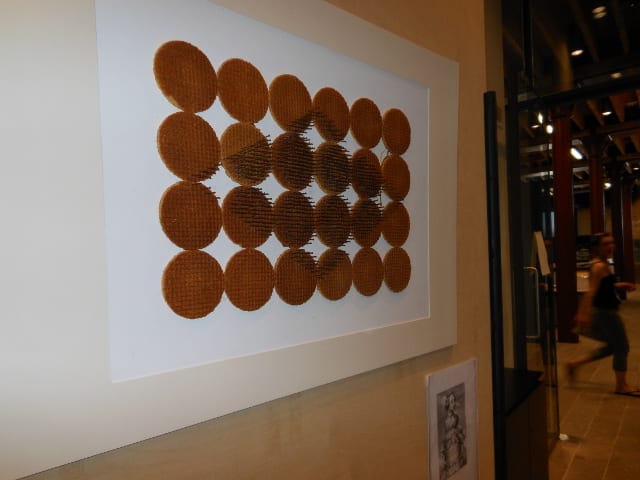
artwork on wall consisting of nails hammered into symmetrical discs of waffle

Artwork inspired by the cross-hatching in Van Dyck’s etchings, (c) Mary Evans installation photograph


In the spring term 2011/2012 a group of second year Fine Art students from Central Saint Martins embarked on a research project at the UCL Art Museum. The project was part of the Expanding Practice unit which is designed to support and broaden students’ approaches to practice and resources for research, production, and reception of works of art. The whole second year cohort across all Fine Art pathways participates in projects in collaboration with other art institutions in London to give students the opportunity to work in new ways and develop new skills. The Guardian Archive, The Petrie Museum, Camden Arts Centre, The Wellcome Collection and UCL Art Museum among others were our collaborators this year.

Curator Andrea Fredericksen expressed what the UCL Art Museum collection had to offer our students thus:

What happens when you have a collection of 10,000 world renowned prints and drawings, dating from the 1490s to the present day, at your fingertips during the development of your artistic practice? Be inspired at UCL Art Museum – home of old master prints by Durer, Van Dyck and Turner as well as innovative works by Slade artists – where you can have hands-on access to this remarkable collection of old and modern treasures. UCL Art Museum invites you to revisit the past masters within their collection to create new work in response; to continue to develop your own practice using contemporary media and contemporary modes of thinking while taking time to consider and appreciate what has gone on before – all in the context of a traditional print room. (more…)

Guest blog: The mysterious American Travel Album

By Krisztina Lackoi, on 10 August 2012

Guest blog by Erin Schuppert, University of Boston and Intern, UCL Art Museum

I began my five-week internship at UCL Art Museum in the beginning of July and I have been busy ever since. I have assisted with a photography project, been introduced to collections care, done copyright research and been in contact with copyright holders, made preparations for researchers and a class, taken inventory, and performed other daily tasks. Despite this long list of experience I’ve gained here at UCL, I still had time to do some of my own research. It all started with the last day of photography, when in the back of the room, Krisztina opened the small corner cabinet and pulled a rather large box from the bottom, placing it on the table and informing me that the museum knows very little about this object.

We slowly opened the lid of the custom-made box and inside was large, brown and green leather-bound book entitled “Travel Album.” I wasn’t too sure what to expect from the inside of the tome, but it looked old and almost forgotten, and so, being hopelessly nostalgic, it intrigued me. Krisztina opened it up to one of the middle pages and I saw before me two sepia-toned images of Yosemite. I had recently travelled to Yosemite National Park in Northern California, so I recognized the landmarks shown in the pictures. I carefully flipped through the next few pages and saw Half Dome, Yosemite Falls, and Glacier Point. Then, just a few more yellowing pages after that, I saw an image of Palace Hotel in San Francisco… I stayed there only two years ago! It did of course look a bit different in the photograph, which I have dated roughly back to the 1890s, than it did when I saw it in 2010, but as soon as I read the inscription in the album and recognized it as the same Palace Hotel in which I had rested my head, I was instantly inspired to find out more about this object. (more…)

Guest blog: Treasures from the East

By Krisztina Lackoi, on 2 August 2012

Guest blog by Stefanie van Gemert

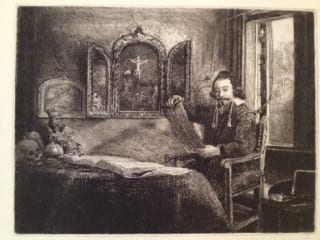
Have a look at this print from the UCL Art Museum’s collection. What do you think this man is staring at? Do you recognize any of the objects he is surrounded by? Who do you think he is?

seated room reading a scroll in room, back to the window

Rembrandt van Rijn, Abraham Francen, Art Dealer, etching, EPC1709  ©UCL Art Museum


This is an etching from 1656 by the Dutch painter Rembrandt van Rijn (1606-1669). We can see Rembrandt’s personal friend, Abraham Francen, staring at, perhaps, another etching, mirroring the gestures and concentrated look of the contemporary art viewer. Francen was a pharmacist in 17th-century Amsterdam, who saw Rembrandt’s fame rise from close-by. Though he was not very affluent, Abraham was a keen collector of paintings, prints and curiosities. I used this print as a starting point for the community workshops I held at the UCL Art Museum over May, June and July 2012, because ‘collecting’ was a core theme in my narrative about Dutch colonial history, global encounters and 17th-century art. (more…)

Engaging Research and Collections

By Jack Ashby, on 27 July 2012

When we go to museums we normally know the kind of information we’re going to be engaging with. In natural history museums it’s usually facts about species, minerals and environments; in social history museums it’s cultures and people; in archaeology it’s much like social history but older. At UCL Museums we’ve started an experiment that doesn’t fit this model.

We have employed a team of UCL post-graduate students to come to each of our spaces a couple of days a week to engage our visitors with their research. They have each found connections between our collections and their disciplines, but they aren’t necessarily what you’d expect. Their PhD’s range from epidemiology and the history of psychology to rhetoric – none of which spark an immediate link to zoology, for example, in most people. (more…)

“Who was this woman and why did she have her back to me?”

By Krisztina Lackoi, on 4 July 2012

Last month 8 history and history of art students from City and Islington College attended a workshop at UCL Art Museum based on some of the images of African and Asian sitters who appear in the UCL collections. (For a background of the Drawing Over the Colour Line project, read organiser Gemma Romain’s guest blog here.) Read what some of the students thought and felt about the images and the workshop day.

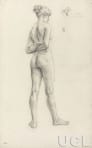
Aimee Nimr, A study of a female figure, between 1918 and 1919, UCL Art Museum SDC6555

by Siobhan Carla

Looking at these sketches makes me think about my heritage a lot, which is oddly why I chose to base this blog on Aimee Nimr. It was mostly bAimee Nimr, A Study of a Female Figure, UCL Art Museum, SDC6555 ecause it was a lot different to what I had seen earlier as it was of a European woman, it had a different feel to it and made me have a different outlook upon it. The woman almost looks scared, maybe insecure and slightly vulnerable which makes me feel sad and, in a way, worried about her. This was portrayed by her slightly arched shoulders and her back to the audience, this made it very mysterious too. Who was this woman and why did she have her back to me? Read the full post here.
 

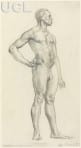
Martin E. Burniston, Study of a male nude, standing to right, with right arm resting on hip, UCL Art Museum, 6271 and John Farleigh, Ecclesiastes and the Black Girl, UCL Art Museum, SPC7331

by Sogol Afshar 

I personally found the nude drawings very interesting, as I am more familiar with this style of drawing and sketching, which are mostly drawn from real Study of a Male Nude, standing to right, with arm resting on hip, UCL Art Museum SDC6271life objects or people. However, I believe life drawing is a westernised technique. And the sitter/model could be anyone from any type of background or race. Therefore, unfortunately I couldn’t relate to the drawings. For example, Study of a male nude by Martin Burniston shows an African nude male standing to the right with his right arm resting on his hip, which is a typical, simple pose for a life drawing model. By finding more about Harlem Renaissance and the black movement, the previous paintings depicted civilised African Americans who are in power of their own identity. Whereas, in my opinion the life drawings didn’t carry any sense of empowerment or civilisation as any artist could ask any black man or woman to pose for them. Read the full post here.
 

Aimee Nimr, A study of a female figure, between 1918 and 1919, UCL Art Museum SDC6555 and Martin E. Burniston, Study of a male nude, standing to right, with right arm resting on hip, UCL Art Museum, 6271

by Lily Evans-Hill

The female figure studies pose embodies a vulnerable position. Her back faces the onlooker and her arms are folded behind her back and we can imagine her armor-less bare front. However, there is a balance of her passiveness as you can see her bold stare. The woman’s face is important in restoring her domination of the page. Her stare suggests she is pondering the scene in curiosity and not in fear. Her pose reminds us of a masculine stance, she has stationed herself with her feet firmly on the ground. Her muscles appear well defined and masculine, the aesthetic that lends to the idea of the woman being dominative. Read the full post here.

Exploring portraiture at UCL Art Museum – Guest blog by artist Nadine Mahoney

By Krisztina Lackoi, on 7 June 2012

Prior to graduation from the Slade in 2011 I participated in the ‘Moreover’ exhibition, organised jointly by the Slade and UCL Art Museum. Having previously used digital imagery as reference, the time spent with the prints brought a new dimension to my work; I shifted away from linear representation to a more embodied depiction of form.

Three portraits from the Anon series, 2011

Anon 14, Anon 4, Anon 3

The research focused on ‘anonymous, untitled’ prints, which inspired a body of work called ANON – a series of monotypes, each a unique original print, that explore identity within portraiture. Having gained so much from this period of study, in September 2011  I proposed to develop the project further. By expanding the search to include all forms of portraiture, the research would involve a wider exploration of the formal, conceptual and aesthetic qualities of the genre.

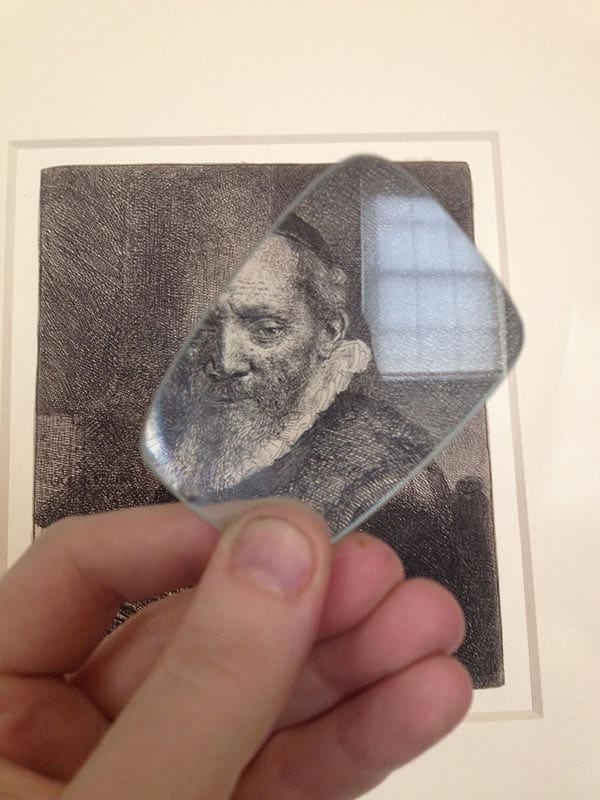
A portrait by Rembrandt examined through a magnifying glass

Looking at Rembrandt

Normally, prints are identified through the catalogue system, through a search for a particular artists or keyword. However, rather than search through the database for ‘portrait’ as a title, the idea was to open every archive box searching for portraits.

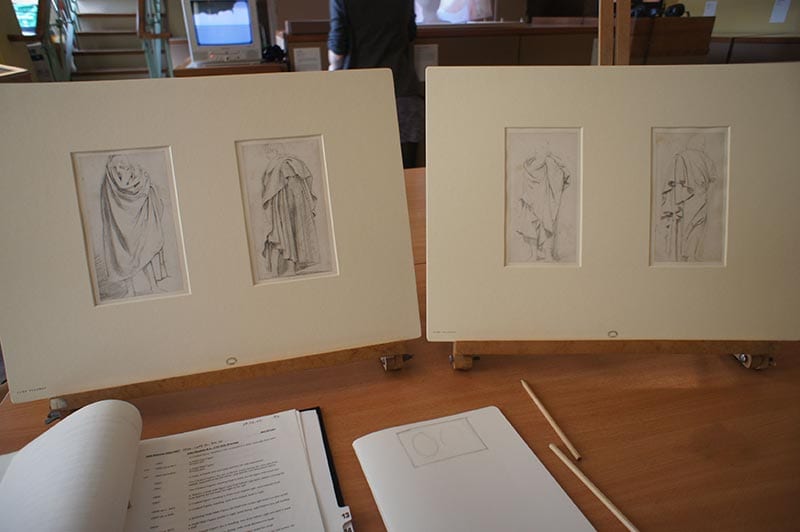
This also allowed a closer insight into the both the collection and museum’s archive system. Each time a box was opened there was a sense of excitement, with prints several centuries apart in the same box.  The experience of viewing the prints and drawings on easels has been a focal point of this experience.

John Flaxman's drawings displayed on easels during a research visit

Research in action – John Flaxman’s drawings displayed on easels

The sense of size, scale and material are often lost in documentation and I gained so much from observing this first hand. Back in the studio scale has been a central theme with the new paintings. A body of work in response to the research has started to take shape;  some are transcriptions of a specific print, whilst others are a wider response to the collection and modes of museum cataloguing.

20 portraits from the Art Museum's collections pasted on the walls of the artist's studio20 drawings of men wearing wigs


Studio Wall (wigs galore) and Wig Drawings

Images courtesy of the artist and Hoxton Art Gallery.

www.nadinemahoney.co.uk


Drawing over the Colour Line

By Krisztina Lackoi, on 13 April 2012

guest blog by Gemma Romain

Sketch of Seated Male Figure looking directly at viewer

Seated Male Figure by Ann M. Tooth, UCL Art Museum

Drawing over the Colour Line is a new project which started in January 2012 and is run by The Equiano Centre in UCL’s Department of Geography. We have been funded by the Arts and Humanities Research Council (AHRC) to carry out a project over the next two years looking at the experiences and identities of Black people in London during the inter-war period by exploring their relationship with the art world. We are specifically focusing on the histories of people of African and Asian heritage who worked as artists and as artists’ models, and contextualising these histories within an examination of interwar political and social movements including pan-Africanism and anti-colonial activism and also histories of empire, migration, and diaspora. The end result of the project will be a public database documenting artworks in various locations, including public and private collections, which relate to Black artists and artists’ models.

We are working with UCL Art Museum throughout the project, researching the collections and carrying out various or co-hosting public events. The project explores some of the artwork created by students based at the Slade School of Fine Art during the 1920s and 1930s, many of which are now located at UCL Art Museum. For example, we are researching the drawings of models of African heritage which won Slade student prizes. Additionally, we will be working with the museum to explore these collections in greater depth by running a summer school for young people, a pop-up exhibition and contributing towards a research guide on Black history and the collections of UCL Art Museum.

Visit our blog and twitter for more details:  http://drawingoverthecolourline.wordpress.com/ and http://twitter.com/DColourLine .

For more information on The Equiano Centre visit our website http://www.ucl.ac.uk/equianocentre/


Kangaroos cooked up by Cook / Strange Creatures

By Jack Ashby, on 13 March 2012

Seeing is believing, right? I’ve often looked at historic animal paintings and wondered “how come artists back in the day couldn’t draw animals?”. We’ve all seen images of animals that are extremely inaccurate, and our recent “Strange Creatures” event had works from UCL Art Museum pop-up in the Grant which included a poorly represented lion, simply because the artist had never seen one. This lack of first-hand inspiration is one reason that the paintings are unrealistic; artists were relying on written accounts by those who had seen the critters.

UCL Art Museum EDC 4766 Anonymous (Dutch, late 17th Century), Lion in a Landscape, late 17th century Red chalk on paper

A late 17th Century Dutch representation of a lion from UCL Art Museum. The opportunity to study lions from life in 17th-century Northern Europe was rare. Lions were kept at the Doge’s Palace in Venice and appear in Jacopo Bellini’s (1400–70/1) sketchbooks, but most Northern artists had to depend upon the accounts of other eye-witnesses.

But reading these descriptions, another massive source of error is that those eye-witnesses are slaves to prior knowledge. When coming across new forms, unlike anything they’d seen before, many attempted to fit models of animals they already knew on top of what they saw. This is perfectly understandable, but in the end often unhelpful. It’s an interesting example of the brain over-riding the visual system and seeing what it thinks it should see.

I’m reading Captain Cook’s account of his first voyage to the South Seas, on the Endeavour, which includes the first descriptions of kangaroos that he came across when he landed on the east coast of Australia, and he was particularly guilty of this: (more…)