X Close

UCL Ear Institute & Action on Hearing Loss Libraries

Home

Information on the UCL Ear Institute & Action on Hearing Loss Libraries

Menu

Archive for July, 2016

James Kerr Love, Scottish Aurist, friend of Helen Keller, 1858-1942

By H Dominic W Stiles, on 22 July 2016
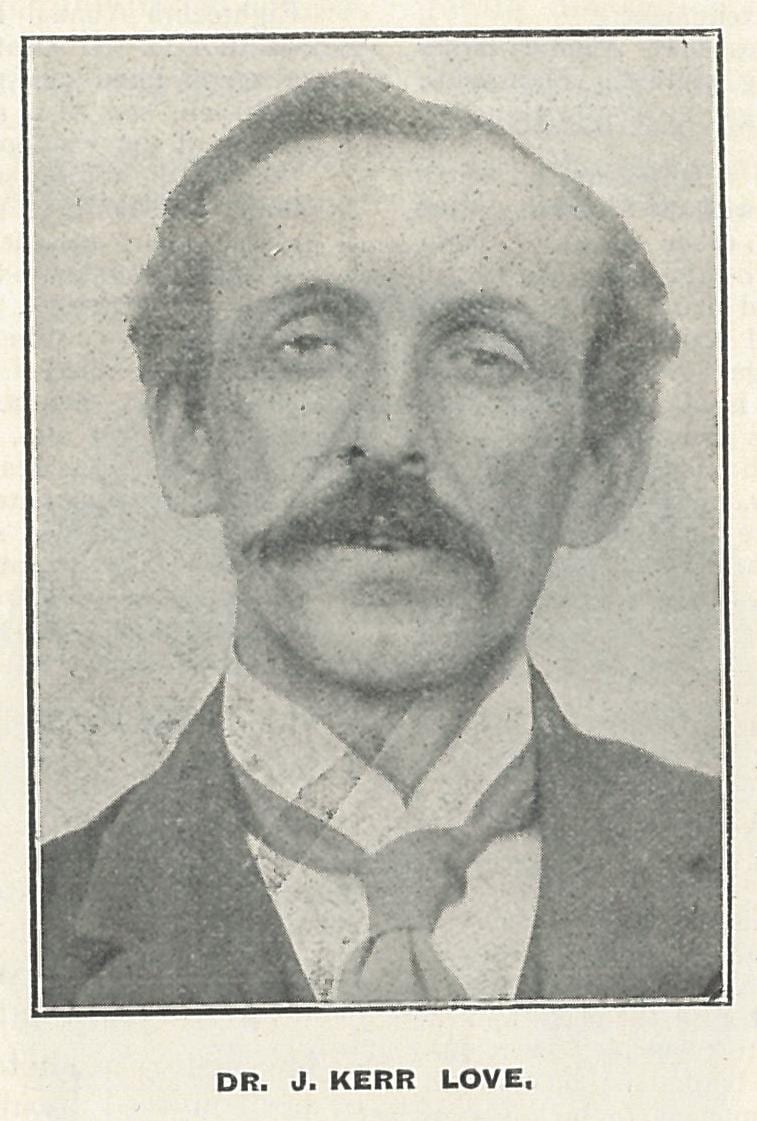
Kerr Love 2James Kerr Love was one of the leading British otologists of the early 20th century, but will be remembered more for his involvement with deaf children and his friendship with Helen Keller than for his surgical skills (BMJ, 1942).

It was this less spectacular work that lay nearest to his heart, and he spared himself nothing in its pursuit. […] In Dr. Kerr Love they had for many years a sympathetic and tireless champion, who wrote, lectured, and organized on their behalf with unflagging energy (ibid).

He was born in Beith, Ayrshire, a ‘son of the manse’. He was educated in Glasgow High School and the University of Glasgow, becoming an M.D. in 1888 writing his thesis, The Limits of Hearing (ibid, & BDM p.128). He was a surgeon at Glasgow Royal Infirmary for thirty years, and worked for the Glasgow Institution for the Deaf and Dumb. It was with his colleague, Dr. Addison, head of that Institute, and later Missioner for the deaf in Salisbury diocese, that he wrote the book Deaf Mutism (1896). His father-in-law was the Rev. Joseph Corbet or Corbett. He died on the 30th/31st of May, 1942, at Sunnyside, West Kilbride, Ayrshire.

It is hard to summarise Kerr Love’s views on education, and he does stress that it is a matter for teachers. Let us look at a couple of passages with his own words.  At the end of his 1906 book, Diseases of the Ear, he says:

So far as State arrangements for the education of the deaf and dumb are concerned, it seems to the author that in every large community two schools for the deaf should exist:

1. One containing all the semi-deaf, the totally deaf with much residual speech, and the ordinary deaf mute who makes good progress on the oral method. Nothing but the oral method should be adopted in this institution. Signs should be used as little as possible, and finger spelling should be prohibited. All deaf children should pass their first year in this school.
2. A school min which the finger method or a combination of the oral and finger methods is taught. It is the writer’s opinion that at least half of the deaf-mute children would ultimately find their way into this second school (p.320).

He seems to have maintained this view that sign language was only good enough for those unable to learn spoken language, writing in 1936 (in The Deaf Child, p.109):

Some of the schools describe themselves as oral schools, some as combined schools. But if it is difficult to define a combined method, it is more difficult to define a combined method school.

I am now speaking of the institutions and not of the day-schools, and I state that, apart from those in Manchester and London, all the residential institutions I have visited are combined schools. Only in these two cities do arrangements exist for the separation of the defective deaf, who should be taught manually, from the ordinary deaf child, who should be taught orally (p.109).

It is probably unfair to give a couple of quotes out of the full context of his thought, and his views seem more nuanced than these quotations might make him appear. His work is worthy of consideration in the history of deaf education in the period from 1890 to the 1930s, as he was well known and widely read, being involved in the foundation of the National Bureau for Promoting the General Welfare of the Deaf. They published his monograph consisting of four essays, The Causes and Prevention of Deafness (1912).

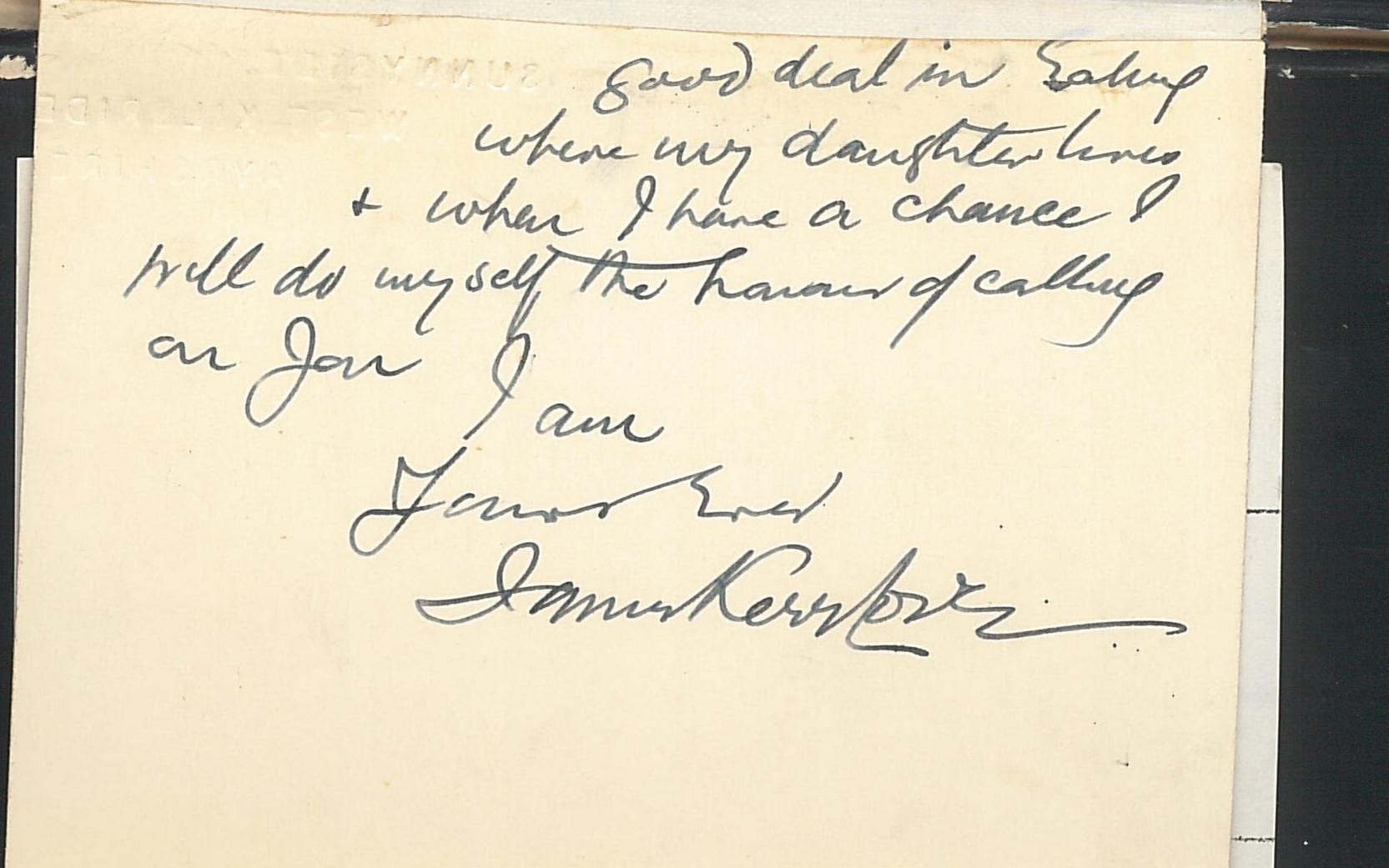
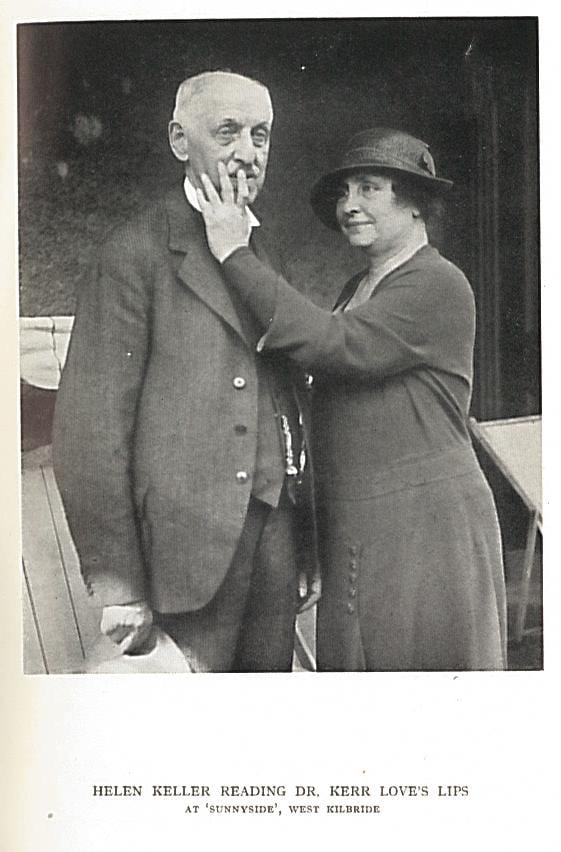
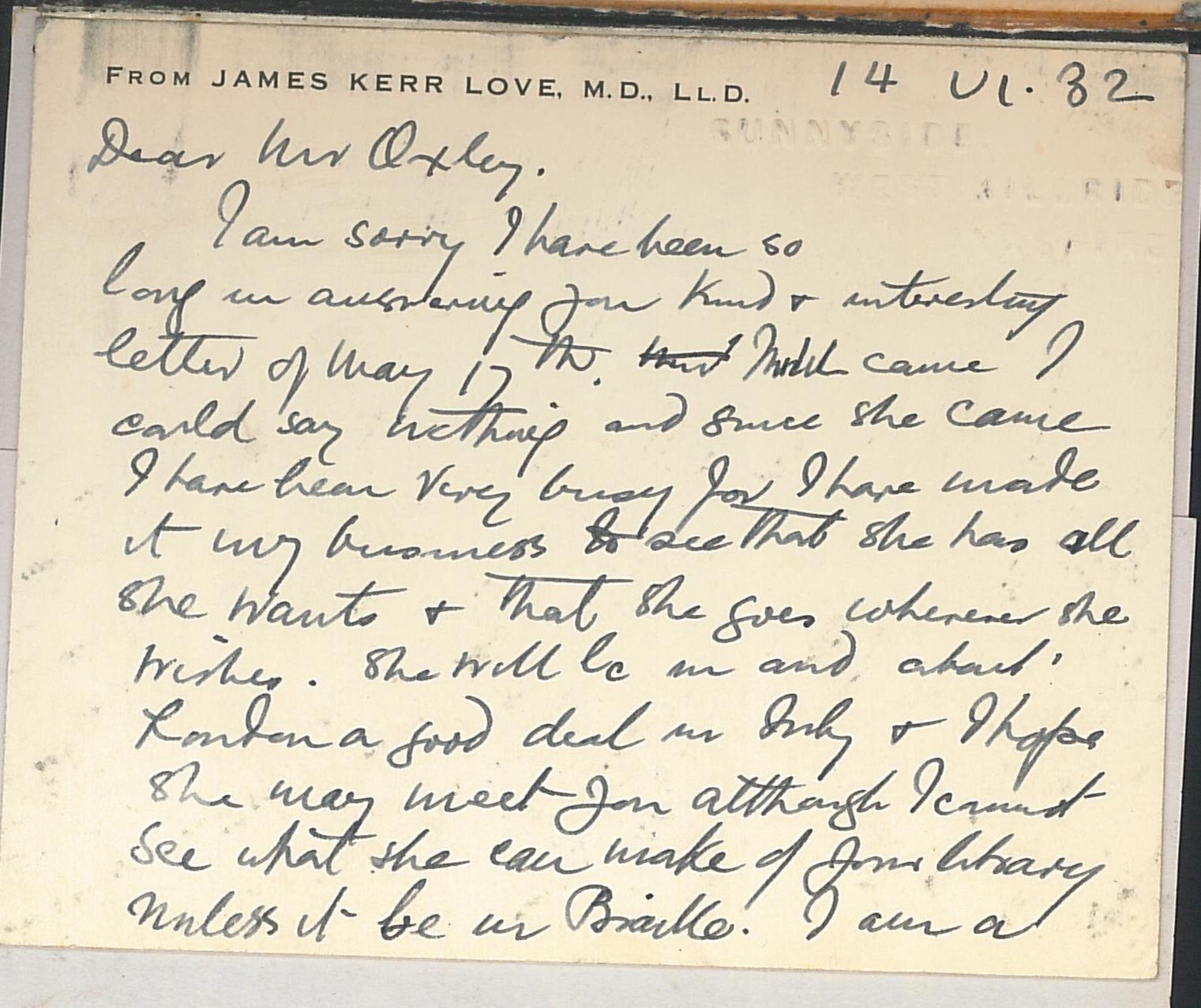
We see him here with his friend, Helen Keller. She was such a celebrity, perhaps one of the first modern celebrities, that everyone wanted to meet her or be seen with her, poets, politicians, doctors etc. Selwyn Oxley contacted Kerr Love when she came to the UK in 1932, as he too wanted to meet her. I love Kerr Love’s reply: “I cannot see what she can make of your library unless it be in Braille.” These notes were later stuck into a copy of one of his books by Oxley.Kerr Love note 1
Kerr Love note 2Kerr LoveKerr Love, J. & W.H. Addison.  Deaf-mutism.  1904

Kerr Love, J. & W.H. Addison.  The education of the deaf and (so-called) dumb: two papers, by James Kerr Love and W.H.Addison. Glasgow: Philosophical Society of Glasgow, 1893.

Kerr Love, J. & W.H. Addison.  A statement on the subject of methods of education, by James Kerr Love, with remarks thereon by W.H.Addison. Glasgow: James Cameron, 1893.

Kerr Love, James (ed).  Helen Keller in Scotland, a personal record written by herself.  1933

Kerr Love, James. Deafness and Common Sense. 1936

Obituary: James Kerr Love, M.D., LL.D. The British Medical Journal, Vol. 1, No. 4250 (Jun. 20, 1942), p. 775

Deaf-mutism, by J. Kerr Love, & W.H. Addison, (review) The British Deaf-Mute p.126-8, Vol. 5 1895-6

A tragedy from 1906 with a modern resonance

By H Dominic W Stiles, on 15 July 2016

I came across a very short item in the British Deaf Times for October, 1906, p.225, which led me to discover more about a Lincolnshire family from over a century ago, and a tragic event.

Harriet Shaw was born in Grimsby in 1826/7, and christened on the 27th of February. According to various census returns she was born deaf. Her parents were Elizabeth, or ‘Betsey’, and William Shaw, who was a shipbuilder, neither being described as deaf on the census. In 1848 she married a Hull man, Robert Matthews, a ship’s carpenter who later became a shipwright like his father-in-law. They had at least six children, William Joseph, born in 1850, who became a boilermaker, Robert, a carpenter, born c. 1853, George, also trained as a carpenter, born c. 1856, Emma born c. 1860, Hannah born in c. 1864, and Elizabeth born in c. 1868. William, Hannah and Elizabeth, were all, like their mother, born deaf, according to the census returns. The 1861 census says that George was also deaf, but he is not described as deaf in the 1871 census. Clearly census returns are not infallible, relying on the information of informants who may not have been thorough in their admissions to the enumerator, and enumerators were also mistaken or careless on occasions. It is a great pity that we have few early reports from local deaf missions, and those we have for Hull, East Yorkshire and Lincolnshire are rather patchy. Local papers might tell us more, and there must have been an inquest. It seems very likely (I would stress without firm evidence) that in a family like this where mother and many children were deaf, that they would have signed.

William, the oldest child, never married. The tragedy is that, on the 6th of September 1906, his sister, probably the youngest sister Elizabeth who was still living at home with her brother, found him hanged in a workshop. One can only imagine what desperation, despair and disillusionment, led him to this, but the truth is that Deaf people are more vulnerable to isolation and mental health issues.  A Mad Act

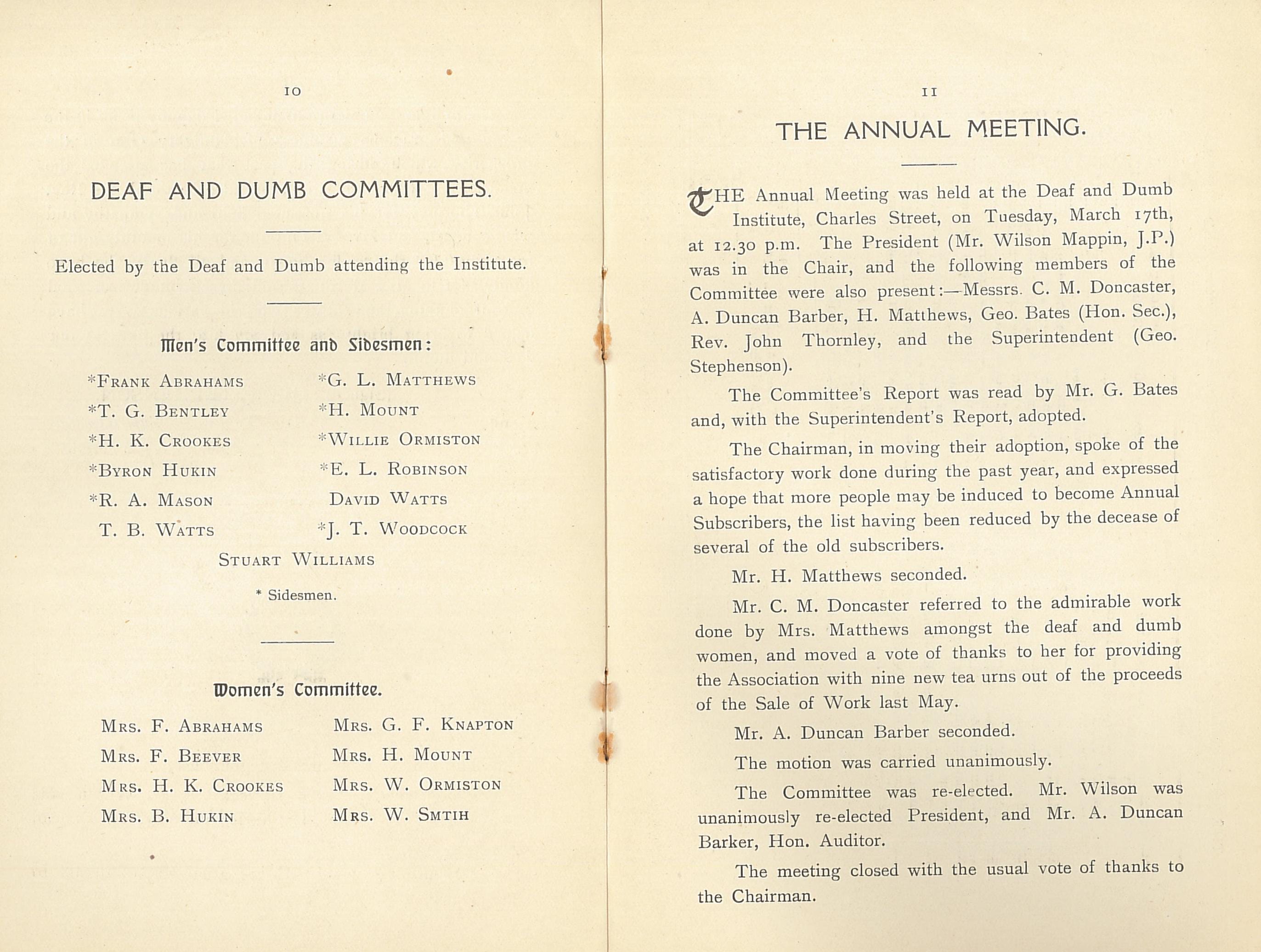
Sheffield 1914In 1882 Emma Matthews married a Deaf man from Sheffield, Thomas Gilley Bentley, an engraver, and they had at least one Deaf child, Victoria Maud Bentley, born in 1887. That is the third generation from Harriet Shaw. The 1911 census shows that the Bentleys had ten children, six surviving at that time. Victoria married Albert B Clarke in 1918. Albert, born c. 1889, was also Deaf from childhood. From the above annual report for Sheffield, we can see that Thomas Bentley was involved with the Sheffield Association in Aid if the Deaf and Dumb. Perhaps we have the sort of idea of ‘deaf ethnicity’ here in the Matthews/Shaw/Bentley/Clarke families – see Lane et. al for a discussion of this.

At that time George Stephenson was still working with the Association, which leads me to suggest that anyone interested in the history of Deaf people in the late 19th and early 20th century, may be interested to read Nick Waite’s new book, Alone in a Silent World, which covers this period and the long association of the Stephensons with the Sheffield Deaf community.

FURTHER INFORMATION

I have heard of a recent case which resonates with the story of William Matthews, although of course we know very little other than the outline of William’s story.

This open access article from 2007 is a review of the literature on Deaf people and Suicide up to that point – Suicide in deaf populations: a literature review.  That article has been widely cited.  This links to PubMed article abstracts using the search terms mental health and deaf.  The British Society for Mental Health and Deafness (BSMHD) “focuses entirely on the promotion of the positive mental health of deaf people.”  Additionally the Samaritans have an email contact jo@samaritans.org

Lane, H., Pillard, R.C. & Hedberg, U. The People of the Eye : Deaf Ethnicity and Ancestry.  2011

1851 Census – Class: HO107; Piece: 2113; Folio: 202; Page: 13; GSU roll: 87742

1861 Census – Class: RG 9; Piece: 2389; Folio: 55; Page: 15; GSU roll: 542964

1871 Census – Class: RG10; Piece: 3414; Folio: 63; Page: 22; GSU roll: 839406

1881 Census – Class: RG11; Piece: 3270; Folio: 36; Page: 24; GSU roll: 1341780

Hannah and Emma in the 1891 Census – Class: RG12; Piece: 3815; Folio: 133; Page: 8; GSU roll: 6098925

William in the 1901 Census – Class: RG13; Piece: 3089; Folio: 62; Page: 36

Albert in the 1901 Census – Class: RG13; Piece: 4375; Folio: 57; Page: 26

An ordinary (deaf) man – Thomas Henry Jones, Tailor (ca. 1837-1921)

By H Dominic W Stiles, on 1 July 2016

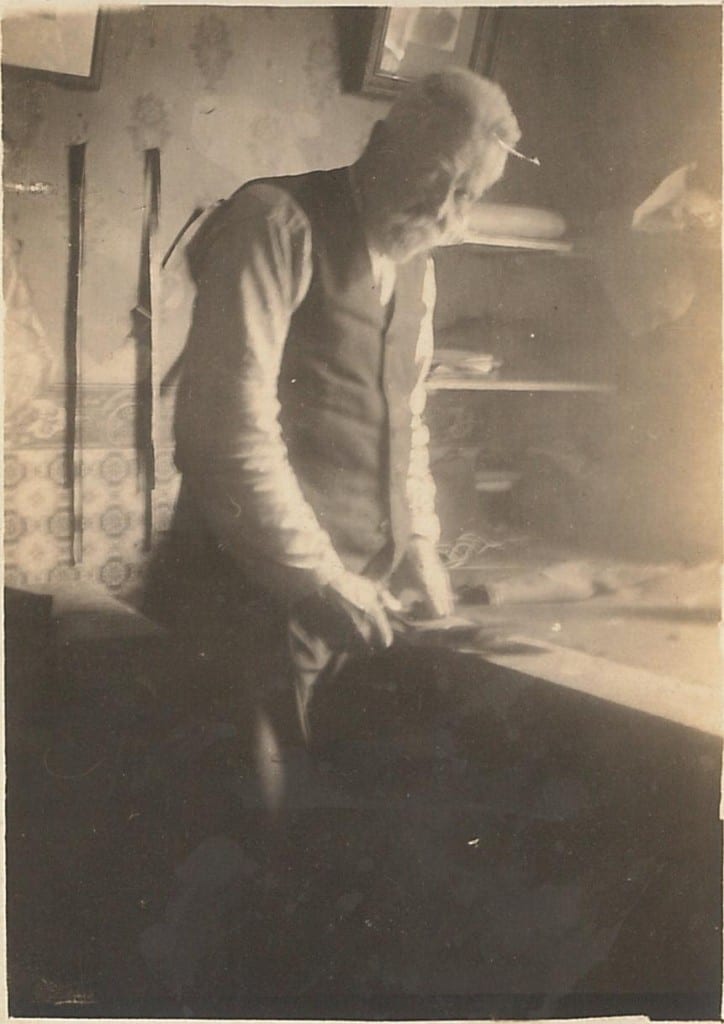
To disappoint you, the person who features today had no exciting adventures, and was probably not significant to anyone outside his friends and family. He was an ordinary person. He probably led an ordinary life, but honestly, while we usually have some additional source to the online genealogical information, such as a short obituary or a story in a paper, I have nothing for Thomas except this rather nice photograph of him with his pinking shears. On the back it says “80 years old” in pencil, then in ink, but not Selwyn Oxley’s hand, “Thomas Henry Jones died Dec. 26 aged 86 at Ashford Mddx Tailor”. Printed below in very small type – the photo is on a postcard backing as are most of our collection – is “Freeman, Photo, Ashford, Staines”.  The photo probably dates from circa 1915 (he was 84 when he died rather than 86 – see below).

Born in Deptford in 1837, Thomas Henry Jones was baptised on the 23rd of July that year, the son of John and Mary Ann Thomas. His father was a shoemaker, and the family lived then in Grove Lane according to the baptismal records (lodged at the London Metropolitan Archives and also on line). He attended the Old Kent Road Asylum, and was there in the 1851 census when he was 13.

In the 1861 census he was living with his married sister and her family in Deptford.  That census tells us he was deaf from birth. Towards the end of that year he married a deaf lady called Susannah or Susan Anderson, daughter of Irish immigrants and, according to the 1861 census, deaf from birth. She was born in Chelsea, circa 1834, and worked as a dressmaker. In 1861 she was living in Carteret Street by St. James’s Park supporting her mother, and with a lodger nineteen year old Hannah Rowe, a deaf shirtmaker from Tiverton. I wonder if they met through being a dressmaker and a tailor, or through the deaf community? They had at least four children, Alfred, Walter, Caroline and Albert, born in Deptford, Rotherhithe and then Deptford, which suggests that the family did not move too far away from where Thomas grew up. Susannah must have died a little after the 1881 census, as Thomas married again, to Eleanor Thompson (b.1851), in Bethnal Green in 1882 (see Free BMD). She too was profoundly deaf, but I have not certainly identified her in the 1861 or 1871 censuses, although there is a Thompson family who might fit in the Hackney workhouse in 1871.

Thomas Jones died 1921In 1901 the family was living in Staines, with their three surviving children of six in total, and with a deaf boarder, William Lake (b.ca 1881 in New Brompton, Kent).  The youngest daughter, Beatrice, was born when Eleanor was 44. Beatrice Eleanor (b. 1895) married a George Matthews in 1915 and only died in 1974.

By 1911 they were living at 5 Vine Cottages, Ashford, Middlesex.  Thomas died at his home in London Road, Stanwell, on the 26th of December 1921, and was buried on the 31st, aged 84.

Thomas –

1911 Census Class: RG14; Piece: 6755; Schedule Number: 220 

1901 Census Class: RG13; Piece: 1175; Folio: 37; Page: 24

1881 Census Class: RG11; Piece: 701; Folio: 17; Page: 28; GSU roll: 1341164

1871 Census Class: RG10; Piece: 743; Folio: 84; Page: 24; GSU roll: 824719

1861 Census Class: RG 9; Piece: 397; Folio: 127; Page: 1; GSU roll: 542630

1841 Census Class: HO107; Piece: 484; Book: 9; Civil Parish: Lewisham; County: Kent; Enumeration District: 5 6; Folio: 9; Page: 11; Line: 2; GSU roll: 306876

Susannah –

1861 Census Class: RG 9; Piece: 53; Folio: 73; Page: 15; GSU roll: 542564

1851 Census Class: HO107; Piece: 1480; Folio: 353; Page: 46; GSU roll: 87804-87805

London Metropolitan Archives, Deptford St Paul, Register of Baptism, p75/pau, Item 007

London Metropolitan Archives, Death records Call Number: dro/022/a/01/020