 Close
Close


Hypsilophodon foxii cast part 3
By ucwehlc, on 3 November 2023
Previously on the Grant Museum blog we introduced our biggest dinosaur, along with several mysteries. How did we get it? Who made it? Why does its head look so strange? Then in an exciting turn of events 4 years later we discovered a picture of our cast being made at the Natural History Museum. Now another 4 years on the story continues with Museum Studies students Imogen Geoghegan, Nadia Adal, Lauren Brown Phelan and Yanning Huang who have written this blog about their dinosaur research project.
**The Hypsilophodon foxii cast (Part 3)**
We took part in a research project with the Grant Museum of Zoology (GMZ) to uncover the truth behind this mystery object in the GMZ’s collection. It started with a few photographs and texts from the GMZ which led us to discover the cast’s background and even the species of the dinosaur (Hypsilophodon foxii), both of which were in doubt and unconfirmed before our project began.
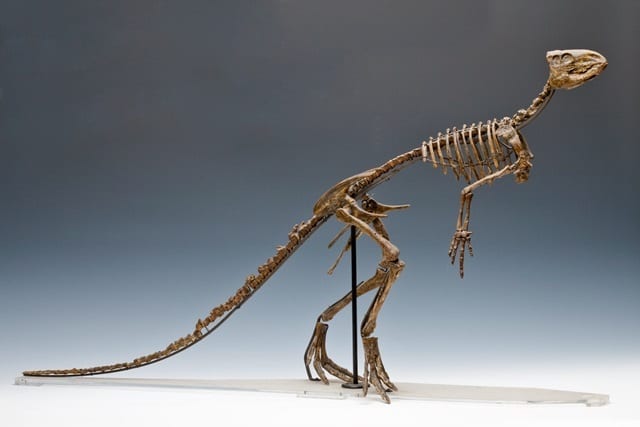
LDUCZ-X185 a one armed cast of skeleton of Hypsilophodon foxii
The Giant Thorny-Headed Worm of Swine
By ucwehlc, on 20 October 2023
The Grant Museum is currently closed for refurbishment works until the new year, but we still have plenty of exciting stories to tell from the collection.
Today’s blog is by visiting researchers Dr Andrew McCarthy and Dr Jennie C. Litten-Brown from Canterbury College, UK, who have been looking into some of the parasites in our collection. This week we meet the Giant Thorny-Headed Worm of Swine, Macracanthorhynchus hirudinaceus (Acanthocephala: Oligacanthorhynchidae), a parasite that causes disease in both pigs and humans, that you will be able to see on display when we re-open.
The Giant Thorny-Headed Worm of Swine
Parasitism is probably the most common life strategy on Earth. Parasites are known to be important factors in maintaining ecosystem health, and the relatively new discipline of Parasite Conservation is devoted to preventing the extinction of endangered parasite species. However, several parasites cause serious disease in both humans and livestock. With increasing trends in more ethical farming methods such as Wild Farming, (often associated with rare breeds conservation), where livestock come into close contact with the natural environment, an awareness of potential pathogenic parasites is important. Specimens of one such parasite, an acanthocephalan, may be found in the Grant Museum of Zoology.
Acanthocephalans, commonly known as the “Thorny-Headed Worms” are a group of parasites typically under-represented in museum collections. Members of the group are known to cause a disease, acanthocephaliasis, in their vertebrate hosts, and some are of both veterinary and medical importance. The Grant Museum of Zoology has in its collection both fluid preserved adult worms (specimens LDUCZ-F21, F22 & F23), and Rudolf Weisker wax teaching model specimens c.1884 (LDCUZ-F26 & F84), of one of the largest acanthocephalans known to science. It goes by the rather dramatic common name of the “Giant Thorny-Headed Worm of Swine”, Macracanthorhynchus hirudinaceus. It may be described as a neglected parasite upon which relatively little research has been carried out. Its scientific name refers to the large, thorned proboscis (see Fig. 1), and the leech-like (“hirudo”) nature of its body (see Fig.2 ).

Fig. 1. The Parasite: Macracanthorhynchus hirudinaceus.
Scanning Electron Micrograph of the proboscis bearing thorns.
(© Migliore et al. (2021) )

Fig. 2. The Parasite: Macracanthorhynchus hirudinaceus. Entire worm from intestine of pig.
(CDC, Public Domain via Wiki Commons)
Parasites from an Endangered Deep-Water Shark and their link to Professor Sir E. Ray Lankester FRS, pioneer of Marine Conservation.
By ucwehlc, on 5 June 2023
The Grant Museum is currently closed this summer for some refurbishment works but we still have plenty of exciting stories to tell from the collection.
Today’s blog is by visiting researcher Dr Andrew McCarthy from Canterbury College, UK.
Initially this short piece was planned to be solely about the identification of specimens of an intestinal parasite of an endangered species of deep-water shark Echinorhinus brucus, the Bramble Shark, from the collections of the museum.

Echinorhinus brucus, the Bramble Shark.
(Goode & Bean (1896) Oceanic Ichthyology. Public Domain via Wiki Commons)
However, by strange coincidence as will be explained, it is being written on the day that the United Nations in New York announced in its new global marine biodiversity conservation initiative “The High Seas Treaty”. Embracing almost two thirds of the World’s oceans that lie outside national boundaries the treaty provides a legal framework for the establishment of vast Marine Protected Areas (MPA’s) to protect against loss of marine biodiversity. The coincidence is that the specimens under discussion here are thought, ultimately, to have their origin associated with the work of a British pioneer of marine conservation of well over one hundred years ago. He was namely Professor Sir Edwin Ray Lankester FRS, a past Director of the Grant Museum of Zoology and Comparative Anatomy (1874-1890), Jodrell Professor of Zoology and Comparative Anatomy at University College London, and Linacre Professor of Comparative Anatomy at the University of Oxford. A larger-than-life figure, some believe him to be one of the inspirations for Sir Arthur Conan Doyle’s Professor Challenger of “The Lost World”.
From the Micrarium: Isoparorchis, a parasite of an Australian catfish species locally endangered in the Murray-Darling Basin.
By ucwehlc, on 22 May 2023
Even though the Grant Museum is closed this summer, we still have plenty of exciting stories to tell from the collection!
Today’s blog is by visiting researcher Dr Andrew McCarthy from Canterbury College, UK.
The Micrarium at the Grant Museum of Zoology is a beautiful and unique display of illuminated glass microscope slides of specimens from a bewildering range of groups within the Animal Kingdom. Each slide has its own story and potentially its own contribution to make to the study of zoology. The specimen on one such slide is probably at present better known than the rest due to its appearance in Jack Ashby’s excellent book “Animal Kingdom: A Natural History in 100 Objects” based on specimens from the Grant Museum. The specimen of a trematode parasite in the genus Isoparorchis appears in the book as a photogenic example of a parasitic flatworm in a concise overview of the group.

The Parasite: Isoparorchis specimen from the Micrarium
© UCL Grant Museum of Zoology & Oliver Siddons
Call for Proposals – Family Activities
By Helen Carney, on 26 January 2023
UCL Museums & Cultural Programmes are seeking proposals from artists, facilitators, and creative practitioners for fun and inspiring family activities. This is to be developed and delivered in response to our collections and displays in the Grant Museum of Zoology, Petrie Museum of Egyptian and Sudanese Archaeology and UCL Art Museum. Building on the success of past workshops, self-led activities, and other family-focused events, we are looking for proposals that fit with our themes and explore our collections in new and innovative ways.
UCL Museums & Cultural Programmes: Themes & Key Moments
For general information about UCL Museums please visit the homepage.
Our programmes and exhibitions explore themes relating to:
- Power & social justice
- Biodiversity, climate justice
- Research related to issues that reflect UCL’s impact locally, nationally and globally
We encourage you to make use of UCL Museums’ Collections Online.
Henry Tonks’ Head-scapades
By Lucy A Waitt, on 15 November 2022
Many of you will be familiar with the legends which surround our beloved Jeremy Bentham and the alleged antics of his mummified and wax heads (two heads are better than one after all). According to UCL tradition these have been head-napped, ransomed and used as a football. For some further reading on this topic please see “Fake News”
This, however is the story of quite another UCL head.
Call for proposals – Family Activities in the Museums
By Helen Carney, on 24 March 2022
UCL Culture are seeking proposals from artists, facilitators, and creative practitioners for fun and inspiring family activities to be developed and delivered in our museums and cultural spaces. Building on the success of past workshops, self-led activities and other family focused-activities, we are looking for proposals that fit with our themes and explore our collections in new and innovative ways.
We are looking for proposals for activity that can be delivered in the Grant Museum of Zoology and the Petrie Museum of Egyptian Archaeology.
Workshop format
- Workshops must be family-friendly, supporting groups of mixed ages and abilities to work together to make, explore, create and move through our spaces
- Proposals can be for drop-in workshops, durational workshops or set timed events/performances
- Proposals should consider the museums as a space for mixed audiences, with families taking part in a space with other visitors
- Proposals must be suitable for delivery in the museum, but may also consider options for further reach through digital delivery
- Proposals can include a range of materials, but must be mainly ‘dry’ and suitable for a space that is use for collections display or handling (no pastels, paint or charcoal)
- For the Grant Museum workshops will need to be adapted to be deliverable for both an early opening for Family Members (10am-11am) and during public opening times (after 11am)
Dates
Workshops will be scheduled for Saturdays across 2022-23.
Confirmed dates for Grant Museum workshops are 30 April, 28 May, 25 June, 30 July, 27 Aug, 24 Sept, 30 Oct and 26 Nov. Dates for Petrie Museum workshops are tbc.
UCL Culture Themes
The Petrie Museum of Egyptian and Sudanese Archaeology houses just over 80,600 objects relating to life and death along the Nile Valley, making it one of the largest collections of Egyptian and Sudanese archaeology in the world. It includes many world ‘firsts’ such as the Tarkhan dress, the oldest known, most complete garment in the world.
The Grant Museum of Zoology has around 68,000 zoological specimens, including the world’s rarest skeleton, the quagga; thylacine specimens; dodo bones and a fine collection of models.
Our programmes and exhibitions explore themes relating to:
- Power & social justice
- Biodiversity, climate justice
- Research related to issues that reflect UCL’s impact locally, nationally and globally
There are also specific themes we are interested in exploring in connection to each museum.
- New entrance gallery in the Petrie (and accompanying family trail release date tbc) connected to hidden characters behind the collection
- Activities that make use of 3D printed replicas and digital images from the collection
- Activity that brings the Grant Museum’s micrarium to life
- Activity that explores the themes of Displays of Power (past exhibition in the Grant Museum)
Examples of recent activity
Family Yoga
An inclusive yoga session drawing inspiration from the incredible specimens on display in the Museum, inviting families to pause, move, breath, and look at the collections in new ways.
https://www.ucl.ac.uk/culture/whats-on/family-event-family-yoga-grant-museum
Puppet Making
This workshop invited families to explore extinction and survival, looking at why extinction has happened, and how we can prevent further extinction of species due to climate change.
https://www.ucl.ac.uk/culture/whats-on/design-and-make-your-own-puppet-animal
Hidden Histories
Map and gallery exploration activity tracing the journeys of some of our animal specimens to discover more about their origins and stories overseas.
https://www.ucl.ac.uk/culture/whats-on/hidden-histories-grant-museum
Fee
The base fee for workshop delivery is £200 to cover up to four hours of activity, with additional budget for materials. Additional preparation time can be agreed, depending on the nature of the proposal, its link to the museum displays and the required devising time. Please given an indication of this your proposal.
Next steps
Proposals of no more than one A4 page should be sent to museums@ucl.ac.uk by 18.00 on Friday 22 April.
What does LGBTQ+ inclusivity mean to UCL Culture?
By Helen Carney, on 10 March 2022
UCL Culture is a multidisciplinary team committed to connecting the world with UCL. We use our collections, museums, theatre and most importantly our people and know-how to mobilise the UCL community, inspiring them to engage people with their research and their research with people.
We know that unless we are inclusive of everyone, including those in the LGBTQ+ community, then we are failing both the UCL community and the wider communities of which we are a part. We also know that “being inclusive” is an active not a passive state of being, and that we, as a department, need constantly to challenge our own thinking and actions, and those of others.
Fundamentally, we want to reaffirm UCL Culture’s commitment to challenging our own thinking and actions on inclusivity – and to ask others to challenge us. Below are some of the current projects we are involved with in support of our LGBTQ+ colleagues and communities. We are also launching an open call for future projects that continue and strengthen this support.
Current projects
- Supporting an informative exhibition on trans lives, led by UCL’s Trans Network, to be displayed in the Cloisters and other locations at UCL around Trans Day of Visibility (TDOV) 31 March 2022. The display will use lived experience from members of UCL past and present to explain what being transgender does and doesn’t mean.
- Writing Trans Lives, enabled by a UCL Culture Beacon Bursary, recently brought together aspiring and established trans and non-binary writers through workshops, a public reading and the published anthology ‘Transcribed’. The established writers provided practical advice and developed aspiring writers’ expertise and experience in writing their own narratives.
- LGBTQ+-led non-profit organisation QUEERCIRCLE are partnering with UCL Engagement on the evaluation of their new LGBTQ+ health and wellbeing programme. QUEERCIRCLE will host a diverse programme supporting LGBTQ+ artists and offering community participation opportunities, and UCL Culture will provide evaluation expertise, including a new trainee role specifically for a person from the LGBTQ+ and Black/Asian/Minority Ethnic community.
- Co-Production Collective recently published a response to UCL’s decision not to rejoin Stonewall’s diversity schemes, reaffirming their commitment to inclusivity at UCL and in their work with external co-production partners. This response also invited audiences to share thoughts on how Co-Production Collective can support the trans community and champion inclusion and challenge discrimination more widely.
- UCL Culture EDI Committee acts to advance and embed equity and inclusion in UCL Culture ways of working across all areas of our activity.
Future projects
- Do you have an idea for a UCL Culture exhibition, workshop, talk, live experience, or other public activity that supports, empowers or champions LGBTQ+ communities, at UCL and beyond?
- Has one of the projects above inspired to you respond, or take an idea further?
Whatever stage your plans are at, we invite you to book onto an online Programming and Exhibitions Drop-in session where you can discuss a proposal with a member of our team.
Please book into one of our regular sessions here: https://calendly.com/chrisjwebb/programmes-exhibitions-drop-in
We look forward to hearing from you!
The Anthropologist, the Anatomist, and the Highwayman: Stories from student research 2020/21
By ucwehlc, on 21 July 2021
Teaching with museum objects during a global pandemic has been something of a challenge, to say the least. You can read more about how the UCL Museums have tackled it in this previous blog.
One of the real success stories has been how UCL students have continued to research objects for their projects without being able to visit the objects in real life, and with reduced access to resources in other museums, libraries, and archives. Their perseverance and ingenuity this year has allowed them to uncover compelling stories of tragedy, prejudice, and redemption in the UCL Science Collections. As the academic year comes to an end, and I add their findings to our database, I thought I would share a few with you.
Eye Colour Gauge by Rudolf Martin: The Anthropologist’s Story
Museum Studies master’s students Karolina Pekala, Helena Smith Parucker, Ailsa Hendry and Emma McKean researched this object for their Collections Curatorship module. Before their project began, we knew that the eye gauge had been designed by someone called Rudolf Martin, and that it had been owned by either Francis Galton or Karl Pearson, both of whom were instrumental in establishing the world’s first Eugenics Department at UCL.

Rudolf Martin’s Eye Colour Gauge LDUGC-365. Copyright UCL Culture
The object itself has an unsettling look to it, even before we consider its links to the history of eugenics. It was designed by Swiss anthropologist Rudolf Martin and manufactured between 1903 and 1907. The students examined Martin’s background and his views on the developing field of eugenics in the early 20th century. They concluded that Martin himself was not actively involved in eugenic research, being more interested in developing methods for accurately measuring humans. However, he was well aware what other researchers were using his methods and tools for, and he supported racially biased anthropological research.
This particular eye gauge was used by Karl Pearson and Margaret Moul in eugenic research on Jewish school boys in London in the 1920s. A later version of the eye gauge was used in German research in the Tarnów Ghetto in Poland in the 1930s.
This story has a tragic sting in the tail for the Martin family. Rudolf Martin died in 1925, so he did not live to see eugenics lead to the horrors of the Holocaust. His second wife Dr Stefanie Martin-Oppenheim survived him, but as she was Jewish, she was imprisoned in Theresienstadt Concentration Camp, where she died in 1940.
You can read more about eugenics, anthropology, medicine, and the Holocaust in this United States Holocaust Memorial Museum online exhibition.
Obtaining Specimens for the UCL Anatomy Museum: The Anatomist’s Story
Museum Studies students at UCL complete a practical placement in a museum as part of their degree. As objects were off limits in 2020/21 our student placements this year were all about our digitised archives. Archival material has a reputation for being a little dull, but it is often the source of the most fascinating insights into our collections. Nicky Stitchman’s project tracked the development of the museums at UCL from 1826 to 1926 using the UCL calendars and committee meeting minutes.
When students visit the UCL Pathology Museum at the Royal Free Hospital we often discuss the ethics of keeping and using specimens of human remains for teaching and study. Nicky’s research demonstrates that this was not always a matter of concern in medical teaching. In 1854 the rules of University College Hospital stated that
“No specimens of disease removed from patients, or from persons who may die in the Hospital, may be taken from the Hospital until after consultation with the Curator of the Museum of the College, for the purpose of determining whether such specimens shall be preserved in the Museum of Anatomy.”
And it was the duty of Physicians’ Assistants and House-Surgeons
“To deliver to the Curator of the Museum of Anatomy of the College according to Regulation § 54, all specimens of disease removed from patients, whether living or deceased, in their respective departments, and to give him previous notice of all post-mortem examinations.”
So, doctors had to inform Professor Sharpey (the Curator of the Anatomy Museum) whenever they did a post-mortem just in case he wanted any specimens for the museum. No mention is made of patient consent or the ethics of displaying the dead.

UCL Anatomy Museum when Professor Sharpey was the curator. Image courtesy of UCL Special Collections, ref: UCLCA/7
These days the UCL Pathology Museum no longer actively collects human remains, and institutions that do so have to adhere to the rules of the Human Tissue Authority, obtaining informed, written, witnessed consent from patients.
You can read more about Nicky’s discoveries in this blog where she shows a little love for Assistant Curators, the unsung heroes of the UCL Museums.
Phrenological Head Cast: The Highwayman’s Story
UCL is home to a truly remarkable collection of heads. These life and death masks were collected by Phrenologist Robert Noel in the 19th century to explore ideas of genius and criminality. Phrenology is the long-disproven idea that the shape of someone’s head reflects their intelligence and personality. It is fair to say that Robert Noel’s collection tells us at least as much about Victorian theories of race, class, gender, crime, and mental health as it does about the personalities of his subjects.
Bachelor of Arts and Sciences student Iris Perigaud-Grunfeld wrote her Object Lessons project on head number 41, Babinsky the highwayman. Robert Noel was convinced that Babinsky was a Robin Hood character who stole for good but misguided reasons, and concluded that his head was not of the ‘criminal type’. This cast was taken from life in Prague in 1845 when Babinsky was in prison for robbery. Later Babinsky was released for good behaviour and became a gardener at a monastery.

Plaster life cast of Vaclav Babinsky’s head. LDUSC-Noel-41. Copyright UCL Culture
Iris’ research uncovered details that Robert Noel had missed, and filled in the gaps about what happened after Babinsky died. After his release from prison notorious highwayman Vaçlav Babinsky became a genuine folk hero in Bohemia and Germany, with songs and novels written about him. He even featured in a Czech TV show, and recently Radio Prague International produced an English language podcast about his life which is well worth a listen.
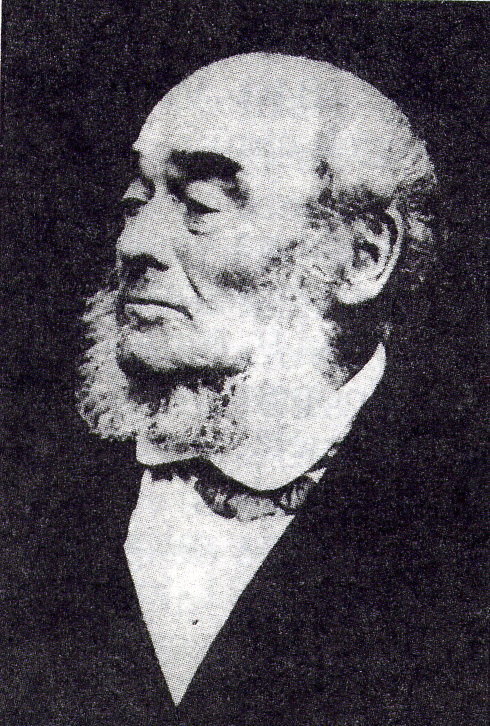
Vaclav Babinsky as an old man. Image in the public domain.
Knowing Babinsky’s full name has also allowed us to find out more about his crimes. He was convicted of attacking a government official, and there is some suggestion that this charge was for biting the town mayor, which makes for a suitably colourful episode in the life of a famous highwayman. However, he was also convicted of at least 2 violent robberies and involvement in a murder, which shows our folk hero in a very different light. Would Robert Noel have interpreted Babinsky’s head differently if Babinsky had been executed for his crimes and never had the chance to turn his life around?
Whether our students next year are working with objects in person, or if they are working with digitised archives, I cannot wait to see what they uncover in the collections.
Hannah Cornish is Curator of Science at UCL Culture
From Egypt to Malet Place: the Wissa Wassef Tapestry in Context
By Anna E Garnett, on 13 July 2021
The Petrie Museum curatorial team is delighted to have hosted two UCL students, Naomi Allman and Max Chesnokov, as virtual curatorial volunteers during this academic year. Here, Naomi and Max describe the display project they worked on during their placement and reflect upon the experience and the skills they’ve gained during the process.
Introduction to the Project
Max and Naomi: Sayed Mahmoud’s beautiful tapestry, ‘Dahshur Lake’, was the focal point of our exhibition design project for the Petrie Museum. Woven in 2003 at the Ramses Wissa Wassef Art Centre in Saqqara, Egypt, our task was to design a new display around this important object, placing it firmly in its historical and geographical context.
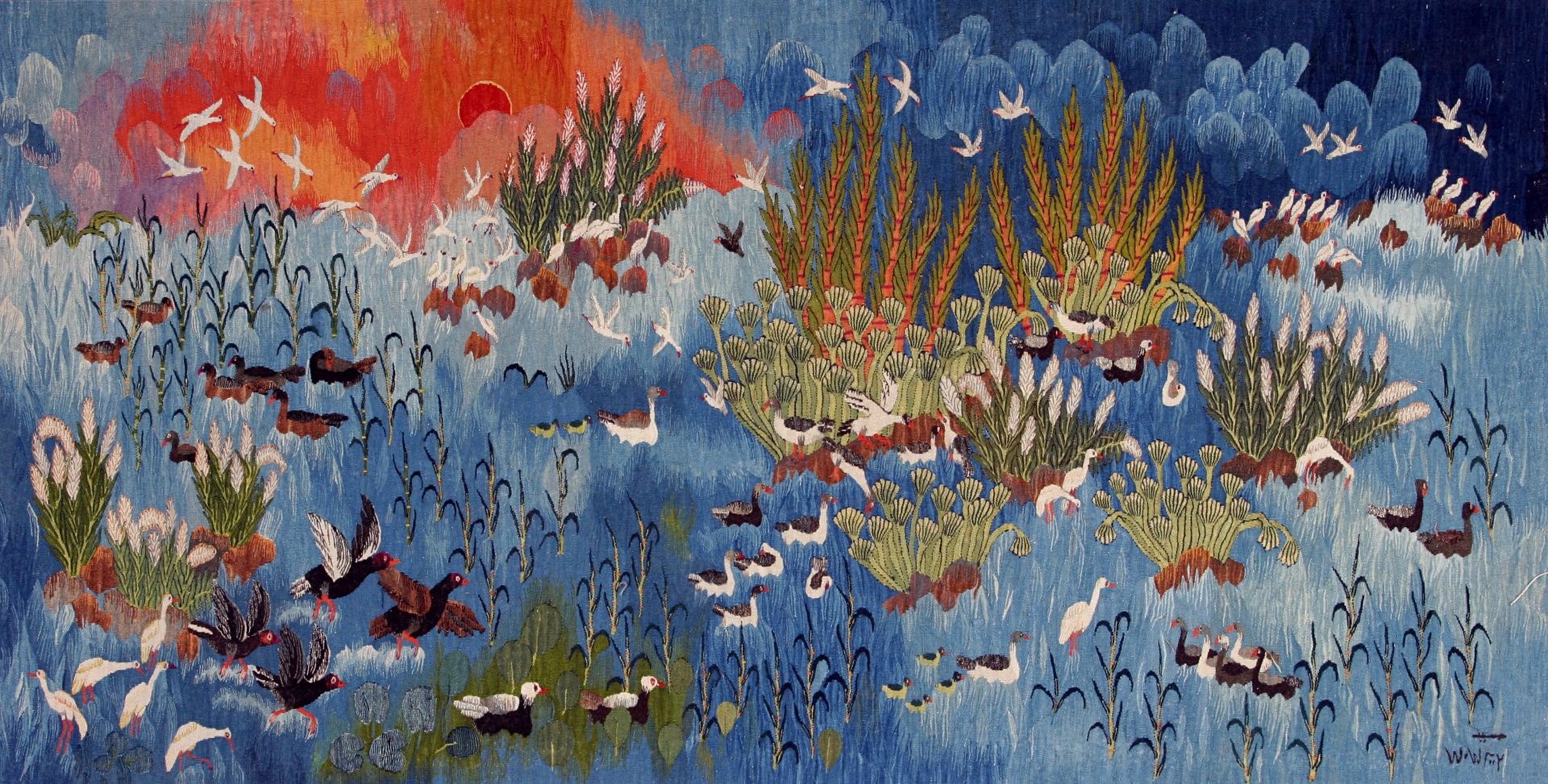
‘Dahshur Lake’ tapestry by Sayed Mahmoud (UC80605)
A key part of this project was to link the tapestry with other objects from the Petrie Museum collection that reflect the ‘image world’ of the tapestry, particularly the vividly coloured faience objects in the collection from the royal city of Amarna in Middle Egypt. The result of this project is a comprehensive display package, ready for the Petrie Museum to use at a future date when the Wissa Wassef tapestry (currently in temporary storage) is redisplayed.

Sayed Mahmoud at work in 2007 (image: Ivor Pridden)
The two main themes we chose for this future display are ‘Heritage in the Landscape’ and ‘Manufacturing Art’, joined together by the vibrancy of colour in a modern tapestry and in fragments of ancient faience (a glazed artificial ceramic).
The first theme, ‘Heritage in the Landscape’, presents an image of a relatively unchanged landscape from Late Dynasty 18 in pharaoh Akhenaten’s capital of Amarna (around 1350BC) to now. The beautiful floral and faunal motifs, represented in both the tapestry and in the rich faience assemblage from Amarna in the Petrie Museum, represent some of the most important elements of ancient Egyptian art. Faience is known for its vibrant colour, and it is here that we have another link between past and present.
The second theme, ‘Manufacturing Art’, takes a closer look at the production processes behind these objects. Here we explored the development of colour itself, from its mineral origins through to pigment processing and application, as well as the continuity between ancient and modern production. Most striking is the first known representation of a loom (UC9547) and an ancient limestone palette (UC2484) placed alongside a modern plastic watercolour palette and a photograph of loom types still in use today.
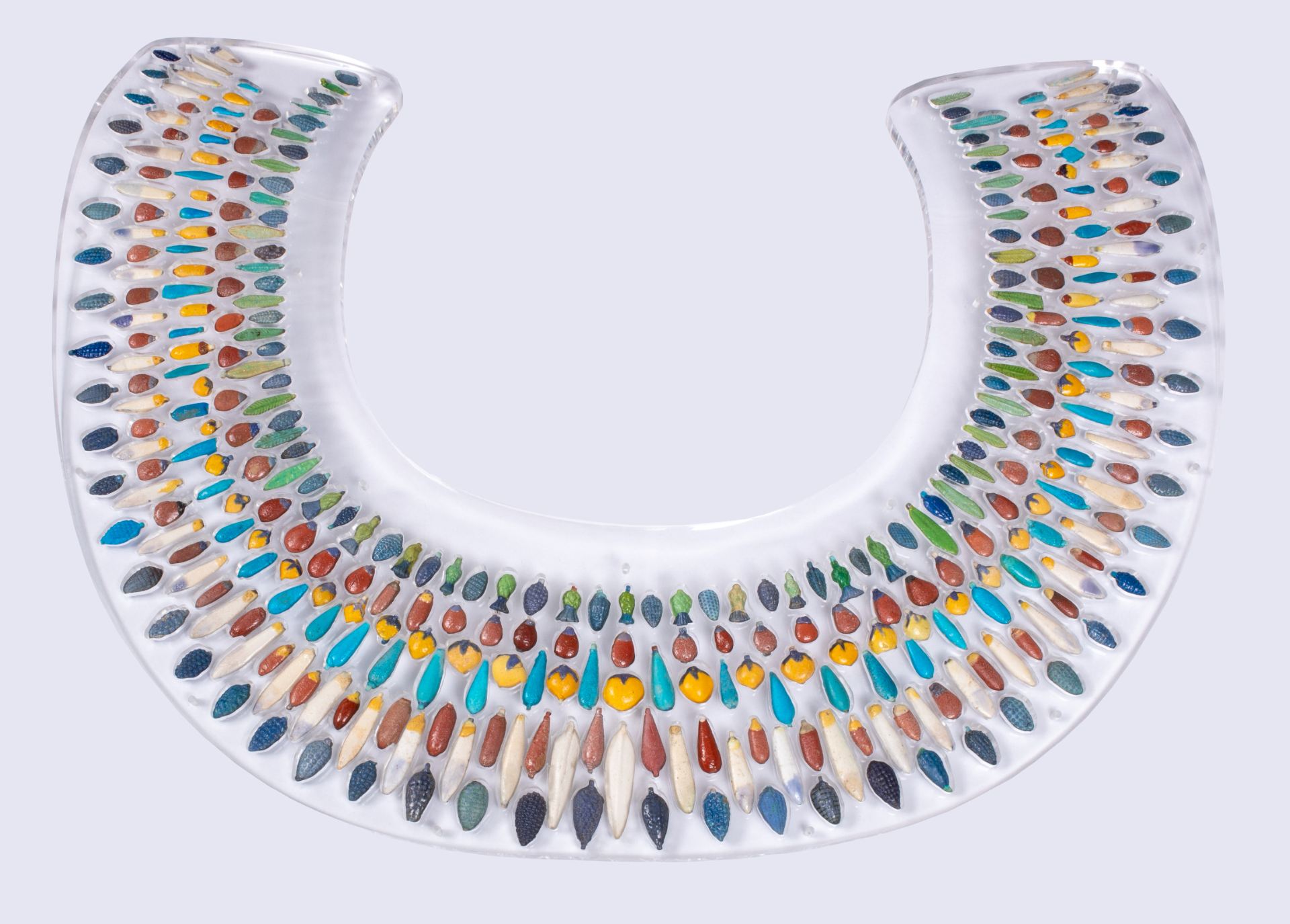
Faience collar from Amarna (UC1957)
The object we’ve chosen as a ‘spotlight object’ for the future display is a stunning faience beaded collar from Amarna, made up of 335 beads featuring vibrant floral motifs from grapes to petals and palm-leaves (UC1957). One bead in the collar even preserves the royal cartouche of Tutankhamun! This collar presents a unique link between Amarna faience and Sayed Mahmoud’s tapestry: a chance to bring together themes of colour, motif, and aspects of the Egyptian landscape both ancient and modern.
Reflecting on our Experience
Max: Working with the Petrie Museum’s collections has been incredible. Selecting only a handful of objects from its rich and representative tapestry (pardon the pun!) was a challenging yet rewarding experience as I got to know and understand these objects on a more intimate level. I enjoyed the process of selection based on not only the comparative links that they could evoke with Sayed Mahmoud’s art but also on their actual condition and viability for display. As a conservator-in-training I have a renewed desire to care for archaeological objects such as these as best I can in my future career so that they remain in place for future generations to learn from.
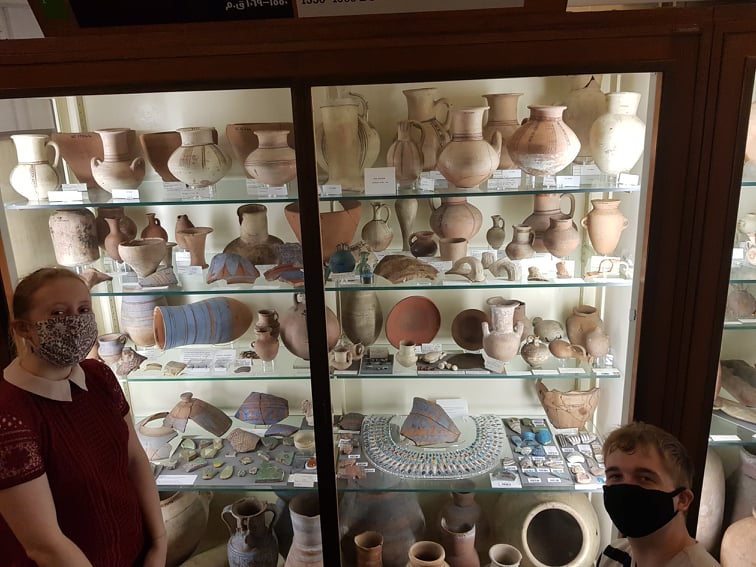
Max and Naomi in the Petrie Museum, June 2021
Naomi: As a child, I always loved seeing how the past is in many ways extraordinarily similar to the present, while still feeling like a whole different world. As an adult, it is my dream to work in museums and heritage, perhaps undertaking a similar role as this project. Working with the Petrie Museum’s collection has been an amazing experience, and one I will never forget. This museum is so unique, and I have loved working with it. I will take from this project a renewed love in Ancient Egypt (though my heart still belongs to Classical Archaeology!) and the joys the Petrie Museum holds.