X Close

UCL Ear Institute & Action on Hearing Loss Libraries

Home

Information on the UCL Ear Institute & Action on Hearing Loss Libraries

Menu

Archive for the 'Deaf Institutions' Category

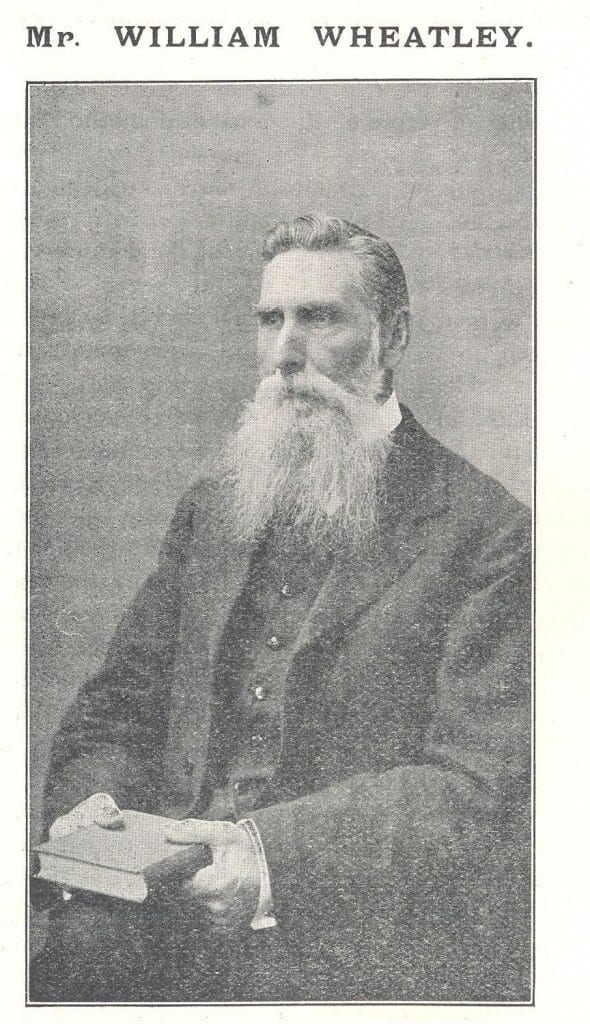
William Wheatley, a teacher at Exeter, Old Kent Rd and Margate

By H Dominic W Stiles, on 8 March 2013

William Wheatley was a veteran teacher of the Deaf at the Margate school from 1868-1911.  He was one of a number of the ‘old guard’ of the later 19th century teachers who retired in a short period leading up to that – Dr. Richard Elliott, Miss Wilcher, Mr. J.P. Barrett, and Mr. R. Pepper. I wonder how this huge change in personnel affected the methods by which the children were taught.  Has anyone done research on the methods of education of Deaf/hearing impaired children at around that time?Wheatley of Margate 001  The major shift was of course from sign to pure oralism.

Wheatley was born in London in 1842.  His family moved to Exeter where he was educated at Hele’s school.  He began teaching as assistant to Mr Scott at the Exeter Institute in 1857.  In 1861 the school had about 40 pupils up to 14 or 15 years old, six of whom were born deaf (see the 1861 census).  Moving to the Old Kent Road school in 1868, William worked under the then head, the Rev. J.H. Watson.  At that time the school had 350 students in classes of about 22, and we are told (in an appreciation of his career from Teacher of the Deaf, 1912, p.18-20), he took “duty” on alternate days.  From 1872-4 he worked at the temporary relief school in Margate.  On returning to London he married in 1874.

When Margate took on the majority of the school pupils in 1881, Wheatley moved there with the head, Dr Elliott.  The Milan conference caused a re-organisation of the teaching methods which is now infamous in the Deaf world, and Wheatley became a teacher of the oral method.  It might sound flippant, but quite how children were supposed to lip read through that voluminous beard I really cannot guess!  This is in fact a serious point, and one that the Rev Gilby touched on when he recalled Sir Benjamin Ackers, the ardent and heavily bewhiskered oralist, and his poor daughter who was Deaf, and never learned to sign.

By the time he retired he was first assistant master. In words that I suspect are by his erstwhile colleague Richard Elliot, the tribute says (ibid)

Mr Wheatley’s high Christian character has always influenced those who came into contact with him, either teacher or child. Keen student of all that pertains to the betterment of the deaf, efficient labourer in their service as he has been, the underlying force that brought the success he achieved was his love for deaf children and his unsparing devotion to their welfare. Even the naughty child would unburden his mind to Mr Wheatley, conscious of the sympathy and affection with which his wrong-doing would be viewed. And yet, the offender would know beforehand that his fault would not be condoned: but he felt sure of justice, calmly and kindly administered; and this begat that mutual confidence between the teacher and the child which has, in the case of hundreds of deaf children, proved to be of such potent influence in the establishment of character upon motives of the noblest description.

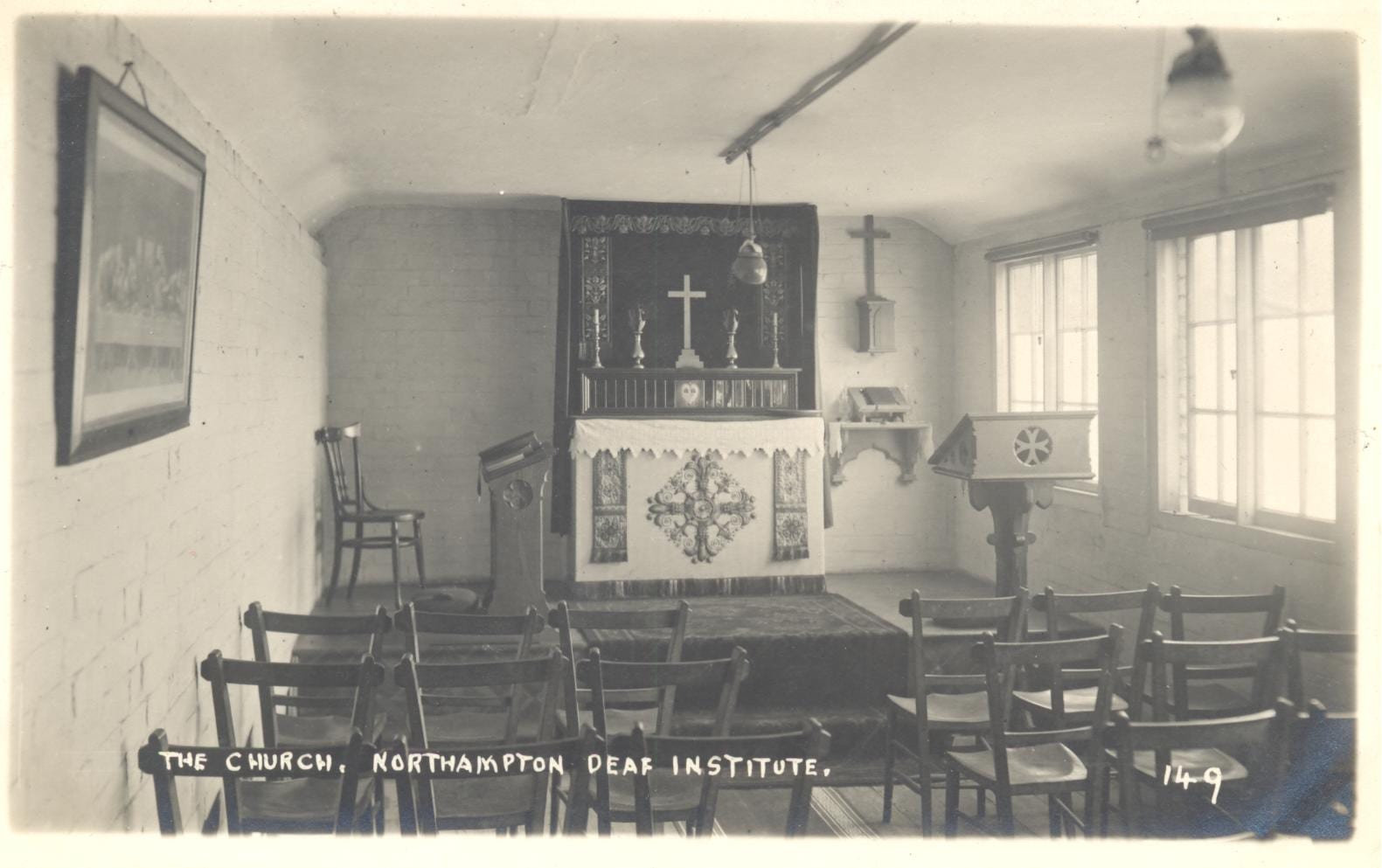
Northampton Deaf Institute

By H Dominic W Stiles, on 22 February 2013

The term ‘Deaf Institute’ can sometimes be confusing, as it can refer to either a school or a mission, or perhaps somewhere that accommodated both.  Many seem to  have originally been missions, and spreading a religious message to Deaf people was therefore at their heart, followed by their educational and social development (for instance with temperence meetings) and helping them with job opportunities where they could. 

The Northamptonshire and Rutlandshire Mission, which I assume is the same as the Northampton ‘Institute’ (can anyone confirm or deny this?), appears to have only started in 1928/9, with the missioner Algernon J.M. Barnett who had trained under the Rev. Albert Smith in London (Smith being Gilby’s replacement there at St. Saviour’s Oxford St.).  It met at 2 Seymour Place (see National Institute for the Deaf’s The Problem of the Deaf, Handbook for 1929).

Click for a larger size image.

There was a famous private Deaf School at Springhill, Cliftonville in Northampton, founded in 1868. The number of students was probably never large – in 1913 when the head was Ince-Jones  it could accommodate only 12 (see National Bureau’s The Deaf, Handbook for 1913).

We have the following mission Annual Reports -1929-1984 [missing 1939, 1941-1948, 1950-1953, 1967, 1970, 1973-1976, 1979, 1981,1982]

Orders taken…

By H Dominic W Stiles, on 25 January 2013

Some homes for the deaf found extra – probably modest – income from work that they did. The back of this photo (possbly circa 1910) tells us that this was the (female) Deaf and Dumb home at Bath. This Home for Deaf Women at 9 and 10 Walcot Parade, Bath, was founded by a clergyman’s daughter in 1868, then later taken over by the NID in 1932 and moved to ‘Poolemead’ at Twerton-on-Avon, near Bath, in 1933. Action on Hearing Loss still runs homes there.  Click onto the image for a larger size.

Picture post – three institutes – Huddersfield, Glasgow and Leeds

By H Dominic W Stiles, on 2 November 2012

A rather brief picture entry today – here are three Deaf Institutes from photos probably taken in the 1910s-1920s and probably by George Brooks. As usual, click on the photos for a larger scale.

Huddersfield Institute

 We have the follow annual reports for these institutions –

Huddersfield and District Adult Deaf and Dumb Institution

1913-1914, 1936-1938, 1948-1949, 1951, 1953, 1955-1965

Leeds Blind and Deaf Institute

Leeds United Institution for the Blind and the Deaf and Dumb

1892/93, 1911/12-1913/14, 1919/20, 1922/23-1924/25, 1926/27, 1927/28, 1929/30, 1930/31, 1932/33-1934/35, 1936/37, 1942/43, 1945/46, 1947/48-1950/51, 1953/54, 1962/63-1979/80, 1981/82-1984/85, 1987/88

History. British Deaf-Mute and Deaf Chronicle, 1895, 4, 33-34.

Opening of new school for blind and deaf children. British Deaf Monthly, 1899, 8, 255-257 (photos)

British Deaf Times, 1903, 1, 29-30. (with photos of staff)

Glasgow Society for the Education of the Deaf and Dumb

1829, 1831-1834, 1837-1861, 1869, 1870, 1872, 1873, 1885, 1889, 1890-1900, 1904, 1908, 1911-1914, 1919, 1924, 1942-1958, 1961, 1962, 1964

Institution for the Deaf & Dumb, Glasgow, in The Edinburgh Messenger, No.6, p.57-62, April 1844

Quarterly Review of Deaf-Mute Education, 1888, 1, 335-46, 384-87

Glasgow Institute


The Northern Counties School for the Deaf in Newcastle

By H Dominic W Stiles, on 28 September 2012

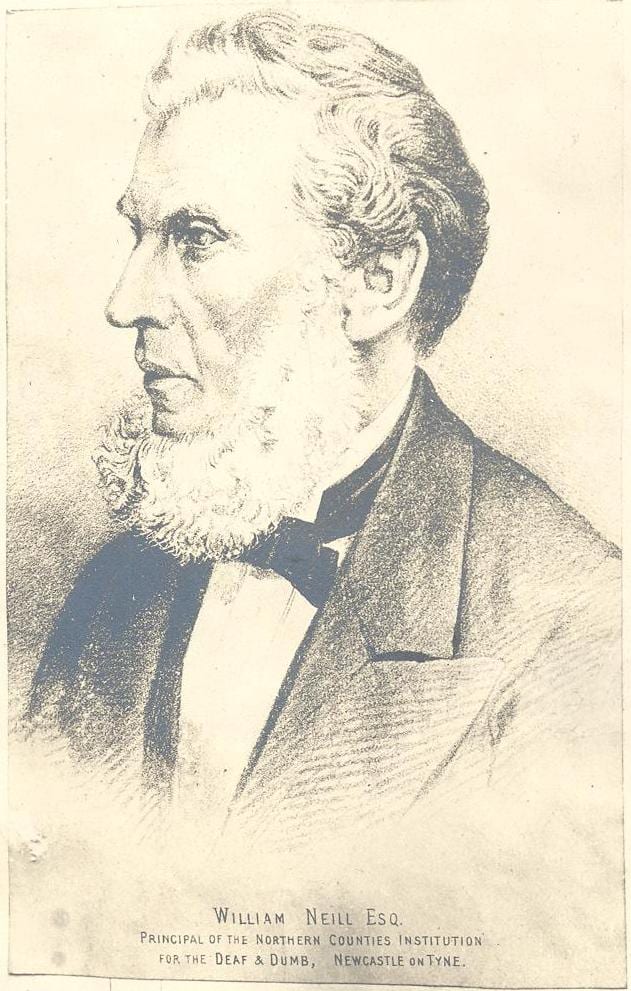
The Northern Counties School for the Deaf (originally the Northern Asylum for the Blind, Deaf, and Dumb) was the first public Deaf School to be founded in Queen Victoria’s reign in June 1838. The school’s first location was in Pilgrim St, Wellington Place.  Its first head was Mr A. Patterson (according to Selwyn Oxley’s card index*), but then a Mr Gould took over and he was in turn replaced by William Neill (in 1845/6) who had been at the Yorkshire Institution.

The first annual report that we have(1846) tells us that there were at the time of writing 31 inmates,

“of these nine are Blind, and twenty-two are Deaf and Dumb.  During the last year eleven Deaf and Dumb children have left the Asylum, and these have been apprenticed to useful occupations, or have returned home to assist their parents. […] It has been well ascertained that there cannot be fewer than five-hundred-and-fifty Deaf and Dumb in the four Northern Counties, of whom only twenty-five are at present under tuition, viz.:- 22 in the Northern Asylum; 1 in the Liverpool Institution; 1 in the Yorkshire Institution; 1 in the Manchester Institution.”

Born in Denny near Stirling on 31st of October 1818, at the age of only fourteen William Neill commenced work as a teacher under Duncan Anderson at the Glasgow Institution where he remained eleven years (Deaf and Dumb Times).  At a meeting in December 1848 Neill carried his plan to separate the education of the blind, and after a brief move to Charlotte Square, in 1861 the Institution moved to specially created premises in North Rd.  The arms manufacturer Sir W.G. Armstrong contributed generously to the cost of the new building.

In 1850 Neill married the Institution’s matron, Miss Jessie Cunningham Wright. In his obituary the Deaf and Dumb Times says

Mr Neill saw the Deaf and Dumb Institution of this city at its lowest ebb, and frequently he had to advance money out of his own pocket to keep the Institution going. Through his exertions- ably aided by his devoted wife- he saw the institution gradually grow in importance, usefulness, and influence, and has lived long enough to see it not only entirely free from debt, but almost self-supporting.
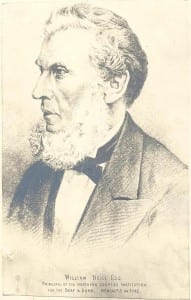
Click onto the picture for a larger size.

Neill was followed as head by Mr Andrew Wright (1890-?1910).  Wright was born in Edinburgh in 1834, then studied at the Edinburgh Royal High School which he left in 1869.  He came to the Northern Counties School shortly after that, becoming second master in 1883 (Ephphatha, p.41).

“In this rush for the ‘betterment’ of teachers,” said our own Gamaliel, “there is a distinct tendencyto run too fast and too far, and, as you know, I have not hesitated to raise my voice, feeble though it be, against it. […]
“Your leading horses, Otium and Oralism, are no doubt nice looking, sleek, and well groomed animals,” continued Mr. Wright, “but they will give you a nasty spill if they are not kept well in hand, and there are already indications that the man on the box is losing control. My advice is to ‘swop horses’ ere you reach the stream, and if you replace your leaders with these two thoroughbreds, Self-Denial and Anti-Humbug, you’ll mount the hill of Secondary Education, now looming in the distance, in grand style.”

“And do you consider that a commensurate improvement has also been effected in the education of deaf and dumb children?”

Andrew WrightMr. Wright’s answer is somewhat startling.  “I am afraid not,” said he.  “Doubtless a much larger proportion is being educated, but I do not find that the standard of general education has advanced.  I admit that their school curriculum now includes more subjects than were thought of 20 or 30 years ago, but we must confess to a weakness in their composition, and a meagreness in their general knowledge and attainments that was not so apparent in former days.”

I thought of men like Armour, Paul and Agnew; of Muir, Maginn, and McGregor; of Bright-Lucas, Payne, Davidson, and many another, and recognized that, compared with these, the scholars of the present day were “no great shakes.”  I asked Mr. Wright to what he attributed this “unsatisfactory state” of affairs.

“Some headmasters and teachers with whom I have discussed this subject, attribute this decline to the time spent over articulation; others say that now-a-days too much time is devoted to kindergarten and manual training during school hours.  But be the cause what it may, the result is one which we must all deplore.” (Ephphatha, P.41-2)

After Andrew Wright, came Mr D.C. Baldie (1910-26, then administrative head for a further two years); Miss Hutchinson (teaching head 1926-8); Mr W. Wearmouth (from 1928 to 1963); Mr F.W. Hockenhull (1963-65).  During the war the school was temporarily evacuated to a camp on the Northumberland coast.  According to the 1941 Annual report, the school resumed at the Institution on the 3rd of April, 1940.  The same report tells us that 5 tons of potatoes were produced from 3/4 of an acre of the school’s land put under cultivation – a valuable addition to the war effort at a time when food production was critical.  In 1946, one of the teachers, Mr. Mundin, left to become head of Mary Hare School.

The 1978-9 Annual report has this brief chronology of the school –

1838 School founded in Wellington Place
1849 School moved to Charlotte Square
1861 School moved to a new building on the Great North Road
1905 Extensions to School Building
1909 School Hospital opened
1955 Nursery Department building opened
1966 Major alterations and extensions to Junior and Secondary teaching accommodation
1967 New Senior Residence, Swimming Bath and Gymnasium opened
1968 Provision of car parking facilities for pupils’ transport
1971 Extensions to Nursery Department teaching and residential accommodation and provision of Educational Assessment facilities

In 1963 when Wearmouth retired, he wrote in the Annual Report,

I am pleased to record my appreciation of the excellent work Mr. Boon has done for the School.  He was always available to help out and I thank him sincerely for the valuable aid he gave me.  I will miss him as we have been colleagues for some 40 years.
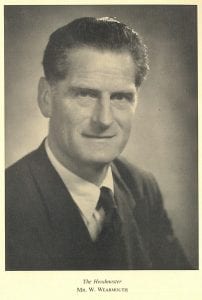
WearmouthInterestingly, the 1964 report tells us (p.7) that there had been a drop in numbers as there were no longer partially hearing children in the school. There were 170 pupils registered that year.  In 1965 Mr. Hockenhull and his wife left to become Headmaster and Matron of the Yorkshire Residential School in Doncaster on the 1st of January, 1966, where he replaced D R. E.S. Greenaway. The new Head was Lionel Evans. In the 1968-9 Annual Report it seems that there were 198 pupils from fifteen Local Education Authorities. The prize-giving in 1970 was done by Mr and Mrs John R. Boon. John Boon was at the school for 43 years, 26 as Deputy Head, and Mrs Boon was at the school for 19 years.  The 1980-81 report shows that the school was facing a financial crisis, and that the number of registered pupils was down to 125 from the previous year when it was 143.  In his comments, John Atkinson the Chairman of the Governors, said that the drop meant that some positions in the school had therefore become redundant.  The drop was a direct result of increased ‘mainstreaming.’  At the time Evans was The Powrie Doctor Visiting Professor of Deaf Studies at Gallaudet College.  The acting Headmaster, T.A. Purdy, defended the school:

Dr. Conrad’s recent research strongly indicated that the ‘combined method employed in this School is the most appropriate method for the education of profoundly deaf children.  The publication “Psychology and Communication in Deaf Children” by R.D. Savage, L. Evans and J.F. Savage, which is based on research carried out in the School from 1973-79, has now been published and complements Conrad’s findings, adding evidence as to the efficiency of “manual media for for transmission of linguistic information” (p.245). There is also an abundance of American research which has findings supporting the use of this method.  The School has a staff well-skilled in using the combined oral-manual method.

The following year, the number enrolled had dropped further to 104, 46 resident and the remainder day pupils.  There was a consequent drop in staffing levels, and in the last annual report we have, for 1982-3, there were only 98 pupils, down from 188 a decade earlier.  The school celebrated its 150th year anniversary in 1989.  It seems to still be going according to the OFSTED reports (below).  It seems there are school records in the Tyne and Wear Archives.

Further Reading:

Mr. Andrew Wright, an interview. Ephphatha 1898, p.41-2

HALL, I. Keeping it in the family: five generations of deafness at the N.C.S.D. Deaf History Journal, 2000, (3), 8-20.

History. Annual report, 1979-80. p. 26. [just the timeline above]

Magazine intended chiefly for the Deaf and Dumb, 1878, 6, 155-58.

Quarterly Review of Deaf-Mute Education, 1891, 2, 321-326.

School for the deaf in Newcastle upon Tyne celebrates its 150th anniversary. British Deaf News, 1989, 20(3), p.6

Wagg, Henry,  A Chronological Survey of Work for the Blind from the Earliest Records up to the Year 1930

William Neill  (1818-90)

Deaf and Dumb Magazine (Glasgow), 1880, 8, 97-98 (illus between p. 105 and p. 105)

Obituary. Deaf and Dumb Times, 1890, 1 (12), 141-42. (illus)

Obituary. Quarterly Review of Deaf-Mute education, 1890, 2, 203-06

Quarterly Review of Deaf-Mute Education, 1890, 2, 161-62

Also Annual Reports for:

The Northern Asylum for the Blind and the Deaf and Dumb, 1845-1847

The Northern Counties Institution for the Education of the Deaf and Dumb (and other names), 1851-5, 1884, 1886, 1910-11, 1913-15, 1919-20, 1923, 1925-48, 1949/50-70/71, 1974/75-77/78, 1979/80-82/83

OFSTED Reports

EDITED 3/10/2014 *This information is confirmed by other sources – see blog entry on Patterson.

EDITED 21/6/2016 Substantial quote from Wright added.

EDITED 27/2/2017 Added much more on the post-war years in response to a comment to bring the item up-to-date.


Aberdeen Institution for the Education of the Deaf and Dumb

By H Dominic W Stiles, on 29 June 2012

ABERDEEN INSTITUTION FOR THE EDUCATION OF THE DEAF AND DUMB (1817-?); later the Aberdeen School for the Deaf

As with the Glasgow Institution, it was inspired by the Edinburgh Institution and its teacher Mr Kinniburgh.  It began at a house in upper Kirkgate in Whitsun 1819, later moving to School-hill.  The young teacher, Mr Taylor, was sent to train in Paris under the Abbe Sicard in 1818.  When Taylor resigned in 1833 a Deaf teacher, Mr Burns, took over until 1841.  From 1841 the teacher was Mr. Weir. In 1909, when the head was Alexander Pender (see picture below, with what appear to be long johns under his kilt!), there were 21 pupils at the school.

A rival day school was set up in 1818 ‘by a person of the name of England’ but it was unsuccessful and closed after a few years.

The school is still going, and has a link to the Education Secretary Michael Gove whose mother taught there.

History. Annual report, 1821. pp. 12-15. [photocopy of original]

Aberdeen Institution – in The Edinburgh Messenger, No.7, p.69-75, June 1844.

New development for Aberdeen School. British Deaf News, 1998, Jun, 3.

Annual Reports – 1821 (photocopy), 1844-6, 1846-1847, 1879, 1910-1912

Mission work in a constituted form did not however begin in Aberdeen until the late 19th century, something we see in other parts of the country.  The Aberdeen Deaf and Dumb Benevolent Society (1895-1959) was founded in 1895, later becoming The Aberdeen & N.E. Society for the Deaf (1960-? ) and The Aberdeen and North East Deaf Society (?-2010). Money problems were a constant issue for these missions, which have always lived on public generosity or small assets, and sadly the Aberdeen society crashed in 2010 with large debts.

We have the following annual reports –

1899-1922 (Bound volume), 1900-1970/71, 1976/77-1980/81 loose

One person of note connected with the mission was  William Wright (1859-1941). The son of deafened parents, he became Missioner at the Aberdeen Deaf and Dumb Benevolent Society in 1896. His son Hugh was Missioner at the Glamorgan and Monmouth Institute from 1931-39 and his daughter-in-law became Matron at Castelview Home in Edinburgh from 1945-62.

WRIGHT, T. William Wright. Deaf History Journal, 2001, 4(3), 18-20.

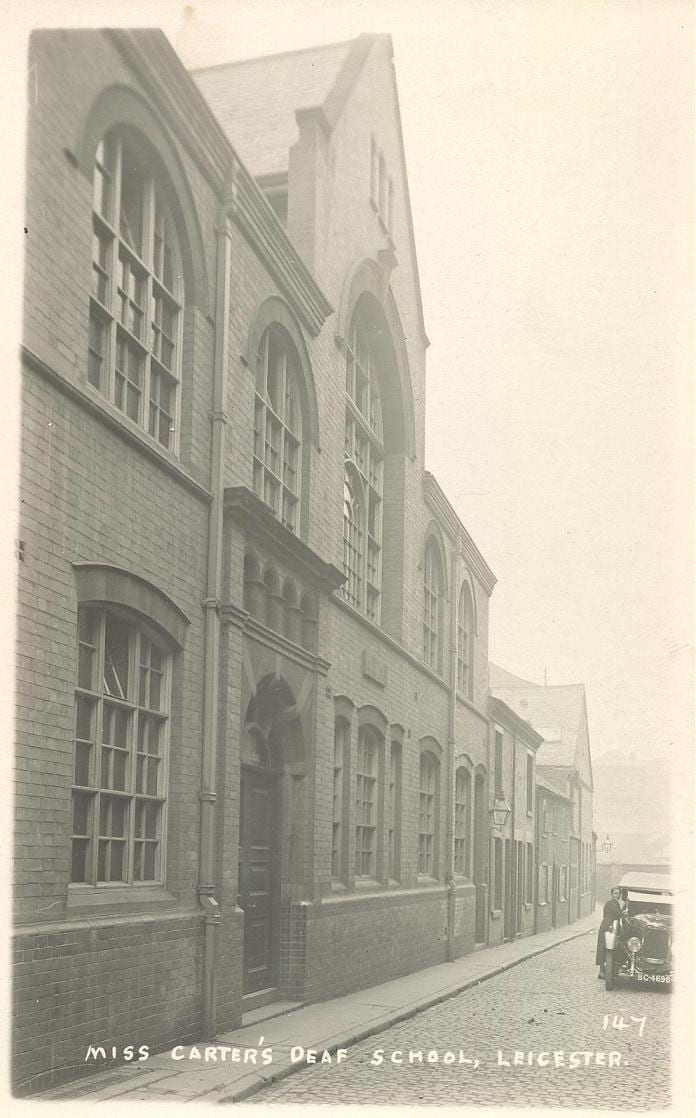
Miss E. Carter’s Deaf School, Church Gate, Leicester

By H Dominic W Stiles, on 8 June 2012

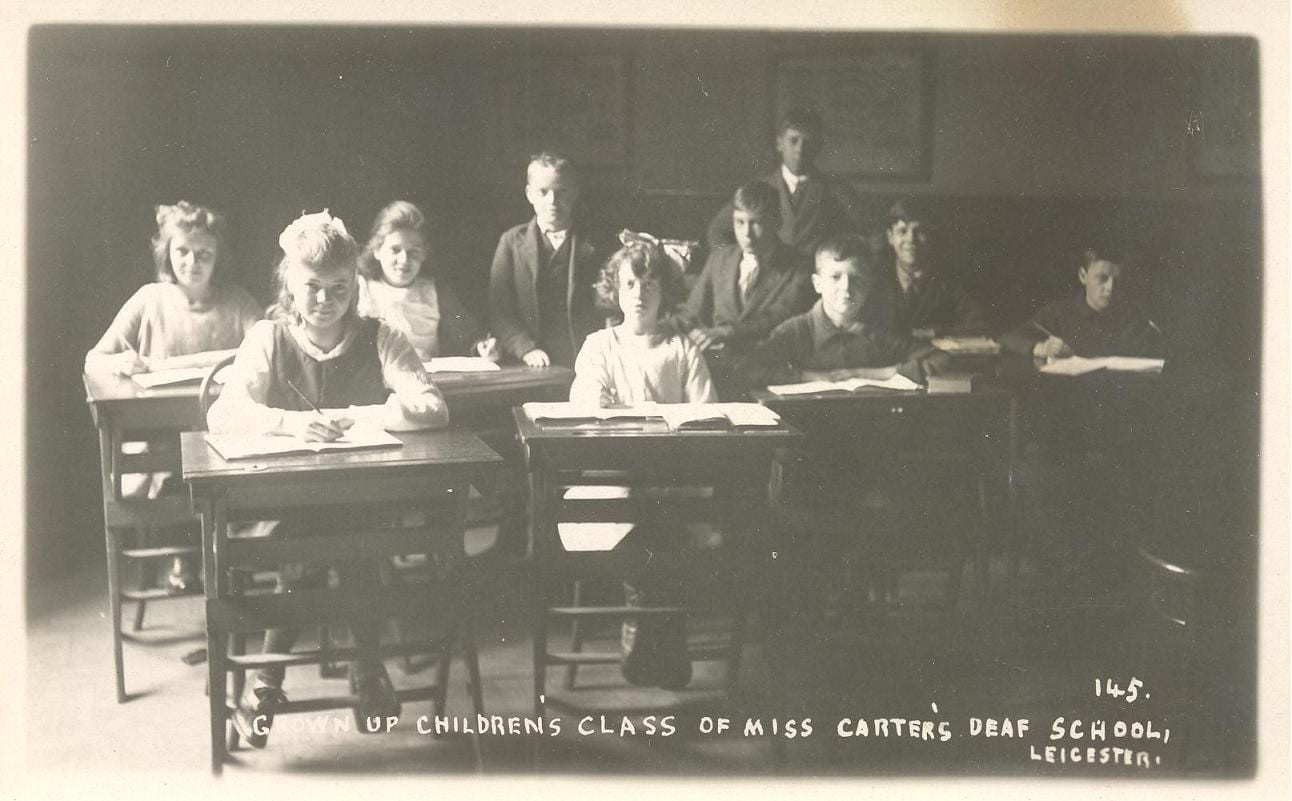
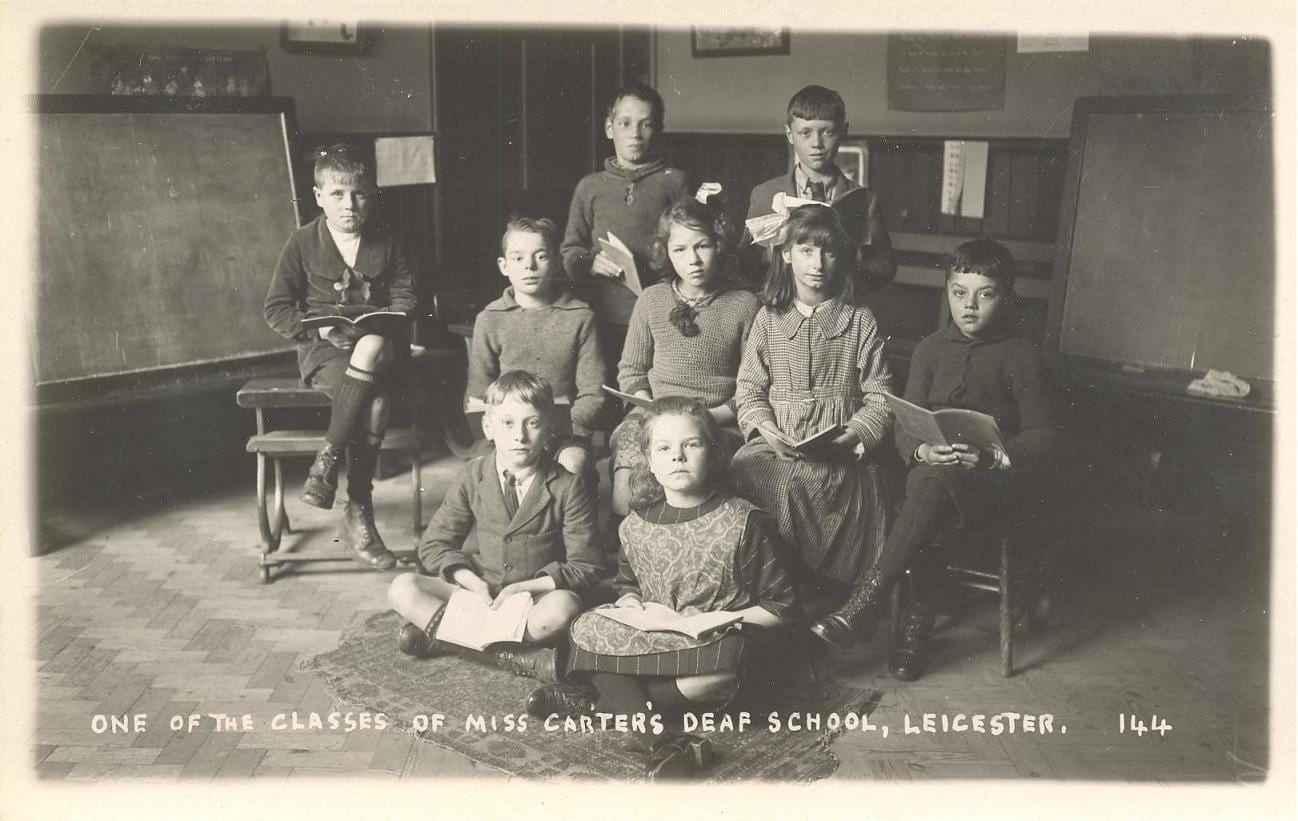
Miss E. Carter‘s School at Church Gate, Leicester, was not as I first said here, comparatively short lived. It was started as early as 1884, with a deaf class in the local Education Board School in Milton Street, and fell under the auspices of the Leicester Education Committee, as we see from the Deaf Handbook compiled by the National Bureau for Promoting the General Welfare of the Deaf (1913, p.3).  In 1888, according to the British History Online website (see link above), another class was started at a school in Elbow Lane.   In 1894 a school in Archdeacon Lane became dedicated to the education of the deaf.  In 1903 the school moved to Short Street, in space hired from the Friends’ Adult School.  Exactly when after that the school moved to Church Gate, I cannot be sure, but suppose it was not long after.In 1913 the school held up to thirty pupils from the age of five, and they were taught with the Oral method. Miss Carter was a member of the National Association of Teachers of the Deaf – and she gave a paper at a National Congress in 1913, on the education of deaf girls.  I have struggled to find out more about her, like her first name, but I have discovered from Selwyn Oxley’s card index, that when she retired, Miss A. Metcalf from Tottenham was appointed, and the school closed at Church Gate, moving to a building called ‘Stoneleigh,’  in Stoneygate Road,* then on the outskirts of the town, in 1927.  It closed in the 1980s.

In the 1920s the Leicester Deaf Missioner was Leslie Edwards.  I looked  through a number of the mission reports, expecting to see mention of the school, but there was nothing that jumped out.

As well as local authority schools, there were quite a few small private schools across the UK in the 19th and early 20th centuries which obviously filled a need.  Some managed to thrive like Mary Hare’s, but eventually most of them would close when the leading teacher(s) retired.   These photos are from the Oxley collection so date from some time from approximately 1914 to the mid or late 1920s.

Click onto the pictures for a larger size.

Blog re-written 15/9/2017

UPDATE: 9/9/2019

The greater part of records concerning the Stoneleigh School for Deaf Children are held by the Record Office of Leicester, Leicestershire and Rutland, while there are also some at the National Archives at Kew: although those at Kew cover the years 1935-1942. The National Archives’ reference is ED 32/968: no indication of what the material consists of was given on their catalogue.

The Record Office of Leicester, Leicestershire and Rutland has the Logbook for the Deaf School for the years 1955-1981 (reference DE 2275/3), the admissions register for the years 1932-1969 (DE 2275/8), the Summary Register (Deaf) for the period September 1959 to July 1964 (DE 2275/12) and the subsequent volume covering September 1964 to July 1969 (DE 2275/13).

These records are partially closed under the Data Protection Act, and you would need to contact the Record Office to discuss access; you will be able to see information relating to you, if you attended the school, but there will be restrictions on the information regarding other people you can see. Their email address is recordoffice@leics.gov.uk and their website is http://www.recordoffice.org.uk/.

*Stoneygate Street is a tautologous name, as ‘gate’ is Danish for ‘street’ and is a loan word from the time of Scandinavian settlement!

London Asylum for the Deaf and Dumb

By H Dominic W Stiles, on 20 April 2012

London Asylum for the Deaf and Dumb (1792-1902) and the Old Kent Road School (1902-1968)

The first free school for deaf children of the poor in the UK, the London Asylum was founded in 1792 by the Rev. John Townsend. Here is a brief chronology.

1792    Opened in Grange Road, Bermondsey.

1809    Moved to Old Kent Road, Southwark.

1840    The streets each side of its grounds were named Townsend Street and Mason Street after its founders.

1862    Some pupils moved to temporary accommodation in Margate.

1875    New building opened in Margate – younger pupils educated in London, older pupils in Margate.

1883    Younger pupils moved from London to temporary accommodation in Ramsgate.

1886    Old asylum demolished and new building for younger pupils erected on its site.

1902    Pupils in London moved to Margate (now the Royal School for Deaf Children, Margate), and building and site sold to the London School Board.

1903    The Old Kent Road School opened, with a school for physically handicapped children on the ground floor and a school for deaf children on the second floor. Properly speaking therefore, this school was a new foundation.

1904    London County Council took over the functions of the London School Board.

1908    J.D.Rowan became headmaster until he retired in 1932 (British Deaf Times, 29 (341-2), 56).

1965    The Inner London Education Authority took over the functions of London County Council when the latter ceased to exist.

1968    The Old Kent Road School closed and a new school, Grove House in Elmcourt Road, Norwood, opened, surviving until 1999.

LCC Old Kent Rd School – Games (click for larger size) I suspect the man on the left is Rowan.

Deaf Pupils Included (among others)

ARNOLD, George (1855-1922) Deafened at the age of 8 and educated at the Old Kent Road and St John’s College, a private school in Margate; on leaving school trained as a tailor with Mr W. Fletcher, tailor to King King Edward VII.

ALLERY, Bernard (1921-93) Team manager and chairman of Lewisham Deaf Football Club; educated at Old Kent Road School and Anerley Deaf School.

ASH, Harry (1863- 1934) Deafened by scarlet fever at 18 months; sent to the London Asylum in the Old Kent Road when he was 11, and later to Margate; designer at the Hogarth Works, Chiswick.

BLOUNT, Hiram (1870?-1932) Deafened at the age of 5; educated at Old Kent Road, London; missioner to the deaf in Plymouth from 1899 until his death in 1932.

DAVIDSON, Thomas (1842-1919) Private pupil of Thomas Watson at the Old Kent Road Institution, who became an artist specialising in naval scenes.

GLOYN, John Pugh  (1830-1907) Son of a London solicitor; deafened between 2 and 3 years old and educated at the Old Kent Road Asylum ; set up in business as a mathematical instrument maker; involved in ‘deaf work’ in a voluntary capacity until 1872 when he was appointed Missionary for the Northern District of the Royal Association for the Deaf and Dumb.

POLCHAR, Mark Michael (1903-94) Pupil at Old Kent Road and Anerley Deaf Schools; founded Clapham Deaf Club’s cricket and football teams in 1925.

(There are references for all the above people  for those interested.)

Further reading:

An historical sketch of the purposes, progress, and present state, of the asylum for the support and education of the indigent deaf and dumb children, situate in the Kent Road, Surrey: with the rules of the society, and a list of its officers and governors. London, March, 1831, see Margate School institutional archive box.

History (up to 1843) The Edinburgh Messenger No.2, p.10-11, 1843

History (up to 1876). Deaf and Dumb Magazine (Glasgow), 1879, 7, 40-43. (illus)

History (up to 1880). Deaf and Dumb Magazine (Glasgow), 1880, 8, 14-26. (illus)

Quarterly Review of Deaf-Mute Education, 1887, 1, 167-78, 197-202.

History, British Deaf-Mute and Deaf Chronicle, 1894, 3, 81-82. (illus)

Teacher of the Deaf, 1904, 2, 29.

British Deaf Times, 1906, 3, 121-25. (photos)

ALLERY, B. Old Kent Road School for the Deaf. The author, 1969 and 1971. (RNID Library locastion: C5664 (REF)

also in: British Deaf News, 1969, 7(5), 148-49.

A mother and her son. British Deaf News, 1997, Jun, 7. (Mrs Creasy and her deaf son John were the inspiration for Rev Townsend’s action; John Creasy trained William Hunter, the Asylum’s first deaf teacher.)

Some religious newspapers for the deaf [updated]

By H Dominic W Stiles, on 23 March 2012

It can be very confusing trying to identify the various combinations of newspapers and missionary journals aimed at Deaf people in the late 19th and early 20th centuries. It was often a struggle for these papers or journals to survive, as they had to find their widely distributed audience and persuade poor people to part with their money to buy copies. They would seem to have been labours of love, and were naturally impregnated with a strong religious element. The Rev. Gilby, about whom we have written previously, was involved with a few of these papers. This is a brief attempt to show the relationship of some of them.

The Deaf and Dumb Herald and Public Intelligencer (1876), by Ralph Clegg, see that link for more details.  Not really a religious paper, though it had of course rtones of that.  It is here because t may have been confused with Gilby’s Herald, see below.

Our Little Messenger to the Deaf and Dumb (1882-?) was a heavily religious short pamplet with some news items on the back page, published by Miss E. Jones of The Mall, Ballyshannon, County Donegal.  

Gilby’s first attempt at a ‘paper’, or perhaps a journal, appears to have been –

The Herald (1885-7), which is mentioned in the first edition of Our Quarterly Paper (1892-3), where it says, “Those of our readers who know the editor best, will remember that many good things were said and printed in it, though with much labour.”  We have not see any copies and it is possible none survive.  Gilby does not talk much about his papers in his memoirs and does not mention eother of these by name.

Our Monthly Church Messenger to the Deaf, (1894-5) edited by Gilby, A. Macdonald Cuttell and W.W. Adamson.  Adamson (1867-1947) was first chaplain for the Deaf at Newcastle Deaf School.  A native of that city, Adamson was educated at Dr. Bruce’s Academy.  From the age of 18 he took a great interest in the Deaf, as in his Boy’s Club he met a Deaf and Dumb boy and got him educated at the Northern Counties School for the Deaf, then recently moved from a house in Charlotte Sq. to Town Moor.  There he found many other Deaf children and from that day in 1885 his vocation was found.  He became a Lay Missioner then a Chaplain and Canon.

In 1896 Our Monthly Church Messenger to the Deaf, became –

Ephphatha, and in 1897 the sole editor was Mr A. Macdonald Cuttell.  This paper amalgamated with-

The British Deaf Monthly in 1899.

The news sheet or circular Our Notice Board, begun in 1901, seems to have been an R.A.D.D. production for the London mission.  Later on ephphatha would be published with local mission newsletters like this one.

Ten years later Gilby was once more involved with editing a newspaper, and he revived his title,

Ephphatha (1909). This paper, or small magazine, included the R.A.D.D. circular, and became the R.A.D.D. magazine. In 1948 it started a new series, but in 1959 it finally ended its run.

[Updated 16/10/2015]

For more information on our holdings of these and other Deaf papers, please contact the Action on Hearing Loss Library.


A.J. Story, Teacher of the Deaf and first secretary of the National Institute for the Deaf

By H Dominic W Stiles, on 16 March 2012

STORY, Arthur John (1864-1938)

Teacher of the deaf, Head of Stoke School 1896-1925, and active in the foundation of the National Bureau for Promoting the General Welfare of the Deaf, Story was born in Rochester, Kent, in 1864.  He began teaching in 1878 at an elementary school there. After attending teacher training college at  St.Peter’s College, Peterborough, he joined the staff of the Royal School for Deaf and Dumb Children, Margate, where he stayed for three years under the then head, Dr. Richard Elliott. He went on to gain further experience teaching at both the Manchester and Derby Institutions, and at the age of 32 (1896) was appointed Headmaster at the newly established North Staffs (Stoke) School, the first residential local authority school established after the Elementary Education Blind and Deaf Children Act of 1893 made the education of deaf children compulsory, placing the duty to provide that education onto the Local School Boards (see Stainer in a previous post).

As an author, Story wrote a number of very influential works which spread his ideas and methods across education of Deaf children in the U.K., for example Speech for the deaf (1901), Language for the deaf: a book for the use of teachers (1905 and 1927), Speech reading for the deaf – not dumb: a book for the use of those who have become deaf after having naturally acquired, through hearing, a knowledge of the English Language (1925), Speech reading and speech for the deaf (1915), etc.

Editor of Teacher of the Deaf for 18 years from 1903 when it began, Arthur Story was twice Chairman of the National College of Teachers of the Deaf (1910-11, and 1920-21),  as well as fulfilling many other roles. He married Jane Turner, also a teacher of the deaf, in 1895, but she died in 1928.

Story played a key role in the foundation of the National Bureau for Promoting the General Welfare of the Deaf in 1911, and when the organisation was reconstituted in 1925 as the National Institute for the Deaf he became its first secretary. Clearly a man of organisational ability, Story “infused new life into its activities” and in 1933 was able to oversee the move from cramped quarters to a new office in Gower St, which reamained home of the N.I.D. and R.N.I.D to the 1990s. The N.I.D. wrote, “he was keenly interested in endeavouring to obtain by means of an Act of Parliament privileges for the deaf similar to those already enjoyed by the blind.” He instigated the move of the Home for Deaf Women from Walcot Parade in Bath to new premises, the new ‘Richardson Home’ in the Midlands, as well as the Hostel for Working Lads in North London. He also established the District Associations of the N.I.D.

Story seems to have been appreciated if not loved. Carey Roe does not pull any punches in his obituary. He says,

I first came into contact with him, as a boy, about forty-five years ago – he gave me my first lessons in swimming and clay-modelling – and from the beginning I had for his work and for himself a very sincere admiration. From Derby, where he was Head Assistant to my father, Story went as Headmaster to Stoke, where seven or eight years later I became a junior member of his staff and for five years worked under his inspiration and guidance. Those years made a deep impression upon me at the time and I owe much to him not only for what he taught but for what he practiced; Story was no easy taskmaster, but he himself set the example in hard work and one valued his informed comments and criticisms, tinged as they often were with irony which helped if anything to impress his points. Perhaps it was at this stage that I acquired an immunity to Story’s tendency to sarcasm – it was part of the man – which others of his colleagues found somewhat trying at times.

Carey Roe goes on to compare him with other teachers of his age –

Story was not always an easy man to work with; he was apt to be very definite in his views and not at all hesitant about saying what he thought of those who differed from him. But, all in all, he was a great man, a personality, and he gave unstintingly of his time, his energy and his great ability to promote the cause he had at heart. Story is the last of a great trio of men- Nelson, Barnes and Story – who for twenty years, each in his own way, were the dominating figures of deaf education.

Perhaps a more kindly conclusion would be to quote W.R. [possibly the Rev. William Raper?] in the British Deaf Times;

Mr.Story and Mr.Frank Barnes, his great friend, may be called the originators of the N.I.D., formed from the Leo Bonn Bureau. We were present at its inaugural meeting, voting and subscribing on the occasion. The writer of this notice being somewhat deaf, Mr.Story kindly gave him an electrical hearing aid.

The Picture shows Story at work in his N.I.D. office.

Late Mr. Arthur J. Story.British Deaf Times, Vol.35, September-October 1938, p.132

The Late Arthur John Story, NID Annual Report 1937-8, 16-17 (photo)

W. Carey Roe, Arthur John Story, “At rest”, September 11th, 1938. Teacher of the Deaf, Vol.36, October 1938, No. 215 p. 161-2.

“The Times” and Mr. Story. Teacher of the Deaf, Vol.36, October 1938, No. 215 p. 163