X Close

UCL Ear Institute & Action on Hearing Loss Libraries

Home

Information on the UCL Ear Institute & Action on Hearing Loss Libraries

Menu

Archive for the 'Deaf Education' Category

William Morris School for the Deaf, Walthamstow

By H Dominic W Stiles, on 23 March 2012

WILLIAM MORRIS SCHOOL FOR THE DEAF, Walthamstow, London (1900-1969)

The William Morris School was a County Council day school founded 1900.  In 1913 it was known as the William Morris School for the Deaf.  It took boys and girls from age 5 through to doing vocational training, eg. boot making. It had accommodation for 20 pupils, teaching with the oral method, but with finger-spelling for backward pupils.  They also took aphasic scholars. At that time the head was Mr J.J. Smith, but according to All about the Deaf  in 1924 the head was Mrs J.J. Smith. Perhaps a family was involved, for by 1929 the head was a Mrs L. Smith, and the trades taught were listed as carpentry, leatherwork, bootmaking, for the boys of course, and cookery, laundry and basket-making for the girls.  To modern eyes this clear division might seem strange, but at the time, and in the midst of the depression years, it was normal for working class children to have few academic possibilities, even more so for Deaf children. The school is listed in the 1939 version of All about the Deaf  as The William Morris Deaf Centre, at Gainsford Road, Walthamstow, having as the ‘Director of Education’ S.W. Burnell who had been listed previously as ‘Secretary’, and the ‘Teacher-in-charge’ as Miss V.K. Mitchell.

In 1965 the school was situated in Hale End Road, Walthamstow.  It was moved to purpose-built premises in Yardley Lane, Chingford, and re-opened in September 1969 with a new name –  the Hawkeswood School – taking nursery and primary-age pupils.

We have not as yet identified a photograph of the school, but if we do we will add it here.

NID. All about the deaf. 1913, NID (RNID Library location: RNID Collection/Directories)

NCTD.  List of schools, units, etc. for the deaf and for the partially hearing, 1965.  NCTD. 1965. (RNID Library location: B4624)

http://www.british-history.ac.uk/report.aspx?compid=42784

Hansard

The Reverend William Stainer, teacher of the Deaf

By H Dominic W Stiles, on 9 March 2012

STAINER, William (1828-98)

William Stainer was an elder brother of the famous composer, Sir John Stainer, who wrote the music to Good King Wenceslas among other more notable compositions. Their father William Stainer (1802–1867) was a schoolmaster at the parish school of St Thomas’s, Southwark, and his wife, Ann Collier (1803–1884), the descendant of an old Huguenot family which had settled in Spitalfields (see Dibble).  William helped his father in the school, teaching boys only a little younger than himself. He also attended lectures of Dr. Leeson at St. Thomas’ Hospital, before becoming a student at the Church of England’s ‘National Society for Promoting Religious Education’. In 1842 aged only 14, he began teaching deaf children at the Old Kent Road School (the London Asylum for the Deaf and Dumb, Old Kent Road).

Having gained experience teaching all age groups, in 1854 he left to became the Superintendent of the Adult Deaf and Dumb Society, Manchester. According to his biographical entry in the Deaf and Dumb Times,

he had not been long at work before he became aware that besides the exclusion of young children from the school caused everywhere by the minimum age for admission being fixed too high, the evil was especially magnified in the manufacturing populations of the north, where young mothers were so commonly called to leave there children and work all day long in the various processes of the cotton manufacture. The evil had struck other observers before him, but no one had grappled with it. He did so. He took council with influential persons; stirred up general interest in the subject; travelled over and canvassed the county; got up a great bazaar held at the Free Trade Hall in 1859, at which £7,000 were realised in five days, and this sum being augmented to £12,000 by numerous donations, the Manchester Infant School was started, built, and opened, and for the first seven years was conducted by Mr. Stainer himself.

Wishing to extend his work to the adult deaf, Stainer made representations to the first Bishop of Manchester, James Prince Lee for specially ordained priests to perform this ministry, but Lee refused. “Lee was stubborn, domineering and opinionated, and was greatly disliked for his personal dictatorial style” (see here). Not to be put off, Stainer went to study at St.Mary’s Hall, Oxford, then Salisbury Diocesan College, finally being ordained in 1872 by the Bishop of London, becoming the second chaplain to the Royal Association in aid of the Deaf and Dumb, at St Saviour’s, Oxford Street after the Re. Samuel Smith. He did not return to minister in Manchester, but was sent to the East End, something that coincided with the Elementary Education Act of 1870 and the realization that many uneducated children were deaf (Deaf and Dumb Times). Meeting with the School Board’s chairman Sir Charles Reed, Stainer undertook to start teaching them, holding the first class of five pupils on 14th of September 1874. The numbers increased to 400 pupils under the Metropolitan School Board by 1889, and 600 by 1898. They then established what became known as Stainer Homes to accommodate the children who lived some distance from the schools. A small fee was charged for board but other care was free.

In 1880 Stainer was blinded in one eye when closing some shutters and an iron bar fell on him.

Stainer gave generously, often from his own resources. He finally retired in 1896 after 22 years. He was a fluent signer and originally used sign language to teach, but “became more and more interested in the oral methodology” (Woodford).  He attended the (infamous) Milan Conference in some capacity, perhaps as an observer. The Stainer Homes were not to survive him and were sometimes poorly managed, finally being condemned by a Schools Board report in May 1898. [We may write about them in a future post].  Stainer died in 1898 and was buried in Highgate Cemerery.

Among other achievements we are told that he was one of the original promoters of the Conference of Headmasters, a promoter of The Quarterly Review of Deaf Mute Education, and “with Dr.Elliott, he was, in July 1885, founder of the College of Teachers, of which his brother, Sir John Stainer, then organist of St.Paul’s, was the first President.” Visiting the U.S.A. in 1887 he received an L.H.D. from Columbia College, Washington, an he was an Associate of the Training College, Ealing, and a Fellow of the Association for Oral Instruction, Fitzroy Square.

The Rev. Dr. Wm. Stainer. Deaf and Dumb Times, 1889, 1, 4-5. (photo)

Jeremy Dibble, ‘Stainer, Sir John (1840–1901)’, Oxford Dictionary of National Biography, Oxford University Press, 2004 [http://www.oxforddnb.com/view/article/36234, accessed 24 Feb 2012]

Obituary. British Deaf Monthly, 1898, 7, 140-141. (photo)

Obituary. Quarterly Review of Deaf-Mute Education, 1898, 6, 75-79.

Obituary. The Silent Messenger, 1898, No.5 Vol 1 (New Series) May, p.69-7-

WOODFORD, D.E. The rise and fall of the Stainer’s Homes. Deaf History Journal, 1999, 3(2), 27-38.

Summery, The Deaf and Dumb Magazine, 1880, Vol.8 No. 87 p.46.

[Page updated 6/2/2015]

All things bright and beautiful… Fanny Alexander and a disastrous fire

By H Dominic W Stiles, on 27 January 2012

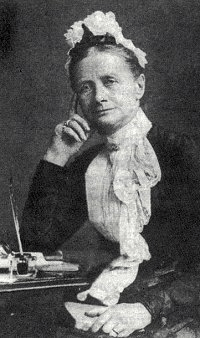
Mrs Cecil Frances (Fanny) ALEXANDER, was also known by her initials C.F.A. (1818-1895)

Wife of the Bishop of Derry, and a hymn writer best known for All Things Bright and Beautiful, Cecil Alexander was born in Dublin in 1818, the daughter of John Humphreys,  a second lieutenant in the Royal Marines (later a major in the Tyrone yeomanry), and his wife Elizabeth Reed, a niece of General Sir Thomas Reed. Attracted with her friend Lady Harriott Howard to the Oxford Movement in the 1840s, the two began writing tracts with Cecil supplying the verse.

Marrying the Rev. William Alexander in 1850 she became deeply involved in parish work in Strabane, County Tyrone. Cecil, widely known as Fanny, was involved with her sister in the work of the Institution for the Deaf and Dumb at Strabane, which became the Derry and Raphoe Institution for the Deaf and Dumb, the proceeds from her early publications helping to fund this work.

Image from Wikimedia Commons

Sadly the Institution was destroyed by fire in 1856, and “the poor children, terrified by the flames, ran into shelter from which there was no escape, and several of them lost their lives” (obituary). The fire started at night and was discovered at 2 am on the 7th of May 1856. Six children were killed and their bodies badly burnt. At the time the Master of the school was Mr (later Rev.) George A.W. Downing, who later went on to teach in London and Manchester. Fanny’s father Major Humphreys presided over an investigation that followed the inquest, but no fault could be attributed to any individual.

Fanny wrote a poem about the fire, and she also wrote The Twin Mutes; Taught and Untaught, a moral fable, to raise funds to build an infant school for the deaf and dumb in Manchester, and the poem was published by Dr. Stainer. Unfortunately we do not have any records from the Derry Diocese Deaf and Dumb Institution as it seems to have been termed.

Among her lyrics were the famous ‘Once on royal David’s City’, and ‘There is a Green Hill far away’, see this link http://www.cyberhymnal.org/bio/a/l/e/alexander_cfh.htm

Harron, Michael, fires and fire fighting in Strabane during the eighteenth and ninteenth centuries.

Deaf history snippets.  British Deaf News, 1997, Nov, 9.

Memorial plaque

Obituary. Quarterly Review of Deaf-Mute Education, 1896, 4, 155-56.

Oxford Dictionary of National Biography.

Then and Now

The Rev. Charles Rhind, chaplain and teacher, and his brother James

By H Dominic W Stiles, on 2 December 2011

The Rev. C. Rhind (1813-88) Teacher of the Deaf

Born on 5th of October 1813, and privately educated, from an early age Rhind was engaged in teaching Deaf children, being at the age of 16 appointed as a teacher under Dr Watson at the Old Kent Road School.  After 11 years he then moved to Belfast where he was Head of the Deaf School, the Ulster Institution for the Deaf and Dumb, and Blind from July, 1840, until September 1846, when the Institution moved into new premises (Quarterly Review of Deaf-Mute Education).  His next move was to Aberystwyth where he founded the first Welsh Deaf School and was its first Principal.  The school later moved to Swansea as the Cambrian Institution.

Rev. C.Rhind

Rhind seems to have found it hard to settle for any length of time for he was soon off again, this time to the position of Principal of the Institute of the Deaf and Dumb, at Henderson Row in Edinburgh, and leaving there he began to work as missionary for the Royal Association for the Deaf and Dumb on 1st December 1860.  Rhind had a small salary as the organisation was poor, and he ministered in the south of London as a missionary.  At this time the church for the Deaf St. Saviour’s in Oxford St was newly completed, and when the chaplain Rev.Samuel Smith died in January 1883, Rhind, who had become a Deacon in 1878, being the only suitable candidate, took over the position which he maintained until retirement three months before he died.

His older brother James (b.1812), was also a Teacher of the Deaf, as was a sister.  James taught at the Old Kent Road School and was later Head of the Liverpool Deaf School (1836).  In the 1851 census he was living in Oxford Street (East), with private pupils Mary Riley aged 11, and Thomas Bennett aged 14.  After a few years he started a private school in the neighbourhood of Regents Park and Maida Vale, according to old index cards we have in the library.  By 1861 however, from the census returns we can see that he had become a civil servant and was a clerk in the India Office.  James died in 1895.

Gilby describes Rhind as

A venerable figure, short, stout, bald, with a bushy white beard and moustache, he was a jolly old soul indeed.  In spite of his great punctiliousness in the keeping of statistics and accounts and in the making of appointments and future arrangements, and a certain fussiness incidental to over-anxiety, the good man enjoyed his life and his family, I am sure.  He usually wore a skull-cap, was sensitive to draughts, and loved a needed snooze in his armchair after dinner.

When Rhind left London for Bromley he was already failing in health.

On July 4th I visited the Rev. C. Rhind at Bromley for the last time.  He was very near the end then.  I find I wrote in my diary “Mrs. Rhind will not long survive him”.  And so it happened.  He passed away in his sleep on Saturday, July 7th and his wife entered into her rest ten days later, on the 17th.  I interpreted to the deaf who were present at Mr. Rhind’s burial at Kilburn on July 12th, and attended Mrs. Rhind’s on 21st. (Gilby)

See also various school annual reports

Gilby’s memoirs

Appreciation. Deaf and Dumb Times, 1889, 1(1), 6. (illus)

The Ulster Institution for the Deaf Dumb and Blind, Quarterly Review of Deaf Mute Education, January 1891, 2, 262-69, 289-95.

[Updated 17/11/2015]


Van Praagh & the rise of Oralism

By H Dominic W Stiles, on 18 November 2011

William VAN PRAAGH (1845-1907)

While other teachers such as Thomas Braidwood in Britain and the Abbé de l’Epeé had used some oral teaching in the 18th century, it was the German Samuel Heinicke who founded what became known as ‘Oralism’ or ‘the German method’ for teaching Deaf children.  In 1778 when Heinicke set up a school in Leipzig which he directed until his death in 1790 (see Wikipedia entry here – Heinicke).  He proved very influential and his followers took the Oral method to Holland.

Wolf  Saloman Van Praagh was born in Holland into a Dutch Jewish family.  He took the name William when he settled in England in 1866 (see interview in British Deaf Mute and Weinberg).  William had been sent to take charge of the Jewish Deaf School by the influential Dutch oralist David Hirsch, Director of the Rotterdam School (see McLoughlin).

In 1871 Van Praagh published a phamphlet (unfortunately not held by us) which moved for the establishment of Day Schools for Deaf children.  Possibly influenced by this and partly as a consequence of the success of the Jewish School, Baroness Mayer (see previous post) wished to start a non-sectarian school and spread the use of the Oral system.  The Association for the Oral Instruction the Deaf and Dumb was set up in 1871, and an associated training college the following year.  The Normal School and Training College was then established in June 1872 in Fitzroy Square, not far from Euston Station, with Van Praagh as the director.

Van Praagh wanted Deaf children to mix with the non-deaf population, and was opposed to the combined lip-reading and manual method of education. The British Deaf Mute article from 1894 includes an interesting interview with Van Praagh in which the following is said –

“The Rev.T.Arnold recently made use of the remark that the combined method of instruction is ‘irrational and immature.’ Is that your opinion , also?”
“Yes. I prefer any system in its purity to any combined methods of instruction.”

Van Praagh died after his annual public demonstration in Fitzroy Square.  His last words were “Gentlemen, I have finished,” then he collapsed with an attack of ‘angina pectoris’.  Immediately after his obituary in the British Deaf Times for 1907, there is a short article on ‘The Shortcomings of the “Oral” Method’, which concludes “Every teacher of the deaf ought to master the sign language of his pupils.”  The spread of Oralism did, and continues to generate great anger in the Deaf community. In his 1910 book ‘The Deaf Child‘ (p.121), James Kerr Love said “Teachers have divided themselves into opposing camps of oralists and manualists, and until this opposition ceases, the deaf child must suffer.”

Andreas Markides, The speech of hearing-impaired children. 1983.

Appreciation. Teacher of the Deaf, 1907, 5, 178-81.

Association for the Oral Instruction of the Deaf and Dumb. British Deaf-Mute and Deaf Chronicle, 1894, 3(33), 113-15. (photo)

Love, James, 1858-1942.:  The deaf child : a manual for teachers and school doctors. Bristol, 1911

McLoughlin, M. G.:  A history of the education of the deaf in England. Liverpool :   [the author] ,   1987

Obituary. British Deaf Times, 1907, 4 (44), 185-86. (photo)

Obituary. American Annals of the Deaf, 1907, 52, 499.

Van Praagh, William,  Lessons for the instruction of deaf and dumb children in speaking, lip-reading, reading and writing… Illustrated. London, Trubner, 1884.

WEINBERG, J. The history of the Residential School for Jewish Deaf Children, 1865-1965.

The Jewish Deaf School in Balham

By H Dominic W Stiles, on 11 November 2011

JEWISH DEAF SCHOOL, Nightingale Lane, Balham, London (1865- 1965)

Henry A. Isaacs (1830-1909) later knighted after being Lord Mayor of London in 1889/90, had sent his two deaf daughters Louisa and Sarah to the Rotterdam deaf school where the Oral method was used.  He and two other members of the Jewish community decided to form a Jewish School for the deaf and managed to get the support of Baroness Mayer de Rothschild.  They bought a house for the school at 15 Mount St in Whitechapel in 1865.  The school was started with 3 or 4 pupils who were taken from the Old Kent Road school.  Initially they were taught by the Rev. C. Rhind using manualism, but the school committee was quickly persuaded by Isaacs that Oralism was better.  Shortly after, under the headship of the Rotterdam trained Jewish Teacher of the Deaf William van Praagh, the school became the first in the U.K. to introduced the Oral method of education.  Shortly after 1865 it seems Isaacs wrote a pamphlet on oral education, Sound versus Signs, which laid out his views on oral education, based on how his daughters were taught.  (We do not have a copy, and neuither does the British Library.  It would have been privately printed so if anyone has a copy, we would appreciate a scan of it.)

In its first few years the school moved several times.  In 1875 it went to Walmer House in Notting Hill the former episcopal palace of the Bishop of Norwich, before ending up in Nightingale Lane in 1899 (see Weinberg).

The school closed in 1965 due to a decline in the number of pupils.

Jewish School – view from the garden circa 1910-20

Annual Reports in the RNID Library – 1884, 1910-1912, 1914, 1915, 1921, 1928-1932, 1934, 1935, 1938, 1945, 1949/50, 1954/55, 1960/61

DENTON, E. The former Residential School for Jewish Deaf Children, Nightingale Lane, Balham, 1865-1965.  The author, 197-? (photos)

RNID Library location: B13977(REF)

RNID Library location: WTG BVF G(REF)

“Sir Henry Isaacs.” Times [London, England] 5 Aug. 1909: 9

The New “Jews Home”, British Deaf Monthly, 1899, Vol.8, no.93, p.174-8 (pictures)

WEINBERG, J. The history of the Residential School for Jewish Deaf Children, 1865-1965.

http://paperity.org/p/33488007/hear-israel-the-involvement-of-jews-in-education-of-the-deaf-1850-1880