X Close

The Survey of London

Home

Recording the history of London's built environment since 1894

Menu

Archive for March, 2016

Shopping in style – D. H. Evans in 1937

By the Survey of London, on 26 March 2016

The name of D. H. Evans disappeared from Oxford Street in 2001, though it lingers in the memory of many. Since then it has been a branch of the House of Fraser, the company which has owned the store since 1954. Just over eighty years ago the present store was completed, officially opened in February 1937. It was designed by Louis Blanc in 1934 and constructed in two phases so that trading could carry on with as little interruption as possible. When it was completed, it made a dramatic impact, occupying an entire block, and rising higher than any of the other shops then standing on Oxford Street.

D-H-Evans-aerial-copy

Cover of the Coronation Brochure produced by D. H. Evans in 1937, with their new store circled, and showing how much higher it was than its neighbours along Oxford Street.

With the coronation of George VI and Queen Elizabeth taking place on 12 May that year, the management of D. H. Evans produced a commemorative brochure for the occasion, which principally served as a promotion for their new store. Traditionally Oxford Street was included in royal processions, and the coronation that year was no exception. The street was part of a six-mile route taken by the new king and queen after their coronation from Westminster Abbey to Buckingham Palace. Some press reports estimated that six million people descended on London for the occasion. All the shops were decorated with special window displays, and the street enlivened with flags and flowers. Royal monograms and coloured streamers abounded.

Side elevation of D. H. Evans

Perspective view of D. H. Evans from the Coronation Brochure. 

Recent relaxation of the height restrictions imposed on trade buildings by the London Building Acts enabled the new store to rise to 100 feet, twenty foot more than the old limit and productive of an additional two storeys. The building was steel-framed, with solid concrete floors and faced in Portland stone above the pale-grey granite facing of the ground storey. The great height of the building gave it presence on the street and produced one of its most exciting spaces inside in the form of the escalator hall. This contained not just the sequence of escalators but also staircases and ‘high-speed’ lifts (the upper trading floor could be reached in one and a half minutes).
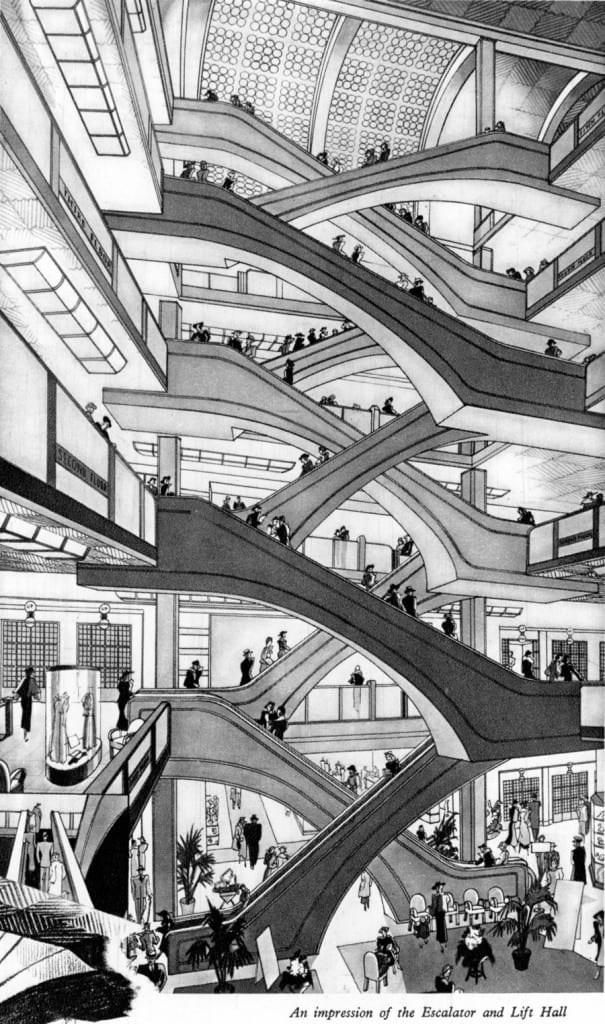
Escalator Hall, D. H. Evans, from the 1937 Coronation Brochure

Escalator Hall, D. H. Evans, from the 1937 Coronation Brochure

In its finish and colour the escalator hall was also intended to be a glamorous focal point, a place to be seen, as well as from which to view all the store had to offer. The walls and pillars were of delicate beige-pink Travertine marble, the floors of polished cork, producing a ‘soft, brown glow’, the fibrous plaster ceiling was in a ‘modernistic design’, the sheen of metalwork on stairs, escalators and lifts was achieved in ‘silver and copper bronze surfaces, satin finished’.

Ground Floor

Ground Floor, D. H. Evans, with the impossibly angular largely female shoppers parading along the wide aisles between display stands.

There were six trading floors. On the ground floor were fashion accessories and fabrics arranged either side of a sweeping central aisle. Branching from each side ‘miniature, self-contained shops’ sold specific accessories or goods: stockings, gloves, handbags, lace, jewellery, perfume, fur trimmings, scarves, haberdashery, needlework, flowers, wools, or household stationery, each defined beneath its own canopy, with diffused light illuminating the merchandise displayed beneath. Fabrics had a larger area, occupying the rear half of the floor with separate sections for different types of material: plain silks, printed silks, tweeds, woollens, cottons, and lingerie fabric (staffed entirely by women). Here were also dress-making patterns, staffed by ‘expert saleswomen’ capable of giving sound and practical advice.
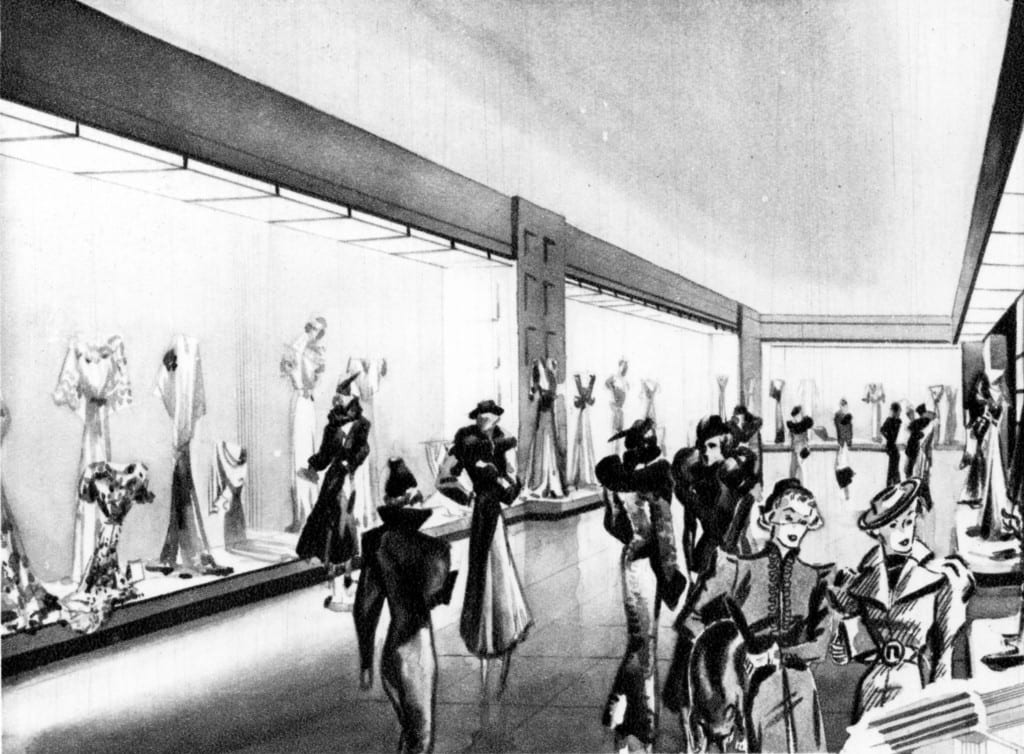
One of the 'display corridors', bringing window shopping indoors.

One of the ‘display corridors’, bringing window shopping indoors.

The first floor was divided into three sections devoted to the principal items of women’s clothing: the hat, the coat and the frock. Display corridors ran around the floor designed to look like shop windows. Thought was given to the way in which people shopped in the arrangement of goods, so they were divided into price groups and size, but also for quick or slow shoppers.
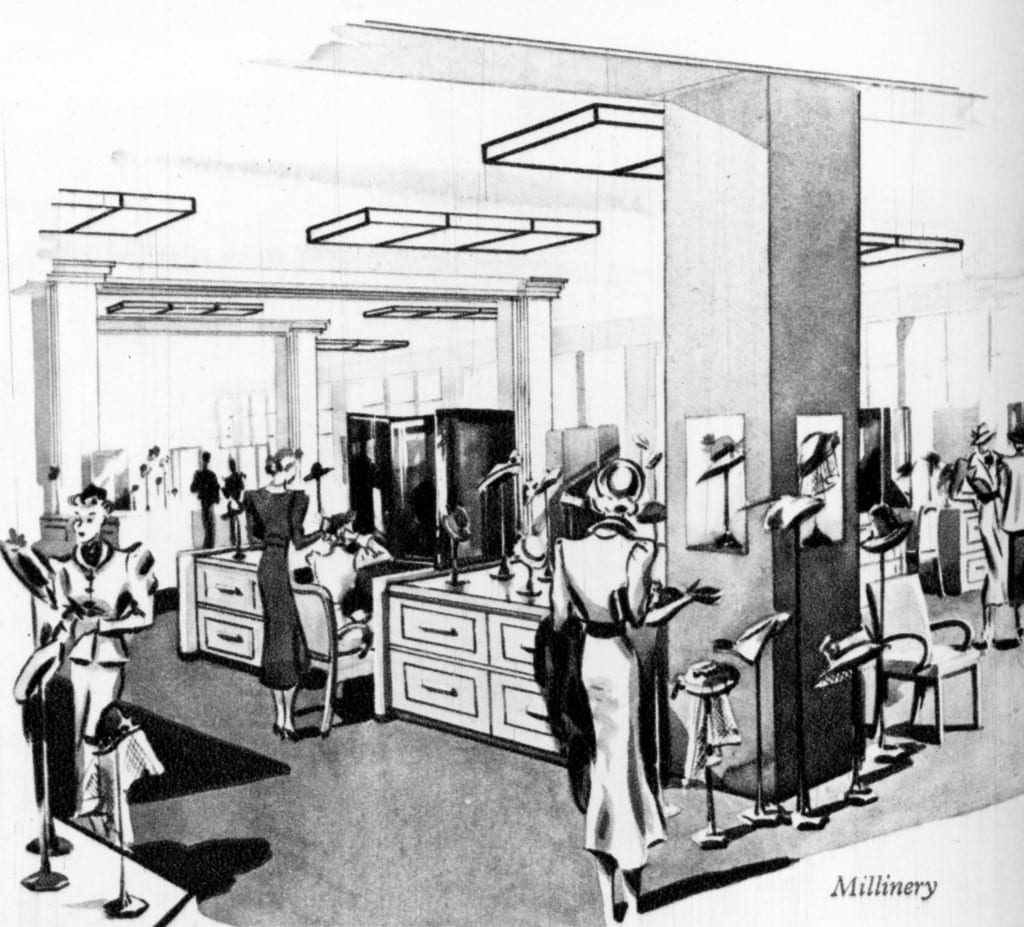
Millinnary department,

Millinery department, where different areas were adapted to differing habits of the shoppers, whether they were fast or slow. 

Hats were arranged on tall counters for quick shoppers, and mirrored alcoves for those wishing to make a leisured choice. A separate room was set aside for three-piece suits, and private fitting rooms, luxuriously appointed, were provided ‘in plenty’.

The corset department.

The corset department.

Underwear, including night-clothes, was on the second floor. More display corridors lead to blouses and knitted jumpers, placed ‘for matching purposes, next to skirts. Knitted suits were in a separate room, and ‘tailormades’ supervised by a specialist tailor. Here too were shoes, furs, and bathing and beach wear. Furs were displayed against a background of Indian white mahogany, and there was a fur storage section resembling a small bank, with a vault of its own, while the cold storage in the sub-basement could store ‘many thousands of pounds worth’.
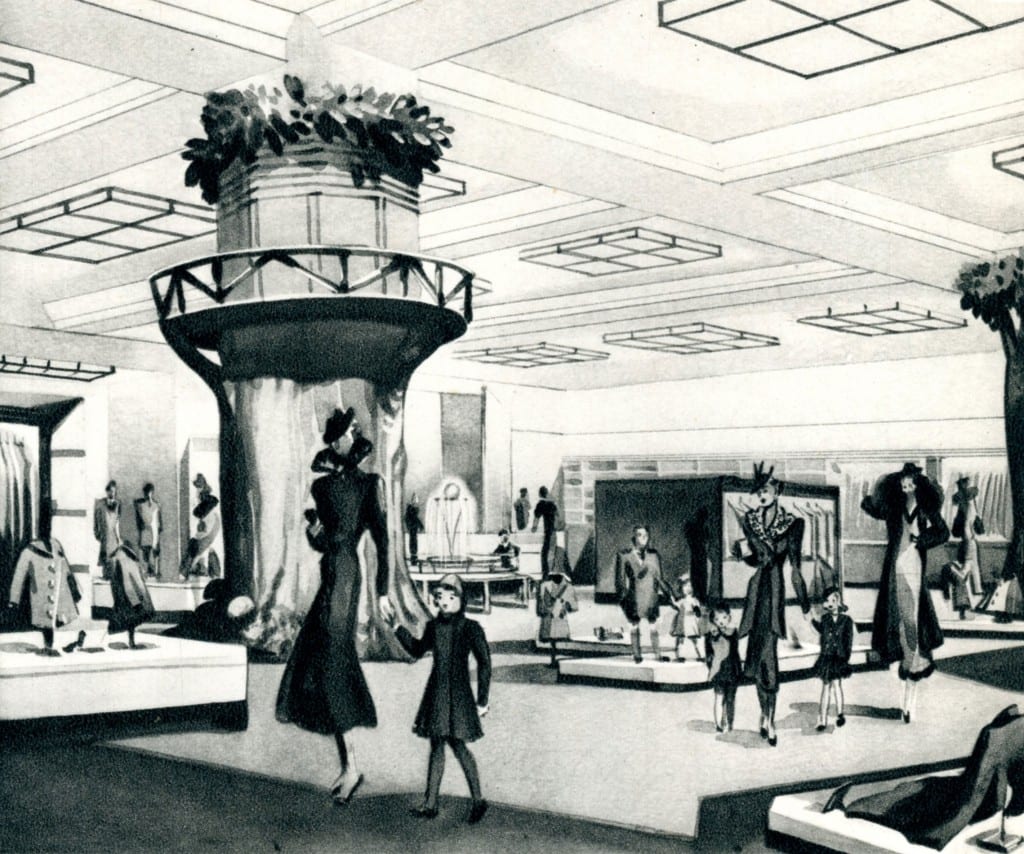
the children's department

The children’s department, which featured Peter Pan’s Playground. ‘The houses of Peter Pan and Wendy take the form of two huge trees which spread their branches over an enchanting ornamental pond and fountain.’

The third floor contained three quite separate sections: the children’s department, household and travel. The children’s department was the largest, taking up about two thirds of the floor and not only selling outfits but also providing two playrooms for the under-sixes – Peter Pan’s Playground (see above).

D-H-Evans-baby-shop

The Baby Shop

The travel section sold school trunks, suit cases, rugs, foot muffs and ladies’ weather-coats and mackintoshes, while the household section included overalls, utility frocks, maids’ and nannies’ outfitting as well as bed- and table-linen etc.
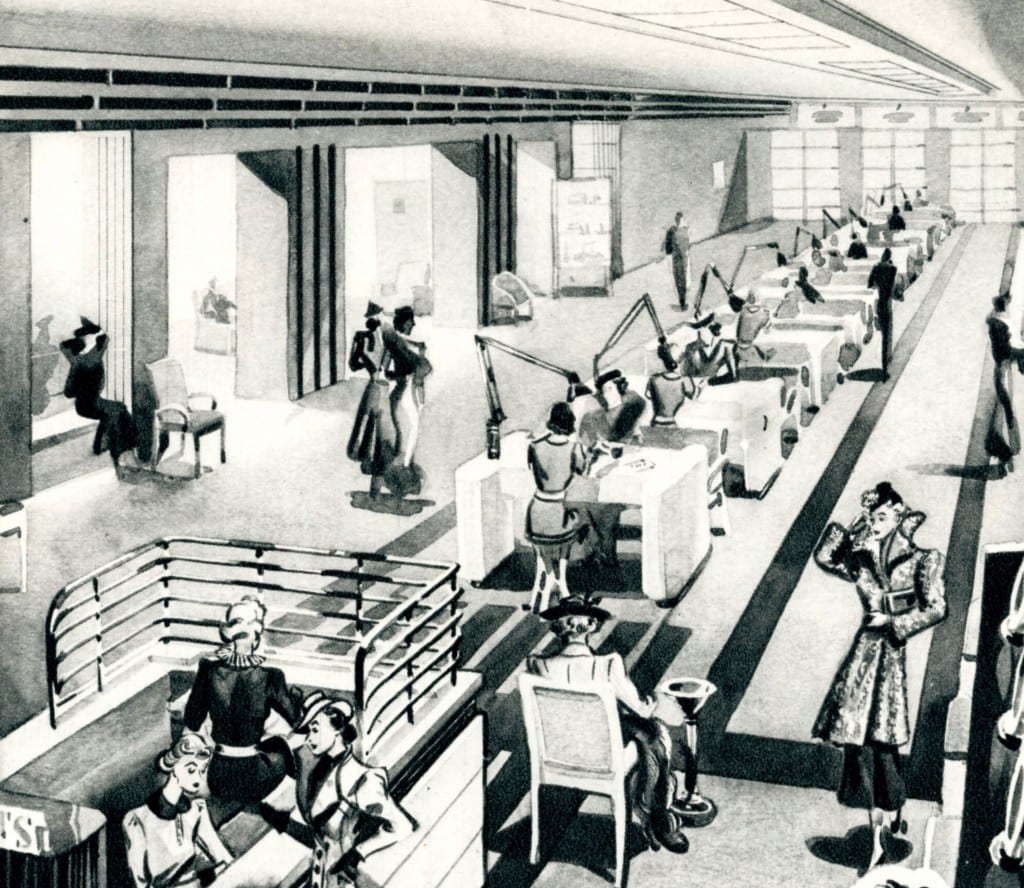
The beauty salon

The beauty salon, offering sound-proof beauty rooms. 

Half of the fourth floor was devoted to hairdressing and beauty salons, boasting ‘an all British staff’. All cubicles had padded comfort chairs, spring rests for the feet, a telephone, and sterilising cabinets – for disinfecting the instruments of beauty treatments. For beauty culture there were nine sound-proof beauty rooms with day or night lighting. Materials used were prepared in the company’s own laboratories, adjoining which were workrooms for the production of postiche. The rest of the floor was given over to the gifts department.

The restaurant

The restaurant on the fifth floor.

The fifth floor was the highest one devoted to the public and contained the restaurant. Furnished in brown, beige and rose, down both sides were plush-seated alcoves while the rest of the floor had circular tables arranged in a grid of squares around the supporting columns, around the base of which were waitressing stations. The restaurant offered table d’hôte and à la carte meals, while a salad and sandwich room catered for customers with less time to linger. Two kitchens, one at either end, were fitted out with all the latest appliances.

Ladies who lunch

Ladies who lunch – enjoying a lettuce leaf or two, and a cigarette, in the fifth-floor restaurant at D. H. Evans in 1937

Sources

The Builder, 8 Jan 1937, p.122; Coronation brochure, 1937

The Langham Hotel

By the Survey of London, on 18 March 2016

The Langham Hotel of 1863–5 was London’s largest hotel when new, and among London’s largest buildings, a prime example of what were dubbed ‘monster’ hotels, more kindly ‘grand’. Following the railway-station hotel boom of the 1850s the Langham was a significant novelty for being dissociated from a terminus. The Langham Place site in a smart district was thought right for a hotel for its openness, therefore healthfulness. Distance from a railway station could be marketed as a virtue, but this was still a bold speculation that looked to American rather than local precedents.

The Langham Hotel (by The Langham, London, reproduced with a Creative Commons licence via Wikimedia Commons [CC BY-SA 3.0 (http://creativecommons.org/licenses/by-sa/3.0)])

The Langham Hotel (by The Langham, London, reproduced without changes under a Creative Commons licence via Wikimedia Commons [CC BY-SA 3.0 (http://creativecommons.org/licenses/by-sa/3.0)]). If you are having trouble viewing images, please click here.

The Langham Hotel Company Limited set out to build a hotel ‘on a scale of comfort and magnificence not hitherto attained in London’. [1] Its ‘very respectable’ directors were a solid bunch of mercantile men, headed by two aristocrats stooping to trade – Henry Chetwynd-Talbot, 18th Earl of Shrewsbury and Talbot, as president, William Coutts Keppel, Lord Bury, as vice president. Among the directors was Peter Graham of Jackson & Graham, a high-class Oxford Street furnishing firm. The adjacency of several embassies including the American consulate inspired hope of accommodating diplomats. Imminent completion of the Metropolitan Railway with its station at the top of Great Portland Street would, it was claimed, make up for the absence of a main-line terminus.

A design competition was won by John Giles, a novice architect. He was persuaded to work with the more experienced James Murray, whose designs for the interiors were regarded by the competition committee as especially good – the forced partnership ended up in court over ownership of the drawings. Giles was probably responsible for the floor plan and exterior, Murray for details of the internal layout. Lucas Brothers, who had recently finished the London Bridge Railway Terminus Hotel, were contractors and major shareholders. Jackson & Graham supplied furniture and brought in Owen Jones to design interiors.

The hotel opened in June 1865 with the Prince of Wales and 2,000 others in attendance to see London’s most splendid hotel, spread over ten floors including basements and attics, and overall half again bigger than the Grosvenor Hotel of 1862. It aimed ‘to suit all from princes to the middle-classes’. [2]

The Langham Hotel, drawn from measured survey. Please click to download a high resolution version of the drawing (© Survey of London, Helen Jones with Andy Crispe).

The Langham Hotel, drawn from measured survey. Please click to download a pdf version of the drawing (© Survey of London, Helen Jones and Andy Crispe).

Plans of the ground floor and first floor of the Langham Hotel (© Survey of London, Helen Jones and Andy Crispe)

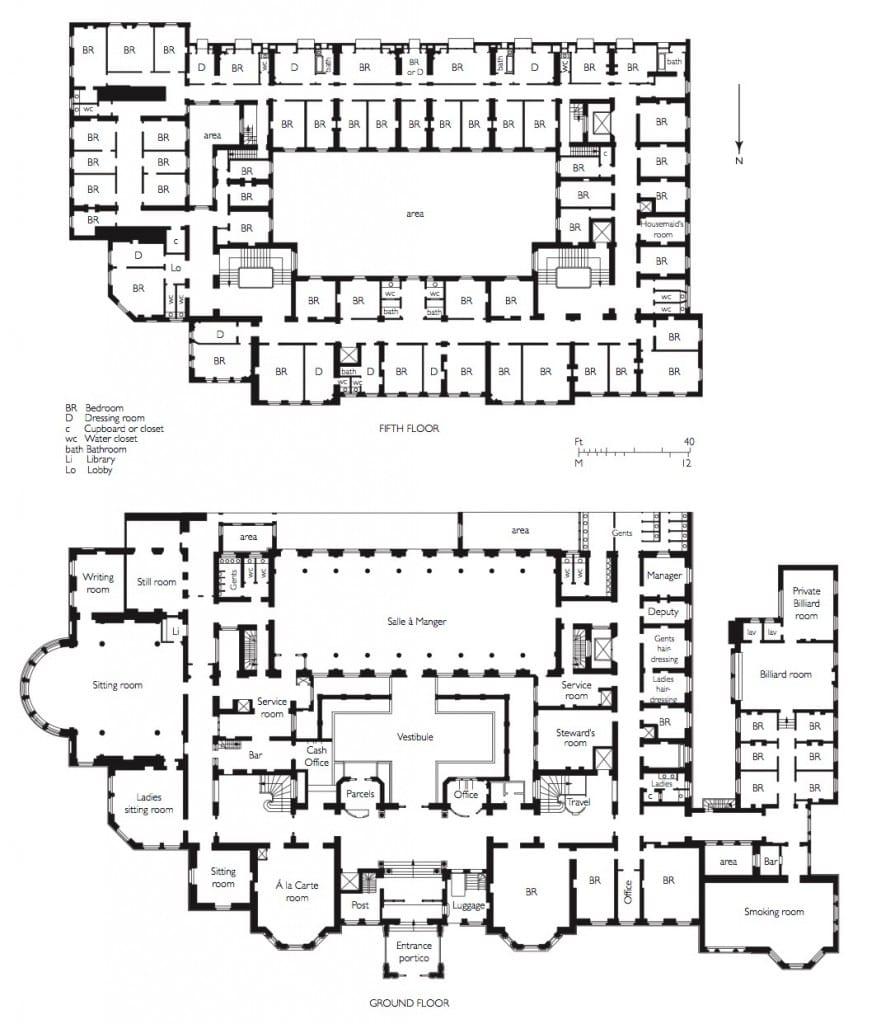
Plans depicting the layouts of the ground and fifth floors of the Langham Hotel in 1907. Please click to download a pdf version (© Survey of London, Helen Jones).

The report of the opening in the Illustrated London News neatly summarizes how the hotel was received:

The style of architecture would be called Italian; it is, however, plain, simple, and substantial, and singularly free from meretricious ornament. It includes large drawing-rooms, a dining-room, or coffee-room, 100 feet in length, smoking-rooms, billiard-rooms, post-office, telegraph-office, parcels-office, &c., thus uniting all the comforts of a club with those of a private home, each set of apartments forming a ‘flat’ complete in itself. Below are spacious kitchen, laundry, &c., and water is laid over all the house, being raised by an engine in the basement. Some idea of the extensive nature of the establishment may be formed when we add that its staff of servants number about two hundred and fifty persons, from the head steward and matron down to the junior kitchenmaid and smallest ‘tiger’. The ‘Langham’, on an emergency, can make up as many as 400 beds. The floors are connected with each other by means of a ‘lift’ which goes up and down at intervals. It is as nearly fire-proof as art can render it. [3]

Giles’s exterior, yellow Suffolk bricks (commonly known as “Suffolk Whites”) with Portland stone dressings, is heavily indebted to the Grosvenor. It is Italianate, but picturesquely so, with consciously eclectic Gothic elements and an eventful skyline with French pavilion roofs. The shape of the site was a gift, allowing, even forcing, some break-up of the cuboid massing to the east, the locus for an asymmetrical parti with a pointily domed tower and a big two-storey bow. The building was praised – ‘The points which call forth admiration are the union of regularity with picturesqueness, so desirable in town architecture; the subordination, at least in the side, of detail to general effect, and the reserve and simplicity which are manifest in a great part of the work.’ [4] Many have since disagreed, but a century later Henry-Russell Hitchcock judged the building ‘a rich and powerfully plastic composition, most skilfully adapted to a special site, and more original than most of what was produced in the sixties in Paris’. [5]

Monster Mash

The rich sculpture which adorns the eaves cornice and imposts of the lower-storey window arches (© Survey of London, Derek Kendall, 1988).

The sculptural detail repays close examination. Below the heavy eaves cornice there are griffins and sphinxes, some addossed and seated, others rampant yet bovine, made of moulded cement on slate armatures. Livelier and lither stone-carved creatures, more griffins, lions and lizards, grace the imposts of lower-storey window arches. These ‘semi-Gothic Grotesques’ were harshly judged – ‘Their antics … have an artificial and done-to-order look about them, very different from the grim humour of ancient work.’ [6] Hitchcock, who suspected the influence of Viollet-le-Duc, saw ‘elephantine playfulness’, which seems fairer.

In December 1940, bombing destroyed the building’s north-east corner and, with consequent flooding, the hotel closed. The BBC took up occupation from 1941, using the premises as offices and studios to 1986. Reconversion to hotel use in 1987–91 was by Hilton International.

Reference

[1] Morning Post, 30 June 1862, p. 2

[2] The Times, 12 June 1865, p. 9

[3] Illustrated London News, 8 July 1865, p. 12

[4] Building News, 20 Oct 1865, p. 72

[5] Henry-Russell Hitchcock, Architecture, Nineteenth and Twentieth Centuries, 1958, p. 16

[6] Building News, 20 Oct 1865, p. 727

Former General Medical Council offices, 44–50 Hallam Street

By the Survey of London, on 4 March 2016

(© Historic England, Lucy Millson-Watkins).

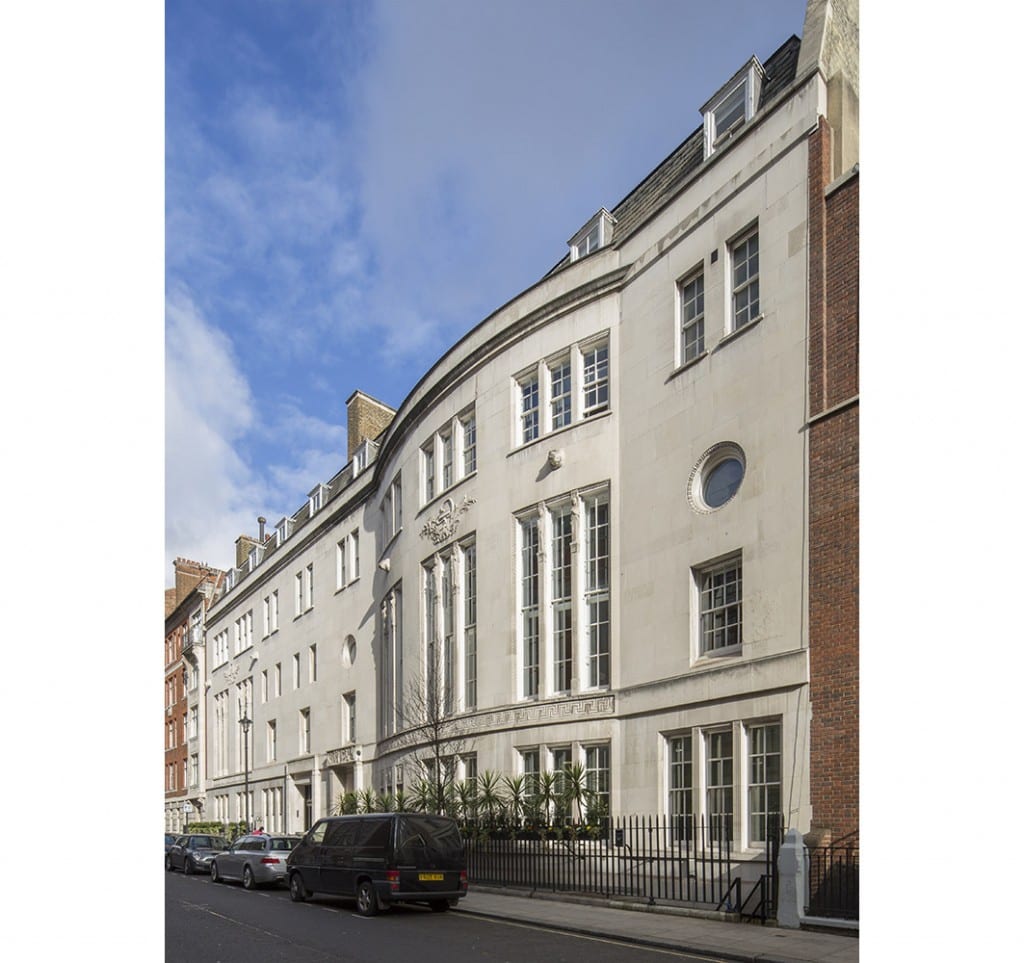
Former General Medical Council offices, 44-50 Hallam Street, from the south-west in 2015 (© Historic England, Lucy Millson-Watkins). If you are having trouble viewing images, please click here.

The southern part of this building (to the right in the picture above) was erected in 1915 to house the General Medical Council (formally the General Council of Medical Education & Registration of the United Kingdom). The Council had begun to investigate a move to larger premises from its offices at 299 Oxford Street in 1903, during the presidency of Sir William Turner. The initiative was seen through a decade later by Sir Donald MacAlister, the Council’s President from 1904 to 1931 and a physician and administrator renowned for his great intellect, probity and firmness. In 1912 a committee was formed to oversee the move. MacAlister was joined by Dr (Sir) Norman Moore, representing the Royal College of Physicians, (Sir) Charles Sissmore Tomes, the Council’s treasurer and chairman of its dental committee, Sir Henry Morris, a recent past President of the Royal Society of Medicine, and Sir Francis Champneys, an eminent obstetrician. An enquiry to the Howard De Walden Estate in 1914 elicited the offer of a development site at 44–48 Hallam Street. The northern part of the building, always intended, was not added until 1922–3. The Dentists Act of 1921, seen through by the Liberal politician Francis Dyke Acland, had established the Dental Board of the United Kingdom to take on the GMC’s oversight of dentists and to deal with the scourge of unqualified dentistry. To maintain good communications with the Council, the new Board, chaired by Acland, built the interconnected premises next door.

(© Historic England, Lucy Millson-Watkins).

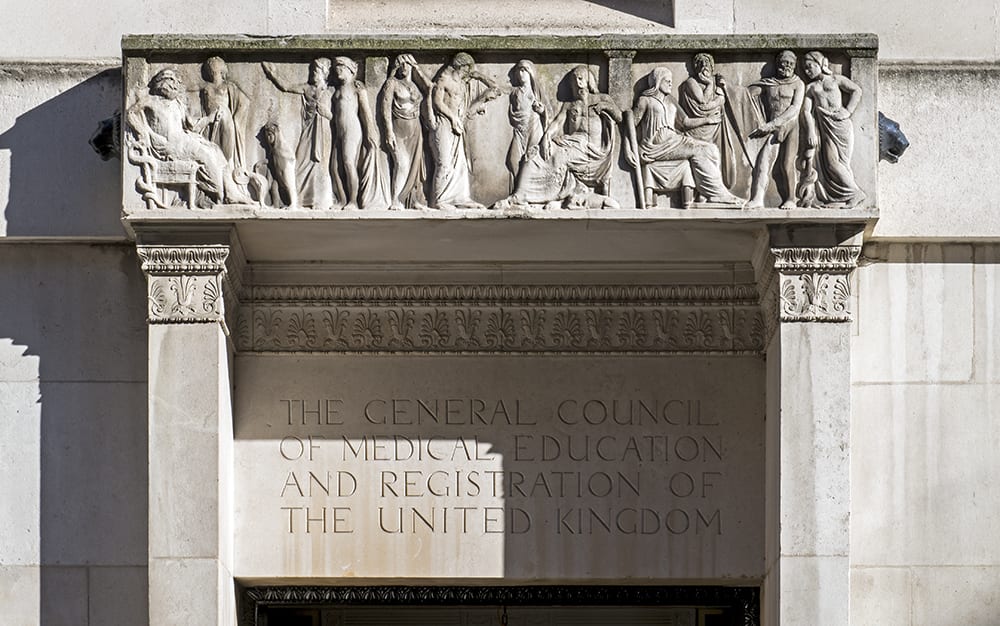
Detail of the bas-relief over the entrance, by Frederick Lessore, depicting the cult of Asklepios and his extended family (© Historic England, Lucy Millson-Watkins).

(© Historic England, Lucy Millson-Watkins).

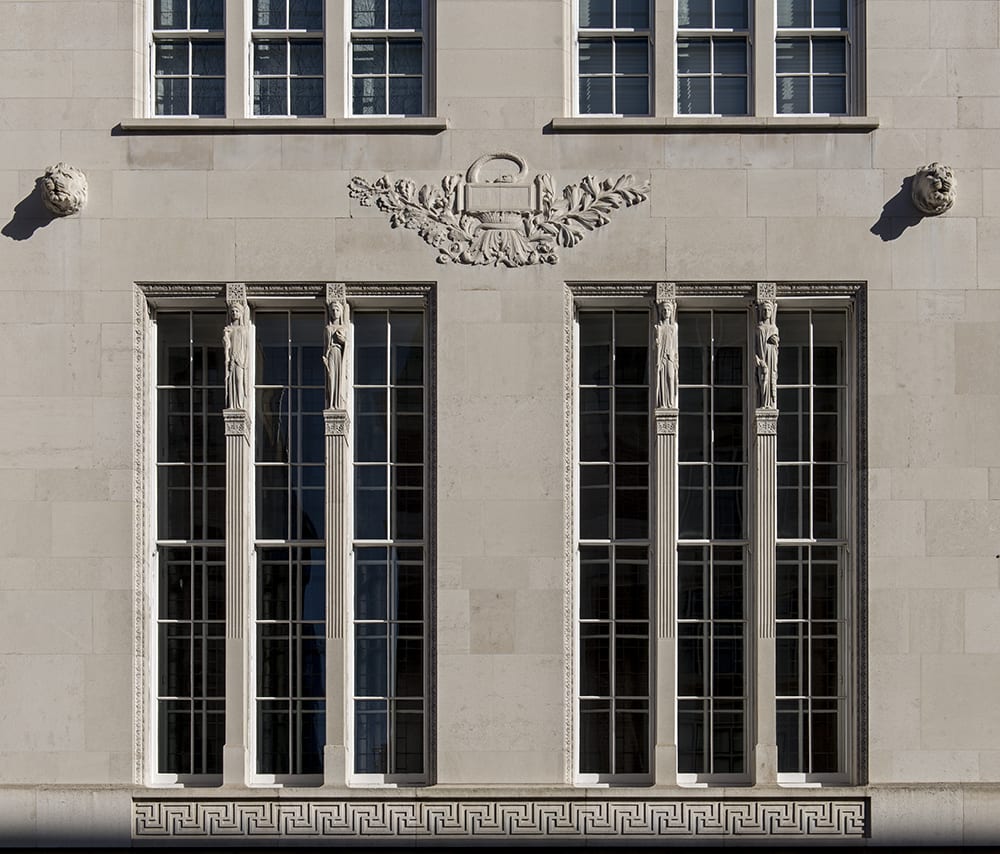
Detail of sculptural ornament at the centre of the bow, with the bowl of Hygieia between the windows (© Historic England, Lucy Millson-Watkins).

The architect at both stages was Eustace C. Frere, of South African origins and Beaux-Arts trained, and the builders Chinchen & Co., of Kensal Green. Robert Angell had prepared plans in 1914, but Frere was preferred, probably because of family connections. The building is distinctive in Hallam Street for its clean Portland stone elevation – Frere was able to steer the Council away from a cheaper brick alternative by saving money in other areas. It is more widely unusual for its synthesis of neo-Georgian form and proportion with Neo-Grec ornament. Above the original entrance in what was at first an otherwise symmetrical front elevation, a once fine but now weather-worn lintel bas-relief by Frederick Lessore follows the suggestions of Dr Richard Caton, a member of the council, in depicting the cult of Asklepios (seated, left) and his extended family whose members represent aspects of medicine. This ‘frieze’ has a Greek-fret continuation across a full-height bow bearing more relief sculpture by Lessore and his assistants. Diminutive caryatids grace the tops of mullions, symbolising the Council’s functions, and the bowl of Hygieia is at the centre of the bow between the upper storeys where a council room was placed under a dining room. These spaces were laid out between separate staircases for members and the public and in front of committee rooms. The extension has similar external detailing, its tall windows lighting a board room. A second entrance was formed in its south bay around 1960 when the Medical Protection Society took the building’s northern parts. Since 2010 No. 44 has been a conference centre, Nos 46–50 three duplex apartments.

(© Historic England, Lucy Millson-Watkins).

Radiator casing in former committee room (© Historic England, Lucy Millson-Watkins).

(© Historic England, Lucy Millson-Watkins).

Council room internal windows (© Historic England, Lucy Millson-Watkins).

(© Historic England, Lucy Millson-Watkins).

Public staircase (© Historic England, Lucy Millson-Watkins).