X Close

UCL Ear Institute & Action on Hearing Loss Libraries

Home

Information on the UCL Ear Institute & Action on Hearing Loss Libraries

Menu

Archive for the 'Deaf people' Category

Sign alphabet exhibition – Digiti-lingua

By H Dominic W Stiles, on 3 July 2013

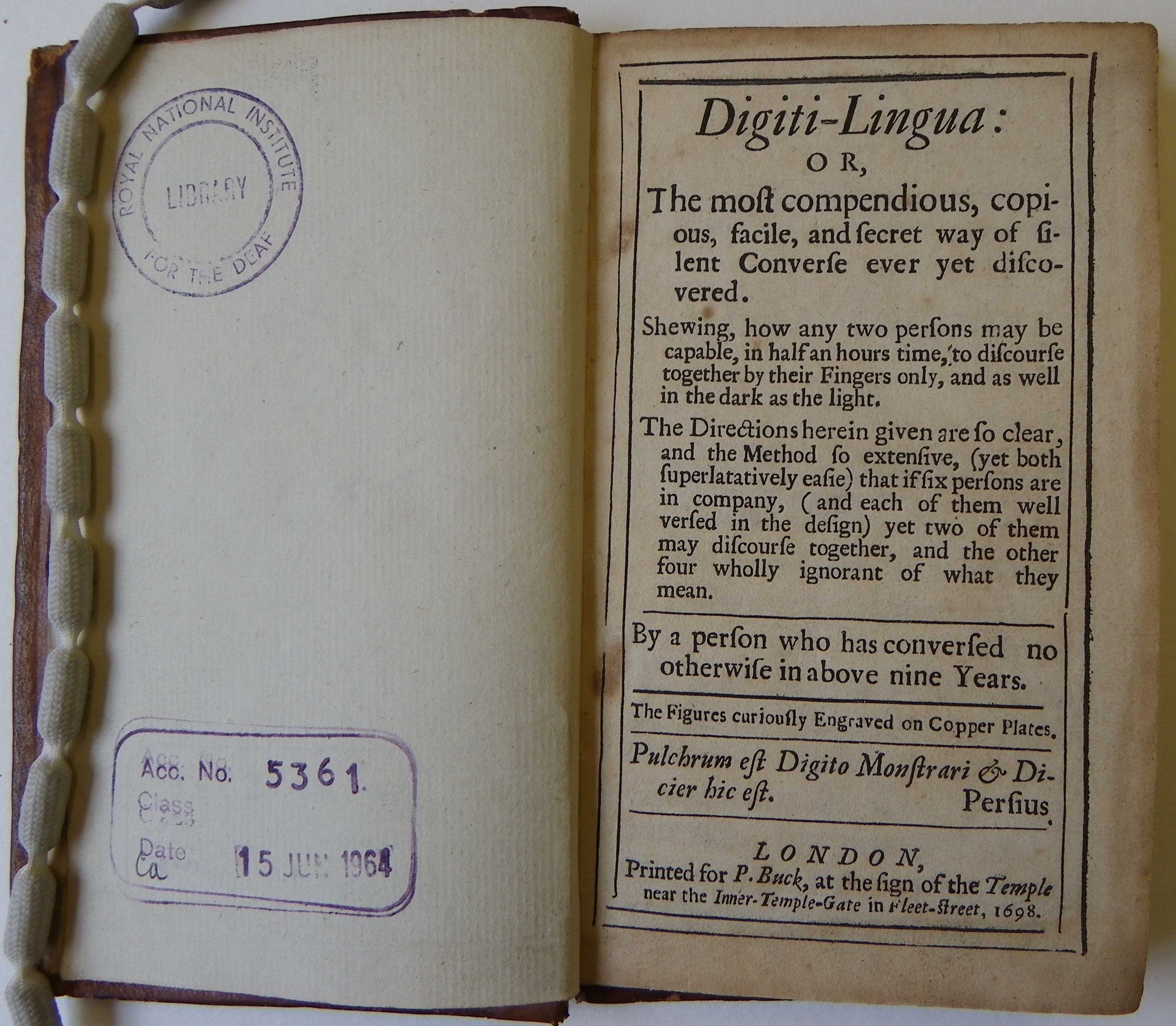
Digiti-lingua, or, The most compendious, copious, facile, and secret way of silent Converse ever yet discovered.  Shewing, how any two persons may be capable, in half an hours time, to discourse together by their fingers only, and as well in the dark as the light… By a person who has conversed no otherwise in above nine Years. The figures curiously engraved on copper plates. London, P.Buck, 1698.  Anonymous 1698.

[The second illustration of the manual alphabet (fig. 2) has been cut out of this copy; it is reproduced in Quarterly Review of Deaf Mute Education, 1889, 2, between p.40-41, in an article by Farrar on the history of manual alphabets.]

digiti front pages

The anonymous author was “obliged (thro’ an unfortunate impediment) to these, or some such like methods of Converse, for now near ten years last past”.  He critiques the “pretty piece of Ingenuity, intituled Sermo Mirabilis” as slower and less easy to follow, saying “All that can be done by the directions given in Sermo Mirabilis, may be more quick, free, and easily done, by the Alphabets here delivered, and much more”.

I have photographed the whole text as a pdf here (lower quality as I am limited to 9MB ‘uploads’ unfortunately) Digiti lingua.


Martin Stojar, Deaf Adventurer

By H Dominic W Stiles, on 26 June 2013

Martin Stojar 001Martin Stojar, “The first deaf and dumb Globetrotter” the headline says.  Stojar aimed to walk around the world with the ‘correct documents’, 100,000 km on foot over ten years, and says “support my aim”.  Can anyone tell us any more about him?  His name sounds Czech, but that might not have been his nationality.  I would guess this was ca 1920. There is a similar photo of him here.

Oxford Deaf and Dumb photo

By H Dominic W Stiles, on 14 June 2013

Oxford Reading Deaf trip to Radley 1919 001Oxford and Reading Deaf and Dumb members at Radley, 7th of June 1919.

Deaf artist, Rupert Arthur Dent, and Jane Besemeres

By H Dominic W Stiles, on 7 June 2013

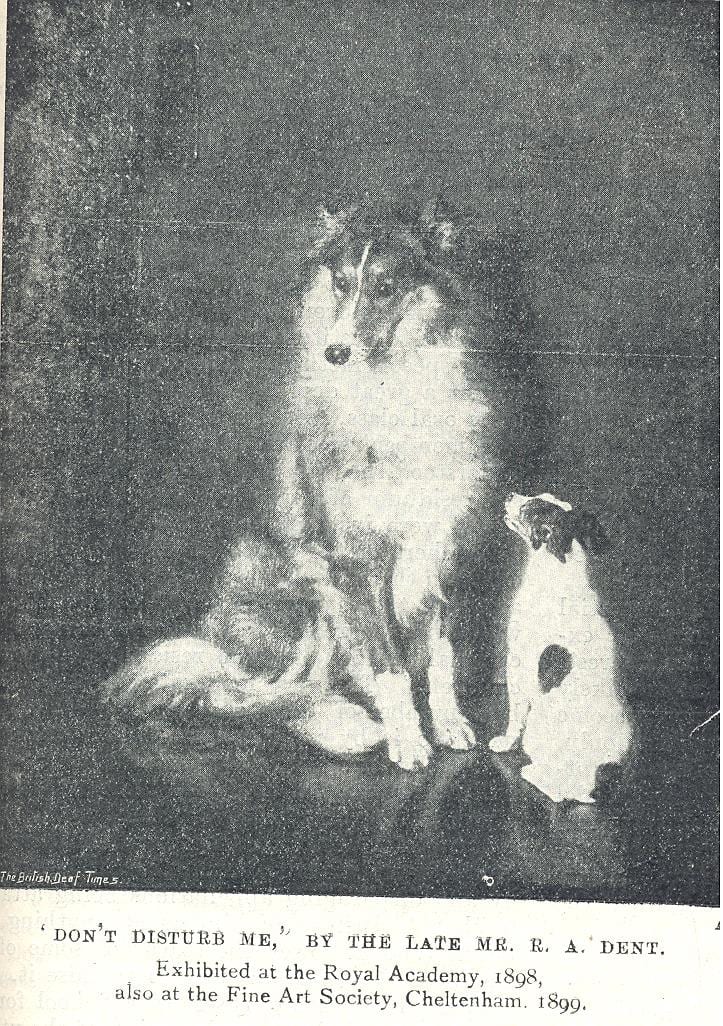
Rupert Arthur Dent (1853-1910) was born in Wolverhampton in 1853, son of a Stafford solicitor, William Dent, and his wife Jane.  In 1861 the family included nine children who had a governess, Miss Jane Besemeres.  Rupert Dent was deaf from birth, and his obituary (British Deaf Times 1910 Vol.7 p.57-9) tells us that one of his father’s sister’s was also deaf and very artistic.  Rupert A Dent 001As early as eight years old he showed artistic talent, observing and drawing animals.  Perhaps the governess was just for the daughters or the younger children as we are told that Arthur was educated at the Old Trafford (Manchester) Institution under Alexander Patterson, then Wolverhampton School of Art.  Aged 23 he became a Royal Academy student and began exhibiting.  The Royal Academy was not appreciative of animal paintings but his artistic treatment and naturalism was recognised as having great merit.

Dent senior 001Dent dogs 1 001

Fond of history and interested in antiquities, Dent was also philanthropic, holding a Sunday afternoon class for Deaf people in Wolverhampton.  His forte was clearly his dog painting, but he also painted miniatures  – see below – and landscapes.

In February 2012 one of his paintings was sold for $4,750 in New York.

Jane Besemeres (1827-1905) was born on London.  She remained a family friend of the Dents after she left her post as governess (she was a visitor there according to the 1871 census return), and went on to be both a teacher, author and found the Staffordshire Mission to the Deaf (1886).  It may well be that working with Rupert Dent inspired her interest in Deaf education and mission work.  Our Monthly Friend for January 1906 suggests that it was teaching ‘a Deaf boy’ that taught her about “the nature of the Deaf and their peculiar needs”, and we might speculate that the boy was Rupert.  She started a small school for Deaf children, recruited the Deaf missioner Agar Russell (himself a fascinating character).  She founded a ‘Home for Deaf and dumb Girls’ in 1902 at 80 Compton Road.  The Dent family were represented at the funeral and donated £5 to a memorial fund.

Jane Besemeres 001

Deaf People and Dementia

By H Dominic W Stiles, on 10 May 2013

By Mina Krishnan

Researchers from the Royal Association for Deaf People, the University of Manchester, City University (London) and UCL – including our own Professor Bencie Woll in the Deafness, Cognition and Language Research Centre – have conducted a research project on deaf BSL (British Sign Language) users living with dementia: their understanding of it, their ease of access to appropriate services and the impact of dementia on the deaf community.  Following the government’s policy document, Living Well With Dementia: A National Dementia Strategy – which lays out recommendations for early diagnosis and greater access to relevant information, but doesn’t make clear how it will apply to deaf people – this project was set up by a team of researchers and funded by the Alzheimer’s Society.

You have probably noticed that dementia has been in the news a lot lately.  Furthermore, connections between deafness and dementia have been indicated: for example, this recent news story, regarding recent research which suggests that deafness may in fact contribute to dementia.  Then there’s the difficulty of diagnosis among deaf people due to various factors, from problems with communication when attempting initially to consult doctors or hospital staff (about any health matters), to the unsuitability for sign language users of the tests currently used to identify cognitive disorders.

The research done for the Deaf People With Dementia project is vital to all of us; according to the WHO, the leading cause of hearing loss in adults is age-related (presbycusis).  Worldwide, this is believed to affect from one third to half of people over the age of 65 and more than half of those over 75; and this is expected to rise significantly during the next 20–30 years, especially in places like Europe and the U.S. where increasing life expectancy means an ageing population (WHO, 2011 – see link above).  With dementia believed to affect about 800,000 people in the UK – as well as, according to issue 733 of Bulletin (the official magazine of the Royal College of Speech and Language Therapists, to which the library has a subscription if you’d like to come in and have a look) an estimated 25 million people knowing a close friend or family member with dementia – it seems highly likely that almost everyone will be affected at some point, either directly or indirectly.

Interested in finding out more?  You could try searching PubMed using terms such as deaf or deafness, hearing loss, presbycusis, dementia and so on.  If you’re a UCL student or staff member, it’s best to go via the electronic library web-page; or if you’re not, visit us here in the library where you’ll have greater access to articles using on-campus computers.  Of course, here in the library we’ll be happy to help you look for further information, too – just drop by during our opening hours or give us a call.

“A shirt of startling hue”: the Drouet “Institute” and Dr. Crippen

By H Dominic W Stiles, on 26 April 2013

Evan Yellon, resident in 1906 at Eton Wick and in 1910 in St.Albans, had made it his business to expose quacks who tried to con money from people with deafness or hearing problems with the lure of ‘cures’. Yellon was himself deaf, and he edited The Albion Magazine for the Deaf.

The Drouet ‘Institute’ was a quack institute, supposedly founded by a ‘Dr. Drouet’ in 1888, established at 72 Regent’s Park Rd.  Late 19th century newspapers had adverts for this place as well as ‘articles’ – presumably essentially some form of syndicated adverts purporting to be reportage – praising it –

To cure is more noble than to kill; to save is a grander work than to destroy. The lover of mankind dwells more gladly on the labours of Harvey, Sydenham, Boerhaave, Jenner, Bichat, Pasteur, and Koch than on the triumphs won on the field of Battle. The opening of the Drouet Institute in the North-west of London, as a branch of the great and famous establishment in Paris, brings before the people of England the name of one of these benefactors of the human race. (The Standard)

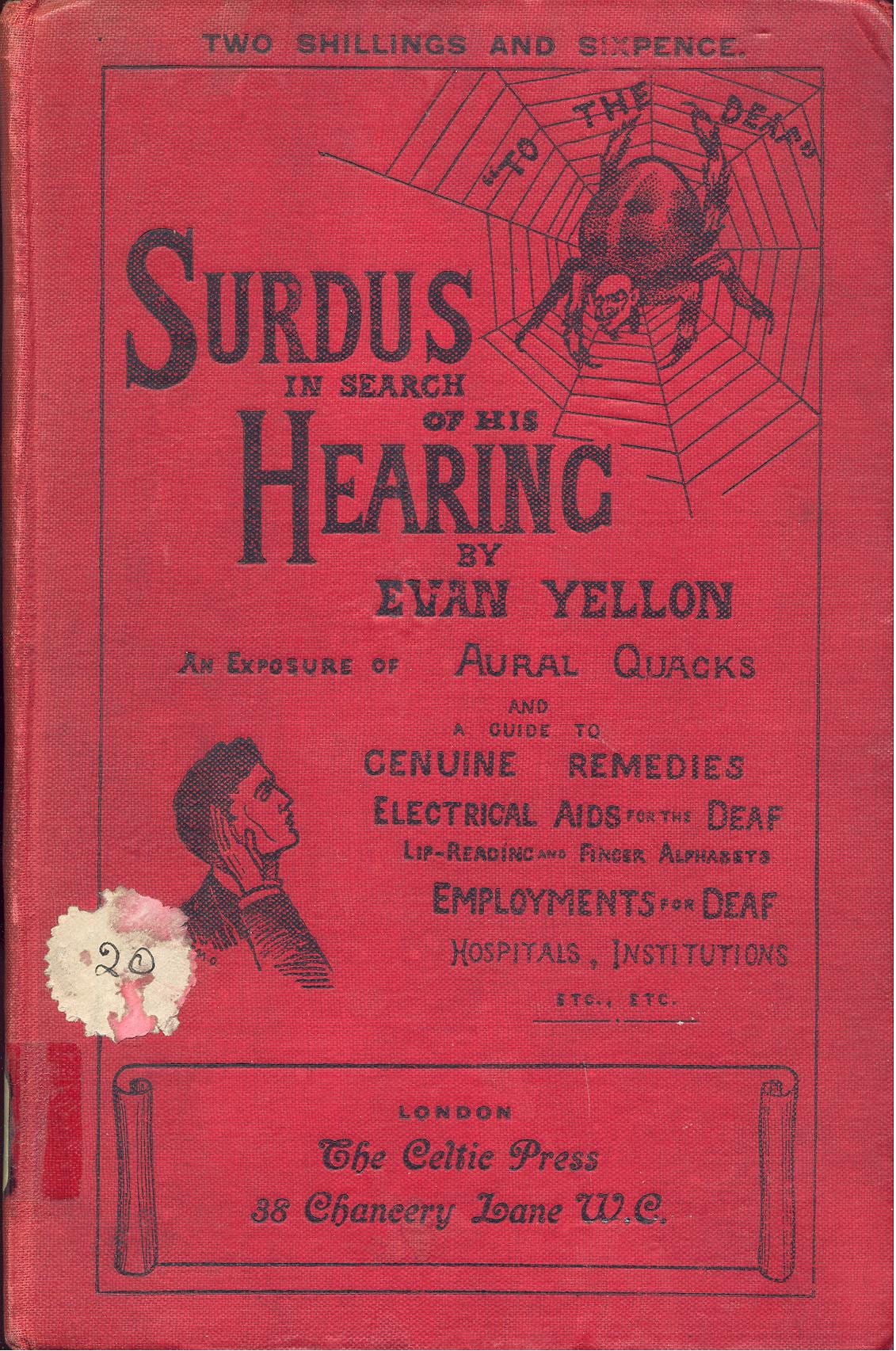
In the first, 1906 edition of his book Surdus in search of his hearing, Yellon describes a visit to test this quack institute – by this time established at 10 Marble Arch. He describes the secretary’s office –

Open upon the desk was a huge ledger, and standing by it was a pile of cards. Just above the ledger a number of labelled bottles were arranged in careless order; while over the fireplace was affixed a great frame containing a selection of letters thanking Drouet’s for wondrous – in fact, staggering – “cures.” All very artistic!

Yellon was taken to see “Dr. Cuppen” –

The carpet was fine, really fine, and the chairs were good specimens of modern Chippendale, and upholstered with refined regard to fitness […] A pair of tapestry curtains hid from my wandering eye a room adjoining that I was seated in.

The curtains are flung aside and a shortish man beckons him into the consulting room, which “was one better than the secretary’s office, and more than one below the waiting room; for that was a really nice drawing room, while by all the signs this was a quack’s den.” On the desk were a number of dirty instruments. The man before him was got up in a “fantastic fashion”.

His frock-coat was orthodox enough; but he wore with it a shirt of startling hue, adorning the front of which was a “diamond” as big as a marble; and the jaunty butterfly tie vied in hue with the shirt. His patent leather shoes were a trifle cracked, and his face a warning to all observant beholders. The flabby gills, the shifty eyes, and the man’s appearance generally, would effectually have prevented me from being taken in, even had all else failed to do so.

The “Doctor” proceeds to examine Yellon’s ears with a filthy specula – “He took altogether not five minutes to make an examination a famous aurist took twenty-five over; and without the least regard for nose and throat.” Back in the male secretary’s office (the first room) Yellon offers a ‘no cure no payment’ deal – having in the meantime been writing out some bill apparently, the secretary hastened upstairs with Yellon’s offer, and on returning wrote “charge you nothing” on the paper with red ink. Marvelling that anyone should be taken in by the “transparent fakery”, and smiling at “the secretary’s disgusted look when reading my offer to pay by results”, Yellon leaves.

The man behind the Drouet Institute in London was the fraudster J.H. Nicholson, who was sent to prison in 1902. The French doctor Drouet who lent his name to the enterprise, was an obscure G.P. in Paris who died of drink .

Henry Labouchère, that fascinating newspaper man and politician, campaigned against the ‘Institute’ in The Truth.  In a 1904 libel action Dakhyl v. Labouchere (Surdus 1906 p.8),

a great deal of light was thrown upon the “Drouet Institute”, and Lord Chief Justice Mathew described it as “a disgraceful institution carried on for unworthy objects by discreditable means.” Since then the fake has dropped out of sight, though an attempt was made to re-start the business under another name.

In the continuance (second volume rather than second edition) of his book Surdus (1910), Yellon describes his earlier visit to the Drouet Institute “on behalf of a journal with which I was then connected” – perhaps The Truth?  The “Doctor” who was “Dr. Cuppen” in 1906 now appears under his true name – Crippen.  Anyone who knows anything about English crime will be familiar with this name. He had also gone under the name Franckel, in New Oxford St. in 1908, selling a “Catarrh Tonic”, and had used his wife’s surname calling himself “Barron [sic] Mackamotzki”. That this was the same person as Cuppen (also Kupfinn) or Crippen, only emerged in 1910 after his arrest.
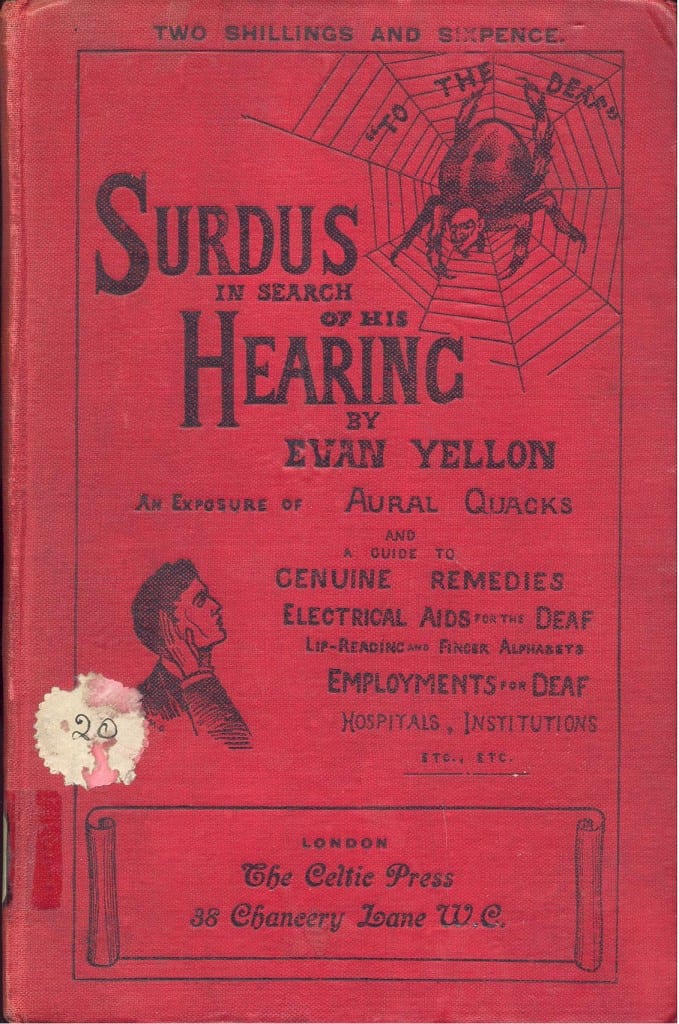
Surdus 001

As an addendum to the chapter Yellon says (Surdus 1910 p.11-12),

Just as this book was going to press the police discovered that a ghastly murder had apparently been committed at 39, Hilldrop Crescent, London, N.W., the private residence of “Dr.” Crippen. A human body seems to have been cut up and buried in quick-lime in the cellar. […] from what I saw of him he appeared to me about the last man I should expect to be guilty of any great crime. He simply belongs to the tribe of rat-men – the petty swindlers of afflicted people, and the first care of this tribe is to keep their own persons out of danger. Crippen had dissolute rogue written all over his face when I met him, but he did not seem to be the type of man to figure in a crime of passion. Still, no man can accurately forecast the trend of any one human character.

The Albion Magazine for the Deaf (vols 1-3 in the library) Vol 1 (6) p.103

“Dr” H.H. Crippen in the Albion 1910 Vol.3 Albion 1 001

The Standard (London, England), Tuesday, August 25, 1896; pg. 6; Issue 22512

Wellcome Library archives

Yellon, Evan, Surdus in search of his hearing, London  (1906 and 1910)

Two Deaf Women Travellers of the Early 20th Century

By H Dominic W Stiles, on 12 April 2013

This photograph has come from our photo collection, however it was clearly originally in a newspaper and I have found it in an Australian newspaper for February 1925. It has proved impossible, on a brief search of various records, to dig up anything further on Margaret Moir beyond what appears here.  Perhaps someone would be able to say, “that is my great aunt” or discover more about her in local papers or some other sources – it would be fascinating to know more.  The text reads

Miss Margaret Moir, of Dundee, with the dancing girls of the King of Cambodia. Although over 60, and completely deaf, Miss Moir travels alone in little-known lands, and recently crossed the Nubian desert in the Northern Sudan.

deaf explorer 001In 1911 after her trip around the world, the American Annabelle Kent wrote a memoir, Around the World in Silence (available on line in an unedited text version probably produced by optical character recognition).   Annabelle compiled her travelogue from letters sent home.

A deaf young lady made the remark to me once that it was a waste of time and money for a deaf person to go to Europe, as she could get so little benefit from the trip. I told her that as long as one could see there was a great deal one could absorb and enjoy. Then, when the time and opportunity came for me to take a tour around the world, there happened to be a young man in the party who was totally blind. I was full of sympathy for him, but he, instead of feeling regret, thought the sympathy should be bestowed on me, since I was deaf instead of blind. Cheerfulness is a fine trait, but I could not bear to think of going to India and then not being able to see the glories of the Taj or the pathetic beauty of the Residency, -Lucknow’s memento of the Mutiny. Feeling that I was fully repaid for the months of strenuous life, I have been moved to rewrite and publish the letters I sent home telling of my experiences on the tour as I would like to show others, as well as my deaf brethren and sisters, how much pleasure and profit one can get through travel not only in Europe but the Orient. I am not merely hard of hearing, but entirely deaf. Part of the time I was with friends of long standing, part of the time with almost entire strangers; and even amid the stress of travel they were always kind and patient with me. If they should chance to read these pages, I would like them to know how much I thank them all.

You can read Annabelle Kent’s book in the library in our biographical collection. Annabelle Kent 2 001

Click onto the images for a larger  size.

“Silent Chess Champions” in Belfast, 1913

By H Dominic W Stiles, on 22 March 2013

The following image and story is from the Belfast Evening Telegraph for Monday 4th August 1913.

A party of twenty deaf mutes, who arrived in Belfast on Friday.  The following “conversation” which took place – on paper, of course – between our photographer and one of the company will explain their mission:- “Could you give me a few details as regards your visit?” “We have come to play the Belfast deaf and dumb in a games tournament.  We are the holders of the London Federation of Working Men’s Social Clubs’ Chess Challenge Cup.  I hear the Belfast Deaf are hot stuff at chess, but I have no doubt we can lick them.  I am a Belfast man myself, but I have been away for fourteen years and hardly know the old place.  They are giving a party here to-night, and I hope to meet a good many old friends – and see a bit of the town meantime.  We are staying here till Monday evening, when we go over to Glasgow on the same errand – to lick them at chess, etc – and then we go on to Edinburgh, also on the same errand, returning to Belfast to-morrow week en route for London.”  “How many men compose your team?”  “Nine.”  “And how many are Irishmen?”  “Only myself; the others have never been out of England before.  In profession they are analyst, engraver, photographer, saddler, compositor, and bookbinder.  The rest are independent.”  The names of the group are:_ Back Row – Messrs. J. Hast, F.B. Caulfield, W. Baird (hon. Secretary), G. Howe, J. Longman.  Front Row – Messrs. E.T. Gausden, A. Padkin, C.H. Rymer. -. Jones, and H.H. Windsor.Silent Chess

Click on for a larger size.

Treating Deafness: Hannah Thatcher, William Wright, and the Danger of ‘Thin Shoes’

By H Dominic W Stiles, on 15 February 2013

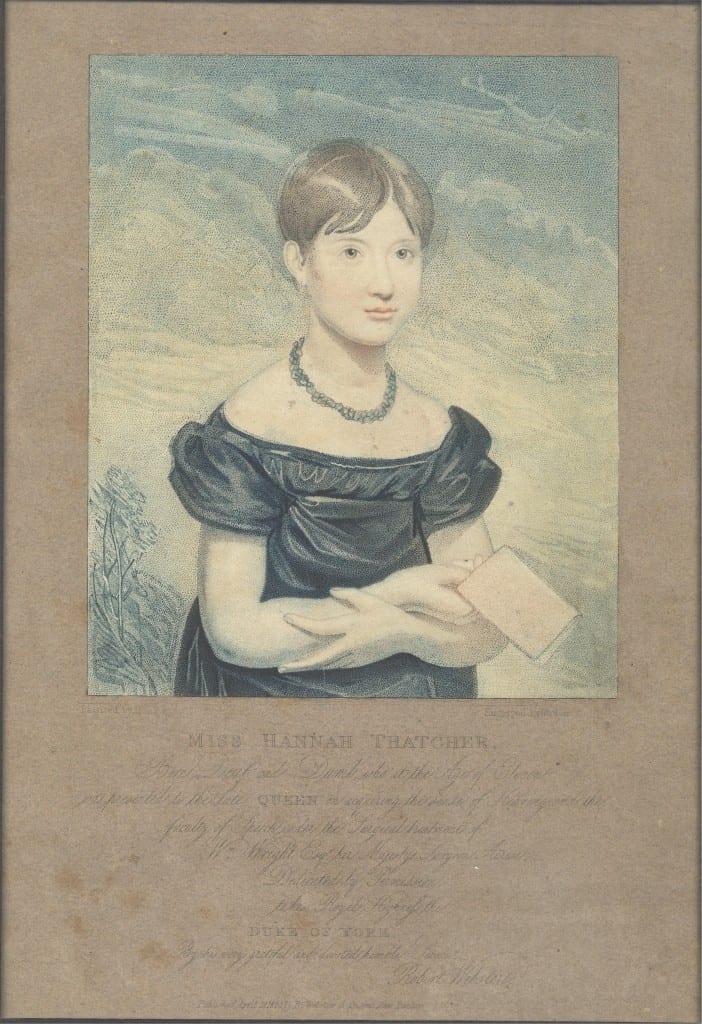
From the RNID Library picture collection, we have this charming image of a young girl.  The picture was presented to the Pierre Gorman of the RNID Library by Mrs Selwyn Oxley on May 2nd 1963. The inscription on the engraving below reads,

Miss Hannah Thatcher, Born Deaf and Dumb, who at the Age of Eleven was presented to the late Queen on acquiring the sense of Hearing and the faculty of Speech under the surgical treatment of Wm. Wright Esq. Her Majestys Surgeon Aurist, Dedicated by Permission to His Royal Highness the Duke of York by his very grateful and devoted humble Servant, Robert Webster. Published April 10 1820 by R. Webster 3 Queens Row, Printer

The name of the artist is faded away, and it looks as if the engraver was Robert [Webster].  Click on for a larger size image. You can read more about William Wright on the excellent website by our friend Jaipreet Virdi, From the Hands of Quacks.
hannah Tatcher 2 001The Ear Institute Library (our two collections are separate) has a copy of Wright’s 1829 book, On the Varieties of Deafness and Diseases of the Ear with Proposed Methods of Relieving Them.  The book was presented ‘with the author’s compliments’, we might speculate to Charles Hawkins, ‘House Surgeon’, who gave it to St. George’s Hospital Library in 1856.  The book went on the the Royal Ear Hospital before ending up with us.  It is fascinating to see the many lives of a book, and consider how such an ordinary object can pass through many hands, outliving the transient owners.

Wright covers various causes of Deafness, and supposed or actual cures for hearing maladies, such as damp clothes (cause) or urine of a variety of animals (supposed cure)  (here Wright appears to be a sensible materialist, explaining a possible ‘mechanical’ effect by reason of the liquid acting on wax).  Of ear tickling , we learn “in China, it is said that this forms a species of luxurious enjoyment amongst the great”. As for ‘Bethesda-Pool mineral water’, “see St. John, Chapter 5”, “recommended by a licenciate of the College of Physician, as a cure for deafness,”

in proof that the water was genuine, the angel of the Lord, he said, periodically troubled it in each individual bottle,-the same as we are told he used to trouble the pool. There were many persons who drank a considerable quantity of this water for a variety of complaints, until the shafts of ridicule spoiled the Doctor’s trade in the article, by correcting the aberration of his patient’s minds from the true standard of sanity.  (see Plain Advice for the Deaf, p.167)  After this, we must not be surprised if a portion of clay and water, said to be from Siloam’s pool, were to be sold by some empiric, to cure blindness! (see St. John, Chap. 9)  Or a pretended importation of casks of water from the River Jordan, to be made by some adventurer, and disposed at a high price, as a cure for leprosy! (see 2d Kings, Chap. 5)  This is not so very unlikely, after the above example; and one much on a par with it, namely, the Quack who a few years ago advertised wild elephants’ milk for sale, and gave a description of the manner in which his agents in Africa performed to operation of obtaining it.

Below we see Wright’s views on snuff.
Snuff 001


Wright also points to to the dangers of ‘thin shoes’ – “Ladies frequently cause serious derangement of their own health, as well as diminution of the sense of hearing, by want of caution as to this part of their dress: damp, or cold applied to the feet of persons of delicate constitution, or who from habits of life are accustomed to warm rooms, or the use of a carriage, is extremely injurious, and sometimes even fatal.”

Now didn’t your grandmother say exactly that?  You have been warned!

The Life and Trials of Frederick Painter, a Deaf Mute of Cardiff, ca 1812-1883

By H Dominic W Stiles, on 8 February 2013

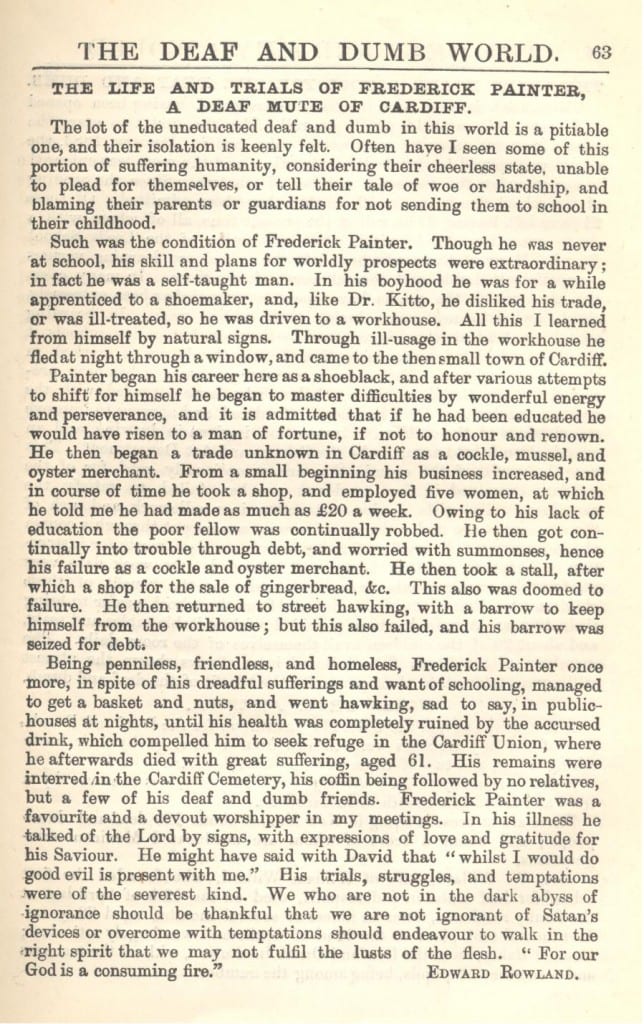
The story in the attached picture (click onto the image for a larger readable file), is taken from the September 1886 issue of Deaf and Dumb World: a Monthly Journal. This little magazine (it measures about 5″ x 8″) was edited by Ernest Abraham.

From Deaf and Dumb World, June 1886 p.63

From Deaf and Dumb World, June 1886 p.63

As such it was a forerunner of the Deaf and Dumb Times.

As to Frederick Painter, the 1861 census tells us he was a fishmonger, born in London, but by the 1871 census he was an “itinerant vendor of cockles, oysters etc”, aged 49 living at 17 Peel St with a Mary Ann Harris, also “Deaf and Dumb from birth”, birthplace unknown.  By the 1881 census he was clearly on a downward spiral as he has no job listed.  A sad story of someone who deserved to get a fair chance.

Unfortunately we have no Cardiff Mission records, but perhaps someone interested in this story could track down more records in Cardiff.