
Oxford Deaf and Dumb photo
By H Dominic W Stiles, on 14 June 2013
 Oxford and Reading Deaf and Dumb members at Radley, 7th of June 1919.
 Close
Close
Information on the UCL Ear Institute & Action on Hearing Loss Libraries

By H Dominic W Stiles, on 14 June 2013
Oxford and Reading Deaf and Dumb members at Radley, 7th of June 1919.
By H Dominic W Stiles, on 7 June 2013
Rupert Arthur Dent (1853-1910) was born in Wolverhampton in 1853, son of a Stafford solicitor, William Dent, and his wife Jane. In 1861 the family included nine children who had a governess, Miss Jane Besemeres. Rupert Dent was deaf from birth, and his obituary (British Deaf Times 1910 Vol.7 p.57-9) tells us that one of his father’s sister’s was also deaf and very artistic.  As early as eight years old he showed artistic talent, observing and drawing animals. Perhaps the governess was just for the daughters or the younger children as we are told that Arthur was educated at the Old Trafford (Manchester) Institution under Alexander Patterson, then Wolverhampton School of Art. Aged 23 he became a Royal Academy student and began exhibiting. The Royal Academy was not appreciative of animal paintings but his artistic treatment and naturalism was recognised as having great merit.

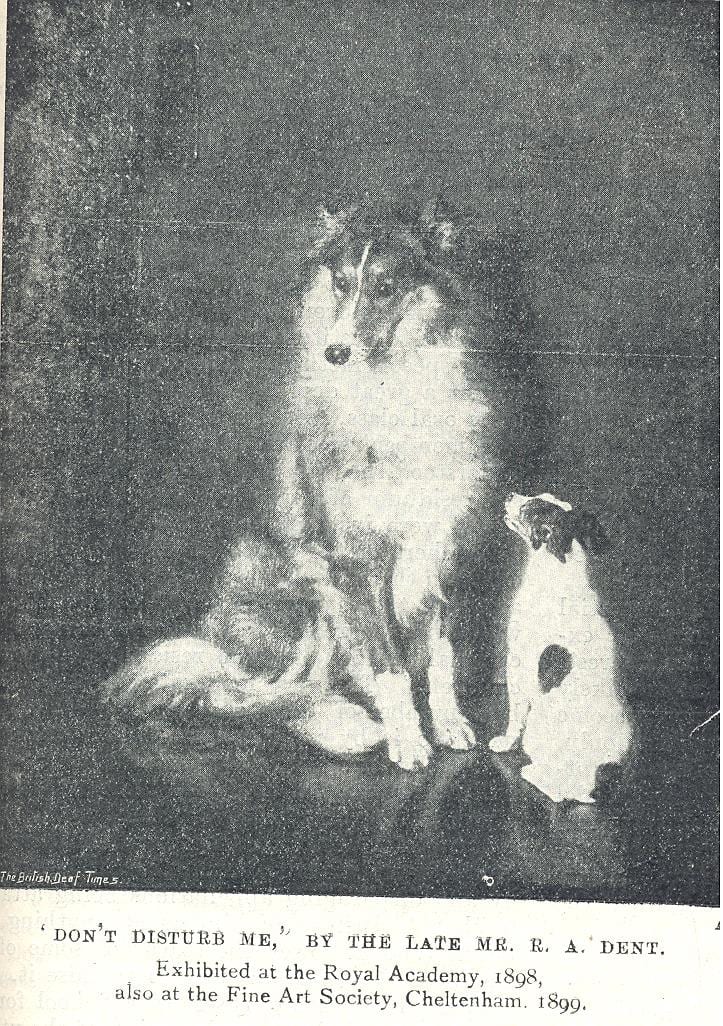
Fond of history and interested in antiquities, Dent was also philanthropic, holding a Sunday afternoon class for Deaf people in Wolverhampton. His forte was clearly his dog painting, but he also painted miniatures – see below – and landscapes.
In February 2012 one of his paintings was sold for $4,750 in New York.
Jane Besemeres (1827-1905) was born on London. She remained a family friend of the Dents after she left her post as governess (she was a visitor there according to the 1871 census return), and went on to be both a teacher, author and found the Staffordshire Mission to the Deaf (1886). It may well be that working with Rupert Dent inspired her interest in Deaf education and mission work. Our Monthly Friend for January 1906 suggests that it was teaching ‘a Deaf boy’ that taught her about “the nature of the Deaf and their peculiar needs”, and we might speculate that the boy was Rupert. She started a small school for Deaf children, recruited the Deaf missioner Agar Russell (himself a fascinating character). She founded a ‘Home for Deaf and dumb Girls’ in 1902 at 80 Compton Road. The Dent family were represented at the funeral and donated £5 to a memorial fund.

By H Dominic W Stiles, on 17 May 2013
John Birkbeck Nevins (1818-1903) was one of those extraordinary Victorians “who combined the life of the scholar with that of the man of affairs” (Obituary 1903). Related on his mother’s side to George Birkbeck, Nevins had non-conformist and industrial roots. Like his contemporary Darwin with whom he shares some parallels, Nevins spent some time as an ‘apprentice’ doctor, and at the same time on long walks he developed his understanding of botany and zoology. After attending Guy’s as a medical student, then practising for a short while in Leeds, he got a position on a Hudson’s Bay Company vessel as a ship’s surgeon, and wrote a book about his experiences.
On his return from his voyages, obtaining a place as a lecturer in Chemistry and Natural Philosophy at Liverpool (a post he held from 1844-68) Nevins settled in that area. He also lectured in botany and medicine at the Liverpool School of Medicine. Nevins was appointed assistant-surgeon and subsequently surgeon, to the Eye and Ear Infirmary in 1853, a post he retained until 1877, when he retired and was appointed consulting surgeon. It was perhaps in this capacity that he became involved with the Liverpool Institution. Unfortunately we do not have the Liverpool Institution reports for the years from 1886-1909. He clearly took a great interest in the Liverpool school as will be seen from the attached document which I have scanned in full, that he took a great interest in sign language as used in the school: The Sign Language of the Deaf and Dumb, J. Birkbeck Nevins. I know little about the history of BSL linguistic studies, but this essay, presented before the Literary and Philosophical Society of Liverpool, seems to me to be quite an early and sympathetic attempt to present the language as a valid means of communication, with brief history of the education of Deaf people, followed by a look at some signs. Nevins compares sign language education with oral education. He says
The “Education Department” now wisely requires both systems to be taught in State-aided schools, while showing an apparent favour for the oral in preference to the sign system, founded upon the Report of the Royal Commission on Blind, Deaf, and Dumb, issued in 1889. In estimating the true value of this report on this particular question it is necessary to bear in mind that the Commission was originally formed with reference to the blind only, and fourteen of the eighteen commissioners were appointed while that was its sole object. The deaf and dumb were added as an afterthought some months afterwards, and four additional names were added, who represented the deaf and dumb interest. From special and exceptional circumstances one or two of these were in some sense committed to the oral system before appointment, but it is my confirmed belief that both the teachers in deaf and dumb schools, and also those who have had the longest and most practical acquaintance with the deaf and dumb prefer the sign system for general use, while willingly encouraging the addition of the oral system for the benefit of the more limited number who possess the time, the means, and also the intellectual capacity for making use of its more exacting requirements.
The copy we have is from the author to Richard Elliott of the Margate School.
The Royal Commission Report is searchable and of interest to anyone researching deaf education in the 19th century.

A. H. SYKES, Dr J Birkbeck Nevins – sage of Liverpool
By H Dominic W Stiles, on 10 May 2013
Alexander Melville Bell (1819-1905) was the father of the now much better know Alexander Graham Bell. He was the son of a shoemaker turned elocutionist, Alexander Bell (1790-1865) (Winzer 1993). He is much less well known now than his son, but in his lifetime achieved fame for his creation of ‘visible speech’. Its aim was to aid the teaching of spoken language to deaf children.
Though they are logical, his symbols seem far from simple, and interested readers might like to try reading the parallel texts below, with the aid of the pictures on the Wikipedia pages. Promoted by the now infamous Milan Conference (1880), Bell’s symbols fell out of favour, though an adaptation by Alice Worcester was popular.
Winzer points to articles by D. Greenberger of New York, that are critical of Bell, for example this one from volume 19 of The American Annals of the Deaf (1874, p.74) –
Grant, even, that deaf-mute scholars may be trained like parrots in the use of “modulations of the voice, expressive of surprise, sorrow, anger,” etc., it is unreasonable to assert, as Mr Bell does, that they, disqualified in consequence of their infirmity, and with their narrow range of thought, can be made effective readers and orators. Hearing persons cannot become good speakers by the study of elocution, unless their minds are disciplined and stored with thought. “Language,” as somebody has forcibly said, “is not a musical instrument, into which, if a fool breathes, it will make melody.” Those disciples of Mr Bell who waste the precious school-time in “combining the elementary sounds in all sorts of ways to form senseless compounds” by means of the Visible-Speech symbols, and teaching the deaf-mute to utter such senseless compounds with “indefinite pitches” of voice, will, we hope, long before their pupils know “the deep meaning” of the oft-quoted apothegm: “He who buys what he does not need will soon need what he cannot buy.”
NOTE.- Mr Greenberger proposes to begin the next number of the Annals a series of practical school exercises, illustrating the method of instruction used in the institution of which he is the head. – ED. ANNALS.
This Visible Speech book, Stories and Rhymes in Bell Symbols, compiled and edited by Rebecca E. Sparrow and published in 1909, has a very fine cover. Sparrow had previously been assistant at the Rhode Island School for the Deaf. Winzer says that Visible Speech symbols were quickly abandoned in most schools that tried them (p.197). Despite this, the late date that the book was produced, suggests that it was perhaps either a Bell family vanity publishing project, or perhaps the symbols were still used at that time at the Rochester School for the Deaf where Sparrow taught.


All This reminds me of the now defunct English writing/orthographic reform, I.T.A. As I understand, it ended up sowing confusion when children who had tried it were then exposed to written English.
You can see some of Melville Bell’s books in our historical collection, including the first edition of Visible Speech (1867).
Winzer, Margaret A., The History of Special Education, 1993.
By H Dominic W Stiles, on 22 March 2013
The following image and story is from the Belfast Evening Telegraph for Monday 4th August 1913.
A party of twenty deaf mutes, who arrived in Belfast on Friday. The following “conversation” which took place – on paper, of course – between our photographer and one of the company will explain their mission:- “Could you give me a few details as regards your visit?” “We have come to play the Belfast deaf and dumb in a games tournament. We are the holders of the London Federation of Working Men’s Social Clubs’ Chess Challenge Cup. I hear the Belfast Deaf are hot stuff at chess, but I have no doubt we can lick them. I am a Belfast man myself, but I have been away for fourteen years and hardly know the old place. They are giving a party here to-night, and I hope to meet a good many old friends – and see a bit of the town meantime. We are staying here till Monday evening, when we go over to Glasgow on the same errand – to lick them at chess, etc – and then we go on to Edinburgh, also on the same errand, returning to Belfast to-morrow week en route for London.” “How many men compose your team?” “Nine.” “And how many are Irishmen?” “Only myself; the others have never been out of England before. In profession they are analyst, engraver, photographer, saddler, compositor, and bookbinder. The rest are independent.” The names of the group are:_ Back Row – Messrs. J. Hast, F.B. Caulfield, W. Baird (hon. Secretary), G. Howe, J. Longman. Front Row – Messrs. E.T. Gausden, A. Padkin, C.H. Rymer. -. Jones, and H.H. Windsor.
Click on for a larger size.
By H Dominic W Stiles, on 15 March 2013
Babu Jamini Nath Banerji 1869-1921 founded a school for the deaf in Calcutta in the 1890s. Babu Girindranath Bhose, a father of Deaf children, had asked the government to get a teacher from England, however it was decided to send a teacher to England for training. In 1895 Banerji had 20 pupils. He said (probably to Dr. Roe) when he visited the Derby School (quoted in Our Deaf and Dumb 1895 Vol 2 (3) p.32),
“I made up my mind to do something for my country’s good, and it suddenly dawned upon me that I must teach the deaf and dumb.” He promptly, and with characteristic devotion, commenced to carry out his ideas at once. In the course of an able and eloquent speech he said, “If education does not open the mind and widen the heart, if it does not teach us the duties of life, and above all, if it does not bring us nearer to God, it is not worth our trouble.”
 In the brief article it says there were an estimated 200,000 deaf people in India at that time with less than 50 under instruction.
There was at that time a school in Bombay, but after four months there Banerji, who had struggled with a copy of one of Arnold’s books given to him by Bhose, decided he needed to travel abroad to learn more. Banerji enrolled at the oralist Fitzroy Square Training College in London. Completing the course in a year, and not satisfied with that alone, he went on to Gallaudet with a scholarship from the U.S. government, before returning to India.
The obituary in Silent Worker says,
In 1905, when Sir Robert Carlyle was President of the School, a daily paper in Calcutta wrote a leader that the government should take up the school. Sir Robert asked Principal Banerji as to his opinion. He said it was a matter for the committee to decide, but so far as he was concerned he would oppose such a transfer in order to give the lie to the statement that Indians were incapable of taking any initiative.
References to various publications by Banerji are to be found on the University of Hamburg Sign Language website http://www.sign-lang.uni-hamburg.de/bibweb/miles/1750-1970.html
*The quotation is from Sir Robert Watson-Smyth in Silent Worker.
Around that time, the Church of England Zenana Missionary Society (CEZMS) (1880-1957) was starting to be active, and in the following years schools were opened elsewhere in the subcontinent. It did missionary and health related work particularly in India. the missionaries were women – ‘Zenana’ refers to the women’s portion of the house in India. Selwyn Oxley was involved to some extent, and there are some of their pamphlets etc., as well as some photographs in the archive collection. A trawl of the British Deaf Times and related publications will add additional articles on the Schools such as Palamcottah (see photograph below). The Hon. Secretary in 1931 was a Miss Pell, who gave the Monthly Broadcast Missionary Talk on the radio on 7th June 1931 (BDT 1931 p.101).
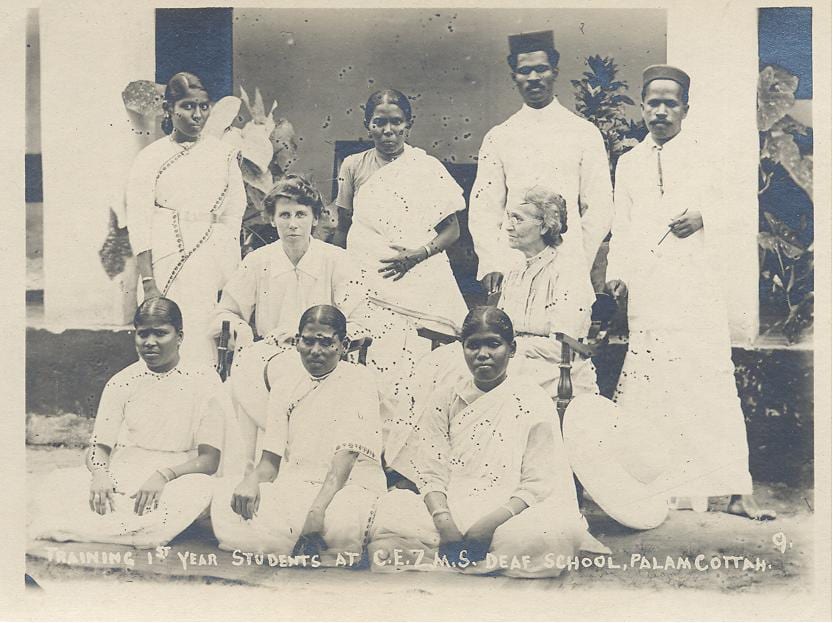
Deaf Work (C.E.Z.M.S.) in India & Ceylon. Historical Collection.
Education of the Deaf in India, Teacher of the Deaf Vol.33 p.169-75, 1935
By H Dominic W Stiles, on 22 February 2013
The term ‘Deaf Institute’ can sometimes be confusing, as it can refer to either a school or a mission, or perhaps somewhere that accommodated both. Many seem to have originally been missions, and spreading a religious message to Deaf people was therefore at their heart, followed by their educational and social development (for instance with temperence meetings) and helping them with job opportunities where they could.
The Northamptonshire and Rutlandshire Mission, which I assume is the same as the Northampton ‘Institute’ (can anyone confirm or deny this?), appears to have only started in 1928/9, with the missioner Algernon J.M. Barnett who had trained under the Rev. Albert Smith in London (Smith being Gilby’s replacement there at St. Saviour’s Oxford St.). 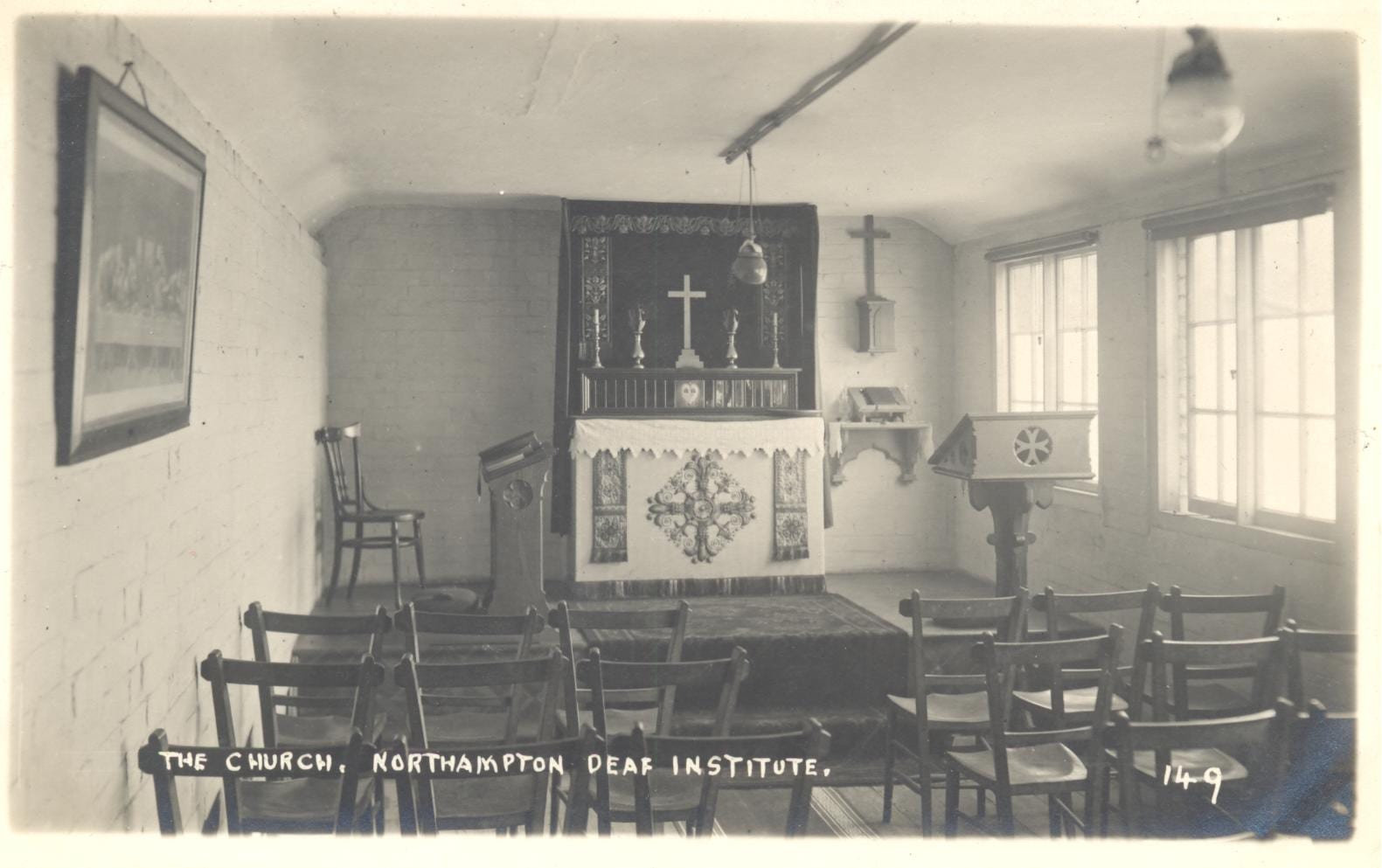 It met at 2 Seymour Place (see National Institute for the Deaf’s The Problem of the Deaf, Handbook for 1929).
Click for a larger size image.
There was a famous private Deaf School at Springhill, Cliftonville in Northampton, founded in 1868. The number of students was probably never large – in 1913 when the head was Ince-Jones it could accommodate only 12 (see National Bureau’s The Deaf, Handbook for 1913).
We have the following mission Annual Reports -1929-1984 [missing 1939, 1941-1948, 1950-1953, 1967, 1970, 1973-1976, 1979, 1981,1982]
By H Dominic W Stiles, on 25 January 2013
Some homes for the deaf found extra – probably modest – income from work that they did. The back of this photo (possbly circa 1910) tells us that this was the (female) Deaf and Dumb home at Bath. This Home for Deaf Women at 9 and 10 Walcot Parade, Bath, was founded by a clergyman’s daughter in 1868, then later taken over by the NID in 1932 and moved to ‘Poolemead’ at Twerton-on-Avon, near Bath, in 1933. Action on Hearing Loss still runs homes there. Click onto the image for a larger size.

By H Dominic W Stiles, on 4 January 2013
Theatre has long been important for the Deaf community, as a form of social expression and participation. Here we see the York Deaf Social Club circa 1920 doing a Victorian farce, The Ghost in a Pawnshop.

In 1960 the NID MIME GROUP was set up by Pat Keysell and Ursula Eason. It developed into the British Theatre of the Deaf in 1969.
Deafinitely Theatre are the best known Deaf Theatre company in the U.K. Their latest offering in February is aimed at children – Tyrannosaurus Drip – “A visual adaptation of the book by Julia Donaldson and David Roberts. When an egg is stolen from the nest of a waterweed-munching Duckbill Dinosaur only to end up on the other side of the river in the nest of a meat-eating Tyrannosaurus Rex, the life ahead for the unborn dinosaur is likely to be a difficult one.”
The RNID Mime Group and the Theatre of the Deaf
The N.I.D. Mime Group. Silent World, 1961, 15(12), 372-374. (photos)
The Waxworks Mystery. Hearing, 1965, 20, 108-09.
Mime at Mayfair: the first West End production by the RNID Mime Group. Hearing, 1965, 20, 372-373.
The R.N.I.D. Mime Group. Hearing, 1968, 23, 16-18.
KEYSELL, P. British Theatre of the Deaf, 1960-1977. Deaf Arts UK, 1999, 8, 7-9; 1999, 9, 3-6, 15. (photos)
SCHLISSELMAN, I. A brief historical outline of the British Theatre of the Deaf. Deaf History Journal, 2000, Suppl. 6, 3-7.
Here is a long list of suggested reading on Deaf Theatre, not all to be found in the library.
ABBOTSON, S.C.W., 2003. Thematic Guide to Modern Drama. Greenwood.
ANDREWS, R.H., Deaf Theatre Performance: An Aristotelean Approach.
BALDWIN, S.C., A History of the National Theatre of the Deaf from 1959 to 1989.
BRADFORD, S., 2005. The National Theatre of the Deaf: Artistic Freedom and Cultural Responsibility in the Use of American Sign Language. In: C. SANDAHL, P. AUSLANDER and P. PHELAN, eds, U of Michigan P, pp. 86-94.
BRADFORD, S.L., 2001. The Australian Theatre of the Deaf: Essence, Sensibility, Style, U of Texas, Austin.
BREWER, D., 2002. West Side Silence: Producing West Side Story with Deaf and Hearing Actors. Theatre Topics, 12(1), pp. 17-34.
COHEN, H.U., 1989. Theatre by and for the Deaf. TDR: The Drama Review: A Journal of Performance Studies, 33(1), pp. 68-78.
DAVIDSON, M., 2006. Hearing Things: The Scandal of Speech in Deaf Performance. In: H.L. BAUMAN, J.L. NELSON, H.M. ROSE, W.C. STOKOE, W.J.T. MITCHELL and C.A. PADDEN, eds, U of California P, pp. 216-234.
DAVIDSON, M., 2002. Hearing Things: The Scandal of Speech in Deaf Performance. In: S.L. SNYDER, B.J. BRUEGGEMANN, R. GARLAND-THOMSON and M. BÉRUBÉ, eds, Modern Language Association of America, pp. 76-87.
DENEULIN, A., 1973. The National Theatre of the Deaf. Kunst en Cultuur, 31 May, pp. 14-14.
FANT, L., 1980. Drama and Poetry in Sign Language: A Personal Reminiscence. In: C. BAKER, R. BATTISON, M.D. GARRETSON, W.C. STOKOE and R. STOKOE, eds, Nat. Assoc. of the Deaf, pp. 193-200.
FRERE, J., 2004. But All the World Is Deaf: Theatre Bazi’s Production of The Mute Who Was Dreamed. TheatreForum, 24, pp. 45-52.
HARRINGTON, B., 1991. Non-Traditional Casting Update: Interview with Linda Bove. TDR: The Drama Review: A Journal of Performance Studies, 35(2), pp. 13-17.
INGALLS, Z., 2000. On Prospero’s Island, Deaf and Hearing Students Learn to Act Together. Chronicle of Higher Education, 46(45), pp. B2-B2.
KELLETT BIDOLI, C.,J., 2008. Transfer and Construction of Identity and Culture in Audiovisual Feature Film Translation for the Italian Deaf Community. In: C.J.K. BIDOLI and E. OCHSE, eds, Peter Lang, pp. 403-432.
KISHI, M., 2003. Shuwa myūjikaru e no henshin: Shinsei Big River. Eigo Seinen/Rising Generation, 149(7), pp. 429-429.
KOCHHAR-LINDGREN, K., 2006. Hearing Difference across Theatres: Experimental, Disability, and Deaf Performance. Theatre Journal, 58(3), pp. 417-436.
KOCHHAR-LINDGREN, K., 2002. Listening with the Third Ear: Kabuki, Bharata Natyam and the National Theatre of the Deaf. Journal of American Drama and Theatre, 14(2), pp. 35-43.
LINDGREN, K.A., DELUCA, D. and NAPOLI, D.J., 2008. ASL in Performance: A Conversation with Adrian Blue. In: Deaf culture, identity, language, and arts K.A. LINDGREN, D. DELUCA and D.J. NAPOLI, eds, Gallaudet UP, pp. 232-238.
NOVAK, P., 1996. Jorjan Lynn Jeter: The Stuff of Dreams. American Theatre, 13(10), pp. 42-42.
PEARSON-DAVIS, S., 1986. Working with Deaf and Hearing Actors in the Same Cast: Even If You Don’t Know Sign Language! Youth Theatre Journal, 1(1), pp. 15-19.
PETERS, C., 2006. Deaf American Theater. In:
Signing the Body Poetic; Essays on American Sign Language Literature H.L. BAUMAN, J.L. NELSON, H.M. ROSE, W.C. STOKOE, W.J.T. MITCHELL and C.A. PADDEN, eds, U of California P, pp. 71-92.
RICH, J.D., 1972. National Theatre of the Deaf. Players: Magazine of American Theatre, 47, pp. 115-119.
ROBINSON, C.L., 2006. Visual Screaming: Willy Conley’s Deaf Theater and Charlie Chaplin’s Silent Cinema. In: H.L. BAUMAN, J.L. NELSON, H.M. ROSE, W.C. STOKOE, W.J.T. MITCHELL and C.A. PADDEN, eds, U of California P, pp. 195-215.
RUEBHAUSEN, D.K., 0101. Art Made Accessible: Redefining Accessibility and Cross-Cultural Communication for the Deaf and Hard-of-Hearing in American Theatre Institution, U of Minnesota.
SCHIMMEL, K.M., 0101. The Effects of Changes in the Rhetoric of the Deaf Culture upon Hearing Playwrights in the Twentieth Century, Bowling Green State U.
STOKOE, W.C., 1984. Not Found, Created: A Major New Source for the Study of Sign Language and Culture: A Review of Sign Me Alice II by Gilbert Eastman. Sign Language Studies, 42, pp. 57-64.
WILSON, J., 1997. Signs of Definitions. In: A. POINTON, C. DAVIES and P. MASEFIELD, eds, British Film Institute, pp. 179-181.
ZACHARY, S.J., 1995. The National Theatre of the Deaf and the Teatr mimiki i zhesta: Two Views on Theatre of the Deaf. Theatre Topics, 5(1), pp. 53-67.
ZACHARY, S.J., 1984. A Language Rationale for Conventional Readers Theatre of the Deaf. Literature in Performance: A Journal of Literary and Performing Art, 5(1), pp. 20-28.
By H Dominic W Stiles, on 20 November 2012
There is, perhaps surprisingly, a large amount of literature on Deaf people and music. In response to a Guardian article which mentioned deaf children feeling the vibrations of instruments here is some suggested reading:
Books / Reports:
Beament J
How we hear music: the relationship between music and the hearing mechanism.Woodbridge, Boydell Press; 2001.
Written for music students but covers the physical basics of hearing music.
RNID DW
Glennie E
Good vibrations: my autobiography. 1990, Hutchinson.
RNID Biography
Marcus H
Music for all: an investigation into the value of music for deaf people. Unpublished MA thesis, 2001, University of Sheffield.
RNID C7234 (reference only)
Rigney M
Deaf side story: deaf sharks, hearing jets, and a classical American musical.Washington DC; Gallaudet University Press 2003.
The story of a collaborative staging of West Side Story by two American Colleges, one of which was Illinois School for the Deaf.
RNID YBX G
Chapters & Articles:
Abdi, S et al
Introducing music as a means of habilitation for children with cochlear implants. INTERNATIONAL JOURNAL OF PEDIATRIC OTORHINOLARYNGOLOGY, 2001, 59(2), 105-113.
Almost famous. DEAF ARTS UK, 2003, 21, 19.
Interview with student flautist Ruth Montgomery.
Annear P
The seashell gamelan. HEARING CONCERN, 2000, 8 (2), 12-13.
Music work at the Royal School for the Deaf (Manchester)
Ash A
Sign song with Caroline Parker. DEAF ARTS UK, 1999, 8, 17.
Brief report of sign song workshop led by sign song artist Caroline Parker.
Available online at: www.deafed.net/PublishedDocs/970723b.htm [last accessed on 20/11/12].
Barron P
They said Janine wouldn’t make it as a singer – now she’s a star! HEARING CONCERN, 2003, 11 (2), 18-19.
Features opera singer Janine Roebuck.
Benari N
Inner rhythm: dance and music for hearing impaired children. MAGAZINE (BRITISH ASSOCIATION OF TEACHERS OF THE DEAF), 1996, Nov, 17-19.
Boone M
Music especially adapted for hard of hearing people. IFHOH JOURNAL, 1990, 11 (3), 17 18.
(Reprinted from SHHH, 1987, Nov Dec.)
Carr G
The development of listening skills, in ‘Audiology in education’, McCracken W, Laoide-Kemp S (eds).London, Whurr; 1997. pp.385-411
Half of the chapter is subtitled ‘Music and musical experience’.
RNID PYB GJ
Chasin M
Hear the music … or not. HEARING JOURNAL, 2004, 57 (7), 10-16.
20 tips from the author on listening to music through hearing aids.
Chasin M
Hearing aids and music. TRENDS IN AMPLIFICATION, 2004, 8 (2), 35-47.
Chasin M
Music and hearing aids. HEARING JOURNAL, 2003, 56 (7), 38, 38, 40-42.
Study of the technical requirements of a hearing aid suitable for hard-of-hearing musicians and listeners.
Cheng W
A musical season. SHHH, 1990, 11 (6), 20 23.
Profile of deaf violinist Wendy Cheng.
Clewes N
A musical journey. NETWORK, 2003, 69, 13-14.
Personal account by cochlear implant recipient deafened at 16.
Clewes N
Music workshop held at the AGM. NETWORK, 2003, 70, 7-8.
Workshop for deafened adults led by members of the London Symphony Orchestra.
Creativity
BATOD MAGAZINE, November 2004.
A special issue of the BATOD Magazine which includes a number of short articles on music in deaf education. A list of contents and short abstracts can be found at:
http://www.batod.org.uk/index.php?id=/publications/magazine/index/year-04/nov-04.htm
Dalgarno G
Enabling hard of hearing people to hear music and enjoyably. HEARING CONCERN, 1996, 1 (1), 12-13.
Enabling for Music Project, based at the Department of Electronics, University of York, carries out research and provides practical advice on using technology to help hard of hearing, deaf, deafened, physically disabled and partially sighted people enjoy music.
Dalgarno G
Music appreciation and deafness. NEWSLETTER (NATIONAL COCHLEAR IMPLANT USERS ASSOCIATION), 2004, 21, 7-9.
Dalgarno G
How new technology can help you enjoy music. HEARING CONCERN, 1999,7 (2), 14-16.
Dalgarno G
Music for deaf and partially hearing people with an emphasis on the application of technology to aid perception. Part 3. The scope through electronic equipment and computers. ASSOCIATION MAGAZINE, BATOD, 1989, Mar, 10 16.
Dalgarno G
Music for deaf and partially hearing people with an emphasis on the application of technology to aid perception. Part 4. Visual and tactile representation of music. ASSOCIATION MAGAZINE, BATOD, 1989, May, 8 11.
Deaf cellist wins international award. BRITISH DEAF NEWS, 2002, Aug, 7
Features profoundly Deaf Catriona Hetherington.
Dryden R
Music comes to Margate. TALK, 1995, 158, 8.
Music programme at the Royal School for Deaf Children, Margate.
Egan D
Keeping a song in her heart. SEE HEAR, 1996, Jun, 8-9.
Interview with music teacher Valerie Hoppe, deafened in mid-career, and founder of Life after Deafness (LAD), a support group for deaf and hard of hearing people working in the arts.
Edwards J
The Beethoven Fund for Deaf Children in association with the Elizabeth Foundation: Claus Bang master class, 10th-12th March 1995. ASSOCIATION MAGAZINE (BATOD), 1995, Sep, 4.
Fawkes, W. G., & Ratnanather, J. T.
Music at the Mary Hare Grammar school for the deaf from 1975 to 1988. Visions of Research in Music Education, 14 2009.
Folts M
Deaf Children Cannot Play a Musical Instrument…Can They? 1977, VOLTA REVIEW, 79 (7), 453-456.
Franklin J
We got rhythm! TALKING SENSE, 2001, 47 (1), 26-27.
Using Aurhythmics to give access to sound and music for deafblind children at Sense’s Family Centre in Ealing.
Gfeller K et al
Recognition of “real-world” musical excerpts by cochlear implant recipients and normal-hearing adults. EAR AND HEARING, 2005, 26(3), 237-250.
Gfeller K, Knutson J E
Music to the impaired or implanted ear. ASHA LEADER, 2003, 8(8), 1, 12-15.
Hart P
Music: a vehicle for communication. DEAF BLIND EDUCATION, 1989, 4, 19 20.
Gfeller K et al
Musical backgrounds, listening habits, and aesthetic enjoyment of adult cochlear implant recipients. AMERICAN JOURNAL OF AUDIOLOGY, 2000, 11(7), 383-406.
Gfeller K et al
Musical involvement and enjoyment of children who use cochlear implants.VOLTAREVIEW, 2000, 100(4), 213-233.
Gfeller K et al
Preliminary report of a computerized music training program for adult cochlear implant recipients. JOURNAL OF THE ACADEMY OF REHABILITATIVE AUDIOLOGY, 1999, 32, 11-27.
Hay J
Face to face: Colin Thompson. BRITISH DEAF NEWS, 1989, 20(3), 7 8.
Interview with Colin Thompson, RNID Regional Officer (East), about his performances of signed pop songs, family background, and views on deaf education.
Hummel C
The Value of Music in Teaching Deaf Students. 1971,VOLTAREVIEW, 73(4), 224-228, 243-249.
Hawley R
Learning in harmony. TALKING SENSE, 2002, 47 (2), 24-25
Hickish E
A programme for aurhythmics in Cornwall. TALK, 1993, 148, 8-9.
Ivankovic P, Ghilpatrick I
Let’s start the music. PERSPECTIVES IN EDUCATION AND DEAFNESS, 1994, 12 (5), 12-14.
Music activities for preschool children.
Kirk T
How to make a musical chair. TALKING SENSE, 1989, 35(4), 4 5.
‘Listening’ to music through a vibrating chair
Liemohn W, Hargis C, Winter T, Wrisberg C
Rhythm production/perception by deaf students. VOLTA REVIEW, 1990, 92 (1), 13-24.
Liston S L, Yanz J L, Preves D, Jelonek S
Beethoven’s deafness. LARYNGOSCOPE, 1989, 99 (12), 1301 1304.
Leal M
Music perception in adult cochlear implant recipients. ACTA OTO-LARYNGOLOGICA, 2003, 123 (7), 826-835.
Looi V, Sucher C, McDermott H
Melodies familiar to the Australian population across a range of hearing abilities. AUSTRALIAN & NEW ZEALAND JOURNAL OF AUDIOLOGY, 2003, 25 (2), 75-83.
MCCRACKEN W, SUTHERLAND H,
Music for hearing-impaired children in Deaf ability not disability: a guide for parents of hearing impaired children: 1991
RNID YBX S
Moore E
BATOD response to the interim reports for music and physical education produced by the National Curriculum Working Groups for these subjects. ASSOCIATION MAGAZINE, BATOD, 1991, Sept, 2 3.
Mitani C et al
Music recognition, music listening, and word recognition by deaf children with cochlear implants. 2007, EAR AND HEARING, 28 (2 Supplement), 29S-33S.
Myers M
When music becomes magic. VOLTA VOICES, 2006, 13 (1), 22-23.
Reports on the successes of a US schoolgirl with a cochlear implant.
Parker C
Sign singing. SIGN MATTERS, 2004, Nov, 16-17.
Reports on a workshop held at the British Deaf Association following on from the popularity of the ‘Deaf Idol’ contest.
Perry N
Workshop 5: Music making for deaf children. In MITCHELL H, IZATT E. Empower ’97: international conference on deaf education. pp. 76-77.
RNID C6967 (REF), C6968
Rocca C
A positive musical experience. 2006, BATOD MAGAZINE, November, 13-15.
Comment upon teaching music at the Mary Hare School for the Deaf.
Signing opera. DEAF ARTS UK, 1998, 7, 8.
English National Opera project with deaf pupils in Exeter.
Shaw J
Teaching music as an aid for speech training of hearing impaired students. ACEHI JOURNAL, 1989, 15 (3), 114 120.
Signing choir heralds Year of Disabled. TALK, 2003, 193, 44.
News item about the signing choir at the Royal School for the Deaf, Derby.
Singers have it in hand. ONE IN SEVEN, 1999, 9, 9.
News item about Music in Motion, a Birmingham-based group of deaf, hard of hearing, and hearing people who sign-interpret pop songs.
Stabej, K.K. et al.
The music perception abilities of prelingually deaf children with cochlear implants (Review) International Journal of Pediatric Otorhinolaryngology Volume 76, Issue 10, October 2012, Pages 1392-1400
Stewart D A et al
Sign language interpreting: exploring its art and science. 1998. pp. 120-121 deal with interpreting songs.
RNID UTB TNX N
Suzor’e: the IV International festival of Signed Songs. BRITISH DEAF NEWS, 2003, Apr, 16-17.
Shearer P D
The deafness of Beethoven: an audiologic and medical overview. AMERICAN JOURNAL OF OTOLOGY, 1990, 11 (5), 370 374.
Spears D
Hearing without listening. SOUNDBARRIER, 1990, 40, 11 12.
Interview with deaf percussionist Evelyn Glennie.
Spanbauer P
Movement arts: unlocking the world. PERSPECTIVES IN EDUCATION AND DEAFNESS, 1990, 8 (3), 12 15.
Swaiko N
The role and value of an eurythmics program in a curriculum for deaf children. AMERICAN ANNALS OF THE DEAF, 1974, 321-324.
Vistamusic in sight and in touch. TALK, 1990, 135, 18 19
Vistamusic is a visual/tactile method of making music using a computer, developed by Gordon Dalgarno.
Wolf F
Dance of life. TALKING SENSE, 2002, 47 (2), 18-21.
Article on creative arts for deafblind people, which features 9-year-old percussionist Thomas Knight.
Web Resources:
www.matd.org.uk – Music and the deaf; a charity that runs music and performing arts workshops in schools for deaf and hard of hearing children.
http://www.musicinmotioncharity.co.uk/ – An English charity group that performs popular songs in BSL.
www.zen59695.zen.co.uk/etsam/efm.htm – Enabling for Music; a charity dedicated to using technology to help people with hearing difficulties listen to music.

