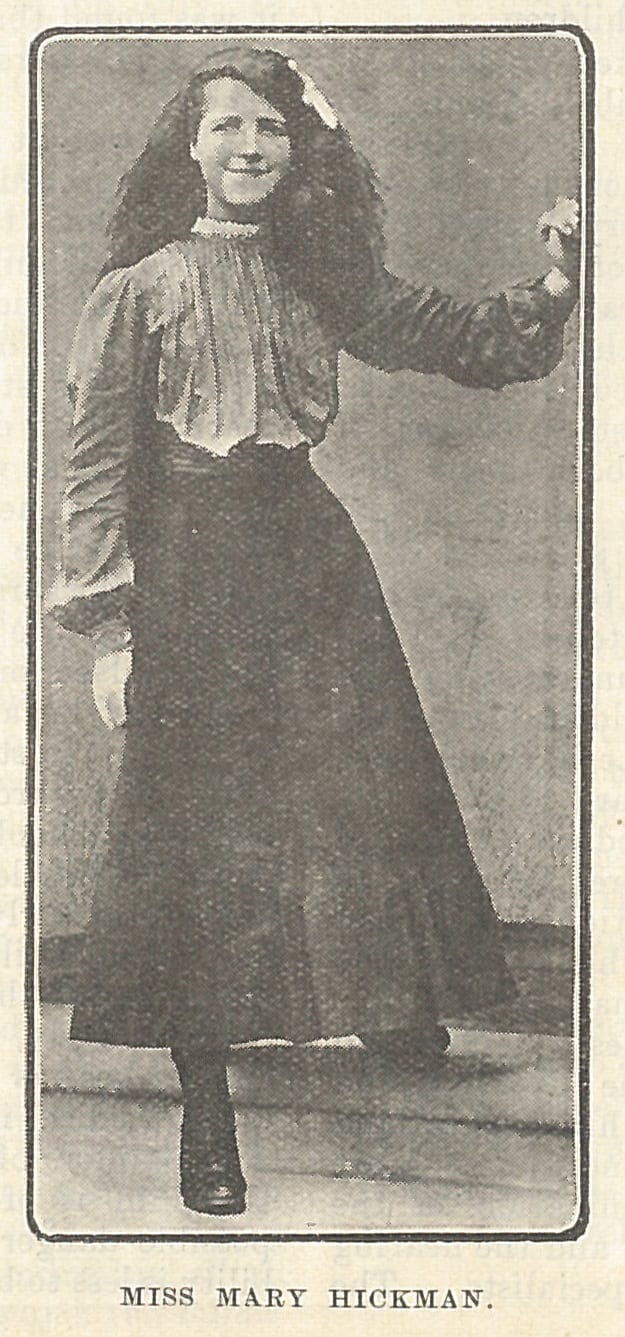
 In 1905 the King and Queen went to Salford to open the New Dock. They also stopped at Henshaw’s Blind Asylum, and The Royal Schools for the Deaf and Dumb, where the pupils did what children do when they meet royalty – they gave them bouquets.* The girl here from the Deaf School, whose photograph first appeared in the Penny Illusatrated Paper, is Mary Hickman (1890-1978), who was Head Girl at the school.
When told that she was to present the Queen with a boquet, Miss Hickman was naturally both proud and elated, and it goes without saying that her mind was fully occupied until the very auspicious Thursday dawned. According to the newspaper reporters, she played her part in the little ceremony very neatly; and to our representative she naively confessed that sh “did not feel a bit nervous. The Queen was very lovely and the Kinglooked very jolly.” (British Deaf Times)
Born on the 17th of November, 1890, Mary Hickman lost her hearing aged five and a half according to the 1911 census and the school annual report (1903), from meningitis. When she was seven she entered the Manchester school, on the 28th of January, 1898. She was due to leave on the 17th of November, 1906 when she was sixteen. When she was at the school her father, salford born Walter, was a clerk. He later became a newsagent and tobacconist according to the 1911 census, when they lived in 224 Ashton Old Road, Openshaw. They were presumably in long gone terraced housing, as the two daughters and son shared a four room house with their parents. Mary had studied for certificates with the College of Preceptors, the oldest professional body for teachers, but we find that in 1911 she was working as a ‘tracer’ for engineers – presumably in a drawing office.
I found that her sister married in 1915, but she seems to have stayed at home, and in the 1939 register she was in Station Road, living with her father. It seems a pity that she never got to teach, but we cannot be sure that she did not – we really have too little information. Perhaps schools would not contemplate taking on a Deaf teacher in the first decades of the 20th century.
Mary died in Manchester in 1978.
If you know anything of her life, please comment below.
*I think someone could probably write an interesting study on the history and sociology of children giving royalty bouquets!
NB I thought this is funny – on the 1911 census her father filled in the nationality – not required unless foreign –
Deaf Girl’s Unique Experience, British Deaf Times 1905, vol 2 (22) p.217
Census 1891 – Class: RG13; Piece: 3938; Folio: 95; Page: 35
Census 1901- Class: RG13; Piece: 3667; Folio: 208; Page: 8
Census 1911 – Class: RG14; Piece: 23729
1939 Register; Reference: RG 101/4546A
Penny Illustrated Paper – Saturday 22 July 1905
 Close
Close


 In 1909 the Finlands Dövstum-förbund produced the first of their special ‘Jul’ – ‘Yule’ – editions. This was a Swedish language journal. Finland has a large Swedish population, having been a part of Sweden for hundreds of years. Below is the cover from 1918, & below that an article on the sign counting system used, from the 1909 issue. It was developed partly from foreign example, by the first teacher of the Deaf in Finland, himself deaf, Carl Oscar Malm (1826-63).


