X Close

UCL Ear Institute & Action on Hearing Loss Libraries

Home

Information on the UCL Ear Institute & Action on Hearing Loss Libraries

Menu

Archive for February, 2013

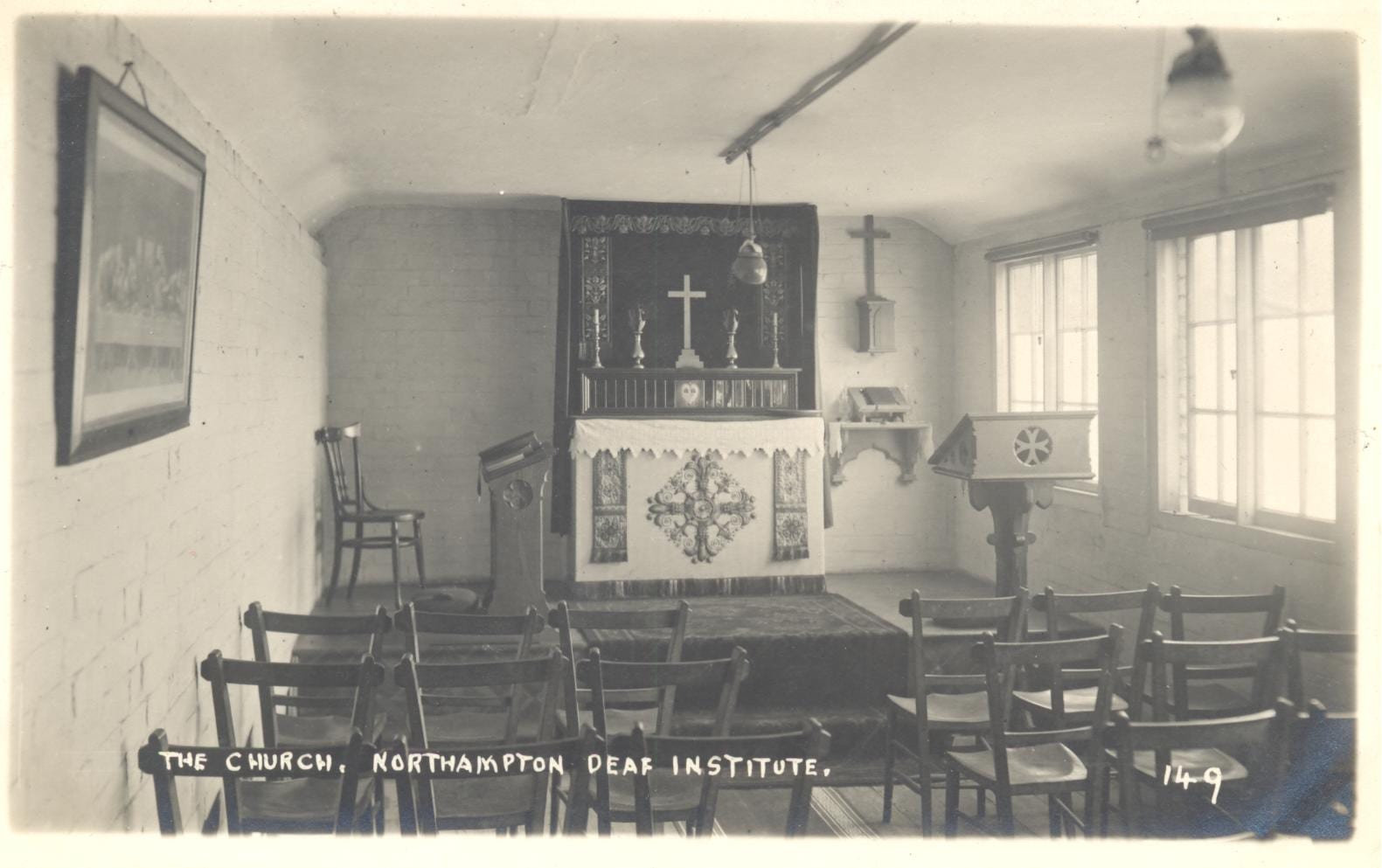
Northampton Deaf Institute

By H Dominic W Stiles, on 22 February 2013

The term ‘Deaf Institute’ can sometimes be confusing, as it can refer to either a school or a mission, or perhaps somewhere that accommodated both.  Many seem to  have originally been missions, and spreading a religious message to Deaf people was therefore at their heart, followed by their educational and social development (for instance with temperence meetings) and helping them with job opportunities where they could. 

The Northamptonshire and Rutlandshire Mission, which I assume is the same as the Northampton ‘Institute’ (can anyone confirm or deny this?), appears to have only started in 1928/9, with the missioner Algernon J.M. Barnett who had trained under the Rev. Albert Smith in London (Smith being Gilby’s replacement there at St. Saviour’s Oxford St.).  It met at 2 Seymour Place (see National Institute for the Deaf’s The Problem of the Deaf, Handbook for 1929).

Click for a larger size image.

There was a famous private Deaf School at Springhill, Cliftonville in Northampton, founded in 1868. The number of students was probably never large – in 1913 when the head was Ince-Jones  it could accommodate only 12 (see National Bureau’s The Deaf, Handbook for 1913).

We have the following mission Annual Reports -1929-1984 [missing 1939, 1941-1948, 1950-1953, 1967, 1970, 1973-1976, 1979, 1981,1982]

Treating Deafness: Hannah Thatcher, William Wright, and the Danger of ‘Thin Shoes’

By H Dominic W Stiles, on 15 February 2013

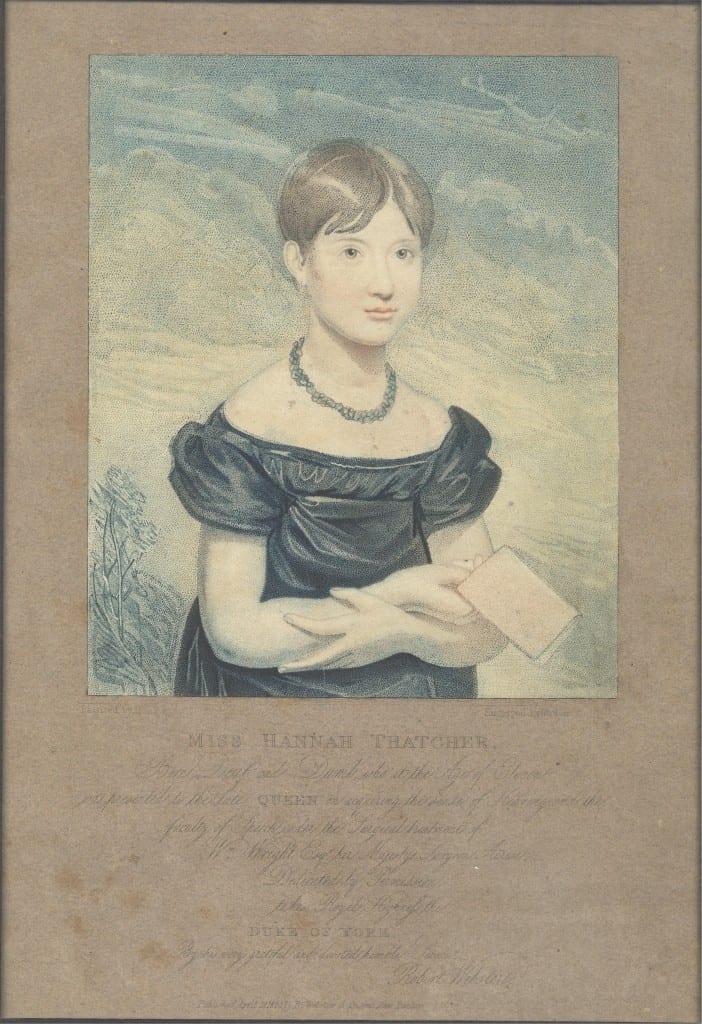
From the RNID Library picture collection, we have this charming image of a young girl.  The picture was presented to the Pierre Gorman of the RNID Library by Mrs Selwyn Oxley on May 2nd 1963. The inscription on the engraving below reads,

Miss Hannah Thatcher, Born Deaf and Dumb, who at the Age of Eleven was presented to the late Queen on acquiring the sense of Hearing and the faculty of Speech under the surgical treatment of Wm. Wright Esq. Her Majestys Surgeon Aurist, Dedicated by Permission to His Royal Highness the Duke of York by his very grateful and devoted humble Servant, Robert Webster. Published April 10 1820 by R. Webster 3 Queens Row, Printer

The name of the artist is faded away, and it looks as if the engraver was Robert [Webster].  Click on for a larger size image. You can read more about William Wright on the excellent website by our friend Jaipreet Virdi, From the Hands of Quacks.
hannah Tatcher 2 001The Ear Institute Library (our two collections are separate) has a copy of Wright’s 1829 book, On the Varieties of Deafness and Diseases of the Ear with Proposed Methods of Relieving Them.  The book was presented ‘with the author’s compliments’, we might speculate to Charles Hawkins, ‘House Surgeon’, who gave it to St. George’s Hospital Library in 1856.  The book went on the the Royal Ear Hospital before ending up with us.  It is fascinating to see the many lives of a book, and consider how such an ordinary object can pass through many hands, outliving the transient owners.

Wright covers various causes of Deafness, and supposed or actual cures for hearing maladies, such as damp clothes (cause) or urine of a variety of animals (supposed cure)  (here Wright appears to be a sensible materialist, explaining a possible ‘mechanical’ effect by reason of the liquid acting on wax).  Of ear tickling , we learn “in China, it is said that this forms a species of luxurious enjoyment amongst the great”. As for ‘Bethesda-Pool mineral water’, “see St. John, Chapter 5”, “recommended by a licenciate of the College of Physician, as a cure for deafness,”

in proof that the water was genuine, the angel of the Lord, he said, periodically troubled it in each individual bottle,-the same as we are told he used to trouble the pool. There were many persons who drank a considerable quantity of this water for a variety of complaints, until the shafts of ridicule spoiled the Doctor’s trade in the article, by correcting the aberration of his patient’s minds from the true standard of sanity.  (see Plain Advice for the Deaf, p.167)  After this, we must not be surprised if a portion of clay and water, said to be from Siloam’s pool, were to be sold by some empiric, to cure blindness! (see St. John, Chap. 9)  Or a pretended importation of casks of water from the River Jordan, to be made by some adventurer, and disposed at a high price, as a cure for leprosy! (see 2d Kings, Chap. 5)  This is not so very unlikely, after the above example; and one much on a par with it, namely, the Quack who a few years ago advertised wild elephants’ milk for sale, and gave a description of the manner in which his agents in Africa performed to operation of obtaining it.

Below we see Wright’s views on snuff.
Snuff 001


Wright also points to to the dangers of ‘thin shoes’ – “Ladies frequently cause serious derangement of their own health, as well as diminution of the sense of hearing, by want of caution as to this part of their dress: damp, or cold applied to the feet of persons of delicate constitution, or who from habits of life are accustomed to warm rooms, or the use of a carriage, is extremely injurious, and sometimes even fatal.”

Now didn’t your grandmother say exactly that?  You have been warned!

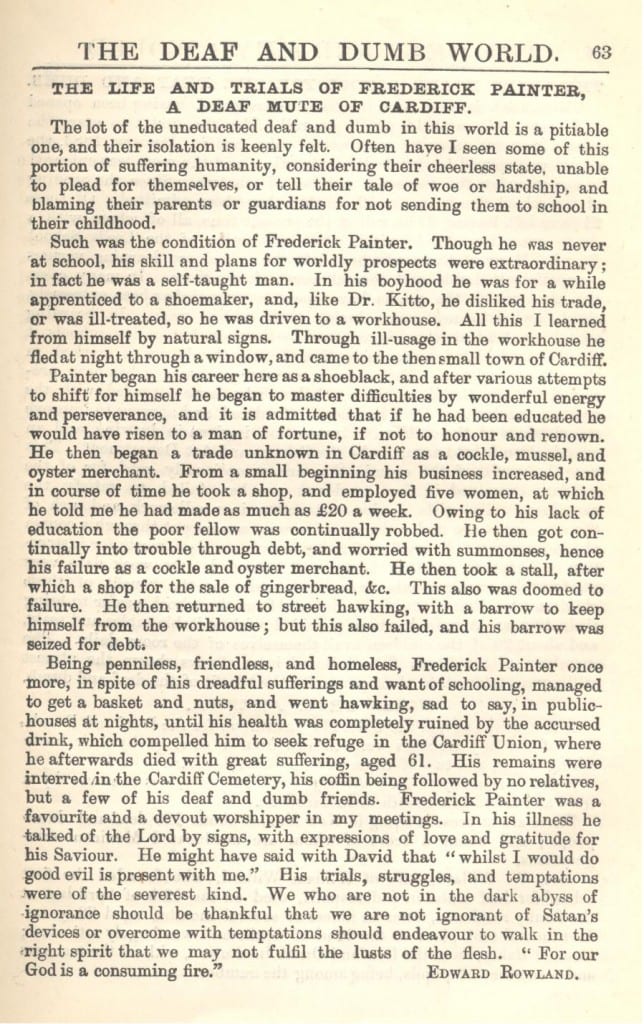
The Life and Trials of Frederick Painter, a Deaf Mute of Cardiff, ca 1812-1883

By H Dominic W Stiles, on 8 February 2013

The story in the attached picture (click onto the image for a larger readable file), is taken from the September 1886 issue of Deaf and Dumb World: a Monthly Journal. This little magazine (it measures about 5″ x 8″) was edited by Ernest Abraham.

From Deaf and Dumb World, June 1886 p.63

From Deaf and Dumb World, June 1886 p.63

As such it was a forerunner of the Deaf and Dumb Times.

As to Frederick Painter, the 1861 census tells us he was a fishmonger, born in London, but by the 1871 census he was an “itinerant vendor of cockles, oysters etc”, aged 49 living at 17 Peel St with a Mary Ann Harris, also “Deaf and Dumb from birth”, birthplace unknown.  By the 1881 census he was clearly on a downward spiral as he has no job listed.  A sad story of someone who deserved to get a fair chance.

Unfortunately we have no Cardiff Mission records, but perhaps someone interested in this story could track down more records in Cardiff.


‘A typical Oldhamite’ and The Deaf & Dumb Herald and Public Intelligencer

By H Dominic W Stiles, on 1 February 2013

CLEGG, Ralph (ca.1849-1918)

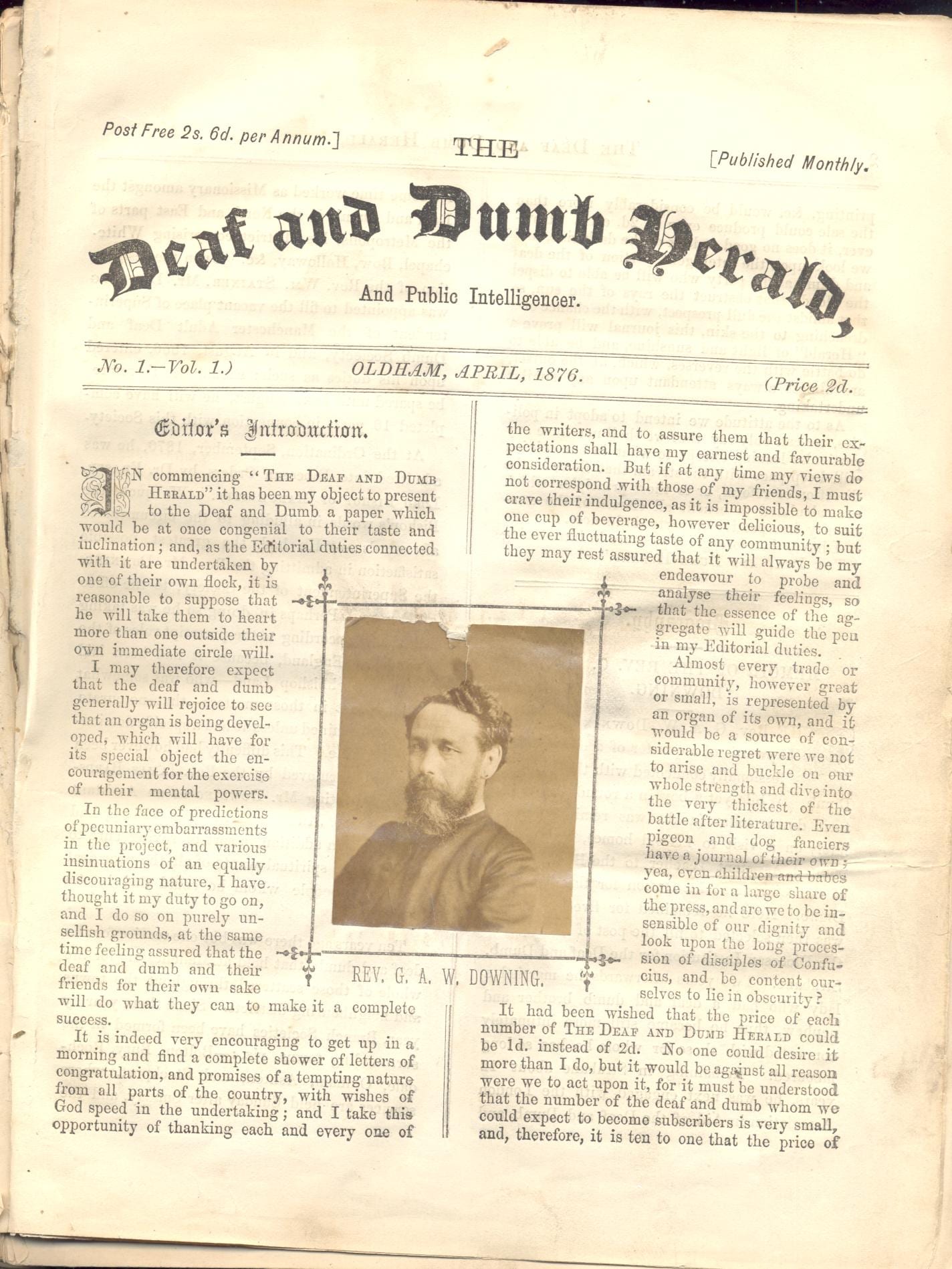
Ralph Clegg was the son of John Clegg a self-made industrialist from Rochdale.  Clegg senior had worked in a mill from childhood, at a time when the working day lasted from 5am to 8pm. He saved his pennies, learned to read and write, and became an apprentice in Heywood.  Marrying a daughter of one of his employers, John Clegg moved on to Samuel Lees and Sons as a manager. His inventions such as “Clegg’s Pick” (used for working the shuttle on a loom) founded his prosperity. His son Ralph would appear to have had a form of deafness from childhood illness as he is not described as ‘Deaf’ in the 1851 census when he was still under two years old. Ralph was the founder & editor of The Deaf & Dumb Herald and Public Intelligencer which lasted for only one year in 1876-7.

In 1881 Ralph was living in  Oldham with his wife and four young children, working as a draughtsman, able to employ a domestic servant. In 1897 he married Martha Ann Topping, also Deaf, in Hendon. One wonders if it was engineering work which took him there. By 1901 Ralph was a mechanical engineer living at Levenshulme in Manchester.  The 1911 census finds them in Warrington, and says that they had had no children together.  Ralph would appear to have died aged 71 in 1918 in Warrington. Unfortunately we do not have the Warrington records for that time and I have not found an obituary.

Mission work with Deaf people began  in Oldham in 1852.  In 1869 it became a branch of the Manchester mission, with the superintendant Rev. G.A.W. Downing.  However the records show that some of the Deaf in the mission in Oldham became discontented at being a junior branch and they broke away from the Manchester Adult Deaf and Dumb Society in 1875.  The British Deaf Mute  for 1894 and the Oldham Mission report for 1903 (Brief Sketch of the History of our Society by W.J. M’Cormick) gives some details of this struggle. Ralph Clegg was a leader of the malcontents and his Herald was perhaps an attempt to give his side some intellectual weight (though a superficial look does not seem to show that the paper highlights any division).  The Herald itself has articles by Deaf people (including Chester Malam, subject of a previous entry), about some related issues such as education, and the old favourite temperance, but Clegg used a good deal of padding as well in the form of stories about animals or anecdotes. He was progressive in some of his views, being greatly concerned about the fate of a young Deaf man, Samuel Todd, convicted for manslaughter in Birmingham and sentenced to 15 years (p.11-12, p.36-7).

The Herald folded after a year having left Clegg £80 out of pocket. His father’s death in 1877 cannot have helped matters.  M’Cormick says of Clegg (Oldham Deaf and Dumb Society Annual Report 1903 p.36-7),

Mr Clegg – long may he live – is a typical Oldhamite; pushing, resourceful, self-reliant, and enthusiastic. He played a large part in Oldham and Manchester Deaf circles. The wielder of a ready pen – virile and logical – in his hands it was and is a mighty weapon. He made things hum, with the result that from the departure of Mr. Woodbridge until the advent of Mr. A. Welsh, now missionary at Dundee, in 1884, Oldham saw no more resident missionaries.

Clegg seems to have been a confident, intelligent Deaf man who wanted to take control of his own affairs.  It is possible that more could be, or indeed already has been unearthed about Ralph Clegg, so please let us know if you can add anything to the story by commenting.

I have uploaded the two contents pages as a pdf file.  If you are however intrigued by the Sheep fond of Practical Jokes, you will have to visit the library!

Herald contents [pdf]

1881 Census RG 11 4074

1901 Census RG13 3692

 Various Oldham Annual Reports

History. British Deaf-Mute and Deaf Chronicle, 1894, 3(35), 163-64.