
X Close

IOE Blog

Home

Expert opinion from IOE, UCL's Faculty of Education and Society

Menu

Archive for the 'Further higher and lifelong education' Category

UCL’s first Arabic MOOC will bring education opportunities to refugees in Lebanon

By Blog Editor, IOE Digital, on 21 February 2019

21 February 2019

By Eileen Kennedy

English dominates the internet. Most MOOCs (Massive Open Online Courses) are available only in English. UCL has run many MOOCs with English language course providers such as FutureLearn. When you want to reach an Arabic speaking audience, however, you need to take a different approach. To reach as many participants as possible, UCL has created its first MOOC on the Edraak platform.

At the RELIEF Centre (for research and learning focused on inclusive growth and prosperity in Lebanon)we are investigating ways of fostering prosperity in places affected by mass displacement. Refugees account for over a quarter of the population of the small country of Lebanon. Such a massive influx of people puts extra pressure on an (more…)

We Are Movers: new ways of collaborating with women migrants and refugees

By Blog Editor, IOE Digital, on 5 February 2019

we are movers image

5 February 2019

By Amalia Pascal, Amy North, Claudia Lapping, Hanna Retallack, Iman Azzi, Rachel Benchekroun, Rachel Rosen, Raphaela Armbruster, Sara Joiko Mujica, Tabitha Millett (as part of Refuge in a Moving World, an interdisciplinary UCL network focused on displacement, forced migration, exile and conflict)

We may think we know about the experience of migrants. We see images of camps, beach landings, tragic losses at sea, the Calais Jungle, targeted racist aggression, disturbing rhetoric about crime and security. We also hear stories of settlement, friendship and educational success. What is our specific responsibility to contribute to this picture?
(more…)

Higher Education Policy Institute report on access: the debate rages on

By Blog Editor, IOE Digital, on 15 January 2019

15 January 2019

By Lindsey Macmillan, Matt Dickson, Simon Burgess

We appreciate the response by Iain Mansfield on WonkHE to the widespread criticism of his paper on selective schooling. However, the points we made about the dataset used and the methods employed remain.

A major critique that has yet to be answered is the inappropriate comparisons made when analysing progression to HE. The key part of the argument about the effectiveness of selective schools is hinged on analysis that is far too simple to support the strong statements made. Mansfield returns to the 39% vs 23% rates of progression from selective compared to non-selective areas in his response. The fact that he again attributes these large differences in progression rates directly to the schooling systems, rather than other factors involved that muddy the waters, is a basic stats mistake. The comparison group of all non-selective areas is wrong. If instead the (more…)

Grammar schools and access to universities: HEPI report not an accurate or complete picture

By Blog Editor, IOE Digital, on 10 January 2019

10 January 2019

By Lindsey Macmillan, Matt Dickson, Simon Burgess

HEPI Occasional Paper out today claims that “grammar schools … play a significant role in supporting social mobility”. This is based on two statements in the paper: firstly, that a high proportion of disadvantaged pupils attend grammar schools, and secondly, that areas with selective systems are better at progressing children into elite universities.
The striking claim is in stark contrast to much of the rest of the evidence, including our own. On closer inspection, the report’s claim relies on faulty data and inappropriate statistical methods. (more…)

There’s more than one way to get a PhD: enhancing women’s career opportunities in HE

By Blog Editor, IOE Digital, on 6 December 2018

6 December 2018

By Ginny Brunton

The latest figures from the Office for National Statistics show that women in academic careers earn on average some 16% less than men. The Times Higher Education reported that 30 institutions had mean average pay gaps in excess of 20 per cent per hour, noting that  more men than women occupy higher-paying senior roles. While the gap has gradually been decreasing, there substantial questions about career advancement for female research staff remain.

Many of these challenges are well-known: women take breaks to have children, and often return part time. When women do pursue higher education to advance their career, they report doing it later in life, for intrinsic satisfaction, and not usually as part of a research group. So women’s trajectories and motivations for undertaking a PhD may not fit in with the standard paths currently on offer at higher education institutions. This situation is not helping to narrow the gap.

Since researchers without a PhD lack the necessary qualifications to apply for more advanced faculty positions, one question we should be asking is: (more…)

Don’t let your cookies leave a trail of crumbs for someone else: why you should care about digital data privacy

By Blog Editor, IOE Digital, on 12 July 2018

12 July 2018

By Kim Nguyen and Romasha Sanyal

Ever thought about how when you use the fingerprint sensor on your Android, you’re actually just uploading a digital print of your biometrics? Or that your Facebook news feed isn’t just confirming what you believe about the sugar tax, but actually shaping it based on prior political activity (be it memes liked, pages visited or blog posts shared)? Or even that the first page of your Google search results is different from what your fellow Candy Crush-devoted tube commuter might find for an identical string of keywords?

Data privacy might have hogged the limelight in recent times because of the ubiquitous GDPR that purged subscribers’ mailing lists nationwide, not to mention the Cambridge Analytica scandal, but not nearly enough is discussed with respect to how it affects the group most vulnerable to its invasion – children. Enter defenddigitalme, an organisation led by Jen Persson, which has been working steadfastly since 2013 to spread awareness regarding the collection of data on school children for the National Pupil Database by the Department for Education. With their recent #MyRecordsMyRights campaign, their mission is not only to raise awareness (more…)

Improving science participation: Five evidence-based recommendations for policy-makers and funders

By Blog Editor, IOE Digital, on 22 May 2018

22 May 2018

By Science Capital Team

To continue with science post-16, young people must achieve certain levels of understanding and attainment. Crucially, they must also feel that science is a good ‘fit’ for them – that science is ‘for me’.

Drawing on more than five years of research conducted by the Enterprising Science project in classrooms and out-of-school settings, the team have developed five key recommendations for policy-makers and funders who want to broaden and increase young people’s engagement with science. These recommendations are set out in Improving Science Participation, a new publication (more…)

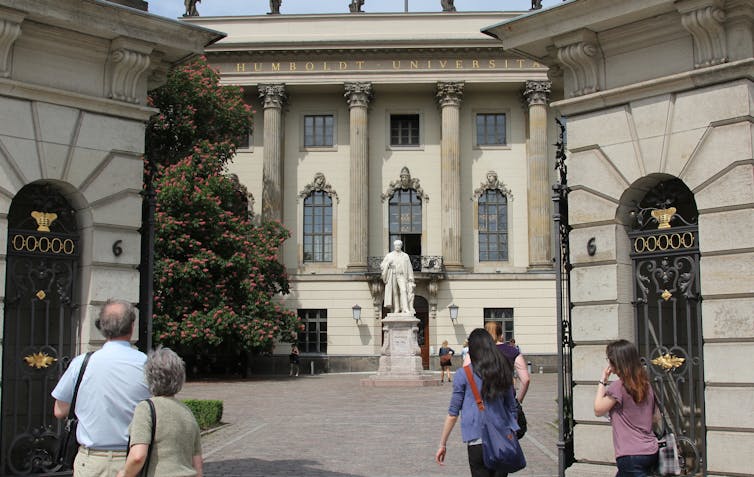
Brexit: German universities among those poised to benefit if researchers and funding shift

By Blog Editor, IOE Digital, on 23 February 2018

Entrance of Humboldt University in Berlin.

Humboldt University in Berlin. German universities may emerge as ‘winners’ from Brexit. Photo credit: Tilemahos Efthimiadis CC BY

23 February 2018

By Aline Courtois

The UK is currently the second-largest recipient of competitive research funding from the EU: 6% of students and 17% of staff in UK universities are from other EU countries. Nearly half of academic papers produced by the UK are written in collaboration with at least one international partner – and among the top 20 countries UK academics cooperate the most with, 13 are in the EU.
While collaboration is important, countries also compete with each other for funding and students. Our new research has found that academics and institutions across Europe, and particularly in Germany, could make significant gains as Brexit shakes (more…)

So what is Further Education? And why is it so hard to define?

By Blog Editor, IOE Digital, on 19 January 2018

19 January 2018

By Martin Doel

According to a recently released CBI Report – In Perfect Harmony: Improving Skills Delivery in England – the English skills system has undergone 28 major reform programmes in the past 30 years. The result, the report argues, is alienated firms, confused training providers and a failure to deliver on skills needs. Somewhat ironically, as is often the case with such reports, the CBI then go onto propose further reform of a current programme – the apprenticeship levy, less than 9 months after its inception in April last year.
(more…)

‘We’re preparing our army for the last war’: why the academic-vocational divide must fall

By Blog Editor, IOE Digital, on 30 November 2017

30 November 2017

By IOE Events

Vocational education suffers from its second class status – variously seen as a ‘consolation prize’ and ‘for other people’s children’. It deserves better – for its own sake and for the sake of social justice, but also, as the speakers at the IOE’s second ‘What if…’ event this week noted, for the sake of our economy.
As Tony Little, chief academic officer of GEMS Education and former headmaster of Eton, remarked, ‘we’re preparing our army for the last war’; the economy and labour market are changing fast, and young people need a broader education. As evidenced by November’s Budget and Industrial Strategy, the government itself seems to have woken from its slumber on skills, and vocational education’s time has come (again). We have been here before, of course, so how can things be different this time around?
Also responding to the question, What if… we really wanted to overcome the academic-vocational divide? were (more…)