X Close

Global Social Media Impact Study

Home

Project Blog

Menu

Archive for the 'Themes' Category

Filmmaking and photography in anthropological research

By Tom McDonald, on 12 June 2014

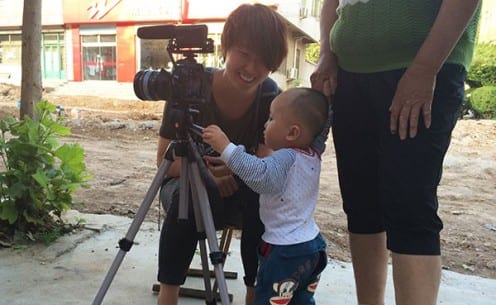
Baby in fieldsite using Kiki Wang's camera (Photo: Tom McDonald)

Child in north China fieldsite explores Kiki Wang’s camera (Photo: Tom McDonald)

As part of the project’s ambitious plans for telling people about the findings of our research, I’m fortunate to have been able to collaborate with the incredibly talented and creative Gillian Bolsover and Kiki Wang who have just finished a short visit to the north China fieldsite, in order to produce a series of photographs and films with the aim of bringing the ethnography to life for people all around the world.

It’s been a particularly intensive week of work for us all, as I have been taking both of them around many places in the fieldsite, trying to introduce them to as many of my friends here as possible and to help them to capture as many different aspects of life in the town and villages as we can.

But I’ve found the exercise to be useful in another sense; it has forced me to reflect on the key relationships and friendships that I have made with people in the town during the past year of fieldwork. These people have been both great and wonderfully understanding about participating in our photos and films. I had assumed that they would be reticent about the process, but often they have been really positive about appearing in the films and see it as a chance to tell people around the world about their hometown and their lives. Traditional anthropological papers and books have always attempted to tell the stories of ‘faraway others’, but it is a shame that so few people tend to read ethnography. I hope that through these photos and videos I can bring the lives of the people in our fieldsite who have been so generous in participating in this project to more people and in different formats.

Having two fresh pairs of eyes in my fieldsite has also helped in other ways. Speaking with Gillian and Kiki over the past week and hearing their opinions on my fieldsite has made me reconsider aspects of my own ethnography and many times they have asked my research participants questions that I had never thought of.

It will take some time for the final results to be ready; however, what I have seen so far suggests they will be a success in every way. The entire experience of working with photographers and filmmakers has confirmed my belief in the value of collaborative anthropological research projects, which draw on the skills of people from all kinds of backgrounds. Before last week I was hesitant about conducting research that involved taking photos and making films, but now I honestly can’t imagine doing research without it.

Our timetable and publishing plans

By Daniel Miller, on 3 June 2014

Photo by XinYuan Wang

Photo by XinYuan Wang

With all of us (apart from Nell who started later) having completed a year’s fieldwork, we met in London for consultation for the month of May. On 1 June everyone returned to the field for 3 months of further research. During May we also discussed our plans for publications and wider dissemination.

We don’t just want to research new media, we also want to use its unprecedented capacities for ensuring that our work reaches audiences who we believe will be fascinated to know more about how social media operates across the world.

We also want this exercise in E-education to move beyond official education institutions, such as university and school, to reach anyone who would wish to be better informed about social media.

Obviously since we haven’t even finished the initial research phase this is very tentative and likely to change and evolve as we proceed. But at least this provided us with some guide as to what we might hope to achieve, and an approximate answer to the increasingly common question by others as to when they might expect to see results from the research. We certainly aren’t promising to abide by either the dates or the scale of what follows here, but who knows – we just might.

By Sept 2014, all fieldwork will be complete (other than Nell who finishes in May 2015).

Danny Miller and Jolynna Sinanan will have largely finished work on a book called What They Post, that is a comparison between what people in Trinidad and England post on social media, showing the marked differences between the two places.

By May 2015, We aim to complete the drafts of nine additional books (one for each fieldsite) of around 70 thousand words each. These will be popular and accessible accounts of what we have learnt about social media in each site. They will all have the same chapter headings, but our ethnographies have shown that the content will remain extremely diverse. Tentative chapters we have discussed might include Facebook/QQ, Polymedia – relating these to other social media, the impact on relationships, and answers to 10 questions people typically ask us, e.g. impacts on politics, inequality, gender and education. Also there is likely to be a chapter in each book on quantitative surveys and questionnaires. Most of these chapters will include 2 or 3 stories about individuals from our fieldsites who help us to illustrate the points being made.

January 2016 Launch of all our materials as Open Access to the general public through a site designed for web/phone/tablet. We hope that this will include a considerable amount of material designed to be more accessible and less academic. This will include a) short YouTube videos taken in our fieldsites by a mix of professional film makers and local informants, b) (if we can afford them) animations and infographics to explain our more theoretical points, c) a presentation of our main general insights with qualifications and caveats given the diversity of our sites. d) data from our more quantitative materials e) shorter texts that make some of the book material available in clear language. We hope to provide various guided routes through these online materials, e.g. organised by fieldsite or by theme. Our ideal would be to have much of this more accessible material available in all the languages of all our sites. Though we don’t expect these translations will be complete at the launch in January 2016.

As part of this site we would include the ten books already mentioned and (if finished) an additional comparative volume. All will be published under a Creative Commons licence. In addition we are considering the idea of creating a free MOOC or Open Access university course, possibly with UCL or perhaps Coursera. This will include lectures enhanced by these others materials such as the books and the films. We would also consider a paid version of this course for credit, including interactivity and examination within the UCL system. But this depends upon many other forces outside of our control.

At this point we believe we can achieve some version of the above. But the quality will be much better if we can gain additional funding or sponsorship which we are currently seeking (so if you know of anyone…….). We are also happy to work with volunteers who would like to contribute to these aims, e.g. helping with infographics or translation.

Further/Future Publications:-

The initial books are to be written in a popular rather than academic style and concentrate upon what each site has taught us about the use and consequences of social media. All the members of the team would also, however, wish to write a second, more academic book, in which we turn this around and ask how working with social media and ethnography has allowed us as anthropologists to learn about the fieldsites and the people who live there. Each of us also has particular themes we are interested in such as gender, education, the hospice, work/family balance, visibility etc. We also expect to write more academic journal papers, and potentially  comparative edited volumes on particular themes such as education, politics and gender.

A final component would be more theoretical academic publications that consider the implications of this study at a higher level, for example, our conceptualisation of sociality, what this teaches us about being human and the potential for comparative anthropology. But this is on the far horizon and we may have a better idea of such mountains when we have successfully navigated the foothills.

Resurrecting and Remixing for Youtube Fame

By ucsanha, on 5 May 2014

Photo by Nell Haynes

Photo by Nell Haynes

The latest music craze here in Northern Chile is actually a song from 1993. Italian band Corona’s Rhythm of the Night has been stuck in the collective brain of young Chileans for the last two weeks. Though reading the song title or artist’s name might not immediately ring a bell for blog readers, the song reached number 11 on the US Billboard chart and number 2 on the UK singles chart for 18 weeks in the early 1990s. The song is admittedly catchy (to refresh your memory: the original music video on youtube ). But the circumstances of it’s recent popularity in Chile are both coincidental and very much due to a convergence of typically Chilean sociality and the ways social media functions in relation to Polymedia.

During the first week of April, a young man called into a radio station in the Dominican Republic and requested a song. In a classic misinterpretation of lyrics, he asked for a song with the lyrics “Esas son Reebok o son Nike” [Are those Reebok or Nike]. After a bit of back and forth discussion between the announcer and the caller, the disc jockey Brea realized he was referring to The Rhythm of the Night (though usually pronounced Nī-kē in English, most Spanish speakers pronounce the athletic brand Nīk), and happily played the song as he laughed at the misunderstanding.

Luckily some enterprising radio listener in the Dominican Republic was recording the interaction, and it quickly landed on Youtube. The “original” posting of the sound clip, accompanied by static graphic of Reebok and Nike logos, includes an explanation that the user received the sound file via Whatsapp and was so humored by it “I had to publish it” (hear the video). Hundreds of parody videos quickly appeared. From there it was picked up by Chilean radio stations, who began playing the sound clip along with the full version of the song. Chileans then did their own Youtube searches, which were quickly passed on through two popular Tumblr-like blog sites that generally publish links and photos pertaining to sex, drugs, drunkenness, humor, or some combination of the four. Among my over 100 Facebook friends in northern Chile, none published a link to the Youtube videos or sound files that circulated. Yet more subtle references popped up, such as the comment on a profile picture in which a pair of shoes is visible: “Esas son Reebok o son Nike?”

I didn’t understand these comments, and did not even notice them until April 10th, when I was invited to a cookout. As we waited for chorizo to heat on the grill, my friend Miguel asked if I had heard “Son Reebok o Son Nike.” Having no idea what he was talking about, a conversation equally as awkward as that between the radio announcer and caller ensued. But shortly, with his Samsung Galaxy phone in hand, Miguel played the radio clip for me. For the rest of the night, everyone was humming the tune. I found it the next day on Youtube and discovered it had almost 4 million views (compared to the original song’s less than 380,000 views). By the next weekend, when I went with some friends to a nightclub in Iquique, the entire dance floor erupted in screams of pleasure when the original song was played late in the night.

Clearly, this story illustrates the ways different forms of media, both online and offline, interact, and in fact depend upon one another to spread. The phenomenon started on the “traditional” media of radio, spread through personal Whatsapp message, was transferred to social broadcasting site Youtube, further spread through blog sites and word of mouth, and found it’s apex on a club dance floor. Rather than being eclipsed by Youtube or other online-based music platforms like Spotify or Soundcloud, music on the radio provides one way in which online music gains a hold. Users of Facebook and Youtube now take the place of radio disc jockeys in deciding what becomes popular. The content is both user-filtered and user-distributed. Yet, in taking on this role, comes the responsibility of being aware, and making others aware as well. If you don’t know why the song’s being played in the club on Saturday night, someone will be happy to tell you, and perhaps even show you the video, but not without a bit of social shame.

At the same time, there is something very Chilean about the importance of recognizing the song. Part of what’s being performed with screams of delight is not simply expressing that the song is good for dancing, but a performance of knowing why it is being played. A performance of being sufficiently socially connected, whether face to face (as I learned of the lyric misinterpretation) or via social networking, to sing along with “Son Reebok o son Nike” instead of “It’s the rhythm of the night.” Chances are, the song’s popularity will not last 18 weeks this time, but the song has found new exposure not only because it’s catchy, but because there is a story—and a funny one at that—that accompanies it.


School fights, moral judgments and racial commentary

By Jolynna Sinanan, on 22 April 2014

front page headline from Trinidad and Tobago's 'Newsday', 19.03.2014

front page headline from Trinidad and Tobago’s ‘Newsday’, 19.03.2014

(note: this blog post contains language around racial categorisation that may be offensive when taken out of context)

In the last month, the circulation of two videos of school yard fights on social media have become the subject of attention by the national news media. The first video, captured on a phone outside a prestigious school in the capital city, Port of Spain, shows a group of girls outside the school yard in a confrontation, which escalates into a fight between two girls, kicking, pulling hair and shoving each other to the ground. The crowd of girls cheers them on, and a passing off-duty policeman tries to break up the fight. Some of the crowd turn on him and yell at him for trying to break up the fight. The second is another group of girls in a high school in the rural town of Toco inside a classroom, one springs off a table onto a girl who has been swearing at her and they struggle on the ground.

Fights between school children are nothing new. They occur in all sectors of society, between boys or girls, between private and public school students alike. The reaction to the fights across the country reflected normative concerns around good versus bad parenting and the decline in morals for kids today. Yet, the stakes are much higher for what these judgement calls imply in Trinidadian society.

The legacy of colonialism is not far away in the consciousness of Trinidadians. From the formation of the society of indentured East Indians and ex-enslaved Africans, there has always been benign (and in periods such as the Black Power movement) overt antagonism between Indo- and Afro-Trinidadians. Yet, the country has also been an exemplary one for the potential of a pluralistic, genuinely cosmopolitan and ethnically mixed society to exist cohesively and peacefully. It is quite common for families to be made up of Afro- and Indo- Trinidadians of Hindu, Muslim and various Christian beliefs. Race and class in Trinidad is an extremely complex topic, way beyond the scope of a brief blog post. There is a well-established argument that despite the appearance of antagonism based on race, the real conflict in Trinidad is based on class (Yelvington, 2010, Meighoo, 2003, Singh, 1994,  )

The concern that arises from the circulation of videos such as these resonates with an argument that Daniel Miller and myself raised in Webcam. To summarise, video footage as evidence has a fruitful contradiction. On the one hand, the visible evidence that we see as real-time captured footage on a phone attests to the truth of the event and on the other hand, the truth that appears on film has more potential to be fabricated and false- especially when taken out of context. The hazard of the rapid circulation of such videos is the moral discourse that is generated by the ‘truth’ of what appears in the videos. If taken as evidence, comments such as these, which appeared on Facebook confirm that girls who are in school yard fights are undisputedly certain sorts of girls.

“These little black children!”

“I don’t apologise for my words, but damn shameful disgraceful old n***a behaviour”

“typical poor black ppl children … not an indian child there … child mudda (mother) with bout 6 chilren for bout 5 different man and one child she eh (isn’t) sure who is d fadda (the father) is … black people need to wake d f*** up before its too late”

And the comments go on, each with at least three ‘likes’. But this is Facebook and the people who leave comments have their names (or pseudonyms) and profile picture clearly visible. A quick scan through the commentators’ profiles where few have tight security settings shows that all of the commentators who comment on race are themselves Afro-Trinidadians.

This brief observation speaks to a well-discussed themes in critical race studies, of internalised racism and institutionalised racism. Face-to-face, when racial observations are brought up in everyday conversations, they are more peppered with humour and are generally good-natured, even if they reflect more harmful racial stereotyping. Yet, comments on Facebook redrew the boundaries of what is said and accepted in public. Offline, none of the conversations around the incidents contained the severity of condemnation of the online comments. Symbolic interactionalism based on racial categorisation has a long history in Trinidad and the visibility provided by the affordances of Facebook adds another dimension to deeply messy areas of race and class.

Bibliography:

Yelvington, K. (2010). Producing power: Ethnicity, gender, and class in a Caribbean workplace. Temple University Press.

Meighoo, K. P. (2003). Politics in a’half made society’: Trinidad and Tobago, 1925-2001. Kingston: Ian Randle Publishers.

Singh, K. (1994). Race and class struggles in a colonial state: Trinidad 1917-1945 (p. 226). Calgary: University of Calgary Press.

Who Am I? – The Case of Caste Related Profiles on Facebook

By Shriram Venkatraman, on 11 April 2014

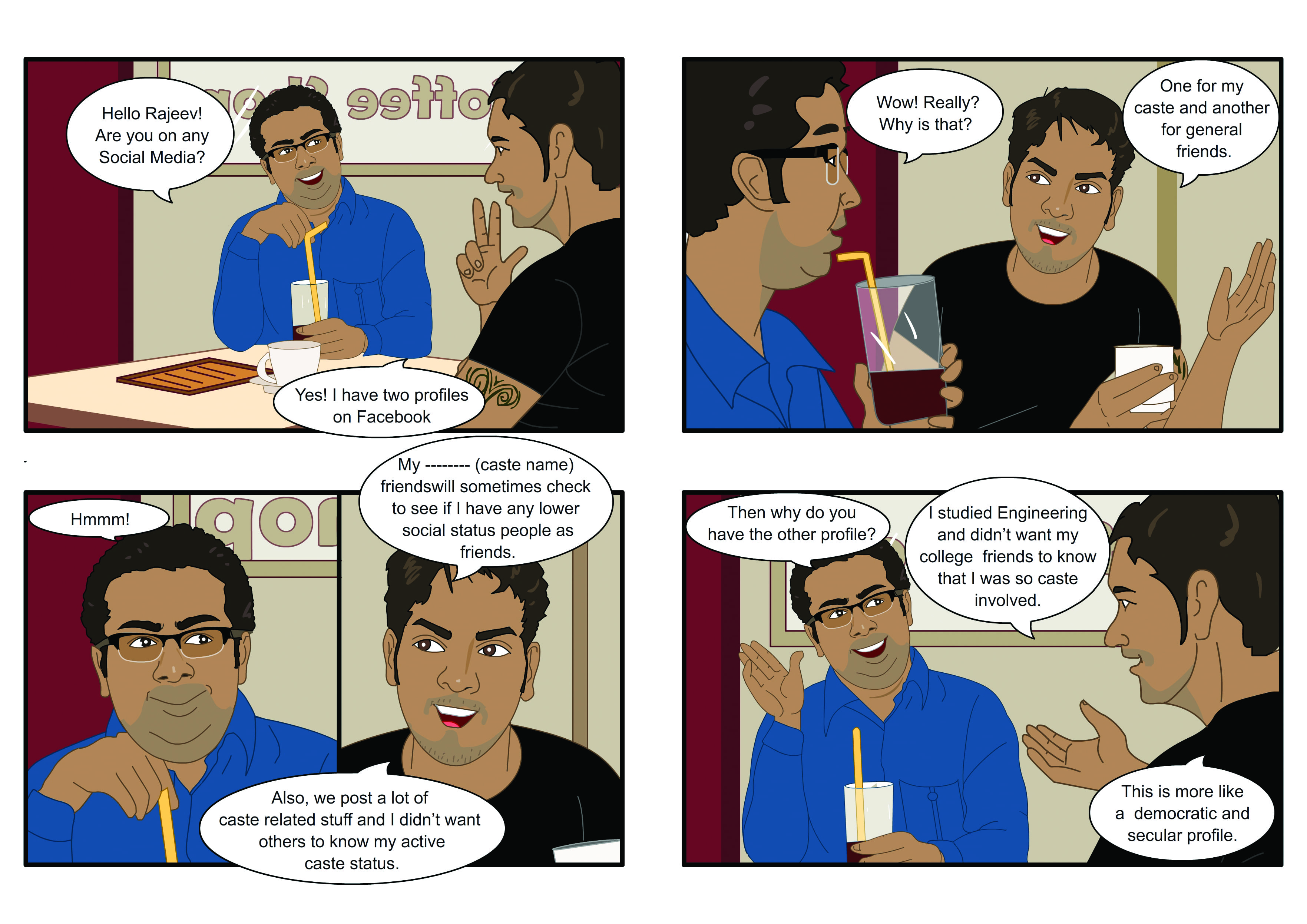
Identity FBThe above cartoon says it all. There are quite a few cases here in my field site as well as in the villages closer to it where this sort of double existence on Social Networking Sites (SNS) seems natural and required. The thinking being that this was the right thing to do in order to avert caste problems or issues of any sort. While this sounds like a great strategy to follow, when seen superficially, this actually indicates identity confusion. This seems specific to the rapidly transforming (urbanizing), rural areas especially closer to bigger cities. Given that my field site is one such peri urban area, I encountered such an identity crisis in my informants quite often.

This identity crisis of a person of a rural background (specifically young men/women) suddenly finding himself/herself in the midst of a rapid urbanization, manifests itself on social networking sites, where you have one caste based SNS profile and another more secular one. The idea is to not really mix these two as you tend to now live both the lives at the same time. However, my informants feel that it sometimes becomes confusing on who they really are and what ideology they really subscribe to. So when I asked Rajeev (the person in the cartoon), which profile would thrive for a longer time and which profile is a true reflection of himself; he said he really didn’t know. But, he was quick to add that it might be the one which is secular, since he thought that he might move away from the village looking out for a job sometime soon and secular was the way to go. However, once again, he reverted to saying that he might still have both the profiles separate without anyone (except for a handful of friends) from either of these profiles knowing that the other one exists, since he didn’t want anyone from his village to be offended. I asked him if he liked his caste based kin and his activity on the caste based profile; he replied that he loved it, as it was what had made him what he is today. But, he thought the secular profile from his college days was also important since it was the one which gave him his friends’ network,  a great worldview and a politically correct picture of him.

After multiple interviews with such informants, it became rather clear that they were in a way struggling to understand and see who they really were and what was the image they were trying to project to the world. It was like they were being pulled on both sides by two opposite ideological forces at the same time. Escaping the geographical boundaries of the village seemed to be a solution to end both the social control and enabling the merging of identities. However, the emotional attachment to one’s caste and kin made them to hesitate to leave the caste based boundaries. Maybe, their identity itself was about existing in both the worlds at the same time and this is what is very clearly reflected on their SNS profiles.

The prejudice of shallowness

By Razvan Nicolescu, on 4 April 2014

Photo by Stefanie Maria (Creative Commons)

Photo by Stefanie Maria (Creative Commons)

Isabella has 28 years old and is engaged (fidanzata) for eight years with a man from a nearby town. In this part of Italy these long engagements are quite common. Actually, Isabella has the most recent engagement in her close circle of friends, who are all engaged for 10 or 12 years. The marriage is thought of as something that should be built on solid grounds, typically a stable workplace and a house. Customarily, the man first builds a house, furnishes it at least partially and then the couple organize the wedding ceremony. In the context of difficult economic circumstances and high social uncertainty these conditions for even thinking of a marriage are quite difficult to be attained.

Isabella is happy that she works full-time as a shop assistant and has time to also study for her undergraduate degree. She is proud she will most probably graduate this year. She started to study Letters at the University of Salento eight years ago. All along this time, her fidanzato supported her determination to complete her studies even against the will of her family. However, during this time the couple was not able to save money for the marriage. He always worked on a temporary basis as a builder and her current job as shop assistant is the first stable job any of them ever had. They estimate that the wedding ceremony alone would cost them at least 10,000 EURO. They come from modest families who could not raise even a small part of this sum. The plan is that Isabella should graduate first and then they could start saving money for the wedding. This means the two could get married in at least two or three years.

Until then, and as most of the fidanzati in the town, the two live separately each with their own families. They also work in the same towns where they live. As the two towns are situated about ten miles away one from the other, they currently do not manage to see each other too often during work days – which here are Monday to Saturday. The two compensate this by spendings the weekends together, living alternatively at one of their parents’ house This arrangement also allows them spending more time with their friends.

Isabella’s closest friends are six female ex-colleagues from her secondary school in Grano who happen to be all engaged with six men from the town of her fidanzato. He is actually a cousin of her best colleague from her secondary school class. She remembers that this was her favourite group of friends since she was a teenager. She always enjoyed the fact that they had the same tastes and very similar passions on a gendered basis. I will not detail this here, but is important to mention that the group itself and this shared intimacy within its strict confines is what makes Isabella feel safe and comfortable.

Whatsapp is important in keeping this sense of intimacy. The group of friends use three main Whatsapp groups: ‘the group of girls,’ ‘the group of boys’ and the group for all of them which is also the least used. Girls use their group most intensively by far: they may start the day with a simple buona giornata (‘good morning’), a question, or a video clip. At least two hours until work starts, roughly at 10:00, there is an energetic exchange of messages and updates inside this group. The boys use their group rather irregularly, with typical peaks such as the ones around the dates when Juventus Torino is playing. What is important for this discussion is that Isabella senses that her fidanzamento depends on the unity of the group of her female friends and this unity currently knows a substantive support because of Whatsapp. Isabella sees that many women of her age become less attached to their peers when they start to work or move closer to their marriage, and therefore, she is extremely happy that Whatsapp allows her reinforce what she senses she needs most.

At the same time, these people who could have a noisy aperitivo in large groups of twelve-fifteen people in late summer evenings could easily be accused of a certain shallowness. A typical criticism is that they ‘stay too much on’ their Smartphones when they are supposed to be together. This blog post goes against these prejudices and social condemnations by suggesting a few reasons why these could simply not be true. Beautiful well-dressed women and jovial men could cheerfully manipulate their Smartphones not because they are more distant one from another but because actually they want to be much closer.

Know thy selfie

By Daniel Miller, on 1 April 2014

Image courtesy of ClaudsClaudio, Creative Commons

Image courtesy of ClaudsClaudio, Creative Commons

As noted by last week’s The Economist it seems that every new cultural development is assumed by both journalists and academics to be a sign of our growing superficiality and especially our narcissism. A primary use of Anthropology has been to bolster the idea that it is `other’ societies that represent authenticity and depth. I have lived in tribal and peasant societies and I do not accept that my fellow Londoners are either more superficial, or more narcissistic, or even that they are more concerned with the public appearance of the person, than would the case for most other societies studied by anthropologists. It is no surprise that the most recent `proof’ of this narcissism is held to be the Selfie, presumed to be a key moment in growing infatuation with our own appearance. But once again I think it is the interpretation of the Selfie, not the Selfie itself, that should be condemned as merely superficial. To equate the Selfie with narcissism is to imply that it is an idealised version of the self, directed at the self. This is surely mistaken.

The Selfie is clearly aimed at others, placed on social media as a form of communication. What is a Selfie without its `likes’? As a school pupil put it:- `But it’s sort of while you are having a conversation, you just send a picture of yourself.’ It is literally a `snap-chat’. More importantly the Selfie is subject to polymedia and cultural variation. With respect to polymedia, the `classic’ young, female, pouting, dressed to party, pose has become strongly associated with Instagram. But there is a whole other genre that is found on the much larger platforms of Snapchat and WhatsApp. For young people in England by far the most common form of Selfie is an image designed to make oneself look as ugly as possible. One common pose is with the camera taking the face from below the chin, right up the nostrils. It is predominantly the same young people who create the Selfie that create this `Uglie’. Many more Uglies are posted that Selfies, but most discussions entirely ignore the more prevalent image. Adults often create a similar dualism, but vicariously. Look at the endless postings of their babies, either highly idealised, or looking as ridiculous as possible. These are not individualistic, rather today they have become highly normative forms. The Uglie relates to English humour and self-deprecation rather than being a universal form and thereby reflect cultural specificity. The single term Selfie also fails to differentiate adult Selfies from teenage usage, the increasingly common group Selfie from the individual. It also ignores the difference between all of these and what might be termed the `meta-Selfie’ where the image is of a person taking a Selfie through the mirror. These are often taken simply because they are a more effective way of showing the whole outfit that an individual is wearing. But at least in the English context they can also become a visual comment, ironic or otherwise, on the taking of the Selfie.

There are even more reasons for taking Selfies than there are genres, and of course, a Selfie can be superficial. I don’t especially admit a tradition in cultural studies that enjoys taking something denigrated as superficial and then making some pretentious claim for its deep significance. But a recent encounter with a Selfie helped me appreciate that the Selfie certainly has that capacity for depth and profundity. This Selfie is the cover photo for the Facebook profile of someone I interviewed as part of my hospice research. One of the main reasons that people dying of cancer retreat into isolation is that they don’t want others to see the devastation to their own appearance that often comes with chemotherapy, if not from the cancer itself.

The physical disfigurement is itself debilitating. This forty-two year old even kept his girlfriend away during chemotherapy which had been particularly gruelling and destructive in his case. After the chemotherapy ended he began to put back on some weight. He once again started to look like himself. After six weeks he decided to take precisely that kind of Selfie that is posed in front of the mirror. The stance and facial expression are clearly assertive. As he makes clear he first had to acknowledge to himself that he could once again become a decent human being and only then could he communicate this to others. The distance between knowing something as an external fact and internalising it as an acknowledged truth is circumvented because this particular kind of Selfie can operate on both of these modalities simultaneously. Prior to the existence of this form of Selfie it is unlikely that there is anything he could have done that could so succinctly have communicated to others that he had acknowledged the change in himself to himself.

In this instance I found myself drawn back to the writings of Sartre whose work on existentialism directly equated issues of self-expression to the freedom to choose the nature and manner of our death. More generally the Selfie seems to fit arguments made by the sociologist Anthony Giddens about self-identity. It is not that we are more obsessed by our public appearance. Compared to say the characters in the world’s first novel from the 11th are almost relaxed. As argued in my and Jolynna’s recent book Webcam, what has perhaps changed is our self-consciousness about this concern with appearance, and therefore the need to not only cultivate our looks, but to simultaneously comment upon that act of cultivation, that suggests we know what we are doing. In England this is ideally done with irony and the Selfie only makes sense when we also include the Uglie in our analysis. But the Selfie can be also a serious and evidently in some cases literally a life-affirming use of a new visual genre that exploits it’s very specific form of self-revelation.

Visibly invisible: you can always see me

By Xin Yuan Wang, on 24 March 2014

The Little Prince is probably the novel which I have read the most times. Each time I read it, I am warmly touched. Amid field work, I am reading it again. My favorite part is the conversation between the fox and the little prince, when the fox tells the little prince that meaning of ‘to tame’ is to ‘establish ties’.

“Just that,” said the fox. “To me, you are still nothing more than a little boy who is just like a hundred thousand other little boys. And I have no need of you. And you, on your part, have no need of me. To you, I am nothing more than a fox like a hundred thousand other foxes. But if you tame me, then we shall need each other. To me, you will be unique in all the world. To you, I shall be unique in all the world…”

“My life is very monotonous,” the fox said. “I hunt chickens; men hunt me. All the chickens are just alike, and all the men are just alike. And, in consequence, I am a little bored. But if you tame me, it will be as if the sun came to shine on my life. I shall know the sound of a step that will be different from all the others. Other steps send me hurrying back underneath the ground. Yours will call me, like music, out of my burrow. And then look: you see the grain-fields down yonder? I do not eat bread. Wheat is of no use to me. The wheat fields have nothing to say to me. And that is sad. But you have hair that is the color of gold. Think how wonderful that will be when you have tamed me! The grain, which is also golden, will bring me back the thought of you. And I shall love to listen to the wind in the wheat…”

I have to quote the whole lot what the fox said,  not only because it is beautifully written, but also it reminders me of a recent talk between myself and  my informant LX about QQ (social media) permission settings.

LX is a sweet factory girl who is 19-year-old. One day she complained that I was always ‘invisible’ (my QQ status) online, which is true. My QQ default setting is ‘invisible’ which means I can get QQ messages but my QQ contacts don’t know I am online when I log in. To be ‘invisible’ means I won’t be disturbed by other online contacts and it has become an accepted/applied strategy among my informants who have hundreds of QQ contacts to log in as ‘invisible’.

There are six online status of QQ (see the screenshot below): I am online; Q me (chat with me); Away; Busy; Do not disturb; and Invisible.  For most people (90%) as long as they are online, the status is either ‘online’, or ‘invisible’, or ‘away’ with auto-response. The reason for being ‘invisible’ varies– the main reason is that people do not want to be disturbed or get involved in a conversation, however still want to view others’ Qzone (online profiles) and don’t want to miss any important message. ‘Do not disturb’ as a status is rarely used since people think that is rude.

QQ status

I thought there were only six alternatives one can choose until LX taught me that actually there were some other ‘hidden’ options in the advanced permission setting. Right click any QQ contact’s avatar, on the pop-up select box (see screenshot below) there are a few options which enact different operations upon the certain contact, for instance: send instant message, send an Email (QQ offers email service which is the dominant email service my informant used), view chat log (one can check the local chat log, which is the chats that occurred on the current digital device or roaming chat log, which refers to all the chats under the same account occurring on different digital devices), put this contact on top of the contact list, edit the name (QQ names, in most cases, are not real names, as I mentioned in my previous report. As a result users will usually note the real-name if they know it), group the contact, delete the contact, report the contact (for online  harassment), create a desktop shortcut, enter his/her Qzone, check his/her Tencent weibo (twitter-like service QQ offers) etc. and permission setting (see the screen shot below, blue highlighted). In the permission setting, there is one option that says “yin shen dui qi ke jian” (make visible to him/her in invisible status) which means the selected contact can always ‘see’ you even when you are in ‘invisible’ status.

QQ advanced permission setting

I felt honored to realize that I am the second person who can ‘see’ LX when she is ‘invisible’ to others on QQ (the first one is her boyfriend).

It is like you can always see me, and I am always there waiting for you, you know, very close and exclusive.

LX further explained the significance of ‘visible invisibility’. In return, I set her as the first contact that can ‘see’ me when I am ‘invisible’, which made her very happy. Such mutual advanced permission setting reinforced our relationship.

‘To see’ is different from ‘to look.’ The latter happens all the time, however in many cases does not necessarily lead to the former. A senior manager of a local factory told me that the logic of assembly line is that humankind is a part of the machine. I asked him whether he personally knew any of the factory workers. Rather than answer ‘no’, he told me “it’s not necessary”. True, he only needs to know the machine. I am probably the first one (the weird one) who visited the factory workshop and paid more attention to the workers rather than the product, the building, and the machine.

“All the rural migrants are just alike” as some of my local informants put it. In this small town, in factory workshops, monotonousness on a daily basis is the grand narrative, eclipsing individuality.  Most of the time, my rural migrant friends are ‘invisible’ to most people, even though they certainly did not ‘set’ themselves as ‘invisible’.  Unfortunately unlike on QQ, the default ‘social’ setting of ‘invisible’ cannot easily be changed in their offline life. To live against such daily ‘invisibility’, LX’s skillful usage of QQ allows herself some ‘privileged’ visibility, and in consequence,  an ordinary factory girl who is just like a hundred thousand other rural-to-urban migrant girls shall be unique in all the world, at least in the ‘virtual world’ created by social media.

The ‘too much information’ paradox

By ucsanha, on 22 March 2014

Photo by Nell Haynes

Photo by Nell Haynes

Here in Northern Chile, Facebook still reigns among social networking sites. Particularly for people over 25, programs like Instagram, Snapchat, and Twitter are rarely used. And through interviews and surveys, as well as actually observing what people here do online, I’m finding that people feel far more comfortable ‘liking’ and commenting on posts rather than creating their own new content.

During an interview just last night, a man in his late 20s who I will call Sebastian told me he thinks sometimes people post too much information. “I see everything but I don’t write anything… If my friend writes ‘I’m angry’ I just don’t see the point. Why tell everyone? For me I like reading what my friends post, but I hardly ever post anything.” He then made fun of his sister-in-law who was also present for sometimes writing ‘Goodmorning’ or ‘Goodnight’ on Facebook. “It’s just silly. Why do you have to tell everyone something so basic? And sometimes—not you Celia, but others, it’s just annoying when my Facebook is filled with all these pointless posts and I can’t see the interesting things posted about films I want to see or friends in Argentina.” This sentiment has been echoed many times by both men and women from their early 20s to late 60s. In fact, when looking closely at around 50 different Facebook profiles from Northern Chileans, the average person only created a new status message 4 or 5 times in 2 weeks.

Yet this is not because they are absent from Facebook. The number of comments and likes on status messages and shared links are often in the dozens. So while many people may not ‘see the point’ as Sebastian said, they are still commenting and liking these posts. Why? As Sebastian explained later, “I want my friends to know that I’m paying attention. Some live far away and I don’t call or write them. But I click like on their post and they know I’m here.” I found similar reasoning—appearing to be paying attention—for sharing memes about politics, as I wrote about here.

But even this explanation leaves a paradox: If everyone is content to simply comment or like posts, who is creating content that they are commenting upon? In my research I have met two of these people who count themselves in the ‘very small percentage’ of people who post regularly, and admittedly, sometimes ‘too much information’. When I asked Alex, a man in his 30s, if most of his friends post as much as him, he told me, “Only about 20%. The others only post what is necessary, and many more only look and hit ‘like’.”

A few days later he posted a cartoon meme with the text “We all have that friend that posts everything they do all day,” with the comment “That’s me!” The post received 42 likes and no comments. Alex was proud that he posted so much “because I make my friends laugh and I give them something to comment on.” So even though Alex realizes that he is sometimes that annoying friend that everyone complains about posting too much information, he sees it as something of a public service, giving his friends pleasure and something to comment upon. “I mean, what’s the point of Facebook if no one ever writes anything!”

Visibility in the society pages of social media

By Jolynna Sinanan, on 19 March 2014

Photo by Jolynna Sinanan

Photo by Jolynna Sinanan

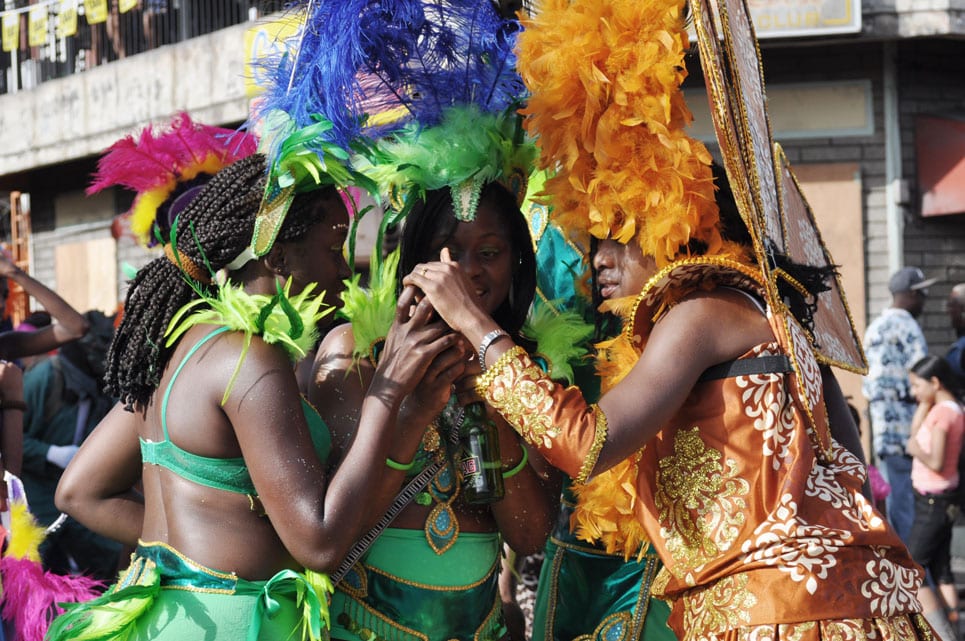
I have passed the 10 month point in fieldwork where I am perhaps getting a bit too comfortable with being in Trinidad. Like hundreds of thousands of Trinidadians this month, all my responsibilities and commitments have come second to the greatest show on earth: Carnival. Although Carnival is the height of the Trinidadian calendar year, it is experienced by Trinidadians is different ways. The parades of people you see on the streets in bikinis, beads and feathers (‘pretty mas’, or ‘pretty masquerade’) that resemble Brazilian Carnival, is a transformed version of Carnival that emerged in the 1980s as part of the state strategy to attract more tourism. It’s a strategy that has worked, thousands of tourists come each year paying up to £6000 to ‘play’ mas with the biggest and most popular groups, or as they’re locally known, bands. Prior to the 1980s, playing mas was a uniquely Trinidadian event that resembled the mix of the callalloo* nation. There were elements of theatre, Amerindian ritual and African dancing and drumbeats and costumes were embodiments of political commentary that mocked upper classes or foreign influences such as American seamen who were based in Trinidad in the Second World War. Many people tend to agree that mas had political potential and social commentary. But what of it today?

February has been a rich month for fieldwork as everybody has an opinion on Carnival. Common discourse and normative values emphasise that contemporary Carnival is vulgar, it’s not really Trinidadian, all the wining (a dance where the main movement is gyrating the hips) and carrying on is indecent. A lot of women agree with this view, but it is undeniable that each year, hundreds of thousands of Trinidadian women play mas. I have been discussing this with Dr Dylan Kerrigan at the University of the West Indies, a fellow anthropologist who has expertise on gender, masculinities and Carnival. We agree that Carnival has retained fractions of its potential for political subversion, perhaps now, not along the lines of race and class, but along the lines of gender. Carnival is the month of the year when a woman of any background, age and race can be extremely scantily clad, dance with whoever she likes and you don’t hear a peep from male onlookers or spectators. Yet, purchasing the space for freedom has an explicit economic dimension, paying for the pre-Carnival parties (fetes) and to play mas with big bands with their own food, drinks, portable bathrooms and security is an investment for a fun (safe) time. The demarcation of expensive fetes and bands makes sure that people of certain levels of society remain in their respective groupings. The one big contradiction to the prestige of going to expensive fetes and playing with big bands is that at this time of year, banks give special loans just for Carnival. People save money over a year (or two) or take out loans to visibly occupy spaces they don’t the rest of the year. Which brings me back to the ongoing theme of visibility.

I thought that if so much money is being spent on parties and costumes, surely this is the time of year Facebook would be inundated with selfies and mirror shots. Carnival is the pinnacle of the year to be seen by others. With the prestige of fetes and bands, comes with being photographed. Danny Miller is currently doing an in depth study of one such photography company that takes photos in fetes and uploads them to social media and their own website, reminiscent of the society pages in newspapers and magazines. Trinidad is a small society with few print magazine publications. The biggest and most expensive bands publish their own magazines after Carnival, displaying photos of masqueraders on Carnival Monday or Tuesday. Anybody who plays mas with these bands could be potentially snapped for the magazine. The photos I have seen on Facebook of masqueraders have mostly been tagged by others. The extreme few selfies have been ‘before going out’ shots. I saw many people with camera phones on the day, but there is an etiquette of visibility that photos of you are posted by others. What is the point of being the show and being the spectacle for your own gaze, otherwise?

Contemporary society pages are now the pages of social media. Four major social photography companies regularly post photos of events they have photographed on Facebook and people can tag themselves. The brands of photographers and the brands of fetes and bands is another aspect of how Facebook is made Trinidadian, through emulating the society pages of print magazines.

*Callalloo: a local dish made of mixed vegetables and cooked together, but also a local idiom for the mixed culture of Trinidad.