X Close

Global Social Media Impact Study

Home

Project Blog

Menu

Archive for September, 2014

Regulating the body in Chilean cyberspace

By ucsanha, on 22 September 2014

no desnudes

Last week, a friend here in Northern Chile posted on his Facebook wall a stylized drawing of a woman’s body with the words: “Don’t show your naked body on social networking sites. Gain the admiration and respect of your contacts and friends by showing your qualities as a person. What makes you sexy and beautiful is not your body, but your personality. Women and girls deserve respect.”

This was not the first time I had seen such a post. I have seen such memes circulating for several months, posted by grandmothers, mothers, and young men and women. But this post made me pause because my friend Miguel was the one who posted it. A few months into my fieldwork, Miguel was showing me a funny meme his friend had posted. As he scrolled down on his Facebook feed, he passed a post from Playboy Magazine that showed two women in bikinis. “Oh, those are my ugly cousins!” he joked. As he scrolled down there were several other posts from Playboy and he told me “My cousins post pictures of themselves a lot.”

Since the subject had been breached, he seemed to feel comfortable discussing semi-pornographic posts with me and I took advantage of the situation by continuing to ask questions. He told me all about “the new thing” of pictures of the underside of women’s breasts rather than their cleavage. He switched to Whatsapp and clicked a link a friend had sent him to demonstrate. There I saw “50 of the Best Underboob Shots on the Internet,” mostly taken selfie-style either in the mirror, or up one’s own shirt. I wasn’t sure whether to be offended or confused.

With this previous discussion in mind, in which, quite openly he discussed how he enjoyed seeing overtly sexy pictures that women take of their bodies, it seemed strange that he would post such a meme chastising women for doing this very thing.

Of course, there is a big difference between the women who are likely the intended recipients of his message and the women who are displayed on Playboy’s Facebook page. That is: he expects his female friends to read his Facebook wall. He does not expect Playboy models, or even the women whose reverse cleavage pictures are floating around the internet to be his followers on Facebook. In essence, his Facebook activity is revealing of something anthropologists have long known; we treat friends and acquaintances differently than we treat strangers (for example see Simmel’s essay on The Stranger and our own blog about chatting to Strangers in China). In this case it is acceptable to objectify the bodies of strangers, but he hopes that the women he knows personally will not openly contribute to their own objectification.

In looking through my own female Facebook friends from Northern Chile, I don’t see any pictures that are overtly sexual and show body parts that one wouldn’t reveal on a hot summer day. However, in my “you might know…” suggestions, I do see several such profile pictures for accounts based in this city. Miguel, along with other friends—both male and female—assured me that these profiles were fake (see also controversies of fake profiles in India and Turkey). “They say they’re from here but I’ve never met any of these women. They’re definitely fake profiles.”

To me this suggests two related points about the ways the regulation of bodies and nudity are happening online. The first is simply that these “Don’t show your naked body” memes represent a way of surveilling and controlling what others do with their bodies. They use straw-women as a warning, suggesting that showing too much body on social media will result in people losing respect. This strategy seems to have worked as well. Young women in northern Chile shy away from showing their bodies in contexts connected to their public personality. Yet the pictures still appear in the form of anonymous or fake profiles. Using fake names and profile pictures, they still post faceless photos exposing body parts fit only for a very liberal beach.

While this in some ways may be seen as a victory for young women’s self-worth based on traits not connected to their sexuality or bodies’ likenesses to those featured in the Sports Illustrated Swimsuit Issue, the surveillance and judgment of their online activity represents another issue—regulation that denies young women agency over the representation of their own bodies. This is one thing when coming from mothers and aunts, but young men like Miguel present a double standard in which their social networking activity elevates the bodies of strangers—from swimsuit models to unknown women taking risqué selfies, while condemning their own peers for similar self-representations. It’s not hard to imagine then why fake profiles might be a good option for young women trying to find self esteem about their bodies and their own ways to fit into the world of social networking.

In the end, what this tells us about social networking sites in this context, is that they are still very closely connected to the body. The internet is not a haven for free-floating identity, disconnected from our physical form, but is a place where bodies may still be seen as a representation of an individual, may still be regulated, and may still be a site of agency or repression. Rather than actually showing the respect that “women and girls deserve,” these memes further regulate women. Much as catcalls on the street regulate women’s bodies in physical space, memes that tell women what is acceptable for their bodies do so in the space of the internet.

If you are interested in themes of surveillance and control, see also Caste Related Profiles on Facebook in India, Facebook and the Vulnerability of the Self and Love is… in Turkey, and Social Media and the Sense of Autonomy in Italy.

On not resolving an issue with statistics

By zcsaf26, on 10 September 2014

By Ciara Green and Daniel Miller

Image by Giselle, Creative Commons

Image by Giselle, Creative Commons

For 18 months, we have worked together on the ethnography of The Glades. As part of this, we intend to write a joint paper focusing on the research we did within four local secondary schools on sixth formers aged 16-18. This will be concerned with the precise impact of new social media on relationships between school pupils, rather than schooling itself. It particular, we will examine relationships that have been discussed in terms of ‘cyber bullying.’ Much of this is dictated by policy concerns and as a result, tends to classify pupils, for example, into victims and bullies. By contrast, we want to situate such issues within the more general and now ubiquitous use of social media amongst this population, without diminishing our concern with the impact of such behaviour, including the potential for suicide. Our method will be to respect the way the pupils themselves discuss these issues, which suggests a much more ubiquitous culture of quarrelling such as the occurrence of what the school pupils refer to as ‘Twitter Beef’ within which many people play varying roles at different times. Our main contribution will be to try and isolate changes which seems unequivocally related to the specifics of social media, such as the use of ‘indirects’, the expansion of communication from within school to potentially 24 hour access, and the idea that people are more inclined to problematic communication when ‘hiding behind a screen’.

We cannot, however, ignore a huge popular debate on whether social media makes the lives of these pupils in some ways better or worse. In particular, there are more sensationalist newspaper articles that imply a massive increase in cyber bullying with major consequences for pupils. In response to this we found we had different perspectives. Ciara is of the generation that experienced this activity and was subsequently more inclined to see social media as exacerbating problems and wants to ensure we don’t detract from this experience of harm. Danny, considering the ubiquity of such issues in periods prior to social media, was more conservative. We both, of course, recognise that the term cause is too simplistic and social media is part of much wider contexts. We will see changes that some regard as negative such as indirects and ubiquity and also ones the pupils regard as positive such as increased access to social support.

Nevertheless, we felt as good scholars we should supplement our interpretation of our pupil interviews with any other data that might be relevant. It seemed worth knowing, for example, whether the period of social media adoption coincided with any change in incidence in behaviour such as teenage suicide, eating disorders, cutting and self-harm. After spending a considerable amount of time on this issue and consulting with a statistician we soon found that good intentions were not enough. We find the statistical data is inconsistent and sometimes related to factors such as reporting self-harm which may not be the same as incidence. The academic papers based on such data are themselves constantly divided in the negative and positive gloss they put on such figures. Meanwhile, accounts in mainstream media tend to use such data to make eye-catching claims, such that the more ‘objective’ the data, the less objectively it seems to be used.

In turn, we have our own ambivalence about our qualitative data. Danny would see teachers’ suggestions that things were just as bad before social media as confirmation of his position, while Ciara sees it as confirmation that teachers are less close to the actual experience of pupils than they think. So where does that leave us? In practice, it leads us back to our starting point. What we can do is write clearly about which specific factors the pupils themselves believe has exacerbated negative consequences. We can also provide an important corrective to the policy directed classifications by using the pupils’ descriptions to give greater nuance that is usually found in terms such as ‘cyber bullying’. We can hope that precisely because we have differing perspectives we can, in combination, provide a fair reading of our extensive findings. Our discussions were not in fact enlightened by this wider enquiry. But, after all, even if the statistics had been clear as to trends, we would still have had plenty to debate around any assumption as to whether the material from our study accounts for any statistical correlation as opposed to many other possible factors. But then no one said academic writing is easy.

Pin down the questions

By Xin Yuan Wang, on 5 September 2014

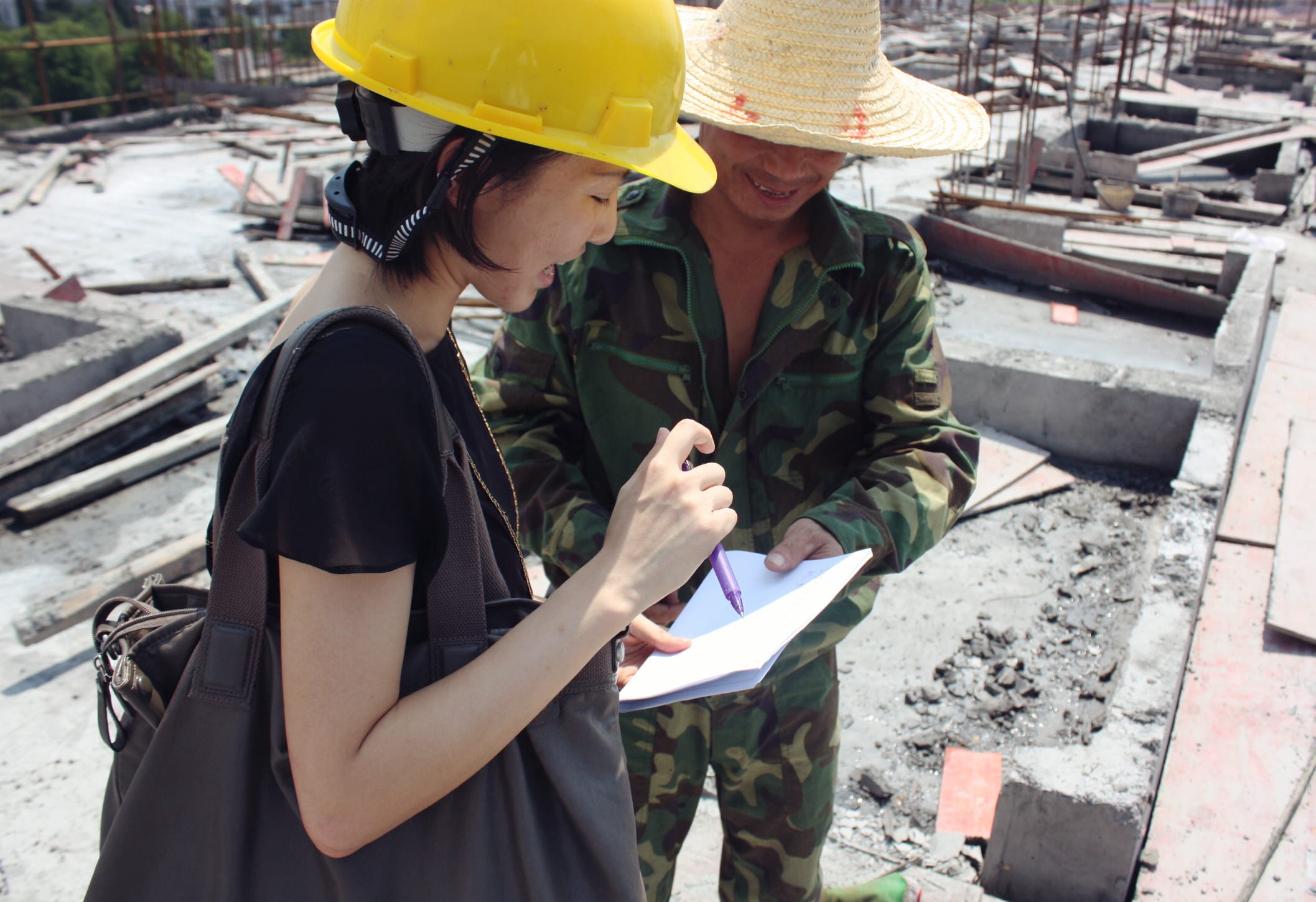
Construction site

Xinyuan asking questions on a construction site among workers (photo by MF)

You should know that the majority of PhD students feel some regret that they didn’t ask enough questions when they came back from the field.

Danny advised so when we walked past a beautiful bamboo forest last year in October when he came to visit my field site.
At that time, after five-months of fieldwork I was frustrated about the situation that on the one hand, I felt as if I was mining hard on poor ground- there was nothing (no longer) new under the sun! On the other hand, I somehow felt it’s very awkward to ask ‘formal’ questions to the informants who treat  me as a friend and I didn’t want to lose the relaxed atmosphere which I believe allows people to show the ‘true self’.

Well, I see, but I still need some time to figure out HOW” I curled my lip and said.

It is really not easy to ask questions, even though the pre-fieldwork project meeting prepared well HOW to do this. Now, at the last phase of my fieldwork, when I look back and ask myself whether I feel any regrets about ‘asking questions’ during my fieldwork, I think the answer is NO, but with several footnotes.

First, useful questions do not necessarilyhave to be asked in a interview-like formal way or even with a question mark. My strategy is to follow people’s organic conversation flow and ‘harness’ the topic by relevant detailed inquiries or directional claim. That means most of the time my inquiries are impromptu. However, such improvisation is not as random as some laid back chic-chat among friends, it has to point towards the impact of social media. In practice, asking questions in a contextual way to address a research question is a mind-taxing and thought-racing process.

For instance, a factory worker informant of mine used to complain about her boyfriend (who is now her husband) in front of me, in such a situation, as a friend, I am supposed to be a compassionate ally who shares the same bitter hatred, rather than a ‘keep-one’s-nose-clean’ researcher who only takes interest in the phenomenon of ‘men keeping ex-girlfriends’ photos on social media’. I had to control my academic inclinations and insert my ‘questions’ patiently among her unrestricted criticism. As a result my questions output is like:

  • Oh gosh, how come? that’s totally outrageous, I just can’t believe it. but..hey you are great, how can you know his password? my boyfriend never told me his!
  • Really?! so…which means he knew you looked at these photos? I don’t get it, what’s wrong with men? why do they think we can accept those ex- bitches…with a big smile?! I just don’t get it!
  • Relax, you are strong, and I hope he will learn a lesson. By the way, did you give him any warning or at least a hint about this?

Framing questions in this way allows people to relate to the topic and express their own opinions. Look at the contrast to more direct research questions:

  • Do you have your partner’s social media password, if so, could you tell me why and how do you get it?
  • Will you remove your ex partner’s photos on social media profile? if so why? and why do you think some people keep their ex partner’s photos on social media?
  • How do you deal with your partner’s ex-partner’s photos on social media?

Furthermore, all my roundabout inquiries are actually aiming to put pieces together of a bigger puzzle, which is the relationship between intimacy and social media usage. Nevertheless, I am not suggesting that such theatrical questioning can be applied in every case- it works only when a researcher has a relatively comprehensive knowledge of his/her informant as well as the circumstance during the conversation.

The funny thing is after just one month when I came back to the same informant and tried to go through some more interview-like questions she appeared slightly uncomfortable and confused about my question with regards to the intimacy and the usage of social media, and asked me why I was interested in those ‘useless’ things and what for. Clearly she forget that’s the reason I was in my field site and I was a researcher which I had told her one-year ago. Her attitude is understandable as for people who have limited education (like many of her fellow workers in the factory she is a middle-school drop-out) and living experience with academic research, words like ‘research’, ‘questionnaire’, ‘interview’, etc are more often than not very alien and sometimes even horrific. Thus it is safe to say the way to ask questions is as important as, if not more, the questions per se.

Secondly, at the closing phase of my field site I started to ‘push the boundary’ and pin down some questions I did not want to ask for the reasons I just mentioned above. The efforts were not in vain. Even though my informants appeared unsurprisingly uncomfortable and couldn’t give me a articulate answer in many cases. They still gave me some valuable information I couldn’t have gotten just by chatting with them, such as do they visit pornographic websites or describe their social media usage situation in the past five years.

Meanwhile, I spent almost one month in Shanghai to do comparative study among urban and rural (or rural migrant) population. Jingwen Fan, a Shanghai-based artist and media researcher, worked with me to conduct interviews among Shanghainese people. Given that we didn’t have enough time to carry out proper anthropological participant-observation, which I was doing among rural migrants in my field site, our interviews targeted personal friends and relatives of Jingwen Fan and I, with whom we have established strong mutual trust and understanding.

The interviews have been ongoing for more than a month and most of the interviews were filmed with consent. We have a list of 24 questions for the interviews (I will post the list of the questions in my next blog posting), which according to my one-year ‘questioning’ experience will lead to some active interaction and valuable data.  So far, the interviews went very well even though I was slightly worried about what Margaret Mead said, ‘What people say, what people do, and what they say they do are entirely different things’.

We appreciate that most of all of our informants trust us a great deal and actively interact with us by showing us their social media profiles and sharing with us their personal stories without hesitation. And on top of it, the people we interviewed not only expressed themselves very well but also discussed different issues with us passionately. Some of them started an answer by saying “You know what, actually I thought about exactly the same question recently and I also discussed it with my friends…” More often than not, a filmed interview took around three hours.

It is safe to say the difference between the urban and rural population’s performance in formal interviews is mainly due to the difference in educational background and living experience. The average education level among factory workers/ rural migrants in my field site is below middle school, and the average among Shanghai-based informants is university. Given the huge information consumption on a daily basis and the diversity of urban life, the urban population appeared much more confident, open-minded and articulate in talking about the society and themselves. Thus, after conducting the study among different groups of people in China for almost 15 months, I am ready to say that the point of ‘pin down the question’ is not only about ‘asking enough questions’ as Danny advised, but also about ‘asking tailored questions for different informants’