X Close

Global Social Media Impact Study

Home

Project Blog

Menu

Archive for April, 2014

The no make-up Selfie

By Daniel Miller, on 29 April 2014

Image courtesy of Send me adrift., Creative Commons

Image courtesy of Send me adrift., Creative Commons

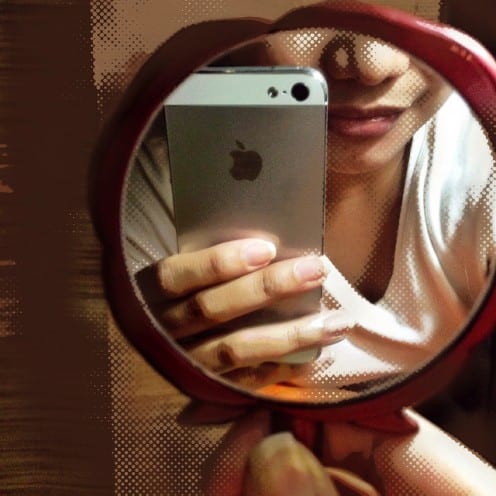
My previous blog post was about the Selfie and our failure to acknowledge its varieties including the ‘uglie’ and the poignancy of a Selfie that proclaimed someone as cancer free. But in general the Selfie is something that has been largely restricted to younger people in my fieldsite. I now want to extend the previous blog to consider one more variety – the no make-up Selfie. Since this is something that had a very clear presence in my study. Most adult women who I have Facebook friended as part of this fieldwork have now put up a no make-up Selfie, even though most of them had never previously posted a Selfie of any kind.

Most of the journalistic attention has focused on several key elements. The first was the sheer level of success, with the UK raising 8 million pounds for cancer charities in around a week. The second was the participation of various celebrities. The third was a critique of this phenomenon. Perhaps one of the clearest critiques was by Jenni Murray. She pointed out that while no one can begrudge the successful raising of so much money for such a good cause, people who have been through cancer have grounds for seeing this as a kind of unfortunate pastiche/parody of the deterioration in their appearance that comes with cancer and especially with chemotherapy. In my hospice work I constantly see the massive impact of this loss of appearance on the desperate need to retain dignity during cancer. So the grounds for this critique are very clear.

This may not have been the intention of those who either began or participated in this genre, and most would probably be horrified to think that they have given offence. Though it is entirely possible that subliminally there was an association made and this was a kind of misdirected gesture of sympathy. However, when I turn to the evidence for the actual participation in this by ordinary people who appear on my research site, I would argue that the success of this campaign was only tangentially about cancer. I suspect it was in fact almost the direct opposite of what Jenni Murray concluded in her critique. Looking at these postings it seems clear that the no make-up Selfie was much more directed at the actual participants, and the excuse it gave them to do two contradictory things at the same time. One is that when a phenomenon becomes as huge as the Selfie and associated with the young, everyone wants to take part and post at least one Selfie, to feel included within the phenomenon. More a sense of inclusion than vanity per se. But at the same time most of these women constantly tell me in our discussions that they share pretty much exactly the same sentiment as Jenni Murray in their critique of young people as narcissistic and self-directed and see the Selfie as symptomatic of this decline in social values.

The no make-up Selfie was a way to both post a Selfie but at the same time be active in expressing a critique of Selfie culture. So far from individual vanity, the no make-up Selfie was highly socialised with each person nominated and then nominating others in turn. It was a direct repudiation of the aesthetics of the ideal Selfie in that it showed people at their worst. Unlike some celebrities most of the people on my site didn’t just decline to wear make-up. They clearly aimed for a kind of truth telling warts and all look that emphasised a view of their face that they would normally hide away. In short they used it to critique not just the Selfie but the much wider social pressure to appear glamorous and made-up for social consumption. Most contemporary English women share, at least in general terms, the feminist critique of these pressures to glamour, even if they routinely succumb to them. It was perhaps particularly important that this came out on Facebook, since it gave public voice to what these women inevitably say to me in private, which is that they want to use Facebook but somehow at the same time repudiate the vestige of shallow self-expression that Facebook became associated with as it emerged with youth. I don’t know if they will stick with Facebook but for Facebook to work for these older women they need to somehow cleanse it from these problematic associations of superficiality. By exploiting this charitable campaign they discovered a way in which they could collectively express their values and express their distaste with media such as Facebook and the Selfie which at the same time they are drawn to and want to employ. What they are looking for is not individualised self-expression but a return to more socialised and collective communication with family and friends that Facebook seemed to provide.

It is a generality of our anthropological observations, that most cultural trends that become this popular do so, not because they are the simple expression of some value, but because they help people deal with a contradiction in the values they perforce live with. The no make-up Selfie may be a typical example of that observation.

School fights, moral judgments and racial commentary

By Jolynna Sinanan, on 22 April 2014

front page headline from Trinidad and Tobago's 'Newsday', 19.03.2014

front page headline from Trinidad and Tobago’s ‘Newsday’, 19.03.2014

(note: this blog post contains language around racial categorisation that may be offensive when taken out of context)

In the last month, the circulation of two videos of school yard fights on social media have become the subject of attention by the national news media. The first video, captured on a phone outside a prestigious school in the capital city, Port of Spain, shows a group of girls outside the school yard in a confrontation, which escalates into a fight between two girls, kicking, pulling hair and shoving each other to the ground. The crowd of girls cheers them on, and a passing off-duty policeman tries to break up the fight. Some of the crowd turn on him and yell at him for trying to break up the fight. The second is another group of girls in a high school in the rural town of Toco inside a classroom, one springs off a table onto a girl who has been swearing at her and they struggle on the ground.

Fights between school children are nothing new. They occur in all sectors of society, between boys or girls, between private and public school students alike. The reaction to the fights across the country reflected normative concerns around good versus bad parenting and the decline in morals for kids today. Yet, the stakes are much higher for what these judgement calls imply in Trinidadian society.

The legacy of colonialism is not far away in the consciousness of Trinidadians. From the formation of the society of indentured East Indians and ex-enslaved Africans, there has always been benign (and in periods such as the Black Power movement) overt antagonism between Indo- and Afro-Trinidadians. Yet, the country has also been an exemplary one for the potential of a pluralistic, genuinely cosmopolitan and ethnically mixed society to exist cohesively and peacefully. It is quite common for families to be made up of Afro- and Indo- Trinidadians of Hindu, Muslim and various Christian beliefs. Race and class in Trinidad is an extremely complex topic, way beyond the scope of a brief blog post. There is a well-established argument that despite the appearance of antagonism based on race, the real conflict in Trinidad is based on class (Yelvington, 2010, Meighoo, 2003, Singh, 1994,  )

The concern that arises from the circulation of videos such as these resonates with an argument that Daniel Miller and myself raised in Webcam. To summarise, video footage as evidence has a fruitful contradiction. On the one hand, the visible evidence that we see as real-time captured footage on a phone attests to the truth of the event and on the other hand, the truth that appears on film has more potential to be fabricated and false- especially when taken out of context. The hazard of the rapid circulation of such videos is the moral discourse that is generated by the ‘truth’ of what appears in the videos. If taken as evidence, comments such as these, which appeared on Facebook confirm that girls who are in school yard fights are undisputedly certain sorts of girls.

“These little black children!”

“I don’t apologise for my words, but damn shameful disgraceful old n***a behaviour”

“typical poor black ppl children … not an indian child there … child mudda (mother) with bout 6 chilren for bout 5 different man and one child she eh (isn’t) sure who is d fadda (the father) is … black people need to wake d f*** up before its too late”

And the comments go on, each with at least three ‘likes’. But this is Facebook and the people who leave comments have their names (or pseudonyms) and profile picture clearly visible. A quick scan through the commentators’ profiles where few have tight security settings shows that all of the commentators who comment on race are themselves Afro-Trinidadians.

This brief observation speaks to a well-discussed themes in critical race studies, of internalised racism and institutionalised racism. Face-to-face, when racial observations are brought up in everyday conversations, they are more peppered with humour and are generally good-natured, even if they reflect more harmful racial stereotyping. Yet, comments on Facebook redrew the boundaries of what is said and accepted in public. Offline, none of the conversations around the incidents contained the severity of condemnation of the online comments. Symbolic interactionalism based on racial categorisation has a long history in Trinidad and the visibility provided by the affordances of Facebook adds another dimension to deeply messy areas of race and class.

Bibliography:

Yelvington, K. (2010). Producing power: Ethnicity, gender, and class in a Caribbean workplace. Temple University Press.

Meighoo, K. P. (2003). Politics in a’half made society’: Trinidad and Tobago, 1925-2001. Kingston: Ian Randle Publishers.

Singh, K. (1994). Race and class struggles in a colonial state: Trinidad 1917-1945 (p. 226). Calgary: University of Calgary Press.

Who Am I? – The Case of Caste Related Profiles on Facebook

By Shriram Venkatraman, on 11 April 2014

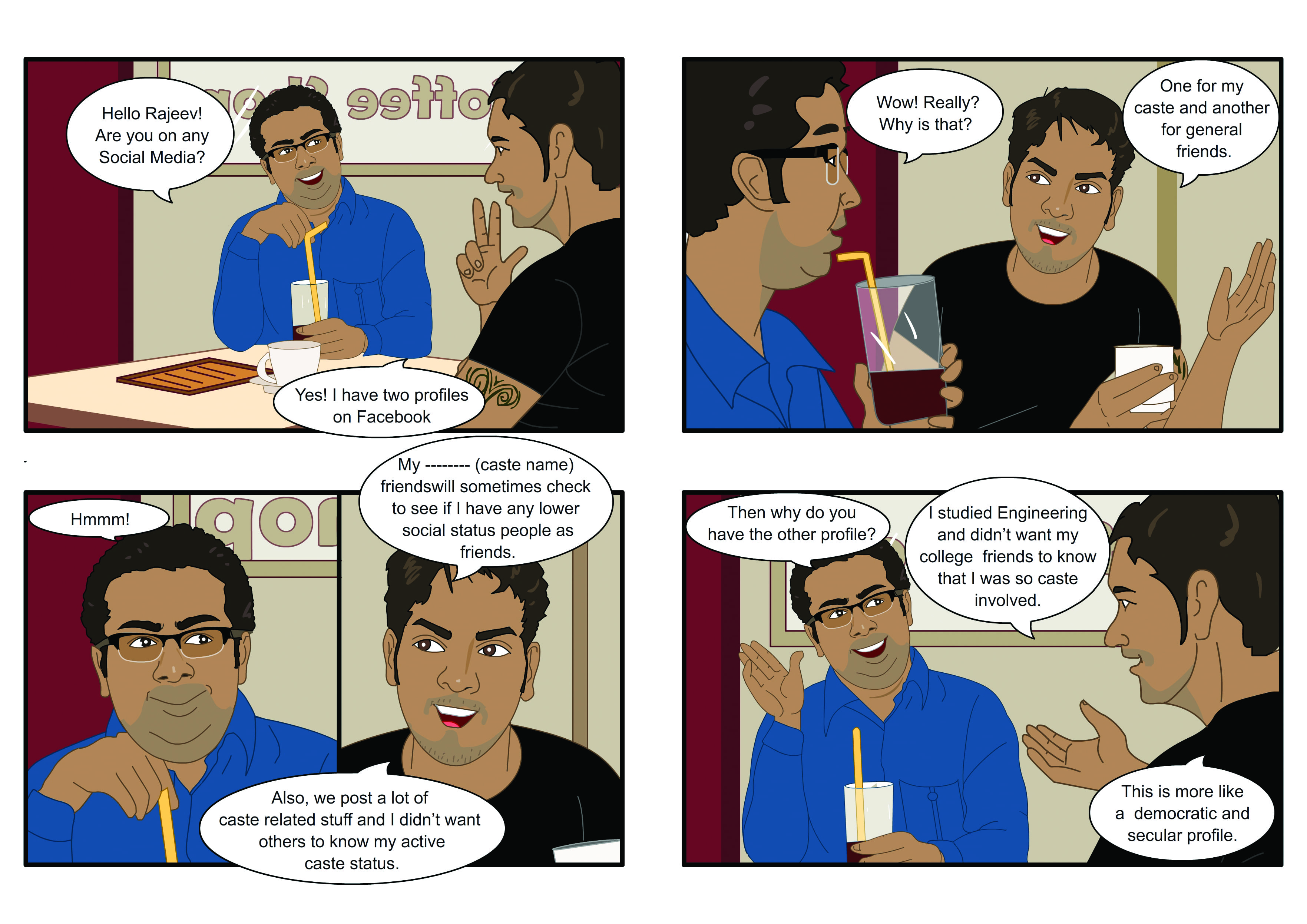
Identity FBThe above cartoon says it all. There are quite a few cases here in my field site as well as in the villages closer to it where this sort of double existence on Social Networking Sites (SNS) seems natural and required. The thinking being that this was the right thing to do in order to avert caste problems or issues of any sort. While this sounds like a great strategy to follow, when seen superficially, this actually indicates identity confusion. This seems specific to the rapidly transforming (urbanizing), rural areas especially closer to bigger cities. Given that my field site is one such peri urban area, I encountered such an identity crisis in my informants quite often.

This identity crisis of a person of a rural background (specifically young men/women) suddenly finding himself/herself in the midst of a rapid urbanization, manifests itself on social networking sites, where you have one caste based SNS profile and another more secular one. The idea is to not really mix these two as you tend to now live both the lives at the same time. However, my informants feel that it sometimes becomes confusing on who they really are and what ideology they really subscribe to. So when I asked Rajeev (the person in the cartoon), which profile would thrive for a longer time and which profile is a true reflection of himself; he said he really didn’t know. But, he was quick to add that it might be the one which is secular, since he thought that he might move away from the village looking out for a job sometime soon and secular was the way to go. However, once again, he reverted to saying that he might still have both the profiles separate without anyone (except for a handful of friends) from either of these profiles knowing that the other one exists, since he didn’t want anyone from his village to be offended. I asked him if he liked his caste based kin and his activity on the caste based profile; he replied that he loved it, as it was what had made him what he is today. But, he thought the secular profile from his college days was also important since it was the one which gave him his friends’ network,  a great worldview and a politically correct picture of him.

After multiple interviews with such informants, it became rather clear that they were in a way struggling to understand and see who they really were and what was the image they were trying to project to the world. It was like they were being pulled on both sides by two opposite ideological forces at the same time. Escaping the geographical boundaries of the village seemed to be a solution to end both the social control and enabling the merging of identities. However, the emotional attachment to one’s caste and kin made them to hesitate to leave the caste based boundaries. Maybe, their identity itself was about existing in both the worlds at the same time and this is what is very clearly reflected on their SNS profiles.

The prejudice of shallowness

By Razvan Nicolescu, on 4 April 2014

Photo by Stefanie Maria (Creative Commons)

Photo by Stefanie Maria (Creative Commons)

Isabella has 28 years old and is engaged (fidanzata) for eight years with a man from a nearby town. In this part of Italy these long engagements are quite common. Actually, Isabella has the most recent engagement in her close circle of friends, who are all engaged for 10 or 12 years. The marriage is thought of as something that should be built on solid grounds, typically a stable workplace and a house. Customarily, the man first builds a house, furnishes it at least partially and then the couple organize the wedding ceremony. In the context of difficult economic circumstances and high social uncertainty these conditions for even thinking of a marriage are quite difficult to be attained.

Isabella is happy that she works full-time as a shop assistant and has time to also study for her undergraduate degree. She is proud she will most probably graduate this year. She started to study Letters at the University of Salento eight years ago. All along this time, her fidanzato supported her determination to complete her studies even against the will of her family. However, during this time the couple was not able to save money for the marriage. He always worked on a temporary basis as a builder and her current job as shop assistant is the first stable job any of them ever had. They estimate that the wedding ceremony alone would cost them at least 10,000 EURO. They come from modest families who could not raise even a small part of this sum. The plan is that Isabella should graduate first and then they could start saving money for the wedding. This means the two could get married in at least two or three years.

Until then, and as most of the fidanzati in the town, the two live separately each with their own families. They also work in the same towns where they live. As the two towns are situated about ten miles away one from the other, they currently do not manage to see each other too often during work days – which here are Monday to Saturday. The two compensate this by spendings the weekends together, living alternatively at one of their parents’ house This arrangement also allows them spending more time with their friends.

Isabella’s closest friends are six female ex-colleagues from her secondary school in Grano who happen to be all engaged with six men from the town of her fidanzato. He is actually a cousin of her best colleague from her secondary school class. She remembers that this was her favourite group of friends since she was a teenager. She always enjoyed the fact that they had the same tastes and very similar passions on a gendered basis. I will not detail this here, but is important to mention that the group itself and this shared intimacy within its strict confines is what makes Isabella feel safe and comfortable.

Whatsapp is important in keeping this sense of intimacy. The group of friends use three main Whatsapp groups: ‘the group of girls,’ ‘the group of boys’ and the group for all of them which is also the least used. Girls use their group most intensively by far: they may start the day with a simple buona giornata (‘good morning’), a question, or a video clip. At least two hours until work starts, roughly at 10:00, there is an energetic exchange of messages and updates inside this group. The boys use their group rather irregularly, with typical peaks such as the ones around the dates when Juventus Torino is playing. What is important for this discussion is that Isabella senses that her fidanzamento depends on the unity of the group of her female friends and this unity currently knows a substantive support because of Whatsapp. Isabella sees that many women of her age become less attached to their peers when they start to work or move closer to their marriage, and therefore, she is extremely happy that Whatsapp allows her reinforce what she senses she needs most.

At the same time, these people who could have a noisy aperitivo in large groups of twelve-fifteen people in late summer evenings could easily be accused of a certain shallowness. A typical criticism is that they ‘stay too much on’ their Smartphones when they are supposed to be together. This blog post goes against these prejudices and social condemnations by suggesting a few reasons why these could simply not be true. Beautiful well-dressed women and jovial men could cheerfully manipulate their Smartphones not because they are more distant one from another but because actually they want to be much closer.

Know thy selfie

By Daniel Miller, on 1 April 2014

Image courtesy of ClaudsClaudio, Creative Commons

Image courtesy of ClaudsClaudio, Creative Commons

As noted by last week’s The Economist it seems that every new cultural development is assumed by both journalists and academics to be a sign of our growing superficiality and especially our narcissism. A primary use of Anthropology has been to bolster the idea that it is `other’ societies that represent authenticity and depth. I have lived in tribal and peasant societies and I do not accept that my fellow Londoners are either more superficial, or more narcissistic, or even that they are more concerned with the public appearance of the person, than would the case for most other societies studied by anthropologists. It is no surprise that the most recent `proof’ of this narcissism is held to be the Selfie, presumed to be a key moment in growing infatuation with our own appearance. But once again I think it is the interpretation of the Selfie, not the Selfie itself, that should be condemned as merely superficial. To equate the Selfie with narcissism is to imply that it is an idealised version of the self, directed at the self. This is surely mistaken.

The Selfie is clearly aimed at others, placed on social media as a form of communication. What is a Selfie without its `likes’? As a school pupil put it:- `But it’s sort of while you are having a conversation, you just send a picture of yourself.’ It is literally a `snap-chat’. More importantly the Selfie is subject to polymedia and cultural variation. With respect to polymedia, the `classic’ young, female, pouting, dressed to party, pose has become strongly associated with Instagram. But there is a whole other genre that is found on the much larger platforms of Snapchat and WhatsApp. For young people in England by far the most common form of Selfie is an image designed to make oneself look as ugly as possible. One common pose is with the camera taking the face from below the chin, right up the nostrils. It is predominantly the same young people who create the Selfie that create this `Uglie’. Many more Uglies are posted that Selfies, but most discussions entirely ignore the more prevalent image. Adults often create a similar dualism, but vicariously. Look at the endless postings of their babies, either highly idealised, or looking as ridiculous as possible. These are not individualistic, rather today they have become highly normative forms. The Uglie relates to English humour and self-deprecation rather than being a universal form and thereby reflect cultural specificity. The single term Selfie also fails to differentiate adult Selfies from teenage usage, the increasingly common group Selfie from the individual. It also ignores the difference between all of these and what might be termed the `meta-Selfie’ where the image is of a person taking a Selfie through the mirror. These are often taken simply because they are a more effective way of showing the whole outfit that an individual is wearing. But at least in the English context they can also become a visual comment, ironic or otherwise, on the taking of the Selfie.

There are even more reasons for taking Selfies than there are genres, and of course, a Selfie can be superficial. I don’t especially admit a tradition in cultural studies that enjoys taking something denigrated as superficial and then making some pretentious claim for its deep significance. But a recent encounter with a Selfie helped me appreciate that the Selfie certainly has that capacity for depth and profundity. This Selfie is the cover photo for the Facebook profile of someone I interviewed as part of my hospice research. One of the main reasons that people dying of cancer retreat into isolation is that they don’t want others to see the devastation to their own appearance that often comes with chemotherapy, if not from the cancer itself.

The physical disfigurement is itself debilitating. This forty-two year old even kept his girlfriend away during chemotherapy which had been particularly gruelling and destructive in his case. After the chemotherapy ended he began to put back on some weight. He once again started to look like himself. After six weeks he decided to take precisely that kind of Selfie that is posed in front of the mirror. The stance and facial expression are clearly assertive. As he makes clear he first had to acknowledge to himself that he could once again become a decent human being and only then could he communicate this to others. The distance between knowing something as an external fact and internalising it as an acknowledged truth is circumvented because this particular kind of Selfie can operate on both of these modalities simultaneously. Prior to the existence of this form of Selfie it is unlikely that there is anything he could have done that could so succinctly have communicated to others that he had acknowledged the change in himself to himself.

In this instance I found myself drawn back to the writings of Sartre whose work on existentialism directly equated issues of self-expression to the freedom to choose the nature and manner of our death. More generally the Selfie seems to fit arguments made by the sociologist Anthony Giddens about self-identity. It is not that we are more obsessed by our public appearance. Compared to say the characters in the world’s first novel from the 11th are almost relaxed. As argued in my and Jolynna’s recent book Webcam, what has perhaps changed is our self-consciousness about this concern with appearance, and therefore the need to not only cultivate our looks, but to simultaneously comment upon that act of cultivation, that suggests we know what we are doing. In England this is ideally done with irony and the Selfie only makes sense when we also include the Uglie in our analysis. But the Selfie can be also a serious and evidently in some cases literally a life-affirming use of a new visual genre that exploits it’s very specific form of self-revelation.

Conosco il tuo selfie

By Daniel Miller, on 1 April 2014

Tradotto da Inglese da Bianca Barone

Per gentile concessione di ClaudsClaudio (Creative Commons)

Per gentile concessione di ClaudsClaudio (Creative Commons)

Come notato la settimana scorsa dal The Economist, sembra che ogni nuovo sviluppo culturale venga assunto da giornalisti e accademici come un segno della nostra crescita superficiale e soprattutto del nostro narcisismo. Un utilizzo primario dell’Antropologia è stato quello di sostenere l’idea che si tratta di “altre” società che rappresentano la propria autenticità e spessore. Ho vissuto in società tribali e contadine e non accetto che i miei colleghi londinesi sono o più superficiali o più narcisisti, o addirittura che sono più interessati all’apparenza, di quanto non accada per la maggior parte delle altre società studiate dagli antropologi. Non è una sorpresa che la più recente ` prova ‘ di questo narcisismo sia il Selfie, che si presume essere un momento chiave nella crescente infatuazione con il nostro stesso aspetto. Ma ancora una volta penso che sia l’interpretazione del Selfie, non il Selfie in se, che deve essere condannato come meramente superficiale. Equiparare il Selfie al narcisismo implica che sia una versione idealizzata di sé stessi, diretta al sé. Questo è sicuramente sbagliato.

Il Selfie è chiaramente rivolto verso gli altri, posizionato sui social media come forma di comunicazione. Che cosa è un Selfie senza i suoi “mi piace”? Così come un alunno lo vede: – ` Ma è come se nel mentre si sta avendo una conversazione, si invia una foto di se stessi’. E’ letteralmente una ` snap-chat ‘. Ancora più importante è che il Selfie è soggetto ad una polivalenza mediatica (polymedia) e a variazioni culturali. Per quanto riguarda la “polimedialità” (polymedia), la ` classica ‘ posa da giovane donna, imbronciata, vestita a festa è fortemente associata con Instagram. Ma c’è tutto un altro genere che si trova sule piattaforme molto più grandi di Snapchat e WhatsApp. Per i giovani in Inghilterra la Selfie più comune serve a mostrarsi quanto più brutti possibile. Una posa comune è quella di inquadrare il viso con la telecamera da sotto il mento, inquadrando le narici. Chi prevalentemente crea il Selfie è lo stesso numero di giovani che crea questi “Uglie” (mostri). Sono pubblicati molti più “Uglie” che Selfie, ma la maggior parte delle discussioni ignora del tutto l’immagine più diffusa. Gli adulti spesso creano un dualismo simile, ma per interposta persona. Se si guarda alle infinite pubblicazioni dei loro bambini, o sono molto idealizzate, o in cerca del ridicolo. Queste pubblicazioni non sono individualiste, ma anzi oggi sono diventate forme sociali altamente utilizzate come standard. L’Uglie è correlato all’umorismo inglese e all’auto-disapprovazione piuttosto che essere una forma universale, riflette in tal modo la specificità culturale. Il singolo termine Selfie inoltre non riesce a differenziare il Selfie degli adulti dall’uso adolescenziale, il gruppo più comune e in crescita del Selfie individuale. Esso inoltre ignora la loro differenza e ciò che potrebbe significare la parola “Meta-Selfie”, cioè l’immagine di una persona che fotografa se stessa nello specchio. Questi scatti sono spesso semplicemente fatti perché sono un modo più efficace di mostrare il vestito che uno indossa. Ma nel contesto inglese ciò può diventare anche un commento visivo, ironico o meno, sulla cattura del Selfie.

Ci sono ancora più motivi per scattare una Selfie di quanti generi ci siano, e, naturalmente , un Selfie può essere superficiale.  Io non ammetto soprattutto una tradizione in studi culturali che si diverte a prendere qualcosa che viene denigrata come superficiale per poi fare una rivendicazione pretenziosa del suo profondo significato. Ma un recente incontro con un Selfie mi ha aiutato a capire che il Selfie ha certamente una capacità di spessore e profondità. Il Selfie cui mi riferisco è la foto di copertina per il profilo Facebook di qualcuno che ho intervistato durante la mia ricerca nel Centro di Cure Palliative. Uno dei motivi principali che le persone che muoiono di cancro si ritirano in isolamento è che non vogliono far vedere agli altri la devastazione del proprio aspetto causata spesso dalla chemioterapia, se non dal cancro stesso.

La deturpazione fisica è di per sé debilitante. Questo 42enne ha anche tenuto la sua fidanzata lontana durante la chemioterapia, che è stata particolarmente faticosa e distruttiva nel suo caso. Dopo che la chemioterapia si è conclusa, cominciò a rimettere su qualche chilo. Ha cominciato a riconoscersi. Dopo sei settimane ha deciso di fare quella sorta di Selfie che si scatta di fronte allo specchio. La posizione e l’espressione del viso è chiaramente assertiva. Come ha lui stesso sottolineato, ha dovuto prima riconoscere a se stesso che poteva ancora una volta essere un uomo presentabile e solo dopo ha potuto comunicarlo agli altri. La distanza tra il sapere qualcosa come un fatto esterno e la sua interiorizzazione come una verità riconosciuta viene aggirata perché questo particolare tipo di Selfie può operare su entrambe le modalità contemporaneamente. Prima dell’esistenza di questa forma di Selfie è improbabile che ci fosse qualcosa che avrebbe potuto fare per comunicare in una maniera così diretta agli altri che lui avesse riconosciuto il cambiamento di se stesso a se stesso.

In questo caso mi sono ritrovato a guardare agli scritti di Sartre e al suo lavoro rispetto l’esistenzialismo direttamente equiparato a questioni sull’auto-espressione e la libertà di scegliere la natura e le modalità della nostra morte. Più in generale il Selfie sembra adattarsi alle argomentazioni formulate dal sociologo Anthony Giddens sull’auto-identità – noi non siamo più ossessionati dall’apparenza in pubblico –  rispetto a dire che i personaggi nel mondo del primo romanzo dall’undicesimo sono quasi più rilassati. Come sostenuto da me e Jolynna nel nostro recente libro Webcam, ciò che forse è cambiato è la nostra auto-coscienza rispetto al problema dell’apparenza, e quindi la necessità di coltivare non solo il nostro aspetto, ma anche di commentare contemporaneamente su quell’atto stesso di coltivare noi stessi, che sappiamo può suggerire che sappiamo quello che stiamo facendo. In Inghilterra questo è fatto idealmente con ironia e il Selfie ha senso sono quando includiamo l’Uglie nella nostra analisi.

Ma il Selfie può anche avere un utilizzo serio e in alcuni casi letteralmente suggerisce l’affermazione nella propria vita di un nuovo genere visivo che sfrutta la sua forma molto particolare di auto-rivelazione.