Jeremy Bentham
Introduction
Time-line
Auto-Icon
Images of Bentham
Videos
Bibliographies
Websites
Introduction
Jeremy Bentham was born in London in 1748 and died in 1832. He devised the doctrine of utilitarianism, arguing that the ‘greatest happiness of the greatest number is the only right and proper end of government’. He was a major thinker in the fields of legal philosophy and representative democracy, and originated modern ideas of surveillance through his scheme for a panopticon prison. He supported the idea of equal opportunity in education and his ideas contributed to the foundation of University College London in 1826, the first institution in England to admit students of any race, class or religion and the first to welcome women on equal terms with men.
Bentham had many associates and acolytes. He was invited to Bowood, the house of William Petty, 2nd Earl of Shelburne and 1st Marquess of Lansdowne, where he met Samuel Romilly and Étienne Dumont. He was friends with Henry Brougham, George Grote, David Ricardo and the radical artisan Francis Place. Perhaps his most significant relationship was with James Mill and his son John Stuart Mill, both of whom were profoundly influenced by, and helped to edit, Bentham’s works. James Mill met Bentham around 1808 and spent summers with Bentham and his circle at Forde Abbey, Bentham’s country house in Somerset. The Mills lived in a house owned by Bentham on Queen Square (now Queen Anne’s Gate). Bentham’s ideas inspired James Mill’s Essay on Government (1820) and the work of John Stuart Mill including On Liberty (1859) and Utilitarianism (1863). In his will Bentham left mourning rings to John Stuart Mill, Francis Place and his other friends. These rings show an image of Bentham and contain a snippet of his hair.
Bentham’s ideas have tremendous relevance to contemporary society; engaging with his thinking helps us to understand better the world we live in today.
Find out more:
- Read an introductory essay on Bentham.
- Consult the Oxford Dictionary of National Biography entry for Bentham (subscription required).
- Watch videos on Bentham.
- Download leaflets on Bentham’s key ideas.
- Find out more about the panopticon.
- Read famous quotations from Bentham’s works.
- Read more about Bentham and his Forde Abbey circle.
Time-line
1748 Bentham is born in London
1755 Attends Westminster School
1760 Starts at Queen’s College, Oxford
1763 Admitted to Lincoln’s Inn
1769 Called to the bar
US Declaration of Independence
1785-88 Stays with Samuel Bentham in Russia and is introduced to Samuel’s panopticon scheme
1789 An Introduction to the Principles of Morals and Legislation
Declaration of Rights of Man in France
1788-90 Political Tactics
1791 Plans for the panopticon distributed to French National Assembly
Bill of Rights proposed by James Madison
1792 Bentham is made an honourary citizen of France
Louis XVI overthrown in France
1796-7 Writes on poor relief
1802 Traités de Législation Civile et Pénale – the first of Étienne Dumont’s recensions published
1811-16 Corresponds with James Madison
Venezuala, Paraguay, Mexico, Argentina and Chile declare independence
1817 Plan of Parliamentary Reform
1819 Radical Reform Bill
Simón Bolívar declares Republic of Gran Colombia
1820 Rid yourselves of Ultramaria
Revolution in Spain
Begins correspondence with Simón Bolívar
Constitutional government in Portugal
1821 Offers to codify penal, civil and constitutional law for Portugal
Dumont’s Traités translated into Spanish
1822 Bentham offers to codify laws of any nation and Portuguese accept
King Pedro declares Brazil independent
Begins Constitutional Code
Simón Bolívar liberates Ecuador
1823 Writes commentary on Greek constitution
Fall of liberal regime in Spain and Portugal
Leading Principles of a Constitutional Code for any State
Founds Westminster Review
1828 Bolívar bans Bentham’s works from universities in Colombia
Bolívar assumes dictatorial powers
UCL opens
1830 Emancipate your Colonies! (1793)
Venezuala and Ecuador declare independence from Columbia
Bolívar resigns
1832 Bentham dies
Great Reform Act in Britain
Auto-Icon created
1838-43 John Bowring publishes incomplete Works of Jeremy Bentham
1850 Auto-Icon donated to UCL
Auto-Icon
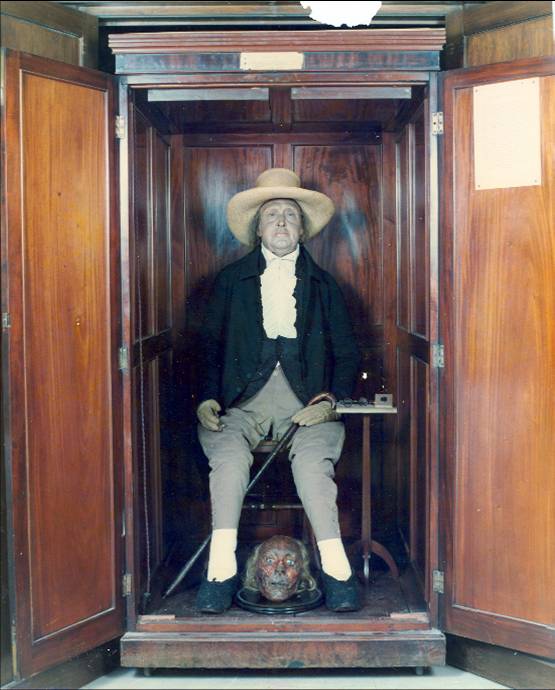
In his will Bentham left his body to medical science. He also requested that his body be preserved and this ‘auto-icon’, as Bentham called it, was gifted to University College London in 1850 by Bentham’s surgeon, Thomas Southwood Smith. Today Bentham sits in UCL’s South Cloisters dressed in his own clothes and sitting in his chair.
You can visit the auto-icon from 07.30 – 18.00 on Monday to Friday. If you are unable to visit UCL, you can view the new Virtual Auto-Icon to see Bentham in fine detail.
Find out more:
- More information about the auto-icon.
- Read an excerpt from Bentham’s Last Will and Testament.
Images of Bentham
View images of Bentham.
Videos
- Jeremy Bentham: Man and Myth, a film by UCL’s Bentham Project.
- Mini-lecture on Bentham by Prof. Philip Schofield, general editor of the Collected Works of Jeremy Bentham and director of the Bentham Project.
- Bentham on Sex, Population and Happiness, UCL Institute for Global Health’s 15th symposium.
Bibliographies
- P. Schofield, Bentham: A Guide for the Perplexed (Continuum, 2009)
- P. Schofield, Utility and Democracy: the Political Thought of Jeremy Bentham (Oxford University Press, 2006)
- J.R. Dinwiddy, Bentham (Oxford University Press, 1989)
- Bibliography on Bentham (from 1989-)
- Reading lists for A-level and Higher pupils
- Bentham texts available online
- Information on the Collected Works of Jeremy Bentham
- The Journal of Bentham Studies (1997-)
- The Bentham Newsletter (1979-88)
- Utilitas