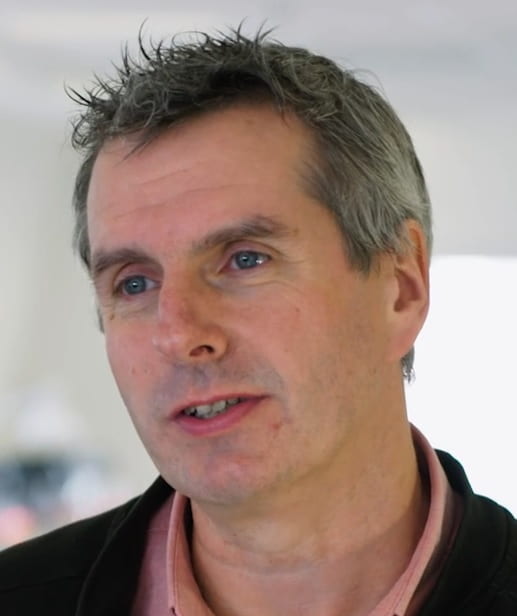
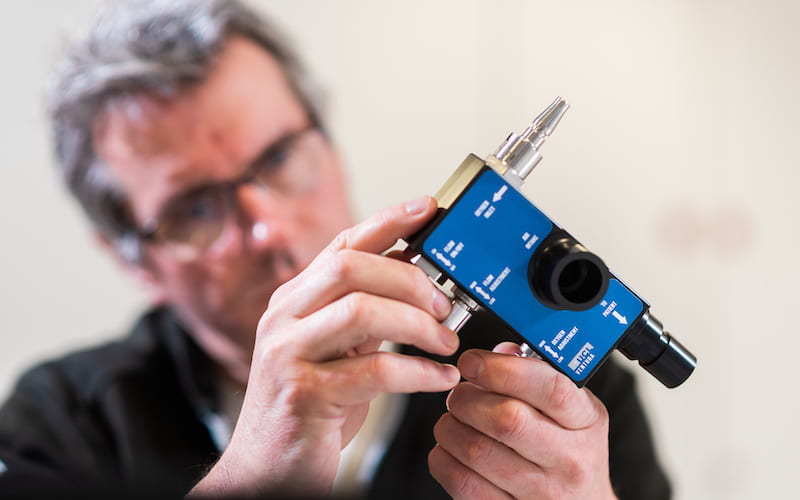
 At the end of March, just days after the UK went into lockdown due to the coronavirus outbreak, Professor Tim Baker (UCL Mechanical Engineering) played a vital role in the UCL team that produced a breathing aid to help keep COVID-19 patients out of intensive care.
The interdisciplinary team of mechanical engineers from UCL, clinicians from University College London Hospital (UCLH) and Mercedes-AMG High Performance Powertrains, brought together by UCL Institute of Healthcare Engineering (IHE), worked around the clock to reverse engineer the Continuous Positive Airway Pressure (CPAP) device, called UCL-Ventura. On 7 April, UCL freely released the designs and manufacturing instructions to aid world-wide response to the COVID-19 public health emergency.
So far, the UCL-Ventura design license has been downloaded more than 1,900 times in 105 countries spanning Europe, Asia, Africa, the Americas and Australasia. At least 30 teams have manufactured prototypes for testing in Brazil, Bulgaria, Canada, Colombia, Germany, India, Iran, Peru, Pakistan, Australia and more.
Most recently, a team in Baja California, Mexico made 100 devices for local hospitals and a team of Ecuadorian researchers, based in Ecuador and abroad, are collaborating to produce the devices for coronavirus patients in their country.
[See here for an interactive map of international distribution]
Professor Tim Baker tells us more about the global impact of the project and what it was like to lead the remarkable team of UCL engineers and partners.
 How did you get involved in the UCL-Ventura project?
I worked in the motorsports industry for many years, which involves fast-paced precision manufacturing to tight deadlines. So although I’m not a medical expert, when I watched the announcement of the government’s ventilator challenge on Sunday 15 March, I was thinking to myself that creating something as complicated as a mechanical ventilator from scratch takes a long time and we needed something that could be built more efficiently. I didn’t realise that less than 48 hours later I’d be involved in creating the CPAP device. Rebecca Shipley, Director of IHE, reached out to me on Monday 16 March and the next day the project to create the CPAP took off. When I left for work that Tuesday morning, I told my wife I wasn’t sure what time I’d be home, referring to that evening, but I actually didn’t come home for four weeks because things moved so quickly. We spoke to the intensive care team at UCLH and knew we needed to create something simpler than mechanical ventilators, so that’s how the idea to reverse-engineer the CPAP was born.
Did you collaborate with colleagues in other countries in the development process?
Yes. Very early on, Mervyn Singer, Professor of Intensive Care Medicine at UCLH, talked to colleagues in Italy and China, which at that time were dealing with the highest number of COVID-19 cases, to get their perspective and find out what treatment was working. This was a disease we hadn’t come across the likes of before so we were trying to research and learn as much as we could from our associates in those countries before the first wave of infections really took off in the UK. We learned that trying to keep patients off mechanical ventilators was the most successful approach and that meant using CPAP devices, which essentially splints the lungs open to allow greater oxygen absorption.
How did the project move so quickly from development to approval and distribution?
Existing personal relationships with the likes of Mercedes AMG HPP meant when something like this happened, we could ask for their help and that foundation of trust was already there. They joined our team on Wednesday 17 March and we quietly got on with the engineering side of things. Meanwhile we gained credibility thanks to the relentless efforts of Vice-Provost (Health) David Lomas and Rebecca Shipley who put a lot of work into changing NHS guidance to include CPAP devices. We got the first devices built and in hospitals for testing in 100 hours, within 10 days we got the approval from the Medicines and Healthcare Products Regulatory Agency (MHRA) and very soon after that the order came from the cabinet office to manufacture to scale. We then had to secure the supply chain to build the CPAP and breathing circuits in quantity at a time when there were massive global disruptions and shortages. We spoke to companies like Intersurgical, a global supplier of medical consumables, and managed to build a convincing case for them to support us. We’re still working with them now on other COVID-related projects and that relationship will likely continue to grow for years to come.
How have you been working with international teams since freely releasing the designs for UCL-Ventura?
We’ve spent a lot of time talking to organisations that have downloaded the designs to help them manufacture the devices for themselves. Something we learned when trying to secure our own supply chain is that in times of crisis like this, countries are naturally going to prioritise their own needs so we wanted to give international teams the ability to be self-sufficient. We have lots of resources on our website, including guidance and instructions in multiple languages like Spanish and Portuguese. We’ve also been holding Q&A webinars to offer support on the engineering side, answer technical queries and offer advice on things like alternative or locally available materials they might use. We’ve also held similar webinars for international teams about clinical use of the CPAP. The MHRA has really helped support our international collaborations by helping teams deal with their own local approvals and satisfy their own regulators. I remember it feeling slightly surreal to keep getting the updates about how many people around the world were contacting us and it’s been incredible to watch the global distribution grow as much as it has.
 Close
Close