X Close

SSEES Research Blog

Home

A showcase of research from UCL's School of Slavonic and East European Studies staff and students

Menu

Archive for the 'Uncategorized' Category

Czech Republic: A challenge to parliamentary democracy?

By Sean L Hanley, on 3 July 2013

Miloš Zeman March 2013

Photo: David Sedlecký CC BY-SA 3.0

Last month, the Czech Republic’s prime minister Petr Nečas resigned after his chief of staff was charged with corruption. Following the collapse of the Nečas government,  President Miloš Zeman, appointed a technocratic caretaker administration over the heads of the country’s main parties.  Zeman’s move may pose a fundamental challenge to the parliamentary character of Czech democracy, writes Seán Hanley.

The collapse of the centre-right government of Czech prime minister Petr Nečas last month came as little surprise. His coalition had struggled on for more than a year without a parliamentary majority trying to push through an unpopular package of reforms and austerity measures that divided even its own MPs. Nor, in hindsight, was it surprising that Nečas was forced to resign in a corruption scandal. Although by reputation a geekish ‘Mr Clean’, Nečas’s efforts to root out corruption in his own Civic Democratic Party (ODS) and in wider political life proved patchy and ineffectual.

The main talking points were how close the arrests came to Nečas – the main accused is his former chef de cabinet Jana Nagyová – and why Czech police and prosecutors had only now got their act together after years of suspicious inaction. Commentators speculated that the anti-corruption probe could open out into a Central European version of Italy’s Clean Hands operation in the early 1990s that brought down the whole party-political establishment.

Most commentators assumed, however, that in the interim the coalition would limp on until scheduled elections in 2014 under the Civic Democrats’ stopgap leader Miroslava Němcová, or that the deadlock would be broken by a cross-party vote to dissolve parliament. Attention shifted to the familiar ritual of party delegations being called in for talks with the president, who constitutionally appoints the prime minister and informally plays a brokering role in government formation.

At this point, however, the country’s recently elected president Miloš Zeman tore up the political script. (more…)
Chicago of the Balkans: Budapest in Hungarian literature 1900-1939

By Sarah J Young, on 27 June 2013

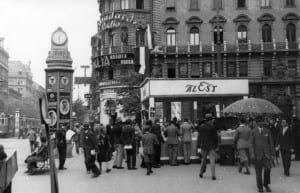
József körút (Boulevard), c. 1935, Pest as the centre of the press

József körút (Boulevard), c. 1935:
Pest as the centre of the press (CC BY-NC-SA 3.0)

From the golden age of Hungarian Jewish culture to inter-war anti-semitism, Budapest is constantly being rewritten, finds Gwen Jones.

Writing in 1910, a good decade before Al Capone and associates attained international notoriety, the Hungarian critic and arts patron Lajos Hatvany (1880-1961) introduced an imaginary Western European reader to the latest developments in his country’s culture and history. Tracing Hungary’s elevation following the 1867 Compromise with Austria, from ‘a rudimentary agricultural people to a higher rank’, into the era of economic growth and progress, he suggested that the country was not merely Europeanizing, it was Americanizing: ‘Budapest will become the Chicago of the Balkans’.

My book takes its title from Hatvany’s ironic remark, and discusses the ways in which Hungarian intellectuals viewed and wrote about their capital city from the turn of the twentieth century until the outbreak of World War Two. Referring to the speed with which Budapest grew in the last quarter of the nineteenth century, and contrasting this with a dusty ‘Balkan’ backwardness on the periphery, Hatvany placed the Hungarian capital within an absurd contradiction. In this, he was far from alone.

While compiling the book’s index, which was by far the most entertaining part of the entire writing process, I began by listing references to ‘Budapest is Hungarian’, and then for ‘Budapest is not Hungarian’. Next, I compiled various images writers had used to describe the city over this forty-year period. Budapest had been compared to, among other things, Babel, Babylon and Sodom. It was a ‘New Jerusalem’ built by Jews, and ‘Judapest’, the latter description attributed to Karl Lueger, who was mayor of Vienna from 1897 to 1910. Budapest was the Hungarian Paris, a muse, a parvenu, a Potemkinopolis, a whore and a volcano. Moreover, the Buda side was stuffy and conservative, much like an elderly uncle, while Pest, the centre of commerce, journalism and cabaret, was a cocotte, a fashionable prostitute. In the words of Rezső Seress’s popular interwar chanson, Hiába van palotád Budán, ‘No point your having a villa in Buda, it’s Pest where you go for fun’. (more…)

Russia: Back to no future

By Sean L Hanley, on 18 June 2013

Moscow Russia anti-Putin Graffiti R-EVOLUTION-2

Photo: Victorgrigas via Wikimedia Commons

With his regime running out of steam, Vladimir Putin is resorting to the rhetoric of the past and traditional values. Marie Mendras sees little future in it. 

The moment of truth for a non-democratic leader is when he needs to revive his fading authority and legitimacy. A snatched electoral victory over a year ago brought Vladimir Putin no new popularity, indeed quite the opposite.

Since his return to the Kremlin, his words and actions have reflected entirely negative emotions, such as fear of his own people, distrust of the elites around him, and a desire to avenge himself on those who have dared oppose him. Much of his energy goes on proving himself right and his critics wrong: he even accuses these of working for foreign powers and endangering national security. Putin has not recovered from the humiliation and scare of last year’s political contest, and is now facing tough economic and social challenges. The choice he has made is to try to restore his authority with a combination of targeted repression, doctrinaire ideology and an increase in control over institutions and companies. This is an unlikely recipe for success.

Weakened legitimacy

Vladimir Putin was re-elected on a controversial vote in March 2012. He could have won his new mandate more honestly, had he accepted the possibility of a second round runoff, but he was determined to win an absolute majority in the first round. He wanted to humiliate the other ‘authorised’ candidates by raising himself high above them, proving that he was the one and only – and a loyal Central Electoral Commission conferred on him a generous 63% of the vote. A year on, all the voters’ associations and NGOs that investigated election fraud are being harassed and some, like the Golos association, might have to close down. Key figures in the movement for free elections are also being prosecuted.

Putin’s election in 2000 and 2004, and Dmitry Medvedev’s election in 2008, were ‘managed’ ballots as well. This time, however, things turned out less manageable than usual. The widespread and vocal public protest of the winter of 2011-12, news of which flew around the country in a few keystrokes, exposed all of the regime’s rottenness and trickery. And the anger of a revitalized civil society was directed at the leader in person, under the ubiquitous slogan: ‘Putin, ukhodi!’ [Putin – out!]. His party fared badly in the parliamentary elections of December 2011, and in Moscow itself its performance was a complete disaster.

Throughout the 2000s, Vladimir Putin built his power and legitimacy on order, rising living standards and Russia’s growing global status. However, he will have more difficulty delivering in all three of these areas in the months and years to come, and he will be held to account for it. (more…)

How Poland came to be a major EU power

By Sean L Hanley, on 12 June 2013

Flaga RP z UE

Photo: Michal Osmenda via Wikimedia Commons

Poland has emerged as a major player in EU politics. The question now is what it wants to do with its new found clout, writes guest contributor Roderick Parkes.

There’s much to be learnt about power in the EU just by walking around its capitals. Parisians don’t walk so much as proceed; Berliners stare; Londoners apologize when bumped into, then look resentful. As for Varsovians, they simply don’t make space for others.

Conclusions? The French view power in terms of self-aggrandisement; the Germans, in terms of scrutiny and mutual control; the British, as a furtive game of playing states off against each other. As for the Poles, everyone knows why they don’t budge: they have an inferiority complex and a strong dose of territorial angst.

Except, of course, that these days they do budge. Polish street etiquette is improving markedly, and a stroll from Nowy Świat to Ulica Warecka is no longer a full-body contact sport. That’s good news for visiting Brits, who no longer have to apologize as they are trodden underfoot.

 It’s good news, too, for the EU: it speaks of a growing sense of ease among Poles as the country’s weight in the bloc has grown. The question now is what Poland wants to do with its new-found clout. (more…)

Moldova: An unravelling success story?

By Sean L Hanley, on 5 June 2013

IMG_9953

Photo: Anna Woźniak via Flikr  CC BY-SA 2.0

Vlad Filat, until recently Liberal Democrat Prime Minister of Moldova, is locked in a power struggle with Vladimir Plahotniuc, the country’s one and only oligarch. This war of attrition threatens the Eastern Partnership’s ‘success story’ and with it Moldova’s reform project says Andrew Wilson.

Not every policy detail may have been perfect in Moldova since 2009, but at least the narrative seemed right. Eastern Europe’s only ruling Communist Party fell from government. The changeover was mythologised as the ‘Twitter Revolution’ – a precursor of the ‘Arab Spring’ and ‘Moscow Winter’ – although in fact it was a prosaic process of elections and parliamentary arithmetic. The Communists were replaced by the smooth-sounding Alliance for European Integration, which was soon getting rave reviews for its reform efforts from the EU. Tiny Moldova leapfrogged the other five states in the Eastern Partnership and seemed to be first in the queue to sign an Association and Deep and Comprehensive Free Trade Agreement at the Vilnius summit in November 2013.

 By 2013, however, reviews were getting more mixed. Since the beginning of the year, Moldova has plunged into the kind of political infighting reminiscent of Orange Ukraine at its worst. After a previous crisis over the presidency was solved in 2012, it had seemed the current parliament would sit out a full term until the next elections are due in 2014. Today, Moldova has to sort out three simultaneous problems: it has no stable government, new elections are threatened and it is limping toward the November summit. It might collapse over the finishing line or just before; it might have a sudden burst of energy in the finishing strait; or it might fail a last-minute dope test.

So what went wrong? In reality, the three-party Alliance for European Integration was badly designed at birth; more exactly, at its rebirth. The first incarnation of the AEI in 2009-2010 struggled with a minimal majority over the Communists. That majority was improved at new elections in November 2010, but the elections also gave Russia the chance to push hard for an alternative alliance between the Communists and the pivotal Democratic Party (which includes many ex-Communists). Vladimir Putin sent his right-hand man, Sergei Naryshkin, to Chisinau to seal the deal. He didn’t succeed but encouraged the Democrats to secure a high price for not defecting back to the Communists, with the signing of a secret agreement in December 2010, leaked in 2012, to partition not just ministries but also supposedly neutral state institutions and revenue streams among the AEI’s three component parties.  (more…)

Crystal Palace (F. C.): Chernyshevsky’s barmy army

By Sarah J Young, on 30 May 2013


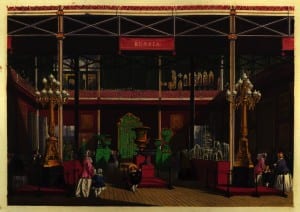
Russia at the Great Exhibition, 1851. From Dickinson's Complete Pictures. Author's copy

Russia at the Great Exhibition, 1851. From
Dickinson’s Comprehensive Pictures. Author’s copy

Sarah J. Young finds a rich history of Russian connections to the Crystal Palace, the glass and iron building by Joseph Paxton for London’s 1851 Great Exhibition.

When one thinks of Russian connections to English football, it is most likely the owners and shareholders of certain premier league clubs that will to spring to mind, or the small number of Russians who have played for English clubs, including Roman Pavlyuchenko and Andrei Arshavin. But as Crystal Palace F. C. reaches the premiership following a tense play-off final against Watford, the status of the club as possibly the only one in the English league to be named after a building – its former nickname the Glaziers emphasizing the connection to the iconic structure, which still features on the club badge – provides a legacy of historical and literary Russian resonances that far outstrip the transient presence of mere players and owners, or indeed football itself.

The Great Exhibition was intended, among other things, to bring together the industry of all nations for the promotion of peace and free trade (whilst, inevitably, demonstrating the superiority of Britain in all regards). The Russian exhibit drew attention owing to its late arrival, and was notable for the malachite products that stood out in a display mainly consisting of raw materials.

Tsar Alexander II at the Crystal Palace, 1874. Author's copy

Tsar Alexander II at the Crystal Palace, 1874. Author’s copy

But in a climate of general xenophobia and fear of foreign revolutionaries who might visit the Exhibition – which took place three years after the 1848 wave of European revolutions – as well as intensifying Russophobia (the Crimean War was only two years away), it is perhaps not surprising that Russians themselves, as much as their manufactures, were seen to be on display. Among the exotic foreigners caricatured in descriptions and cartoons, the fearsome ‘Don Cossack’ always had his place alongside the Chinese mandarin and the African ‘savage’, reminding us how alien and un-European Russians seemed to the British imagination at that time. The notion of the palace as an international space may also have been behind the visit of Tsar Alexander II in 1874. As a later cigarette card commemorating the event indicates, the emphasis on this occasion was reconciliation and sameness – the Russians in the royal entourage pictured here are indistinguishable from the British guests – but the commentary on the reverse reminds us of that ‘other’, alien Russia, ending ominously: ‘The Tsar was assassinated by Nihilists on 13th March 1881.’

But if British views of Russians at the Great Exhibition simply reflected contemporary events and attitudes, within Russian literature the Crystal Palace assumed a particular significance, as it became a touchstone for debates about modernity, westernization and social transformation. (more…)

Alexei Balabanov: the potency of cinematic story-telling

By Sarah J Young, on 22 May 2013

Balabanov on the set of 'Morphine'. Via Wikimedia Commons

Balabanov on the set of ‘Morphine’. Via Wikimedia Commons

Alexei Balabanov was as much a cinematic translator as a chronicler of post-Soviet reality, finds Seth Graham

A few days before Alexei Balabanov’s death at age 54 on May 18, I was finishing a blurb for a talented film scholar’s forthcoming book on the director’s work. I wrote: ‘The downside to studying artists who are still alive and working, of course, is that they will always outflank those who study them by creating more art’.

The particularly superstitious might accuse me of hastening Balabanov’s death with this fate-tempting, tongue-in-cheek line (sglazil!). But Balabanov himself did some mortal tempting, and hinting, of his own in his fourteenth and final film, Me Too (2012), in which he appears as a film director who (spoiler alert!) dies an early death. It was not a secret that Balabanov was chronically ill. His relatives, friends and colleagues certainly knew it, and he did not hide it from the public. He said in his last interview that ‘there probably won’t be any more Balabanov films’.

Still, the news of Balabanov’s passing, announced by Sergei Sel’ianov, the director’s perennial producer and co-founder of the CTB production company that funded all of his films for nearly two decades, came as a cruel surprise to Russophiles and cineastes who had gotten used to the regular pleasure of seeing what Balabanov’s latest work had to offer, and which self-designated guardians of Russian culture it would offend.

The latter pleasure was made even more, well, pleasurable due to the fact that Balabanov as an artist typically stayed above such criticism; he was simply not interested in epatage or chernukha or schlock/trash/exploitation or whatever film-studies term you want to use that has been lobbed at filmmakers whose work is considered controversial. He did not make films in order to antagonise or offend or scandalize. He was not the ‘Russian Tarantino’ or even the ‘Russian Scorsese’, despite a similar level of graphic violence combined with formal virtuosity and thematic omnivorousness; Balabanov’s depictions of violence were not, as they often seem to be for Scorsese and other directors, excursus on the nature of violence. His films were excursus on nothing but the concentrated potency of the particular form of storytelling at which he excelled: cinema. (more…)

Eastern Europe: Parties and the mirage of technocracy

By Sean L Hanley, on 16 May 2013

Non-party technocratic governments of experts have stepped in to fill a political gap in several European countries. But in East and Central Europe they are not always what they seem, writes Seán Hanley

Many commentators saw the governments of non-party technocrats formed in Greece and Italy in 2011 as an ill omen for development of party-based democracy in Europe. Established parties, it is suggested, are turning to technocratic caretaker administrations as a device to manage economic and political crisis, which allows them both to duck (or least share) responsibility for painful austerity measures. Such non-partisan governments of experts, it is argued, can only widen the yawning the legitimacy gap between governors and governed.

 Technocratically-imposed austerity backed by big established parties can further undermine party democracy by provoking anti-elite electoral backlashes:  the rise of new populist parties or breakthroughs by previously marginal radical groups. This in turn, makes coalition formation difficult and further rounds of caretaker government or awkward left-right co-operation more likely. The success of the Five Star Movement in Italy and its difficult political aftermath, which has finally resulted in an implausible Grand Coalition, seems to illustrate this scenario perfectly. Sometimes, caretaker technocrats themselves even add to the uncertainty, revolting against their erstwhile masters and founding their own new parties.

 How has the drift towards technocratic crisis management impacted Central and Eastern Europe?  The region is sometimes grouped with debt- and crisis-afflicted Southern Europe states as an economically weak periphery of flawed and potentially unstable democracies, where technocratic crisis governments are the order of the day.

And not without reason. In March this year the President of Bulgaria Rosen Plevneliev appointed a technocratic caretaker government to lead the country to early elections on 12 May following the resignation of prime minister Boyko Borisov in the face of street protests against poverty, high utility prices and corruption. Hungary had a year-long technocrat-led government in 2009-11, as did the Czech Republic in 2009-10 following the fall the centre-right minority government of Miroslav Topolánek. Meanwhile, Slovenia – one of three CEE states in the Eurozone – is set for a Southern European-style bailout following the downgrading of its bonds to junk status with undoubted domestic ramifications. (more…)