X Close

Institute of Epidemiology and Health Care Blog

Home

Menu

Archive for the 'Inequalities' Category

What’s law got to do with it?: Reflecting on my time in the Q-DaPS team as an In2research student

By Eleanor Mason, on 17 July 2025

Student Shania Essah Aurelio shares her experience with the Q-DaPS (Qualitative Data Preservation and Sharing) team at the UCL Institute of Epidemiology and Health Care through In2research. In2research is a one-year programme developed by In2scienceUK and UCL, designed to enhance access to postgraduate research degrees and career opportunities for people from low socioeconomic backgrounds and under-represented groups. 

Why I chose this placement

The Q-DaPS study is a multidisciplinary research study led by academics and Public & Patient Involvement (PPI) experts. It is funded by the NIHR School for Primary Care Research (FR4 – Project No. 596).

The study’s primary objective is to create a centralised repository for qualitative health and social care data that is secure and trustworthy. To inform the repository’s design and infrastructure, this study involved interviews with data professionals and qualitative researchers as well as focus group discussions with PPI collaborators who have previous experience of participating in primary care research.

Despite not coming from a medical sociology background, I applied to the Q-DaPS project for three main reasons:

  1. I was curious to look at health data from a different perspective. For context, I was completing my Masters degree in Law at the time, where I had been researching data protection laws and how they’re applied to personal data processing activities in the public sector.
  2. I wanted to learn about how qualitative data are used and managed in health and social care research, as well as the issues that may arise from this.
  3. It was clear that collaboration was at the project’s core from the very beginning and I wished to be part of a co-created project between academics and PPI contributors.

Looking back, I can confidently say that my time with the Q-DaPS team has definitely exceeded those expectations.


Working with the research team

Throughout my placement, I met and worked with various members of the Q-DaPS team: Professor Fiona Stevenson (who was my placement host), Professor Geraldine Leydon, Dr Barbara Caddick, Dr Karen Lloyd, and patient and public involvement (PPI) experts Lynn Laidlaw and Ali Percy.

PPI increasingly plays a central part of health and social care research. Safe to say, I had never worked with PPI contributors before. That, mixed with the readings I’ve done in a discipline I’d never come across before, would explain why I came to the first full team meeting with a page full of questions: from “how does triangulation work?” to “how do PPI contributors get onboarded on research projects like this?”. I knew that delving into a whole new discipline was going to be a challenge, so I’m thankful to the Q-DaPS team for actively  involving me in their discussions and patiently explaining concepts and terminology that I couldn’t get my head around.

Another in2research student, Kim McBride, also joined the Q-DaPS team later that summer. Even though we didn’t start our placements at the same time, we got to work together on days when our schedules overlapped. In retrospect, it was probably for the best—every time we were in the same room together we always ended up chatting about our studies and research interests. I really enjoyed working with Kim; like the rest of the Q-DaPS team, her contributions were informed by the work she’s done in her discipline (which is Social Psychology) and getting to see the same dataset (i.e., focus group transcripts) from her perspective was incredibly valuable.


Working on my project

The Q-DaPS project involved a qualitative multistakeholder study, which essentially means that there’s a lot of reading involved—especially in the earlier weeks of my placement. Before homing in on the focus group transcripts, I went through interview transcripts from the multistakeholder study, where I gained insights from various experts in the field (i.e., PPI contributors in health and social care research, researchers, and data protection lawyers).

Having gone through the focus group and interview transcripts, I ended up researching the intersections between UK data protection law and health data-related research ethics. I mainly focused on the UK GDPR as well as the Taipei and Helsinki Declarations. Through this placement, I got to explore the connections between them which I thoroughly enjoyed.

What made the research process enriching was the feedback phase; this is where the varied expertise of the Q-DaPS team shined. Looking back on the dialogue I developed with the Q-DaPS researchers through the ribbons of comments on my research outline, I have learned so much from their experiences—from how data protection laws are applied in academic settings to how data ethics are approached by ethics committees across institutions.

Even though I was based in the Department of Primary Care and Population Health, I got to meet researchers from other departments. From them, I learned more about topics like social prescribing, safety standards for baby food, and even health economics—things I’d never looked into before. Being able to hear about their research and share experiences and anecdotes with them really encouraged me to keep going with my project.

The chances of being onboarded onto a medical sociology research project with a CV filled with legal research experience are very slim, and I am very grateful to the in2research team for having afforded me this opportunity by matching me to the Q-DaPS placement. My gratitude is extended to the Q-DaPS team, who have warmly welcomed me into their side of the research world and enthusiastically encouraged my curiosity.

Fried egg sandwiches and a recipe for digital inclusion

By Eleanor Mason, on 12 June 2024

The team behind the Digital Health Inclusion Project check in with the Breakfast and Browsing group at Burmantofts Community Friends. This blog was written by Lily Arnold and Emma Carta (UCL Research Assistants).

Introduction

The Digital Health Inclusion Project at UCL has been researching Digital Health Hubs across Leeds for the last year. These hubs are part of a community based approach to digital inclusion, facilitated by 100% Digital Leeds, in collaboration with VCSOs and the health sector.

As the project wraps up, we took a last visit to the Breakfast and Browsing club run by Burmantofts Community Friends, to check in with the group members about our initial findings. Some members have given their time to the project already, but this workshop allowed us to open up discussions with the group and hear more experiences and perspectives.

Digital exclusion has wide-ranging implications for individuals, including poorer health outcomes, increased social isolation, and limited access to essential services. The National Government has been criticised for lacking a credible strategy and failing to prioritise the issue of digital exclusion effectively. But local authority led interventions in Leeds, which are delivered through community hubs and partnerships, play a crucial role in reaching digitally excluded individuals and building essential skills and confidence.

Workshop Overview

We began the session thinking about what works well at the Breakfast and Browsing group, asking the members why they enjoy coming along to the sessions. Then, armed with craft supplies, we turned these discussions into recipe books coming up with recipes for getting online.

While participants mostly only finished the covers of their recipe books, the conversations happening around the table were very insightful! As the workshop drew to a close, instead of a recipe book, members of the group asked for their work to be turned into a poster which could advertise the Breakfast and Browsing sessions to a wider audience.

Key Findings from Field Notes

  • Participants enjoyed and appreciated the warm and welcoming atmosphere of the group, and talked often about the importance of social connections and friendship. Multiple times, and in different contexts, the word ‘family’ was used to describe the bond the group felt to each other.
  • Breakfast and Browsing meets the need for personalised and flexible approaches to digital inclusion, and it recognises the diverse needs and preferences of individuals who attend the session.
  • In depth, ad hoc, one on one digital inclusion work takes place at the periphery of the sessions, with light touch scaffolding at the centre for those who want to engage.
  • The breakfast element of Breakfast and Browsing is so much more than just a meal, eating together contributes to the warm atmosphere of the group and establishes a trusted routine.
  • The time the group runs on a Monday morning was also noted as being useful, with participants describing their participation as starting the week off on the right foot.

Checking in with the Breakfast and Browsing group provided valuable perspectives from participants on what makes Digital Health Hubs successful. Just as the group requested, here is a poster which combines their different ideas together to advertise the session for more people to join:

Humanitarianism – what does it mean today?

By e.schaessens, on 18 August 2023

Woman holding an IV drip bag.

On World Humanitarian Day, Dr James Smith, Lecturer and Co-Director of UCL’s MSc in Humanitarian Policy & Practice reflects on the evolution of the humanitarian landscape and some of its inherent challenges.

The United Nations have stressed that the number of people requiring immediate ‘humanitarian assistance and protection’ has never been greater than this year. In the absence of concerted action, the impact of violence, widespread lack of access to essential public services, and wilful political indifference and neglect will continue to generate catastrophic levels of human suffering and ecological damage.

If we define humanitarianism in its broadest sense as a belief in the equal value of human life and a concern for human welfare, then the need for some form of humanitarianism appears as urgent as ever.

At the same time, popularised expressions of humanitarianism have shifted and changed over time. Humanitarian values have been institutionalised and bureaucratised, and corresponding systems and sectors have formed and grown. Now-dominant forms of humanitarianism have histories and contemporary articulations that are intimately tied to capitalism, colonialism and whiteness. Relatedly, criticism of the humanitarian system and its interventions has increased exponentially in recent years, driven forward by scandals that detail abuses of power, the undignified treatment of people in vulnerable situations, and a failure to enact the radical changes needed to alter how financial support is generated and distributed, or the means by which communities can take control of their own decision-making.

The growing number of instructive critiques of humanitarian action should inspire us to identify new ways to teach, study, and enact humanitarian values. It is increasingly clear that existing institutions, systems, and processes need to change and adapt in order to practice an ethics of care and concern. At the same time, calls for transnational solidarity (consider, for example, the vibrant civil society movements that pressed for equitable access to COVID-19 vaccines), and global resource and knowledge sharing, are strong. The fundamental values that define humanitarianism can support and amplify these calls.

With UCL’s new MSc in Humanitarian Policy & Practice we are enthusiastic about working with students and professionals that are representative of the current and future global humanitarian workforce in order to think creatively and critically about humanitarian values and ethical and effective forms of humanitarian action. In doing so we will ensure students have the ability to develop programmes while continually interrogating foundational values, principles and motivations, and to design research studies while thinking critically about the politics of knowledge production, alongside several other priority topics.

By taking these steps we hope to contribute towards future humanitarianisms that enact a concern for our shared welfare in a way that is equity oriented, justice motivated, and solidarity driven.

Exploring barriers to equitable participation in health research among ethnic minorities: A co-production workshop

By Eleanor Mason, on 16 November 2022

Written by Camilla Rossi, Jo Blodgett, Chandrika Kaviraj, and Aradhna Kaushal 

The way we research health matters. Despite a growing awareness of stark health inequities across the UK, most health research does not involve people from ethnic minority groups. This under-representation not only hides the experiences of those who are often most at risk of poor health, but it also prevents appropriate solutions from being developed. Through a UCL Research Culture Award, we organised a co-production workshop in London to better understand what might prevent equitable participation in health research and how to start addressing these barriers.

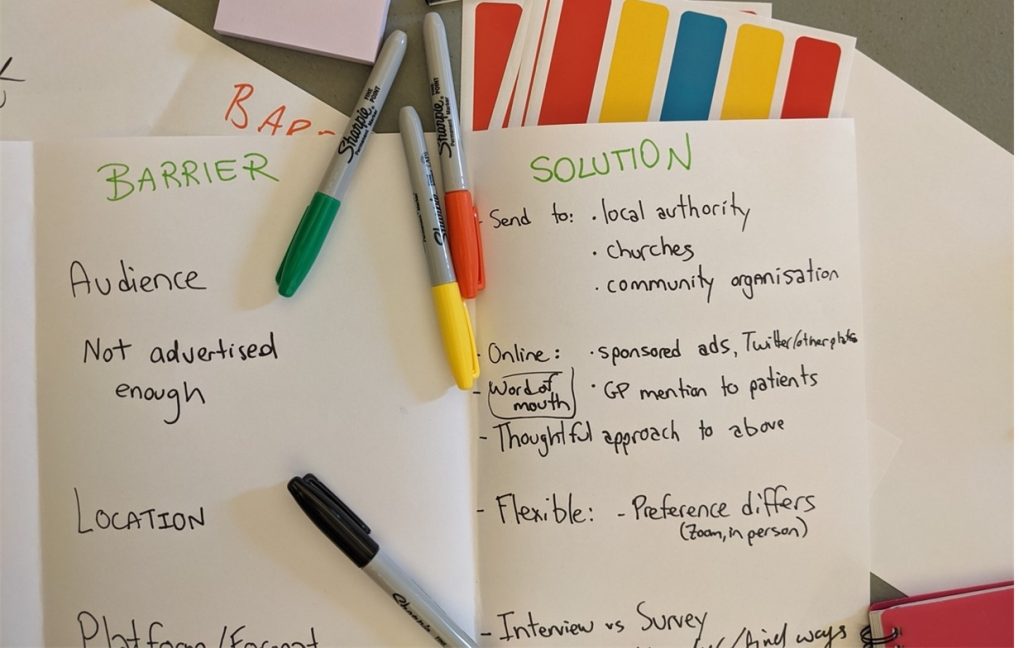
The workshop was held in June 2022 at UCL and brought together a group of six participants who identify as ethnic minorities. The activities developed around two main sessions: in the morning, the group brainstormed potential barriers to participation and discussed when they might emerge; the afternoon was dedicated to considering how they could be addressed, discussing the practicalities of involving people from different ethnic minority communities.

The project was informed by the notion of ‘knowledge co-production’. Through this approach, the researchers step back from their traditional role as ‘experts’ to make space for lived experiences as central forms of expertise. One of the ways we did this was by designing the workshop in collaboration with a member of the public, Chandrika Kaviraj. Chandrika reviewed and informed our initial proposal and is now overseeing the analysis and communication of the findings.

What is preventing equitable participation in health research?

Drawing from their families and their personal experiences, the participants identified a variety of potential barriers which we grouped under three main categories.

Lack of trust in institutions and their representatives emerged as a key underlying theme.  Participants discussed the effects of “previous negative experiences”, “fear” of institutions and of the repercussions of getting involved, and shared a general perception that medical professionals and researchers are not trained to engage with racism and the trauma it causes:

“My mom would have so much to add to and learn about health research, but she is so deeply scared of institutions because of how she has been treated in the past.” (British Asian, male, 18-29)

Language and socio-cultural obstacles experienced within the health sector were identified as often concurrent, leading to a difficulty in communicating and being heard from both a linguistic and cultural point of view. This can contribute to a sense of “being invalid”, “incorrect”, and “uneducated”:

“Due to language barriers, due to feeling like it is something we’re not a part of, and due to doctors not understanding the cultural context … this leads to an inability to express.” (Black British, female, 40-49)

Practical barriers contribute to people perceiving health research as “not doable” or “relevant”. These can include lack of time and childcare needs, as well as the use of technology and the location of the study.

It is important to stress that the term ‘ethnic minorities’ includes a highly varied population, with ethnicity being only one of the many social categories shaping personal and social identity: different barriers might be more or less relevant to certain individuals or communities depending on factors such as gender, age, disability, or socioeconomic status. Engaging with this diversity and fluidity of experience is essential to avoid simplistic representations which may end up reinforcing the very barriers we are trying to dismantle.

What are the possible solutions?

Participants agreed that all barriers are exacerbated by researchers’ lack of knowledge and engagement with communities. This leads to research methods that do not fit with people’s lived experiences and needs.

The group developed four main recommendations.

  1. Tap into existing community structures

Researchers need to go beyond “traditional means” to make the research meaningful and relatable to people. Engaging with existing community structures and “physically going out there” was highlighted as essential. When the researcher has no existing links with a particular group, the involvement of a community member in the design and development of the project was recommended.

“You need more of a ‘community development mindset’: use the local authorities and look for places where people are already involved. Go out there.” (Black British, female, 40-49)

  1. Be transparent about the research aims, objectives, and challenges

The aims and objectives of the research needs to be communicated with clarity and transparency from the beginning: how can the research add value to their communities, families, society? What impact could it have and what are the limitations? Participants agreed that being transparent about the potential challenges involved might help to build trust, making researchers easier to relate and resonate with:

“These communities can smell fraud from miles: be honest about the barriers involved, we can relate to your constraints! If you manage people’s expectations, they will respect you more.” (Black British, male, 50-59)

  1. One size does not fit all: make the project flexible and adaptable 

Investing time and resources into tailoring the research process was highlighted as essential both to encourage people to participate and ensure that they are not forced to drop out. Participants recommended advertising the study through different means of communication, both online and offline, hosting the study in safe and inclusive spaces, dedicating ample space for questions, and being ready to allow time, space, and support for participants struggling to commit for personal reasons:

“Show support and availability, the whole process needs to be more adaptable, flexible, and caring… which also means labour intensive!” (British Asian, male, 18-29)

  1. Bring the results back to the communities

Confining the research findings to academia can widen the gap between participants and the researcher, discouraging people from taking part in future studies. Instead, diversifying how research is communicated, including accessible reports and in-person presentations within community settings, could contribute to strengthening trust and generate new opportunities for engagement:

“The research needs to get back to the public who participated, they cannot be forgotten. Otherwise, they won’t participate again, and mistrust will continue.” (Black British, female, 40-49)

Next steps

The results of this project will be written up for publication in the coming months with plans to disseminate the findings widely across UCL, and beyond and to embed the learnings into relevant courses and teaching practices.

If you are interested in finding out more about this project or would like to be kept informed about future development – please email research.involvement@ucl.ac.uk