
X Close

Global Social Media Impact Study

Home

Project Blog

Menu

Archive for August, 2015

What ordinary Chinese people post on social media after the Tianjin Blast

By Xin Yuan Wang, on 24 August 2015

For two days, my WeChat news feeds has been awash with all kinds of articles and images about the Tianjin blast. But after merely two days, the routine on social media came back, food photos, holiday photos, kids photos, articles teaching you how to deal with the relationship between you and your mother-in-law all came back. People seemed to forget about the disaster already.

A week after the appalling blast in Tianjin, China on 12th August, Zhou, a free-lance journalist and photographer, who I got to know when I was doing field work in Southeast China last year, told me her feelings concerning Chinese social media reaction to this event. She could not hide her disappointment.

Zhou’s remark accords with my own observations of my informants’ posts on both QQ and WeChat, the two Chinese dominant social media platforms. And like Zhou, I heard the news for first time from my personal WeChat. Social media has become the main (if not the first) channel for access to various kinds of information. But unlike traditional channels, social media presents these different kinds of information from news to a whole range of personal conversation together without curation. This clearly contributes to Zhou’s feelings about information fragmentation on social media where significant news becomes diluted by the huge amount of the ‘daily life’ content on social media.

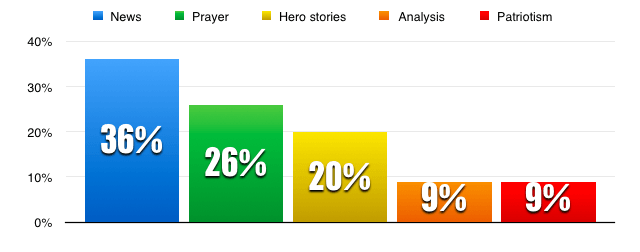
But what exactly ordinary Chinese people post on their personal social media profiles vis-a-vis the blast? After the completion of  15 months fieldwork, I continued to follow two groups on social media on a daily basis. One comprise the rural migrants in a factory town where I did most of my field work (50 persons), and the other one a control group with whom I conducted in-depth interviews in Shanghai (30 persons). The table below shows how remarkably different the Tianjin blast related social media performance are of these two groups of people (All the people in Shanghai use WeChat, and the majority of rural migrants remain with QQ). Taking the four days following the blast (from 13 August to 17th August), on all 80 social media profiles, 44% of postings (42 postings out of 95) were related to the blast, of which almost 53% were posted the day after the blast. In general, there are five themes: News about the blast (36%), Prayers for Tianjin (26%), Hero stories (20%), in-depth analysis (9%), and patriotism postings (9%).
chart_blast


The News postings were straightforward, usually news reports with photos and very simply comments by people who shared it, such as “It’s shocking!”, “How terrible!” or “I am so sorry for Tianjin”. 60% of those news-based stories shared on social media came from people in Shanghai.

The ‘Prayers for Tianjin’ postings are those memes with text like ‘pray for Tianjin’  (see screenshots below). Some postings shared on people’s profiles went even moralized by claiming “Tonight we are all from Tianjin and suffer the same suffering, if you are Chinese please share this!”, a bit like “We are Charlie”. The majority (64%) of those memes come from rural migrants.

屏幕快照 2015-08-18 下午8.08.49

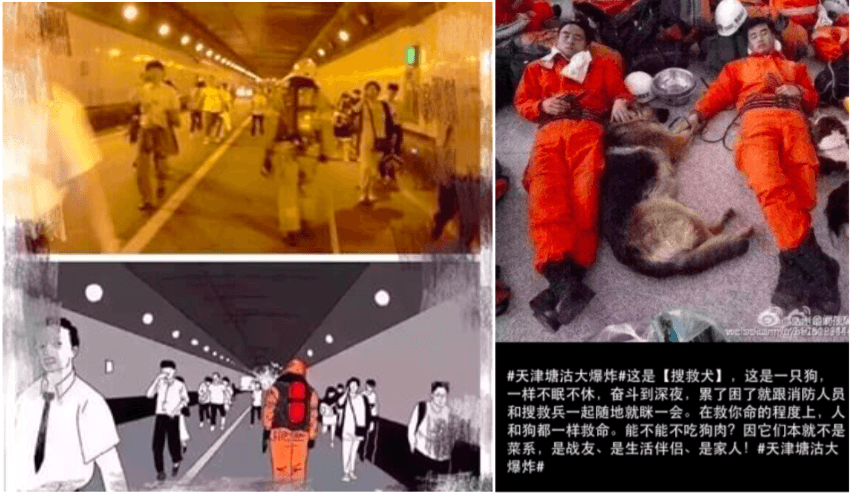
The ‘hero stories’ are also widely shared on people’s social media profiles where both people from Shanghai (50%) and rural migrants (50%) seems to show similar interests in stories like how firemen sacrificed their own lives, running into the fire when everybody was fleeting away; or how sniffer dogs worked day and night in order to save human beings.
屏幕快照 2015-08-19 上午11.09.00

In-depth analysis refers to editorials focusing on the cause of the accident. Articles of this kind were only shared only by people from Shanghai, who had education at master-level and above. In one of the articles the government and disaster relief system is strongly challenged. There is explicit criticism of the way that after a disaster people only share ‘pray for ***’ memes on social media, rather than really asking for the truth behind the disaster.

In contrast to the situation of ‘in-depth analysis’, rural migrants contributed all the ‘patriotism’ postings.  One typical ‘patriotism’ (see screenshots below) started with a list of Chinese celebrities and companies who had donated money for the disaster relief, followed by the list of foreign celebrities and companies (such as south Korean stars, Samsung and Apple) who didn’t donate any money for this Tianjin blast. In the end of the article, it was urged that Chinese people should love the state since only the Chinese army can protect them and people who are big fans of foreign stars and foreign products should feel ashamed of themselves. Though I happen to know that one such person, a factory worker, had just spent on whole month salary on a iPhone prior to a blind date with a girl arranged by one of his fellow villages,

屏幕快照 2015-08-19 上午11.49.45

A close inspection of this pattern of posting on social media is revealing then not just about reactions to a disaster, but also key issues in contemporary China, such as the differences created by education and the appeal of nationalist ideology.

Ropa americana online: the local market for used clothing

By ucsanha, on 15 August 2015

Screen Shot 2015-08-13 at 16.23.47

A Facebook announcement from an online shop in northern Chile announces “Jackets, Vests, and Sweatshirts”

Ebay, Etsy, Alibaba, and Taobao have changed the way many people around the world shop. Now, you can get virtually any product from anywhere, delivered right to your door. Tom McDonald has even observed companies that have sprung up to make this possible in rural China where even courier services does not deliver (also see his blog about business Facebook pages). But in northern Chile, people aren’t really all that concerned with getting interesting things from far off places. To them, ropa americana [American clothing, code for used goods] is the cheapest and least impressive form of dressing. If one is looking for style, the department stores in the larger cities will do just fine.

But this doesn’t mean that there’s no market for these goods online. Many people, particularly older women, have developed “shops” through Facebook in order to sell used clothing. Just like their counterparts who operate physical used clothing shops in the semi-formal markets around the city, these women buy used clothes in bulk, and sell it to individual consumers. But instead of renting a stall, they take pictures of the individual items to upload to Facebook accounts that they have just for that purpose. When a potential buyer likes and item, they will negotiate a price (usually about $4 for a tshirt, a bit more for jeans or a dress, up to $20 for a coat), and a time and place to meet for the exchange. While new customers may simply ask the price as a comment on the picture, or send a private message through Facebook to arrange a drop-off, regular customers will send WhatsApp messages asking about specific items, hoping to get the best of the best before they even make it to the Facebook page.

Paola, who sells clothes mostly for men told me that a miner requested she meet him as he got off the bus, coming home from his shift at the mine. He had ripped his coat while at work, and was afraid of being very cold between the bus drop off and walking a few blocks home. Paola agreed to meet him at midnight at the bus, for just a few extra dollars.

So while in many ways social media has the ability to expand consumption options globally and allow people access to cosmopolitan goods they might not have imagined a decade ago, it can also take on a form that is distinctly local and personal. Like Paola meeting the miner at his bus, this is just one way that social media can truly strengthen the community bonds that people feel in their local place.

Sharing anthropological discoveries on social media: ‘marketing’ or ‘interactive learning’?

By Daniel Miller, on 6 August 2015

Indian teenager using smartphone

Social media and engaging anthropology? (Photo: Pabak Sarkar CC BY 2.0)

Over the last year, people have often asked us questions like “Surely you will market your project using social media?” or, “What exciting campaigns based on social media will make your project a success?”

Well the answer is that indeed we think we have learnt a good deal about social media. What it is useful for, but equally where claims are made that are not borne out by our evidence. We have concluded that this huge emphasis on marketing through social media has far more to do with the wishes and desires of the marketing industry for this to be the case than any sober assessment of what social media actually is.

Looking at our research as a whole, we find quite limited successful employment of social media as a form of mass marketing and promotion. Yes certainly in some cases, but in most of our field sites it’s force is quite limited.

Our primary theorisation of social media is instead as a form of sociality and the formation of small groups for internal discussion. It is not generally a means for trying to reach new or different people but rather for consolidating social groups that are largely known. Some platforms such as LinkedIn and Twitter clearly command a wider presence but even here, social media generally works best for groups that are linked by common interests such as devotees of Star Wars, rather than in reaching a generic audiences.

We are not alone in this. Fore example, even people in business are starting to appreciate that Twitter is not always effective in driving traffic in the direction that they would wish.

So yes, we do envisage a role for social media in the dissemination of our project findings but mainly other than as a tool for mass marketing. We see social media as an important instrument for interactive learning. So people who take our online course will be encouraged to form small groups in which they can discuss the material and make and receive comments about what they are learning.

People who cannot meet physically in class rooms can use social media for discussion. Social media can also harness one’s personal networks to disseminate information in limited ways, and much of the more successful commercial usage we observe in our field sites relates to businesses where personal interaction is also important.

What people seem to imagine is that a project that studies social media will – for that very reason – concentrate on using social media. But we have never been advocates for social media.

The point of our research is to remain open and cautious about our findings, and we are just as comfortable noting the limitations and negative effects of social media as its potentials.