Workshop held at the Imam Hussein Holy Shrine, Karbala, 26 November 2018: report by Paul Collins
Organized by Dr Paul Collins (Nahrein Network), Dr Alaa Ahmed (Imam Hussein Museum), and Dr Jaafar Jotheri (Qadisiyah University)

The museums workshop in progress
The workshop brought together twenty-three representatives of seventeen museums (out of twenty-one museums that had accepted an invitation to attend) from across Iraq, along with interested parties from the Prime Minister’s Office, Mosul University, and Najaf University:
- Al-Ataba al-Husseiniya, Imam Hussein Holy Shrine, Karbala
- Al-Kafeel Museum, Imam Abbas Holy Shrine, Karbala
- Al-Muthanna Museum
- Amarah Museum
- Anbar Museum
- Babylon Museum
- Basrah Museum
- Diwaniyah Museum
- Diyala Museum
- Green Zone Museum
- Kut Museum
- Mosul Museum
- Najaf Museum
- Nasiriyah Museum
- Samarra Museum
- Samawah Museum
- Wasit Museum
Not in attendance: Duhok Museum, Erbil Museum, Kirkuk Museum, and Sulaymaniyah Museum.
Although the majority of the museums represented at the workshop are run by the SBAH, a small number are linked to universities or religious institutions with different organisational structures and resources. The museums vary considerably in the size of the populations they serve, ranging from cultural heritage sites to provincial centres and major cities like Basra and Baghdad. This inevitably means that there are many variables around local and regional demographics and infrastructures that need to be considered in evaluating the responses to the workshop questions. Indeed, some museums are not open (e.g. Mosul) and lack display cases (e.g. Diyala).
The principal aim of the workshop was to bring together museum professionals from across Iraq to assess the current situation and explore opportunities for knowledge exchange, especially around best practice. This is the first occasion that such a meeting has been taken place in Iraq, certainly within the last three decades. It was hoped that one outcome might be the formation of a network of country-wide museum professionals. An offer by Dr Alaa Ahmed, Director of the Imam Hussein Museum, to lead on the establishment of an Iraqi Museums Association to be based in Karbala was warmly welcomed by the participants.

Fortunately the workshop venue did not completely stifle discussion
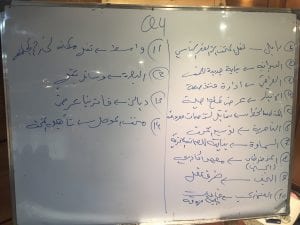
The plan for the workshop was to use break-out spaces where small groups could discuss a series of questions, record their answers on flip charts, before coming together to share and discuss the results. The available space—a lecture room with fixed, tiered seating—meant it was necessary to change the format; there was little opportunity for conversations other than between colleagues from the same museum who sat together on a row. The workshop questions were delivered from a podium at the front of the room (translated from English into Arabic by Dr Jaafar Jotheri) and, after time for discussion/thought, representatives of each museum gave their answers in turn. Dr Jaafar recorded these on a white board (see below). Not every museum responded to every question.

Dr Jaafar Jotheri records answers from Basrah Museum
The questions posed were deliberately very broad with the intention of revealing the range of audiences currently visiting the museums as well as aspirations for creating greater diversity in the future. Participants were asked to identify their museum’s top three visitor groups – suggestions were offered on a slide. Some museums chose to provide longer lists but for consistency these details have not been included in the following summaries.
The format of the workshop meant that there was time to explore only four questions.
1. Who are your current visitors?

Current types of visitors to Iraqi museums
School children represent a significant component of museum visitors followed by university students. Few museums identified local tourists as significant, although foreign tourists figured heavily for some institutions. Other museums had distinct visitor profiles because of their location (Green Zone) or collections (Al-Ataba). Only the Iraq Museum and Al-Ataba identified academic researchers as sizable.
2. Who would you like to visit?

Types of visitors wanted by managers of Iraqi museums
A clear desire for many museums is to attract a greater number of families, while a current lack of female visitors was also noted. There was also a desire to see more visitors from the surrounding countryside. Some institutions who didn’t regularly receive school and university students saw this as priority. A small number of museums were interested in attracting people on low income and those with special needs.
3. How would you encourage visitors to your museum?

Ways in which managers of Iraqi museums would like to encourage future visitors
A variety of very interesting approaches were suggested. Multimedia – both in galleries as well as through social-media – was viewed as an important method of engagement. A significant concern was the lack of transport links to museums, many of which were considered to be poorly located. A greater understanding of the country’s rich cultural heritage, which might be provided through school education, was also viewed as an important method for encouraging visitors.
4. What one thing would you change about your museum?
- Change the location of the museum
- Refurbish the museum building/gallery
- Provide unique exhibitions
- Provide transportation to the museum
Answers focused on concerns around the museum’s location, infrastructure and transport links. There was also an interest in providing temporary exhibitions.
Evaluation
Future workshops would benefit from a more flexible meeting space to provide greater opportunities for discussion and debate. This meeting was, however, very successful in attracting a large number of Iraq’s museum professionals; there was a clear sense that they valued the opportunity not only to meet collectively but to contribute personally. Participants were also keen to be part of an Iraq museums association, which would provide a means for developing future workshops/gatherings.
The broad questions around museum audiences addressed at this workshop fits with a growing interest within museums globally about identifying visitor types and developing ways to encourage specific segments, e.g. http://intercom.museum/documents/1-4Waltl.pdf, including in the Middle East: https://lra.le.ac.uk/bitstream/2381/37244/1/2015AlAliMPhD.pdf. Finding ways of expanding the number of visits by families to museums is of particular interest and there are a wide range of case studies to draw upon, e.g., https://gulfnews.com/uae/family-fun-at-sharjah-musuems-1.1093567
A future workshop might explore in greater detail what Iraq’s museums are currently doing to support their visitors as well as identify a segment, such as ‘families’, as a focus for sharing ideas around best practice and to develop new approaches. Other areas of interest, such as the use of multimedia, could also be explored in a workshop, not least around identifying sources of funding as well discussing inherent issues of equipment and software maintenance and update.
In order to deliver in these areas, future meetings could also be opportunities for training in areas such as audience evaluation and management; desirables also identified at a workshop held at Basrah Museum in January 2018: http://www.friendsofbasrahmuseum.org.uk/sites/default/files/report_on_fobm_jan_2018_training_programme_evaluation.pdf
The answers in full
Translation provided byRahma Ismail,Project Administrator, Centre on Culture, History and Humanities for Sustainable Development, University of Kurdistan Hewler.
Question 1
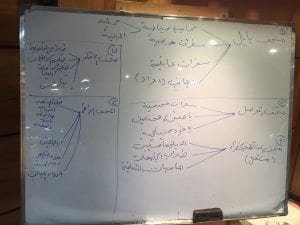
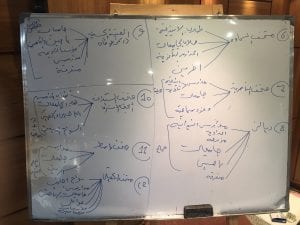
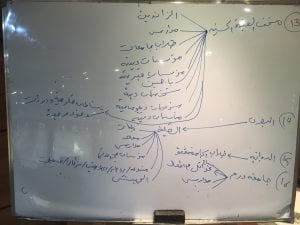
- Babylon Museum:
- Tourist groups
- Local
- International (foreign)
- School trips
- Family trips
- Foreign individuals
- Mosul Museum:
- School trips
- Researchers and specialists
- Tourist groups
- The Green Zone Museum (mobile)
- Diplomats
- University students
- Cultural events
- Anbar Museum:
- High school students
- University students
- Post graduate students
- Senior citizens
- The Iraqi Museum:
- Elementary, secondary, high school and university students
- Researchers
- Senior citizens and ?
- Foreign visitors
- Samawa Museum:
- Elementary school students
- University students
- High school students
- Others
- Nasiriya Museum:
- Local schools: elementary, high school
- Local universities
- Local tourist groups
- Diyala Museum:
- Local elementary schools
- Local secondary schools
- Local high schools
- Local universities
- Local researchers
- Miscellaneous
- Al-Ataba Al-Husseineya (Manuscripts)
- Foreign and others:
- Universities
- Researchers and academics
- Religious institutions
- Schools
- Miscellaneous
- Al-Kafeel Museum:
- Foreign tourists
- Schools
- Universities and researchers
- Families
- Institutions
- Diplomats
Question 2


- Babylon Museum:
- The poor, countryside residents, slum residents
- Mosul Museum:
- Families
- The Iraqi Museum:
- Elementary school students
- Anbar Museum:
- Families
- University faculty members
- Politicians
- The Green Zone Museum:
- Women
- Nasiriya Museum:
- Persons with special needs
- Children under school age
- Al-Muthenna:
- Families
- Countryside residents
- Al-Ataba Al-Husseineya Manuscripts
- No problem?
- Najaf Museum:
- Women
- The educated class
- Businessmen
- Countryside residents
- Waset Museum:
- Families
- Countryside residents
- Persons with special needs
- Diyala Museum:
- Families
- Politicians
- Countryside residents
- Basra Museum:
- Families
- Craftsmen
- Countryside residents
- Al-Kafeel Museum:
- Children
- Al-Ataba Al-Husseineya Manuscripts
- Visitors
- Schools
- University students
- Religious institutions
- Charities
- Researchers
- Religious scholars
- Diplomats
- Religious events
- Government activities and training courses
- Religious visits
- Basra Museum:
- Students:
- Schools
- Universities
- Colleges
- Civil society organizations
- Miscellaneous; writers, media, companies, diplomatic missions
- The military
Question 3
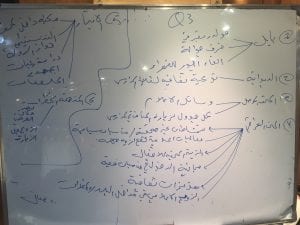

- Babylon Museum:
- Digital folders
- Mobile teams
- Free entry for the poor
- Diwaniya Museum:
- Cultural awareness for students
- Mosul Museum:
- Media
- Develop a museum visit schedule at schools
- The Iraqi Museum:
- Non-museum activities; political events
- Media coverage important heritage pieces
- Museum visits for children
- Free entry on special days/ holidays
- Cultural conferences
- Publicity promotion at borders and airports
- Anbar Museum:
- Library inside the museum
- Collaborations with government institutions
- Researching audience needs/ interests
- Folders
- The Green Zone:
- Rehabilitating exhibition location
- Publicity prior to visits
- Wasit Museum:
- Selecting appropriate location for the museum
- Use of social media
- Changing the exhibited pieces
- 3d stereoscopic images/ sculptures
- Folders
- Presenting results of ? in the museum
- Non-museum activities
- Diyala Museum:
- Screens
- Lectures and workshops on paintings and antiques
- Games for children
- Library
- Folders/ filing
- Presenting results of?
- Basra Museum:
- Exhibitions presenting the current situation
- Subjective workshops for materials not present in the museum
- Media promotion
- Presentation technology
- Nasiriya Museum:
- Virtual visits
- Developing divisions that represent the society
- Samawa Museum:
- Folders/filing
- Exhibitions for paintings not owned by the museum
- Book signings
- Countryside visits (mobile museum)
- Al-Ataba Al-Husseineya Manuscripts
- TV channels & satellites
- Rehabilitation of manuscripts division in the university
- Awareness/education through trainings and workshops
- Najaf Museum:
- Find out audience (tribes) interests
- Exhibit paintings representing cultural heritage in the museum
- Renewing exhibit structures periodically
- Use of media
- General awareness raising
Question 4
- Babylon Museum:
- Move the museum to the presidential palace
- Diwaniya Museum:
- New building for the museum
- The Iraqi Museum:
- Professional management
- Anbar Museum:
- Exhibit original pieces
- The Green Zone Museum:
- Sculptures for well-known personalities
- Nasiriya Museum:
- Expanding the museum
- Samawa Museum:
- A building for heritage maintenance
- Al-Ataba Al-Husseineya Manuscripts:
- Academic institution
- Najaf Museum:
- Transpiration facilities
- Al-Ataba Al-Husseineya Manuscripts:
- New halls?
- Wasit Museum:
- Move the museum outside the university
- Basra Museum:
- Transportation facilities
- Diyala:
- Install vitrines
- Mosul Museum:
- Rehabilitate the museum
 Close
Close



