X Close

The Nahrein Network

Home

Fostering the sustainable development of heritage in post-conflict iraq and its neighbours

Menu

Archive for the 'Heritage' Category

Nineveh Gates: Challenges, Sustainability and Strengthening Community Relations in Mosul

By Zainab, on 18 June 2025

We talk to Mustafa Yahya Faraj, an archaeologist with the Iraqi State Board of Antiquities and Heritage. Mustafa held a Nahrein – BISI Visiting Scholarship at UCL. His project is titled Nineveh Gates: Challenges, Sustainability and Strengthening Community Relations in Mosul and is under the supervision of Professor Mark Altaweel.

Mustafa with Prof Eleanor Robson at UCL

Tell us a little about yourself.

I’m an archaeologist from Mosul, Iraq. I hold both a Bachelor’s and a Master’s degree in Ancient Archaeology from the University of Mosul, and I have been working with the State Board of Antiquities and Heritage of Iraq (SBAH) since 2013. I have worked at some of Iraq’s most significant heritage sites, including Nineveh, Nimrud, and the Mosul Museum, where I’ve been actively involved in excavation, restoration, and emergency rescue projects. These experiences have also allowed me to collaborate with esteemed institutions such as the University of Mosul, the Smithsonian Institution, and the University of Heidelberg.

From 2023 to 2025, I was part of—and helped lead—the restoration project of the Mar Toma Syriac Orthodox Church in the old city of Mosul. This initiative, supported by the ALIPH Foundation and L’Œuvre d’Orient, aimed to revive one of the city’s most iconic landmarks. I’m also passionate about documenting historical buildings and sites, especially in Mosul before and after the ISIS occupation. My work includes extensive photographic and written documentation to help preserve cultural memory and identity.

I have completed several international training programs, including a rescue archaeology course at the Iraqi Institute for the Conservation of Antiquities and Heritage (IICAH) in Erbil, and courses on archaeological entrepreneurship offered by Koç University and the University of Bologna. In 2025, I was honored to serve as a Visiting Scholar at the Institute of Archaeology – UCL, where I conducted research on the social, economic, and cultural impact of the Gates of Nineveh on the local community.

I am a member of ICOMOS and ISCARSAH, and throughout my career, I have received over fifteen certificates and letters of appreciation from both Iraqi and international institutions in recognition of my contributions to heritage preservation.

Tell us more about your project.

My research project focuses on the Gates of Nineveh from three key aspects. First, it involves assessing their current condition, documenting violations, and reviewing previous excavation rescue and restoration efforts after 2017. Second, it explores sustainable approaches to the conservation and management of the gates. Third, it examines the relationship between the gates and the local community, how people interact with these structures and perceive them as symbols of heritage and identity.

How was your Visiting Scholarship experience in the UK?

My Visiting Scholarship experience in the UK was truly transformative, both academically and personally. I had the honor of joining the Institute of Archaeology at University College London (UCL) as a Visiting Scholar, where I focused on researching the Gates of Nineveh. This opportunity allowed me to engage with outstanding researchers, and explore the British Museum and UCL’s extensive library collections.

Living in the UK gave me the chance to learn about the country’s rich heritage and preservation practices. I visited several historic sites including Avebury, King Richard III Visitor Centre, and the city of Bath. These visits offered hands-on insight into how archaeological sites are presented, protected, and integrated into public life. I was especially impressed by the museum interpretation techniques, the integration of digital media in storytelling, and the urban planning efforts to preserve architectural identity in historic cities like Bath.

Equally important were the cultural experiences exploring London’s communities, visiting monuments and landmarks, and building friendships with people from around the world. These moments broadened my perspective and strengthened my belief in the importance of international collaboration in cultural heritage protection.

The knowledge, skills, and inspiration I gained during this scholarship are already influencing my work in Iraq, especially in documentation and site management. I am grateful to the British Institute for the Study of Iraq (BISI) and Nahrain Network for making this journey possible, and I look forward to building on this experience in future heritage projects.

What were the main benefits of your scholarship?

I was given a remarkable opportunity to start conduct research on the Gates of Nineveh at the Institute of Archaeology – UCL, focusing on four key aspects. First, the study the current condition of the gates and the violations they have been subjected. Second, it explored methods of archaeological site management and sustainability, with the aim of adopted these practices to the Gates of Nineveh. Third, it investigated the relationship between the gates and the local community, considering them as symbols of cultural identity, tourist attractions, and potential agents of community healing in Mosul’s post-conflict context. Finally, the research involved the creation of a new multi-layered map of the Gates of Nineveh, based on aerial and satellite imagery. This map includes three layers: the first from Royal Air Force (RAF) aerial photographs taken in the 1920s, the second from CORONA satellite images dating to the 1960s, and the third from recent satellite imagery, allowing for a comparative analysis of the gates condition over the past 100 years. Without this generous scholarship, it would not have been possible to carry out the research in such depth and from these important perspectives.

What was the main highlight of your scholarship?

The main benefits of my scholarship included access to academic resources at UCL and the other institutions, as well as the opportunity to engage with leading experts in archaeology and heritage preservation. I visited archaeological sites and museums across the UK to learn new methods of site management and sustainability, with the aim of adopted these practices to the Gates of Nineveh. The experience also allowed me to expand my professional network and gain valuable insights into the protection and promotion of cultural heritage.

What were the main things you learnt from your Host Institution?

From my host institution and supervisor, I learned advanced methods of interpretation and heritage management. I gained a deeper understanding of conservation and promotion strategies for archaeological sites, enhanced my academic research skills, and learned how UK institutions collaborate with local and international partners on heritage projects.

How has the scholarship helped you in your work in Iraq?

The scholarship has significantly strengthened my ability to contribute to the preservation of Iraq’s heritage. It equipped me with sustainable methods for managing archaeological sites, which I can apply in Mosul. Additionally, it broadened my perspective on how heritage can serve as a powerful tool for reconciliation, education, and economic development.

What will you do to continue your research in Iraq?

I will continue my research by collecting field data from the Nineveh Gates, analysing satellite imagery, and interviewing local residents about the cultural significance of the gates. I plan to publish my results and contribute to national and international discussions on the preservation and future of Nineveh’s heritage.

Iraq’s Higher Education Cultural Heritage Curricula and Teaching Materials. Mapping, Assessment and Knowledge Exchange

By Zainab, on 24 March 2025

We talk to Dr. Ahmed A. Al-Imarah, Professor of Higher Education Management at theUniversity of Kufa. Dr. Ahmed held a Nahrein – BISI Visiting Scholarship at the University of Oxford, Department of Education. Dr. Ahmeds project is titled Iraq’s Higher Education Cultural Heritage Curricula and is under the supervision of Professor Nigel Fancourt.

Dr Ahmed at UCL

What were the main benefits of your scholarship?

  • The scholarship provided the opportunity to systematically map, assess, and enhance cultural heritage curricula in Iraq’s higher education system.
  • Collaboration with Oxford University academics, particularly Professor Nigel Fancourt, led to developing a research proposal on how universities can support cultural heritage.
  • Access to Oxford’s scientific references and academic resources significantly contributed to advancing research.
  • Participation in weekly seminars, lectures, and networking with faculty and PhD students expanded academic skills and research perspectives.
  • Visiting museums deepened the understanding of tangible heritage and its role in fostering social cohesion and cultural appreciation.

What was the main highlight of your scholarship?

  • A key highlight was the development of a collaborative research plan with Oxford University staff to address gaps in cultural heritage education. This included examining how universities can support cultural heritage and engaging in meaningful discussions about its societal impact.
  • Another significant moment was delivering a joint lecture with Professor Fancourt at the Iraqi Embassy in London, discussing opportunities for collaboration between Iraqi and British universities.

What were the main things you learned from your host institution?

  • Insight into curriculum design mechanisms across different educational systems, with a focus on improving Iraq’s cultural heritage education.
  • The importance of interdisciplinary collaboration in cultural heritage studies.
  • Effective methods for integrating cultural heritage themes into university programs to promote social cohesion and national diversity.
  • The value of museums in preserving history and fostering a shared cultural identity.
  • Best practices for conducting and publishing academic research, particularly in underexplored areas like Iraqi universities and their role in cultural heritage.

How has the scholarship helped you in your work in Iraq?

  • It has provided a foundation for enhancing cultural heritage curricula in Iraqi universities by incorporating global best practices.
  • The collaborative research proposal with Oxford University will contribute to addressing gaps in Iraq’s higher education sector.
  • Connections established during the visit will facilitate future academic partnerships and knowledge exchange between Iraqi and British institutions.
  • The insights gained from museum visits and academic discussions will be applied to promote awareness of Iraq’s tangible and intangible heritage.
  • The discussions at the Iraqi Embassy contributed to shaping higher education policies by identifying areas for cooperation between Iraqi and UK universities.

What will you do to continue your research in Iraq?

  • Implement the findings from the research project into the cultural heritage curricula at the University of Kufa.
  • Continue collaboration with Oxford University through the extended university ID, allowing further access to academic resources.
  • Organize a training program on global research methodologies for Iraqi professors.
  • Work on publishing research on the role of Iraqi universities in supporting cultural heritage.
  • Promote interdisciplinary approaches to cultural heritage studies and encourage faculty members to integrate these topics into their teaching.
  • Advocate for academic partnerships between Iraqi and British universities, focusing on faculty exchange, student opportunities, and research collaborations.

Dr Ahmed at UCL

Bab Baghdad: A Gateway to Culture, History, and Heritage

By Zainab, on 23 October 2024

Written by Talib Issa

The Baghdad Cultural Center is one of the most significant cultural institutions in Baghdad, Iraq, and the wider Arab region. Housed in the historic building of the Rashidiyah Military School, which was founded in 1869 by Ottoman governor Midhat Pasha, the centre has a rich history. After serving as a hospital during the British mandate, the building was later used as civil courts in Baghdad. It was restored by the Heritage and Antiquities Authority and continued to hold importance until 2011, when it was transformed into a cultural centre. Today, the centre hosts seminars, poetry sessions, and history halls, along with several museums, and has acquired over 30 libraries from notable Baghdad figures.

The center’s courtyard is located along the banks of the Tigris River.

Given the significance of this project, the Nahrein Network at UCL has aimed to make a meaningful contribution to the lives of Baghdad residents through an interactive research initiative. The project, carried out by the Peta Cultural Services and the Baghdad Cultural Center, involves researching the building’s history for the first time by exploring the Ottoman archives and relevant Iraqi institutions. Additionally, the project includes developing an interactive guide, a first-of-its-kind effort in Iraq.

As the first phase of the project came to an end, the features and details became clearer, and the preliminary designs for the interactive guide were completed. This guide is expected to make a unique contribution to Iraq’s cultural scene, especially in Baghdad, by highlighting over 100 years of significant times in history in a modern format. It draws on Baghdad’s heritage in both its design and content.

The media team continued their diligent work in creating and producing reports that will be displayed on special screens at the Baghdad Cultural Center. They completed the first video, which features a beautiful presentation about Baghdad’s libraries and their esteemed scholars, along with a delightful and distinctive collection of photographs.

Baghdad Cultural Centre Team Meeting

The survey team prepared several survey models for the center’s staff, attendees, cultural organizers, and event hosts, which contained information that will be utilized for the first time in evaluating and reconsidering the administrative and cultural work at the center.

Additionally, the designated wing for the project at the center has been completed and equipped with all necessary supplies for use in periodic meetings for various teams, as well as for the storage of the project’s extensive archive, which has started to grow gradually over time.

The team’s trip to Turkey marks a significant step forward for both Baghdadi and Iraqi research. By looking from “Baghdad of Peace” to “Istanbul of Books,” the team created a cultural bridge between Iraq and Turkey’s intellectual communities. During the visit, the team obtained valuable photographic archives from the Presidency of Istanbul University and the rare books library. They uncovered around 3,600 documents related to the Rashidi Military School and Ottoman education in Iraq, written in ancient Ottoman script and dating back over 130 years. The Bab Baghdad project was the first to access and review these documents, which will continue to be studied for years to come.

Documents collected from team’s trip to Turkey

Additionally, we acquired from the private museum of the Turkish Ministry of Defence documents pertaining to the Rashidi Military School and everything related to the building from 100 years ago, which are considered the most important and oldest records in the center’s history. These included signatures from the director of the military school, Ali Saib Effendi, and names of teachers from that time.

In the war museum under the Turkish Ministry of Defense, we found the names of the Rashidi Military and preparatory schools in Baghdad displayed on informational posters, illustrating the administrative level of the military school and its connection to the military academy.

We have provided valuable historical material for the project, which will be used in the interactive guide, the signage system, and a final book that will serve as a comprehensive reference for the center. This material represents the start of a significant transformation in the center’s future activities and will have a lasting impact on cultural efforts in Mutanabbi Street. The positive engagement from various parties, including academics, has been encouraging, particularly with the near-complete electronic archive of the Al-Zawraa newspaper, which spans from the 18th to the 20th century, along with several other initiatives that will be discussed later.

The Digital Heritage Internship Program: From Idea to Impact

By Zainab, on 16 July 2024

In this blog, Dr. Rozhen Mohammed-Amin, Co-Director of the Nahrein Network, discusses the Cultural Heritage Organisation’s (CHO) new initiative: the Digital Heritage Internship Program (DHIP).

Follow CHO on X: @Cho_Kurdish

In 2016, my post-PhD academic plans hit the walls of a (largely) disconnected higher education system in Iraq and its Kurdistan Region. Bringing students from different disciplines and departments to think together and deliver interdisciplinary digital heritage projects proved much more difficult than I had anticipated and prepared for. The stubborn silo and teaching-intense higher education system also brought teaching overload for students and faculty members’ competition for those teaching hours. Add to these a debilitating economic crisis in the Kurdistan Region that resulted in an up to 75% reduction in the salaries and (therefore) reduced working hours of public servants, including academics in public universities. These and other factors left the departments with no time, space, and (for most) motivation to explore new teaching and learning approaches for their students. Outside of curriculums, the local higher education landscape, environment, and culture were/are not very receptive to new non-traditional approaches either. After all, in practice, interdisciplinary research papers involving academics from different disciplines are not approved for academic promotion purposes. So, justifying interdisciplinary projects for undergraduate credits in different departments within such a silo system was/is a very difficult task.

My Nahrein Network Co-Investigator fund empowered me and my team to try transformative teaching and interdisciplinary learning approaches through our new Digital Heritage Internship Program (DHIP). The program brings together and trains local youth (mainly graduates) from different disciplines to conceptualize, design, develop, promote, and fundraise for innovative digital heritage projects. They do so using state-of-the-art technologies like Augmented Reality (AR) and Virtual Reality (VR). DHIP aims to connect heritage protection and promotion with local and global needs and challenges for the sustainable development of the Kurdistan Region and Iraq’s heritage. The program also equips local youth with 21st-century digital knowledge, skills, and networks for expanding the creative industry in the Kurdistan Region and the rest of Iraq for making cultural, social, environmental, or economic impacts. Through this program, we strive to practically embody “think globally, act locally” in our digital heritage Research and Developments.

In its first pilot year (2023-2024), we brought together and trained 15 graduates (10 women and 5 men) in Sulaimani city from a total of 12 disciplines within Engineering, Design, Social Science, Arts, and Humanities, and IT. Having more women in the program was one of our objectives for addressing the vast digital literacy gap between men and women in Iraq[1]. In the first six months of the program, we delivered a total of 120 hours of structured training sessions (in-person or online), accompanied by work sessions as well as in-person and remote consultations in team or individually. We also integrated peer learning in some parts of the program. The gained knowledge and skills were applied in the team capstone projects, assigned by our team from the Cultural Heritage Organization (CHO) and the Kurdistan Institution for Strategic Studies and Scientific Research (KISSR).

[1] https://iraqtech.io/digital-illiteracy-isolating-iraqi-women-from-the-outside-world/

Our CHO-KISSR team and international and local collaborators provided extensive in-person and online training in DHIP. Learning from esteemed and supportive international and non-Kurdish speaking trainers like Mary Matheson (Arizona State University), Dr. Akrivi Katifori (Athena Research Center), and David V. Madrid (Historic Environment Scotland) was truly rewarding for our interns and for building their confidence at an international level. To encourage role modeling, we targeted more women trainers. The interns received theoretical and hands-on training in a wide range of topics they take to imagine and develop for the interdisciplinary and multi-dimensional world of AR and VR-based heritage experiences. The training ranged from independent learning to AR and VR experience assessment and everything in between, Design thinking, AR and VR experience design for heritage, historical research methods, immersive storytelling, story writing, storyboard development, team building and working, photography, photogrammetry, drone use,  360 tours, UX/UI design, crowdsourcing in heritage, participatory design, design for participation, AR and VR  development in Unity Game Engine, communication, community engagement, marketing, proposal writing, and fundraising.

Capstone Projects

By design, DHIP training and learning is project-based. Such training is intended to not only enhance and consolidate the program’s learning outcomes but also to build the interns’ portfolio in the utilization of promising AR and VR technologies in the field of heritage and beyond. Our CHO-KISSR team has foreseen the local need for investing in AR and VR knowledge and skills even before the recent labor market survey, led by KRG’s Ministry of Higher Education & Scientific Research and its partner universities, IREX, and the US Embassy/Baghdad. We identified the main themes of the assigned capstone projects based on a local need or requests of local stakeholders, who were excited or inspired by our past Talk to Sarai[1], Virtual Sarai, and Feel Like Me digital heritage projects. We also connected the project themes to global and local challenges and needs such as climate change and women empowerment.

In a span of 10 months and with the four-team capstones, the interns managed to greatly impress those who supervised, heard about, or experienced their projects! The depth and breadth of their activated imagination in the digital heritage field, creative thinking, and synthesizing have shocked our team, collaborators, and even international trainers like Mary Matheson.

[1] https://www.ucl.ac.uk/nahrein/news/2021/nov/talk-sarai-telling-stories-digitally

The Historical Empathy

Learning from Our Past Thinker VR Project guides users through the life, stories, memories, writings, and wisdom of Piramerd, a celebrated local poet, writer, and founder of the influential Zheen printing house and newspaper. Through a blend of visual and aural immersion, the VR experience aims to evoke empathy in users by allowing them to connect with the poet’s lived experiences and legacies, focusing on his dedication to education, ethical journalism, cultural advocacy, and public service.The project fosters an appreciation for heritage and historical understanding that can bridge the knowledge and emotional gap between past and present generations.

The Climate Heritage

Bridging Art, Culture, and Heritage for Protecting Environment VR Project combines the power of heritage, technology, and storytelling to immerse users in the sights and stories of the escalating pollution and environmental crisis of the Tanjaro River, near Sulaimani City in the Kurdistan Region of Iraq. By immersing users in the perspectives of a local fisherman, an eagle, and a fish, the experience shows and tells about the massive pollution occurring in Tanjaro. The project aims to raise users’ awareness about the largely overlooked but fatal environmental crisis around them and to inspire sustainable actions.

The Historical Evolution of Cities

How Industrial Change is Changing our Life AR Project showcases the economic, social, and cultural influences of Sulaimani City’s first factory, the former Cigarette Factory (renamed as the Culture Factory). By integrating location-based storytelling with witness testimonies, the interactive tour engages users with the factory’s transformative impact on the city and its people. It also unveils unheard-of or little-heard stories and encourages reflections on how industrial rise and fall can create and transform a vibrant economic and social centre into an abandoned ghost complex, and how such neglected spaces can be repurposed into a creative hub.

The Narrative Spaces

When Storytelling Meets Design, the AR Project enriches the physical spaces of Hotel Farah (renamed to Kurd’s Heritage Museum), the oldest hotel in Sulaimani City and a current museum, by adding narrations through a statue and displayed collections. Through a mix of captivating stories from historical figures and fictional characters, the mobile AR tour unfolds the stories and significance of the building, related people, and its current collections. This interactive journey through time and space heightens users’ engagement with the museum space, drawing their attention to its diverse components, contents, and stories. The project aims to enrich visitors’ experiences with and perceptions of heritage places.

In designing and developing each of these capstone projects, the interns worked closely with diverse experts and local stakeholders. This close engagement and co-creation exposed the interns to real-world challenges and problem-solving related to (among others) finding scarce archival resources, handling diverse (and sometimes competing) interests and requests, and balancing ambitions with resource and technical capabilities. The project-based nature of DHIP proved to be the “glue” for holding the interns together and to the programme as they were navigating the many challenges of the underdeveloped infrastructure of AR and VR developments in the Kurdistan Region and the rest of Iraq. Our planned post-DHIP promotion of the projects through the local stakeholders and interns themselves promises to further deepen the interns’ interest, and sense of ownership for the promotion and expansion of the projects, and local heritage.

Beyond Expectations

As we embark on the formal and in-depth evaluation of our pilot internship, some interactions and outputs are worth celebrating. First, the high retention and attendance rate of the interns in the program came as a surprise, even to our best-case scenario and most positive team member! Warned by the experience of other training and internship programs and refusing to adopt the penalty measures some of these programs had to take to protect against high dropouts (even in the case of paid internships), we expected to retain only one team of four in our non-paid internship by the end of the originally estimated four months of our program’s life span. Yet, even after extending the structured training for another two months and the whole program for a total of 10 months for completing and testing the scaled-up capstones, we retained all the interns. Only two interns were absent slightly below our high threshold of 90% of attendance. Some of the interns had zero or close to zero absences.

Beyond numbers, the scaling up of the capstone projects by the interns and the enthusiasm the four teams showed for their projects speak volumes about the overall high engagement of the interns with the program and increased interest in digital heritage. This happened despite the fact that the majority of them had not heard about AR or VR before the internship and only a few of them initially showed interest in heritage.

The co-creation nature of our interns’ digital heritage projects proved (at least from our perspective) highly effective for engaging these young interns with heritage promotion and protection and raising their heritage awareness to a degree that even we, the organizers, did not imagine when we planned the program. The content and stories they found and the connections and reflections they made were truly impressive and inspiring. It is also fair to say that the interns helped to achieve one of the main overarching goals of DHIP, establishing a digital heritage network. Although we have yet to publicize the projects in a closing ceremony, we have been approached by excited local community members and media to try and feature our interns’ projects.

A Demanding Ride

Running the program was anything but smooth. Disruptive thinking and working is never easy anywhere, let alone in Iraq. We experienced and had to solve/balance many logistical and technical challenges. One of the challenges has been the scattered state of local heritage collections, resources, and even knowledge. Balancing the needs and competing interests of stakeholders was another challenge. As it turned out, flying a permitted drone (needed by one of the groups for 360 tours) in a post-conflict country like Iraq is far more complicated and team and paperwork-consuming than what we had prepared for.

Managing our interns’ growing expectations was another key challenge to solve. As an ambitious educator and an immensely curious scholar in digital heritage, I was finding it really hard to limit the interns’ growing ambitions in the face of time, resource, and expertise limitations. Then there were challenges related to team dynamics and equitable contribution among the interns.

Also, from the early stage of applying, we experienced an imbalance in recruiting interns based on the four targeted main disciplines and subdisciplines. We could not find or attract any intern with basic skills in the technical development of AR and VR. Although our interns’ feedback and incoming requests point to our limited promotion of DHIP and passive recruitment strategy, limited local skills in computer programming, software development, and/or Game Engine use are reported/observed by many others. In fact, our own team’s software developer had to self-taught himself about AR and VR development due to a lack of such training in and outside his university program. Add to these, the very limited infrastructure and external local expertise in the technically demanding and fast-growing world of AR and VR developments. As a result, the recruitment imbalance extended to the teamwork and the workload of our CHO-KISSR developer. Although the technical development (understandably) was not picked up by almost all of these non-technical interns, the program created a good pathway for increasing the motivation of our existing interns and others. We managed to increase local appreciation and understanding of what it takes to (for example) open a virtual book from the right (not left) side and why local culture, language, and perspective matter in creating or blending virtual and physical worlds.

Internally, our CHO-KISSR team also experienced an imbalance when two key team members started their postgraduate studies in the early months of the internship. So, other team members periodically stepped in to cover for them to ensure the quality and depth of DHIP. Periodic covering for each other and work catch-up is a supportive team culture that we are proud of because it has been making our largely women team accommodating and accessible to mothers, students, and others with proven long-term commitment and dedication but periodically require flexibility.

I should also mention that since the start of the first lecture of the program and referrals, we have been receiving calls, emails, messages, and even visits from local students and graduates inquiring about the start date of a new round of DHIP and expressing interesting in registering in our program.

The “Shoulders of the Giants”

The planning and implementation of DHIP stood on the shoulders and insights of several giants that I would like to acknowledge. The root of DHIP and its inspirations dates back to my life-changing postgraduate studies at the University of Calgary in Canada and my transformative experience as an intern at the Human Interface Technology Lab of New Zealand or HITLabNZ (based at the University of Canterbury). At the University of Calgary, Prof. Richard Levy, Prof. Tang Lee, Dr. Jeffrey Boyd (my supervisors), Prof. Branko Kolarevic, and Prof. Sebastian von Mammen have inspired and guided me in connecting heritage with digital technology. These have been two areas of my intellectual curiosity and activating imagination since my childhood, and all the way to my postgraduate education and ongoing scholarly pursuits. My postgraduate exposure and interest was further consolidated by my experience at HITLabNZ. The inspiring nature, culture, and environment of this leading AR and VR research lab profoundly increased my appreciation for positive and supportive research and education environments and networks. HITLabNZ and its then-director Prof. Mark Billinghurst have deeply embodied the lab’s people-centered approach to finding technology-based solutions and inventions. The very idea and conception of DHIP was inspired by the “Virtual Intern Program” from Mark’s current Empathic Computing Laboratory (based at the University of South Australia) and informed by local and international consultations and need assessment. My transformative postdoctoral experience, funded by the Nahrein Network and BISI and supervised by Prof. Maria Economou at the University of Glasgow, was pivotal in shaping our interns’ emotionally engaging and empathy-driven storytelling approach for designing and evaluating their AR and VR projects. Beyond contributing knowledge and methodological guidance, Maria played a crucial role in connecting me with the highly inspiring and insightful EMOTIVE project and team members such as Dr. Akrivi Katifori (Athena Research Center), who delivered training to our interns. Another significant outcome of my visiting scholarship was meeting Dr. Lyn Wilson and establishing connections with Historic Environment Scotland (HES), whose direct support was instrumental to DHIP’s success. The consultation of Gabo Arora from Johns Hopkins University and his colleagues from LightShed (Barry Pousman and David Samuels) helped with setting up the pillars of the program. The critical insights of Prof. Eleanor Robson (Nahrein Network’s director) and the support and informed feedback of Abdullah Bashir (a Senior Business Advisor and a former member of 51 Labs) and some of his colleagues provided timely guidance for minimizing the program’s blind spots. In the logistical planning of the program, we also received feedback and support from Mustafa K. Ali and Ravin Rizgar (from Suli Innovation House), and Dr. Khabat Marouf and Dr. Vian M. Faraj (from Culture Factory). During the implementation, the program also received generous support from Dr.  Lyn Wilson and her colleagues at the Historic Environment Scotland and many supportive local collaborators from organizations such as Zheen Center, Waterkeepers Iraq, KISSR, Kurd’s Heritage Museum (Hotel Farah), Culture Factory, Slemani Directorate of Antiquities and Heritage, Jamal Nabaz Museum, Anwar Sheikha Medical City, and beyond.

The Unknown Soldiers

I cannot write about DHIP without expressing my deep appreciation and gratitude for the dedicated CHO-KISSR team members who worked on running the program, with Khelan S. Rashid and Khazan F. Salih at the forefront, followed by Karo K. Rasool, Tabin L. Raouf, Khanda S. Majeed, Alan K. Sharif, Shajwan H. Abdalla, Davin D. Ahmed, and Bestun O. Amin. In addition to the giants, the demanding implementation of this program would not have been possible without the extra mile and immense care of these unknown soldiers. I would also like to thank the other CHO-KISSR team members (Roza A. Radha and Gulala A. Aziz) and our volunteer (Niyan H. Ibrahim) who indirectly and through their work for the CHO-KISSR team contributed to the program.

Dark Heritage

By Zainab, on 19 June 2024

We talk to Dr Salah Al-Jabri, Professor of Philosophy, University of Baghdad. Dr Salah Al-Jabr held a Nahrein – BISI Visiting Scholarship at UCL. Dr Salah Al-Jabris project is titled Dark Heritage and is under the supervision of Dr. Beverly Butler.

Tell us a little about yourself.

I am Salah Al-Jabri, Professor of Philosophy in the Department of Philosophy, College of Arts of University of Baghdad, the holder of the UNESCO Chair for Genocide Prevention Studies in the Islamic World, and the former Dean of the College of Arts of University of Baghdad. My interest in the topic of genocide, atrocities and crimes against humanity arose from the suffering and pain that my own family suffered during dictatorship due to the oppressive practices, physical liquidation, and deliberate destruction of their property by the totalitarian Baathist regime in Iraq before 2003.

The security services of Saddam Hussein’s regime killed two of my brothers arrested my parents and sisters, and demolished and burned our house. From these tragedies my interest in turbulent heritage arose, especially genocide, places of pain, and the memory of pain. This interest was embodied in attempts to explain what has happened, preserve the memory of pain, measure the extent of the damage and suffering to which my family and thousands of other Iraqi families were exposed, and the extent to which transitional justice and reparation were achieved. Then the idea of documenting and preserving these crimes developed through blogging, museum exhibition, technological displays, and others. Through my personal effort, determination, and perseverance, University of Baghdad obtained the UNESCO Chair for Genocide Prevention Studies, and I was chosen to chair it and to implement its programs.

Dr Salah in front of the Wilkins Building

Tell us more about your project.

Difficult Heritage is a concept which is synonymous to heritage that hurts, heritage of atrocity and places of pain or shame. Difficult heritage sites are places and institutions “that stand as legacy to painful periods in history, massacre and genocide sites, places related to former penal institutions, prisoners of war, battle fields and many more.” Difficult heritage site management is a structured activity which supports a meaningful and holistic experience for visitors within the context of diverse and complex services scopes. The aim of this study is to increase the understanding of how difficult heritage of the past is expressed within museum management in UK and apply it in Iraq.

In this research project, I aim looking to examine models and best practices in developing collections for and displaying difficult heritage (especially genocide) in the UK to convey to Iraq. This involves field visiting and analyzing War and Holocaust Museums and Centers and Institutions on Genocide Studies and talking to UK experts on best practices for developing collections and curating exhibitions involving difficult heritage and genocide. In the second part of my research, I will analyze and contextualize those strategies and ways for developing genocide collections and curating genocide exhibitions in Iraq.

This study has been supported by important Iraqi institutions: the State Board of Archeology and Heritage, the Directorate of Mass Graves in the Iraqi Martyrs Foundation. They have recognized the need to establish museums for the difficult heritage in southern and northern Iraq to preserve the Iraqi memory in the marshes, Kurdistan and cemeteries and all kinds of difficult heritage, whether pre or post ISIS.

Prof Salah with Prof Eleanor Robson at UCL

What was your Visiting Scholarship experience?

The project of documenting and displaying difficult heritage in Iraq is one of my current jobs, which I am studying and developing by studying important international models, especially models of war museums, difficult heritage, science and art museums in UK. In this context, the research fellowship project was kindly funded by the Nahrein Network, an institution that has served Iraqi heritage, history, and culture for years.

This visiting scholarship opened the gates of London and Oxford, which were closed to me before. I visited London museums such as the Imperial War Museum, the British Museum and the Art Museum. I also visited the city of Oxford, its university and its museums such as the Science Museum, the Oxford University Museum, and other heritage places. I benefited greatly from this fellowship in reformulating and enhancing my ideas, in addition to being acquainted with methods of documenting difficult heritage through museum display, photography, video, audio recording, as well as the use of advanced display technology.

What are your future plans now that you are back in Iraq?

I am currently completing and developing my research, benefiting from my visits to University College London and the University of Oxford, and from my visits to museums in London and Oxford. I will employ the amount of research sources I collected from the University College London Library, and other libraries in London and Oxford, to develop the theoretical structure of the research, achieve the research hypotheses, enrich its results, and provide hypotheses for other new research. I will also use the information I obtained from my visits to museums in London and Oxford to develop the practical dimension of the research, especially related to museum display methods, display technology, and the use of sound and artistic effects to reconstruct a poignant memory of past events, such as those photographs used in the Imperial War Museum in London.

The books and research I obtained from the University College London library helped me to develop my research, plan other research, and design workshops on difficult heritage to be held in the College of Arts and in other Iraqi universities. There are other work projects that I am looking to launch, such as a project of documenting the difficult heritage of the marshes in southern Iraq. I was also inspired by my visit to University College London and the London museums and libraries, the idea of holding an international conference under the title: Painful Memory in Iraq and the Islamic World. I actually presented the idea of the conference to the university and received approval, and the conference will be held next November.

Prof Salah Al-Jabri, Prof Beverly Butler and Dr Mehiyar Kathem at UCL

Intangible Heritage of Najaf

By Zainab, on 24 January 2024

We talk to Dr Ali Naji Attiyah, Assistant Professor at the Faculty of Engineering, University of Kufa. Dr Ali Naji Attiyah held a Nahrein – BISI Visiting Scholarship at Bartlett School of Architecture, UCL. Dr Ali Naji Attiyah’s project is titled Intangible Heritage of Najaf and is under the supervision of Professor Edward Denison.

Tell us a little about yourself.

Dr Ali Naji with Prof Eleanor Robson at UCL

My name is Dr. Ali Naji Attiyah, I am an Assistant Professor at the Faculty of Engineering in University of Kufa. I got a Ph.D. in Structural Engineering from University of Baghdad. My interest in cultural heritage started in 2003 when I worked as a consultant on the conservation of the Imam Ali shrine in Najaf City. I wrote a book titled the “Spiritual Values of the Holy Shrines Architecture”. I tried to explore the intangible values affected the traditional design of the shrines. I was appointed to be a member of the National Committee to inscribe Wadi Al-Salam Cemetery to the World Heritage List. For this I got training courses at the UNESCO Iraq Office on the protection and enhancement of tangible and intangible heritage. In 2019, I earned a grant of 30,000 GBP from Nahrein Network to document the heritage buildings in Kufa City.

Tell us more about your project.

The project aims to explore the interrelation between tangible and intangible cultural heritage to increase the awareness of people to cultural heritage. The proposed project briefly discusses the idea of the correlation between spirit and matter from the fact of that the strength of urban output is the product of its moral dimension. The historic centre of Najaf with its society and culture represents the treasure of knowledge and culture, a centre for science and human development. Hence, there is a need to keep all these values through revival of the historic part of the city. An approach will be presented and discussed with experts in UK to revive Najaf tangible cultural heritage in the historic centre of the city. The approach will depend on defining the intangible cultural heritage elements related to the buildings and old city fabric, which will arise the values imbedded inside the tangible heritage. Such values will increase the awareness of communities belong to Najaf to the importance of its cultural heritage.

What was the highlight of your trip?

A seminar was organized by Endangered Archaeology in the Middle East and North Africa EAMENA, which was based at the University of Oxford. I described the role of intangible cultural heritage in the revival of tangible heritage and he considered the historic City of Najaf as a case study, where the presentation title was: “Najaf, Iraq: Developing a Sustainable Approach to Threatened Heritage”.

The Nahrein Network – UCL and the British Institute for the Study of Iraq organized a symposium on the “Future of Najaf Cultural Heritage, A View on Sustainable Approach”. The seminar was a good opportunity to make use of the experience of visiting many British heritage cities such as Oxford and York. The comparison focused on the challenges faced by their heritage and are continued, because of the needs and development projects. However, the regulations written for the York City Council in the 1990s were briefly reviewed as they may be a good resource for the recently established Najaf Historic Center municipality.

The visit to the Cities of Oxford and York was very useful, as those cities keep their urban and architectural identity. The university buildings at Oxford were deep-rooted and survived for a hundred years and are attractive for visits of tourists. So, they are good examples of living heritage buildings, their academic function still works in the same traditions. Najaf’s old schools have the same cultural identity and can be attractive for tourism, where thousands of scientists lived and studied. The City of York’s heritage faced a lot of challenges since the late 1960s, when the need for development projects increased rapidly. Many similarities and differences as well can be seen between York and Najaf. For example, both cities receive millions of visitors annually and this issue adds pressure on their cultural heritage. The main difference can be seen in the living heritage, where this type of heritage has been practiced in Najaf for a hundred years and is threatened by the potential changes in the city buildings and alleys. But in the case of York, the main challenge is the archeological sites under the city, where the ruins of Romans and Vikings are the base of the buildings built later.

What was the highlight of your trip?

A seminar was organized by Endangered Archaeology in the Middle East and North Africa EAMENA, which was based at the University of Oxford. I described the role of intangible cultural heritage in the revival of tangible heritage and he considered the historic City of Najaf as a case study, where the presentation title was: “Najaf, Iraq: Developing a Sustainable Approach to Threatened Heritage”.

The Nahrein Network – UCL and the British Institute for the Study of Iraq organized a symposium on the “Future of Najaf Cultural Heritage, A View on Sustainable Approach”. The seminar was a good opportunity to make use of the experience of visiting many British heritage cities such as Oxford and York. The comparison focused on the challenges faced by their heritage and are continued, because of the needs and development projects. However, the regulations written for the York City Council in the 1990s were briefly reviewed as they may be a good resource for the recently established Najaf Historic Center municipality.

The visit to the Cities of Oxford and York was very useful, as those cities keep their urban and architectural identity. The university buildings at Oxford were deep-rooted and survived for a hundred years and are attractive for visits of tourists. So, they are good examples of living heritage buildings, their academic function still works in the same traditions. Najaf’s old schools have the same cultural identity and can be attractive for tourism, where thousands of scientists lived and studied. The City of York’s heritage faced a lot of challenges since the late 1960s, when the need for development projects increased rapidly. Many similarities and differences as well can be seen between York and Najaf. For example, both cities receive millions of visitors annually and this issue adds pressure on their cultural heritage. The main difference can be seen in the living heritage, where this type of heritage has been practiced in Najaf for a hundred years and is threatened by the potential changes in the city buildings and alleys. But in the case of York, the main challenge is the archeological sites under the city, where the ruins of Romans and Vikings are the base of the buildings built later.

Did you have any promising conversations or collaborations with colleagues at UCL or other institutions?

The first activity was the meeting with Dr. Eleanor Robson, the principal investigator of the Nahrein Network project at UCL. She encouraged visiting heritage cities in UK to have good experience in dealing with Iraq heritage.

Mrs. Macrae is administrating the archeology department in the City Council of York. Meeting with an expert holding such a position in a historical city was very useful as well. She mentioned that regulations were developed for the City Council in the 1990s and helped the city to keep its heritage. Recently, a new municipality was established in the historic part of Najaf, which is the first initiative step in Iraq. York City Council and its experience in managing historic cities can be a good example for the new Najaf municipality.

ArCHIAM, Centre for the Study of Architecture and Cultural Heritage of India, Arabia, and the Maghreb, is an interdisciplinary forum based at the University of Liverpool. Crossing traditional disciplinary boundaries, the Centre provides an exciting opportunity for the study of both historical and contemporary phenomena with the aim to develop theoretical positions but also practice-based research. A meeting in person was held with the ArCHIAM team to discuss the potential cooperation in cultural heritage projects. Last year, the ArCHIAM team worked with the University of Kufa on our Nahrein Network funded project: Heritage Buildings of Kufa. The team’s role was training the students on documenting heritage buildings. The training was online and an in-person meeting was necessary to introduce more cooperation potential. Three main issues were discussed, such as cooperation in research works, building capacity, and partnership in submitting for grants.

What are your future plans now that you are back in Iraq?

The project proposal was to design an action plan to be implemented by students at University of Kufa. The plan will contain training program for the students to learn them how to do inventorying for the intangible cultural heritage elements. Four communities are related to Najaf old city: pilgrims, scientific religious students, workers, and residents. Documenting of the chosen elements will increase the heritage awareness.

Dr Ali in front of the Wilkins Building


The Impact of Social and Climate Changes on Iraqi Earthen Buildings

By Zainab, on 3 January 2024

Written by Ammar Al-Taee

Mud as an essential material has been associated with Mesopotamia since the early maturity of civilization in the land now known as Iraq, with its earliest mentions in religious epics and myths. One of the first concepts that apparently occupied human thought was the origins of existence and the creation of humans. The Sumerians, as well as the Babylonians, considered mud the primary material from which humans were created, with this belief echoed in later Abrahamic ideas.

One of the key features of Mesopotamian construction and architecture was that, throughout the ages, it relied primarily on mud. The environment determined both types of building materials and construction methods, as well as architectural styles and designs. From these historical, ideological and environmental notions, earthen buildings, constructed as they were from mud, became crucially important to ancient Mesopotamia, representing an essential part of the identity of this early civilisation.

Earthen houses:

Today, the towns, cities and even villages of modern-day Iraq are primarily concrete in nature, as cement has become the most widely used basic construction material, at the expense of mud.

To discover why Iraqis have become reluctant to continue the country’s long traditions of relying on earthen buildings, we find examples of earthen houses still in use today. After a long search, we found a small village called Al-Samoud (Resilience) in Babel Governorate. This village still steadfastly preserves some of the ancient traditions of earthen buildings. We met Abu Abbas, the head of the village, who told us about local mud-built houses still in use today and discussed his own involvement in building earthen houses. However, he told us that because of developments in building materials and the popularization of cement – an economic material that can be prepared quickly, unlike mud, which needs specific mixtures and seasons to prepare it for construction – local people increasingly turned to cement.

Abu Abbas beside a traditional mud bread oven with one of his sons, credit: Ammar Al-Taee

His son Abbas believes there are other reasons for earthen houses falling from favour. The introduction of cement contributed to the gradual disappearance of craftsmen who specialized in making mud bricks and earthen plaster. The process of building mud bricks is similar, in principle, to the process of building fired bricks. However, building earthen structures requires specialist skills in preparing mud bricks, binding materials, and plastering methods, as well as expert knowledge of the timings and duration required to ferment mixtures appropriately. These processes are far from instantaneous, meaning that building earthen dwellings requires additional time and costs than constructing concrete buildings. In addition, earthen houses require annual maintenance to ensure they remain weatherproof, unlike cement which requires more minimal and sporadic attention. Abbas believes that dwindling local interest in earthen houses is not only a result of these practical aspects and loss of skilled and knowledgeable craftsmen but because people have also come to reject earthen houses as a symbol of poverty and low social standing.

A group of earthen houses that were abandoned by their owners after they moved to the city, credit: Ammar Al-Taee

Abu Abbas said that, whilst his son’s points were correct at the current time, building with mud bricks was previously a considerably cheaper option than cement as work depended on villagers helping each other. His perspective is that earthen buildings were linked to a strong, stable and mutually beneficial social environment. Abu Abbas also pointed out that, although the village is surrounded by earth, after several drought years, the decrease in groundwater levels and the increase in salinity has had an additional impact on the environment upon which this community, and even its social cohesion, long depended. “We are no longer able to farm or raise our livestock easily, as both our lives and the lives of our animals today depend on the water truck that stands next to my house,” he said. He views these environmental changes as the main reason for the migration of many village residents towards Iraq’s towns and cities, something which, in turn, has speeded up the disappearance of previously common building methods and customs.

The impact of such climate changes is not only limited to tangible heritage, such as the earthen buildings themselves, but its threat extends to intangible heritage. Traditional customs, social living, especially tribal social structures and the songs and oral traditions that have long been part of the fabric that binds communities together, are now also under threat.

Abu Abbas prefers earthen houses because they are cool in summer and warm in winter, in contrast to concrete properties which retain heat, something which is incompatible with the local climate, especially the soaring summer temperatures of central and southern Iraq. According to recent studies, average temperatures in the region have been consistently rising, something regularly described as a result of climate change. Although Abu Abbas is committed to preserving his earthen house and traditional way of life for the time being, he admits that, if consistent and reliable electricity and water supplies were to become available in his remote village, he would sacrifice his earthen house and replace it with a cement one, relying on air conditioners to cool it in the summer months.

The village river drought and layers of salt appear on the river banks, credit: Ammar Al-Taee

During our visit to the house of Abu Abbas, I noticed beds and chairs also constructed out of mud, which evoked many household scenes depicted on ancient Sumerian cylinder seals. The Iraqi Museum in Baghdad holds collections of miniature models of mud furnishings very similar to those seen in Abu Abbas’ residence. The mud bed was located in the outside courtyard of the house and is where Abu Abbas sleeps at night in the summer, under the stars, to enjoy the cooling dawn breeze. The survival of mud tools and furniture is linked to the presence of earthen houses, which will also disappear with the disappearance of earthen houses.

Earthen heritage monuments:

Many specialists believe that protecting this Mesopotamian heritage of earthen buildings, as well as all aspects relating to mud craftsmanship, is very important. The responsibility of protecting this cultural heritage falls primarily on Iraqi governmental and non-governmental institutions working with heritage, but Iraqi universities should also share this responsibility. To this day, departments of architecture, whether in Baghdad University or at Babil University, do not generally study the earthen architecture of Mesopotamia.

“There is no real interest in teaching the earthen architecture of Mesopotamia in Iraqi universities, and all we know about such earthen buildings is that they used mud to make mud bricks and added straw to them,” said Dima Saad Zabar, an architect who holds a Master’s degree from Nahrain University, Baghdad. “After my work documenting the Temple of Ninmakh in the ancient city of Babylon with the World Monument Fund, I realized the importance of this architecture, and I now believe it deserves to have a special section dedicated to its teaching in Iraqi universities.”

Dima is working on documenting the Ninmakh Temple, credit: Ammar Al-Taee

The Iraqi higher education system also faces an additional problem, as archeology departments countrywide lack specialists in teaching conservation. Despite this, there has been a recent trend towards lecturers encouraging students to write theses focusing on the maintenance of historic buildings and/or ancient artefacts. There have been reported instances of professors specialising in, for example, Islamic arts and having no practical field experience in maintenance, supervising theses on the preservation of ancient buildings or artefacts. This not only threatens to undermine the value of Iraqi qualifications but, in the future, could put valuable archaeological sites and artefacts in danger. Graduates with backgrounds lacking in sound historic preservation principles, an understanding of international practice, and practical experiences may one day be responsible for maintaining Iraq’s precious heritage.

During a 2015 overland trip visiting Iranian heritage and religious sites, which encompassed Mehran, Khorramabad, Arak, Qom, Nishapur, Mashhad, Yazd and Isfahan, I found that earthen buildings and related crafts received significant care and attention. Furthermore, I discovered that Iranian plans for managing, preserving, and protecting earthen heritage sites differed greatly from our limited capabilities in Iraq, where heritage management and maintenance has long been a low priority for successive governments.

Today, the earthen monuments in Iraq, and in Babylon in particular, suffer from many problems that urgently need to be addressed. The first of these is the lack of overall management plans for individual sites, as well as a lack of any comprehensive countrywide maintenance strategies. Another problem is one of recent history. Between 1979 and 2003, monument maintenance relied on direct implementation of maintenance work without any prior studies for long-term viability of this and without suitable consideration of materials used. Such prior studies would have represented not only a doctor’s diagnosis of a disease but also could have identified appropriate methods of treating it in the long term.

Part of Babylon’s inner walls after they were maintained with baked bricks and cement in the eighties of the last century, Credit: Ammar Al-Taee

Therefore, previous maintenance work undertaken on earthen monuments included reinforcing ancient structures by filling them with hundreds of tons of cement, concrete, fire bricks and assorted other materials. For example, more than 40 different non-earthen building materials were used on the Ninmakh Temple alone in order to keep it standing. Whilst this gave an outward appearance of the integral strength of the temple, during a Babylon International Festival, in fact the use of modern construction materials meant that its interior was carcinogenic to the structure itself.

Unfortunately, since 2003 and up to the present day, the reality of Iraq’s earthen monuments has become bitterer. Valuable ancient buildings and sites have suffered from two decades of near-total neglect. The result of an ongoing lack of regular maintenance, the impact of climate change and human interventions, and the negative impact of former inappropriate modern materials deployed during maintenance is that large parts of earthen monuments have been lost.

Today, Iraq’s State Board of Antiquities and Heritage (SBAH) which is the institution responsible for these monuments does not have the funds needed to maintain them. When funds are available, usually at the end of the fiscal year (in the months of October and November) these are very modest and must be spent within these two months. The question is: What can be accomplished in just two months?

A project to maintain parts of just one of Ancient Babylon’s temples in an appropriate scientific manner require at least two years. Here we return to the words of Abu Abbas from the village of Al-Samoud: “Building with mud requires not only prior preparations but also specific seasons for the processes.” Long-term successful maintenance using sympathetic materials requires years not months. In addition, the effects of the climate changes seen in the region over the last few years have further complicated maintenance operations as base materials – including water and earth – now have higher salinity and a greater presence of pollutants. Processes to make sympathetic maintenance materials now have to include more careful soil selection, and the purification of both water and earth before construction materials can be made, which takes still more time.

Another challenge – also seen in Al-Samoud village – is that the mud brick craftsmen and masons have all but disappeared, abandoning their former careers due to the prevalence of cement, fire bricks and concrete in not only construction but also building maintenance.

A group of young Iraqi masons, after rebuilding the the Cella room of Ninmakh temple, Babylon. Credit: Ammar Al-Taee

Today, those specialists and experts have grown old, and their health does not often allow them to practice this arduous craft. Therefore, since 2018, the World Monument Fund has focused on training a new generation of specialists by selecting 10 local youth from villages surrounding ancient Babylon to become mud brick and earthen craftsmen, to fill the gap that the cement created it. The goal is for these young people to have the skills to be able to maintain the earthen buildings in Babylon in the event that Iraqi institutions concerned with heritage preservation ask them to do so in the future.

Although undoubtedly a valuable initiative for Babylon, it does raise concerns about what the future might hold for the thousands of other earthen heritage sites spread across Iraq.

Egyptian architect Mohammad Tantawi, who specializes in earthen buildings, is working with us today to maintain Babylon’s Temple of Ninmakh. He believes that traditional adobe (clay) buildings in Egypt face similar problems to those seen in Iraq, both from maintenance and climate perspectives.

Preserving and maintaining earthen heritage and even reviving traditional building practices in the Middle East and North Africa is something largely dependent on international universities and maintenance missions. Unfortunately, in light of the apparent inability of national governments and institutions to prioritise heritage and provide appropriate levels of financial and practical support and expertise in this field, foreign institutions remain a key supporter in the fight to preserve this cultural heritage from further ruinous deterioration or even extinction.

Interview with Niyan Ibrahim Recipient of the 2022 Graduate Studentship

By Zainab, on 7 December 2023

Meet Niyan Hussein Ibrahim, the first recipient of the UCL-Nahrein Network Graduate Studentship. Niyan recently completed an MSc in Sustainable Heritage at The Bartlett Institute for Sustainable Heritage and has secured a PhD place in the same department, fully funded by the Nahrein Network.

Tell us a little about yourself.

My Name is Niyan Ibrahim. I am from Sulaimani City in the Kurdistan Region of Iraq. I have both my BSc and MSc degrees in City Planning from Sulaimani Polytechnic University. I worked as an Urban Planner at Sulaimani City Municipality and at the Sulaimani Directorate of Antiquities. I am also a co-founder and deputy head of the Cultural Heritage Organization for Developing Cultural Heritage (CHO), funded by the Nahrein Network. I have worked with the heritage neighborhoods within Sulaimani City and on other aspects of urban planning within the different departments I worked in. That’s why I am trying to have a disciplinary research approach because of my different carrier experiences.

Niyan at UCL’s Japanese Garden Pavilion

How was your experience studying at The Bartlett?

Studying at The Bartlett is a wonderful opportunity, as it is UK’s largest and most multidisciplinary school for studying and researching the built environment. While conducting my MSc at the Institute of Sustainable Heritage within The Bartlett, I had a great opportunity to cover various aspects of heritage studies and conduct practical work and research on different projects.

How is learning in the UK different from Iraq?

Learning in the UK is different from Iraq, in the sense that it is more practical and more based on empirical studies, and the courses are more appropriate for the working environment. You don’t just attend lectures which are taught by your professors, but they collaborate with people who are conducting the work on the projects, and they are also the ones who will deliver it to you. So it is a mix of academic and research education and empirical studies.

What was the focus of your Master’s research?

The focus of my Master’s dissertation was ‘Assessing the Level of Sustainability of Public Policies Regarding Cultural Heritage in the Kurdistan Region Iraq’, in which I aimed to assess the state of public policies regarding cultural heritage in the Kurdistan Region. This field of research is quite novel in general and for the context of Iraq especially.

Niyan at UCL’s Student Centre

Has completing this Master’s degree shifted your research interests and how?

Completing the Master’s provided me with a clearer perspective and narrowed down my research objectives. Before finishing the master’s program, I had a general proposal for my PhD studies. I knew what I wanted to achieve but not exactly how. But after undertaking the modules I had a better vision, and I knew exactly what I wanted to study and how to conduct my research.

Tell us more about your PhD research proposal and how you see your career benefitting from a PhD.

It is about exploring the relationship between sustainable heritage management and public transportation. There is a gap in this research area, and it has not been explored extensively. So as a researcher, it naturally gives me the opportunity to contribute to a novel research field that has yet to be explored. And in the context of a developing country with a rich heritage like Iraq, this kind of research is needed to inform policymakers and direct the country towards the sustainable development agenda through managing its heritage. So as an urban planner and a heritage professional, I will develop my career in many different aspects and levels.

Follow Niyan on X: ⁦@NHusseinu

Remembering the ‘Camp Speicher‘ atrocities

By Mehiyar Kathem, on 6 December 2023

Not all atrocities are remembered equally. Some are forgotten, or deliberately erased from public memory, buried like the victims. Sites of memory, including monuments, art and other public depictions and displays, can help society remember and negotiate traumatic pasts.  

On 13th June 2023, the provincial government of Wasit in Iraq unveiled a memorial to the events that unfolded in and around Tikrit’s Camp Speicher in 2014. The military site was renamed by the US Occupation after Michael Scott Speicher, a US pilot shot down by the Iraqi Army in the 1991 Gulf War. Camp Speicher was used from 2003 up to the withdraw of the US Army from the country in 2011 where it was then renamed the Tikrit Air Force Academy. In the Iraqi public sphere, the name Speicher however has lingered and become indelibly associated with the military camp and the unfolding atrocities.  

In June 2014, DAESH rounded up some 2000 student air cadets who had tried to escape the disorder and collapse in Iraq’s security command chain. After Mosul fell to DAESH, Tikrit and its environs, including Camp Speicher became under the control of local tribes who proclaimed allegiance to the armed group. Student air cadets, most of whom were between the ages of 18 and 24 years fled hurriedly on foot in civilian clothes. They were told by local tribes that they would be offered a route to safety. Sunni air cadet trainees were freed and the Shia among them were quickly rounded up by Tikrit’s tribes and marched to trucks that would then take them to Saddam Hussein’s former palace compound, overlooking the Tigris river.  

They were divided into groups and distributed between Tikrit’s main tribes, with each participating tribe now free to enact the most grotesque forms of torture on those in their possession. After those ordeals, some of which lasted for two or three days, most were shot and then dumped in shallow trenches in and around the palace compound. On another key location, prisoners were executed at the edges of the river Tigris in the palace compound. The presidential compound was effectively transformed into a factory of torture and death.  

Former Presidential Palace Compound. At the one of the sites of the massacres. 2023.  


The Speicher Memorial in Kut, the provincial capital, is one of Iraq’s first attempts to remember those atrocities in the form of a physical, public-oriented structure. The new memorial in Kut is inspired by Freedom Monument – an iconic emblem in central Baghdad’s Tahrir Square. Designed by renowned artist Jawad Salim, Freedom Monument represents notions of justice and dignity through a collective storytelling of Iraq’s modern and ancient history. Whereas Freedom Monument represents Iraq’s self-determination, calling to the stories of its peoples and rich histories for inspiration, this new memorial depicts the suffering of victims of the Camp Speicher massacres.  

Wasit, Kut. 2023.  

The memorial weaves this event’s traumatic memories, derived from those graphic images captured in videos and photographs posted on social media by DAESH. The spiralling cone structure, not unlike that of Samarra’s famous minerat, is dotted with artistic pieces made of brass depicting scenes of the ordeals endured by the victims. The memorial depicts handcuffed and blindfolded prisoners, some kneeling on a staircase adjacent to a palace building where their bodies would then be dumped into the river.  

A site of execution, at the former Presidential Palace Compound. 2023. 

Painting by Iraqi Artist Ammar Al-Rassam of the former presidential palace adjacent to the Tigris river, Tikrit.  

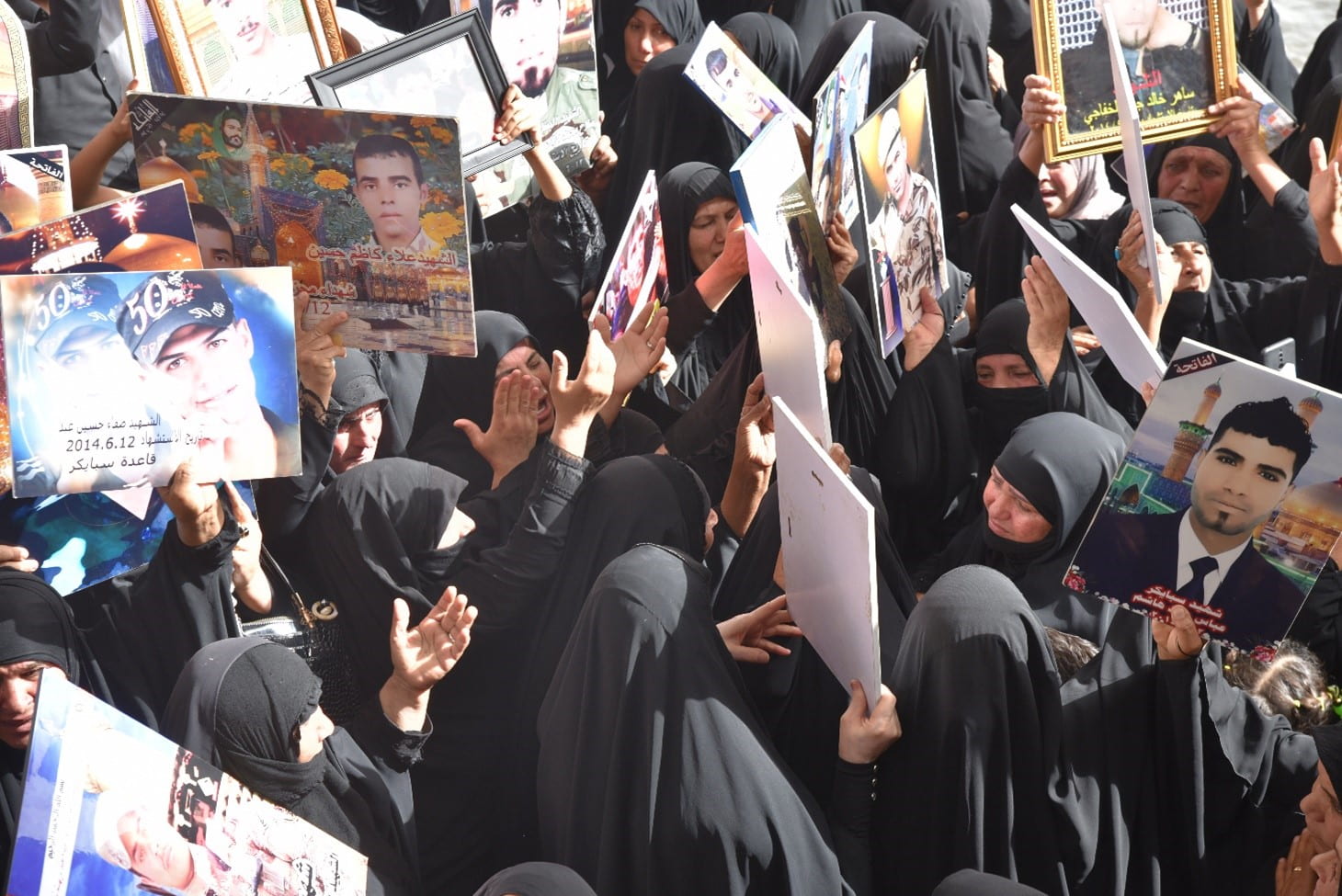
This is the not the first attempt to memorialise the Speicher massacres. Since 2014, families from different parts of Iraq would visit on every 12 June the former presidential palace compound. A monument that had been erected at the palace complex displays three mothers, one standing defiant and two wailing over a mass grave containing replicas of human skulls and bones strewn on the ground. In addition to recognition and remembrance, those now annual visitations serve group mourning. In the absence of any form Iraqi or foreign psychosocial support – particularly for victim’s children, wives and mothers– the gatherings have assumed a site for catharsis, even in a situation of an absence of justice for victims and where over 700 air cadet students are still missing.  

 A ‘Speicher Camp’ memorial at the former Tikrit Presidential Compound. Tikrit, Iraq.  

Other than families’ own ad hoc efforts to print and display photos of their children, up to the present moment, this was the only memorial to the camp Speicher atrocities in the country. Printing and raising a photo of their missing or deceased loved ones has been a common way families have sought recognition for those atrocities. Significantly, and as simple as this act is, it is perhaps one of the few ways those mostly impoverished and marginalised families can ask for a semblance of justice expressed through society-oriented remembering.  

Former Presidential Palace Compound, Tikrit. June 12th 2023. 

A woman whose son was killed by Daesh collapses at the Speicher Memorial site in Kut, Wasit. June 2023. 

On a recent visit to the former presidential palace, Victims of Camp Speicher, a registered Iraqi non-governmental organisation made up of family members whose sons were killed, discovered an unidentified human skull lying in a heap of earth next to a staircase. Human remains continue to pop out of the ground on the site as a result of rain and wind. The Victims of Camp Speicher Organisation is Iraq’s only non-governmental organisation working to document what happened. It is made up of members of families of those killed by DAESH. Abu Ahmed, the director of the Baghdad office, retrieved his son’s body from one of the mass graves in the Tikrit Presidential compound.  

Photo from Sadiq Mahdi at the former presidential palace, Tikrit. 2023.  

Many identified mass graves have not been excavated and those that have been opened lie without any labelling or proper, professional or even basic demarcation, a sign of the dysfunctional nature of the management of this case. Indeed, anyone visiting the site could easily be walking over a mass grave without knowing it. The presence of unidentified human remains and absence of informational panels or professional management of mass graves is symptomatic of the wider neglect victims and their families continue to endure.  

A mass grave at the former Presidential Palace Compound. Tikrit, Iraq. 2023.  Photo: Sadiq Mahdi. 


The absence of professional and organised documentation is indicative of forgetting of the ‘Camp Speicher’ atrocities. Similarly, US-European governments and their funding agencies and organisations in Iraq have up to recently shown little interest in the case. Their interest has focused instead on one section of Iraqi society, namely the plight of Iraq’s Yezidis. US-European funding has imposed and reinforced on Iraq a ‘hierarchy of suffering’ where some groups or sections of Iraqi society are seemingly more worthy of support than others. 

Through a UN Security Council resolution in 2017, the United Nations Investigative Team to Promote Accountability for Crimes Committed by Da’esh/ISIL (UNITAD) was established. A year later, a director  was installed. UNITAD’s mandate is seemingly meant to serve the people of Iraq, namely through ‘collecting, preserving and storing evidence’ on the crimes of DAESH. In a recent discussion at the UN, the Iraqi Government has underlined its unwillingness to extend UNITAD’s mandate, with a closure date of September 2024.

A central reason cited by Iraq’s representative at the United Nations for this decision has been that UNITAD has shared information and data with European governments but not with the Government of Iraq, instigating questions about violations of Iraq’s sovereignty, ethics pertaining to how victim-related and also Government-obtained information is used and who it is shared with and more broadly issues of accountability.  

The year 2024 will mark ten years since those atrocities were enacted on the people of Iraq. It will be a time of reflection and hopefully an opportunity to better explore how memorialisation can assist its people in recovering or at least coming to terms with a traumatic recent past.

Ceramic Craft in the Babylon Province

By Zainab, on 30 November 2023

Written by Ammar Al-Taee

Ceramic is one of the oldest crafts in Mesopotamia, having its roots in the depths of prehistory, and it represents the extent of human profound harmony with earth, a versatile material that was formed by man for many uses. Ceramic was known in the Sumerian language as bakhar, synonymous of the Akkadian pakḫāru, which became fakhar in modern Iraqi accent. 

Four methods to produce ceramic have been listed so far in Iraq.

In the beginning, ceramists shaped clay using fingers to form the sides of the pots. In a second period, they used a different method, manufacturing separately the base, the sides, and neck of the pot, and then connecting them together.

The inhabitants of Mesopotamia used a third method for making pottery, proceeding by placing clay rolls in spirals one on top of another, until reaching the required height. These spirals were then further hydrated and pressed to obtain the desired shape. This method is still widely used in Iraq, especially in the local bread oven industry.

The fourth method implies the use of a wheel. Clay dough is placed on a disc turned by a wheel put in action by the artisan with his foot. The artisan uses then his hands to form the shape of the pottery. This method is the best one to produce pottery, in terms of speed and quality. The first traces of the pottery wheel were found in the city of Uruk, in the south of Mesopotamia:  a seal dating back to the fourth millennium BC contains scenes representing the fabrication of pottery. According to the cuneiform written texts, the owners of this profession used to operate in workshops in the cities.

At present, ceramists became very rare. The craft of pottery production, like other crafts traditional and techniques of the ancient cities of Mesopotamia, is in rapid decline.

The ceramist Aqeel Al-Kawaz in Borsippa, photo by Ahmed Hashim

Aqeel Al-Kawaz, a professional ceramist from Borsippa in the Babil province makes pottery for various uses in different shapes and colors. The clay he uses comes from different provinces in Iraq such as Kirkuk, Diyala, Najaf, Samawah and, of course, Babil. The reason for the variety of clay he uses is for artistic purposes, as some pottery pieces are preferably made from the soil of certain provinces. 

Some of the pottery that Aqeel is currently producing, is used to preserve food and water, but he focuses on the most requested pottery in the Iraqi market: ceramic drums. He also produces a kind of small coloured jug that symbolizes female and male kids. These are symbolically used in commemoration of the birth of the Prophet Zakariya, to keep evil away from children. 

The clay is prepared in advance, collected in tubs during the summer. He sometimes adds cow bones in the basins to increase the quality of the clay. Based on his experience, Aqeel believes that bones help to spread a type of bacteria, which makes the clay smoother and better workable. 

Although the craft of making pottery seems very easy to those who see Aqeel making an object in a few minutes and with a few swift movements, reaching this skill is difficult and requires long training and endless patience.

Ceramic drums, photo by Ammar Al-Taee

Nowadays Aqeel works alone in his modest workshop and fights to preserve the craft, as he is the only member of a family of artisans who kept the craft alive. Before I left his workshop together with Zainab, Nahrein Network’s media officer, he told us “I’m the last pottery maker in the Babil province, and my children refuse to work and even to learn this craft”. He is not optimistic about the future of the pottery profession, not only in the Babil province, but in all of Iraq.

Finally, one of the worst challenges the pottery craft is called to face, is that it is considered a symbol of poverty and primitiveness.

For all these reasons, there’s an urgent need to create training and education both to increase the numbers of professional artisans, to revive the countless crafts and skills necessary to maintain precious elements of the local heritage, and to sustain the still operating artisans with governmental support.

These actions together will also help to contain the threat represented by the introduction on the market of foreign pottery, which is sold at a much cheaper price. 

Pottery is an environmentally friendly material, it is easily renewable, opposite to plastic or metal cans that cause great pollution at global level. Drinking water from- or cooking with pottery is healthy and recommended. Moreover, pottery is a natural water-cooling tool used in the countryside in Iraq to reduce the impact of the summer heat, helping to overcome power outages occurring for many hours every day. 

Ceramist Aqeel Al-Kawaz in his Borsippa workshop, photo by Ahmed Hashim

Preserving traditional crafts in Iraq is a challenging effort that requires continuous support to create an environment that guarantees financial and social stability for artisans. Therefore, to ensure the survival of these memories and crafts, it is necessary to disseminate community awareness on the importance of preserving this heritage and increasing the numbers of pottery craftsmen.