X Close

Events

Home

UCL events news and reviews

Menu

Archive for the 'Medical Sciences' Category

The divestment debate: should UCL sell up?

By ucyow3c, on 8 April 2015

pencil-icon

Written by Brigid Marriott, Faculty Communications Officer, UCL Laws

As calls for fossil fuel divestment grow, universities across the world are being forced to consider the management of their endowments. Stanford, Glasgow and Sydney universities have already begun the process of full or partial divestment from fossil fuels.

Oxford has decided to defer its decision on the issue, while Harvard is preparing to fight a lawsuit – brought by its own students – to try to force the university to drop its direct investments in coal, oil and gas companies.

Fiddlers Ferry power station

Fiddlers Ferry power station, Cheshire (credit: Alan Godfrey)

On Tuesday 24 March, the Guardian newspaper published a letter from UN Climate Chief Christiana Figueres to her alma mater, Swarthmore College, calling on the college’s administration to decarbonise its investment portfolio.

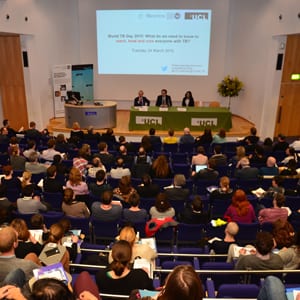
That same evening, six experts from across UCL gathered to debate whether the institution should do the same and sell off its £21 million investment in fossil fuel companies.
(more…)

Reducing tuberculosis in London and beyond: the woodpecker and weasel approach

By ucyow3c, on 27 March 2015

pencil-iconWritten by Catherine Smith, UCL Infection and Population Health PhD student

'What do we need to know to reach, treat, and cure everyone with TB?' eventMany people are surprised to learn that the problem of tuberculosis in London is so serious that it is now known as the ‘TB capital of Europe’. In the worst affected London Borough of Newham, more than one in every thousand people is diagnosed with the disease each year, and the trend is increasing.

I live in Islington, where the situation is not quite as severe. However, it is still alarming to note that the rate here is much closer to that of relatively high incidence countries, like Bosnia and Herzegovina and Brazil, than the USA or Sweden.

London is also a major hub for TB research. On 24 March, the 133rd anniversary of the discovery of the pathogen that causes the disease, researchers from UCL and the London School of Hygiene and Tropical Medicine jointly hosted an event that asked the question: What do we need to know to reach, treat, and cure everyone with TB? The event was attended by 270 people, and watched online by over 1,300 from 46 different countries via a live stream.

(more…)

SEVEN the play

By Siobhan Pipa, on 11 March 2015

Professor Peter Brocklehurst at SEVEN (Courtesy of Ben Sharman)

Professor Peter Brocklehurst at SEVEN
(Courtesy of Ben Sharman)

As part of a series of events to celebrate International Women’s Day at UCL, the UCL Institute for Women’s Health put on a special production of SEVEN – a documentary play based on the lives of seven inspirational women from seven countries around the world.

Presented as a reading, seven of the most senior men at UCL lent their voices to the female activists: Professor Michael Arthur (UCL President & Provost), Professor Sir John Tooke (Vice Provost, Health and Head of UCL School of Life & Medical Sciences), Professor David Lomas (Vice Provost-elect, Health and Dean of Medical Sciences), Professor Anthony Smith (Vice Provost, Education & Student Affairs), Professor Alejandro Madrigal (Pro Vice Provost for the America’s), Professor Peter Brocklehurst (Director, UCL Institute for Women’s Health) and Professor Anthony Costello (Pro Vice Provost for Africa & the Middle East and Director of the UCL Institute for Global Health).

The play, which was directed by Tove Eriksson and organised by Asma Ashraf and Professor Judith Stephenson (UCL Institute for Women’s Health), depicts how these women overcame extreme adversity to become leaders for women’s rights, both within their own society and globally.

(more…)

UCL Infection, Immunology and Inflammation Symposium 2014

By ucyow3c, on 2 December 2014

pencil-icon

Written by Yusuf Topal, first year PhD student

Discoveries in infection, immunology and inflammation (III) are defining 21st-century medicine, shifting the paradigm of almost every clinical discipline.

UCL-III-Symposium

This is reflected by the broad scope of research taking place at UCL, as showcased at this year’s UCL III Symposium, held at the UCL Institute of Child Health on 24 November.

The UCL III Theme is a large cross-disciplinary research community, which helps to facilitate interaction and collaboration across UCL and its partner hospitals and organisations.

The amalgamation of III scientists and clinicians across UCL have already unlocked some of the long kept secrets of diseases such as HIV, cancer, malaria, TB, asthma and arthritis. Such a collaborative culture also provides a rich platform for aspiring PhD students and postdoctoral scientists.

(more…)