X Close
Menu

The House of Commons row over opposition day amendments: procedural background and implications

By Rowan Hall, on 29 February 2024

Last week’s opposition day debate in the House of Commons about Gaza and Israel was overshadowed by a bitter procedural row over the Speaker’s selection of amendments. But the rules governing opposition days – and their role in allowing these arguments – are not straightforward. Tom Fleming discusses the procedural background and implications.

The background

Last week saw a House of Commons debate about a ceasefire in Gaza and Israel overshadowed by a bad-tempered row about the Speaker, Lindsay Hoyle, selecting an amendment from the Labour Party.

This debate came on an ‘opposition day’. There are 20 such days in each parliamentary session, when MPs can debate motions put forward by opposition parties rather than by the government. Of these, 17 are allocated to the largest opposition party in the Commons (currently Labour), and three to the next-largest, which is currently the Scottish National Party (SNP). Last Wednesday’s debate was on an SNP motion calling for ‘an immediate ceasefire in Gaza and Israel’.

Usually when the House debates motions, MPs can propose amendments to them in advance, and the Speaker selects which of those amendments will be debated. MPs then vote on the selected amendments before voting on the final motion (incorporating any successful amendments).

If this usual practice were followed on opposition days, it could mean opposition parties’ proposals regularly not getting voted on. This is because any government amendment is highly likely to pass, after which MPs would only be able to vote on the amended motion, not the original proposal. In acknowledgement of this, government amendments on opposition days are voted on after the main motion. In contrast, any non-government amendment selected would be voted on before the main motion. But it is a long-established convention that when a government amendment has been selected, no further amendments are chosen.

(more…)

The marginalisation of the House of Commons under Covid has been shocking; a year on, parliament’s role must urgently be restored

By Rowan Hall, on 21 April 2021

A year ago today, the House of Commons returned from Easter transformed by Covid. Since then, accountability for far-reaching government policy and spending has often been limited, many MPs have been excluded from key virtual proceedings, and whips now hold over 500 proxy votes. Meg Russell, Ruth Fox, Ronan Cormacain and Joe Tomlinson argue that the combined effect in terms of parliament’s marginalisation has been shocking, and that there are risks of government becoming too comfortable with decision-making which evades proper parliamentary scrutiny. One year on, more robust parliamentary accountability must urgently be restored.

A year ago today, the House of Commons returned to business transformed by Covid. Since March 2020, the public has lived under some of the UK’s most restrictive peacetime laws, and to support the economy public money has been spent on a vast scale. Yet parliamentary accountability for, and control over, these decisions has diminished to a degree that would have been unthinkable prior to the pandemic. One year on, with lockdown easing, the restoration of parliamentary control and functioning is now an urgent priority.

This post highlights five ways in which the government’s approach to the House of Commons during Covid has marginalised MPs. In a parliamentary democracy, government accountability to parliament is a core constitutional principle. But in a national emergency, when time for normal process is short, the gravity of the situation can require that parliamentary scrutiny be temporarily sacrificed in exchange for broader accountability. Yet the government has failed to keep its side of the bargain. Too frequently, announcements have been made at press conferences, or briefed privately to the media, rather than presented for democratic scrutiny and questioning by MPs. Ministers have sought extraordinary powers while consistently excluding both the House of Commons as a whole, and certain MPs, from participating in proper oversight.

In the early days of the pandemic necessity arguably justified this approach. But a year on, a real risk exists of damaging precedents being set. This is magnified by the fact that some recent developments have accelerated negative trends predating the pandemic. Unless MPs collectively take a stand against parliament’s continued marginalisation by ministers, what was once extraordinary risks becoming the norm.

(more…)

Five years of ‘EVEL’

By Rowan Hall, on 23 October 2020

In the wake of the devolution settlements of the Blair years, political pressure to answer the ‘West Lothian Question’ persisted. In 2015, the proposed answer was ‘English Votes for English Laws (or EVEL). Today, on its fifth anniversary, Daniel Gover and Michael Kenny assess how EVEL has worked, during one of the most volatile political periods in living memory.

On 23rd October 2015, the ‘English Votes for English Laws’ (or EVEL) procedures came into force in the House of Commons. Introduced by David Cameron in the aftermath of the Scottish independence referendum, these new rules were designed as an answer to the notorious ‘West Lothian Question’ – the late Tam Dalyell’s resonant enquiry about why Scottish, Welsh and Northern Irish MPs should continue to be able to vote on matters that only affected England after devolution, while MPs in England were not able to reciprocate in devolved areas.

When EVEL was introduced, the procedures were sharply criticised by opponents. For some, the reform would not only be logistically difficult to implement – likely to be ‘incomprehensible’ to MPs and the public alike – but would also threaten the UK’s constitutional makeup. In particular, it was argued that EVEL would establish ‘two classes of MP’ at Westminster, undermining the ability of non-English MPs to represent their constituents’ interests. Others, meanwhile, criticised the procedures as too tame, and falling short of providing adequate representation to England.

The five-year anniversary provides an opportune moment to review how this contentious reform has fared in practice. Yet the wider territorial politics of the UK have also undergone significant changes in the intervening period. The questions to which these complicated rules were a response have become ever more pressing, but whether EVEL can provide a sustainable response to the increasingly fraught question of English devolution is increasingly doubtful.

(more…)

Coronavirus and the hybrid parliament: how the government moved the Commons backwards on remote participation

By Rowan Hall, on 23 June 2020

49798136018_3a8ba80e48_c (1)

Image Credit: Return of the House of Commons rehearsal (CC BY 3.0) by UK Parliament

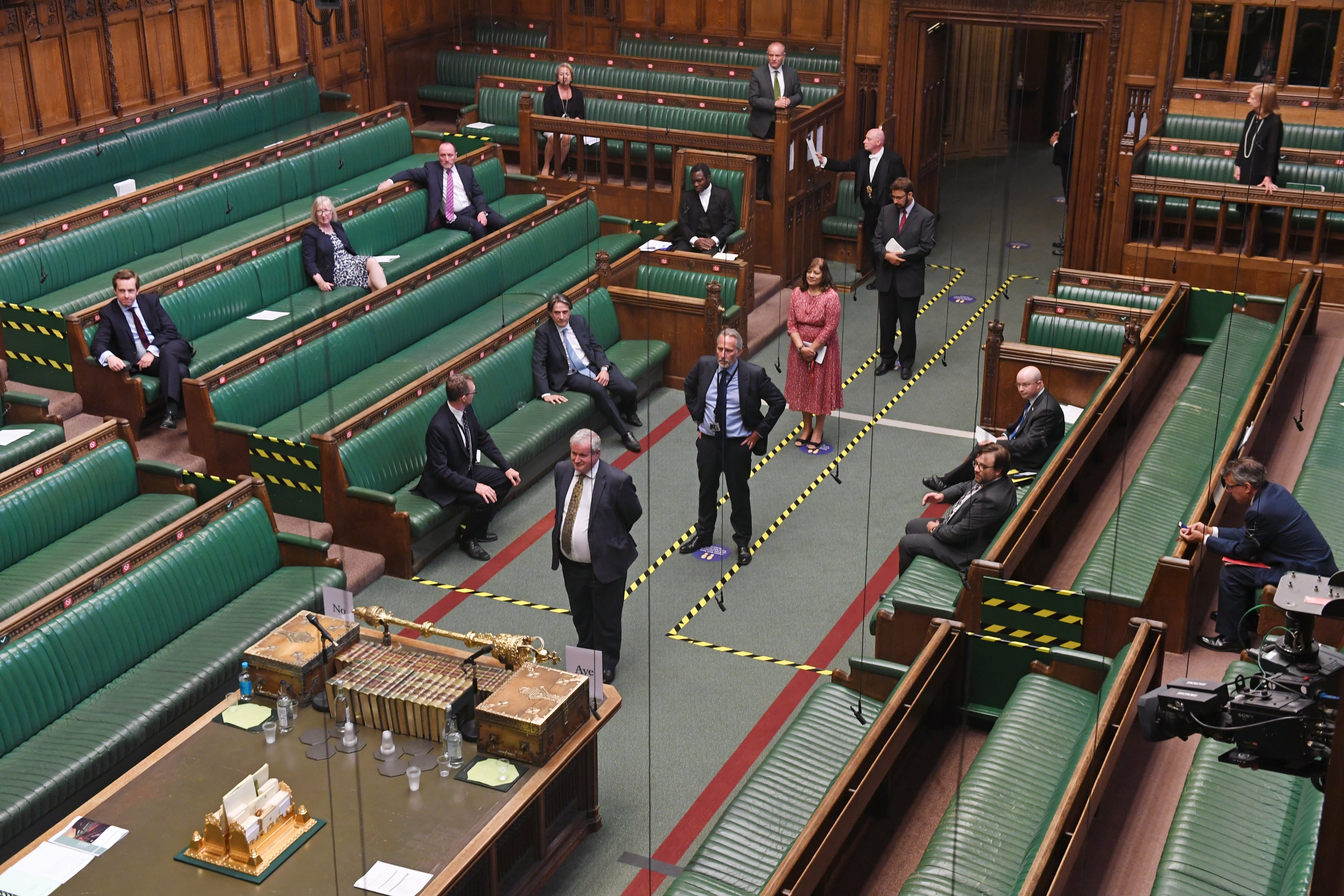
sir_david_natzler.smiling.cropped.3840x1920.jpgIn recent weeks, the government has taken the Commons from an acceptable hybrid system to the current confused regime of limited virtual participation and proxy voting. As David Natzler has outlined in previous posts, during the coronavirus lockdown the Commons moved with surprising speed and unity to create a hybrid parliament in which MPs could participate remotely, with the same speaking and voting rights as members present in the chamber. Here David outlines how the Commons moved so fast and so far backwards on virtual involvement for MPs. 

In this blog I intend to summarise the confusing developments in the past three weeks in the regime for doing parliamentary business in the House of Commons, and to analyse some of the reasons for the almost daily change of regime and the emergence of a new temporary hybrid regime. 

The first regime of virtual participation: 21 April to 20 May

On 21 and 22 April, on its return from the Easter recess, the House agreed to several government motions which established a temporary regime allowing for virtual participation by members in hybrid scrutiny and substantive proceedings, and for remote voting, to endure until 12 May. The regime was founded on a resolution of general principles also agreed on 21 April, including a requirement for parity of treatment between members participating virtually and those participating in person. Virtual select committee proceedings had already been established under a separate and longer-lasting order. On 12 May the House agreed to extend the debating and voting regimes until 20 May. 

Non-renewal of the regime

This regime operated successfully for the best part of a month, until the House rose on 20 May for the Whitsun recess, at which point the detailed operative Orders agreed on 21 and 22 April, but not the resolution setting out the founding principles, lapsed. It became known on 11 and 12 May through the government strategy statement and remarks by the Leader of the House, Jacob Rees-Mogg, that the government had no intention of renewing the regime of virtual participation, on the grounds that it was time for parliament to ‘get back to business’. But the government offered no opportunity over the next few days, before the House rose on 20 May, for the Commons to give its positive assent for letting the regime lapse. (more…)

Ending of the hybrid House of Commons breached fundamental democratic principles

By Rowan Hall, on 8 June 2020

Last week Leader of the House of Commons Jacob Rees-Mogg demanded the end of ‘hybrid’ arrangements allowing MPs to participate and vote remotely during the COVID-19 crisis. In this open letter, a group of senior democracy specialists point out this breached the fundamental democratic principle of equality in decision-making, because the MPs most benefiting from remote participation (e.g. due to ‘shielding’) were excluded from the vote. They urge the Leader of the House to reinstate procedures allowing all MPs to participate fully in all Commons business.

IMG_20200608_051657

MPs queue to vote on Tuesday. Parliamentary copyright images are reproduced with the permission of parliament.

Dear Mr Rees-Mogg

We write to express our very grave concerns about the way in which the ‘hybrid’ House of Commons was suspended. As specialists in the principles and practice of democracy it is clear to us that these actions breached fundamental democratic principles.

The ‘hybrid’ arrangements, allowing for a mix of virtual and in-person participation in parliamentary proceedings were brought about by necessity, to enable the House of Commons to continue to fulfil its essential functions of scrutiny and representation during the coronavirus crisis. Parliamentary accountability is crucial at any time, but more crucial than ever when ministers have taken unprecedented emergency powers, and the broadest possible public consent for health measures, and restrictions on citizens’ usual freedoms, is needed.

At the initial stages of the crisis there were troubling suggestions that parliament might close down completely for up to five months (as reported in The Times on 5 March). Thankfully, attention soon moved on from this drastic (and fundamentally anti-democratic) suggestion, to exploring how parliament could keep working through the crisis.

Parliamentary staff have worked tirelessly to devise innovative technological solutions to allow MPs to contribute virtually, and online select committee meetings began during the Easter recess. The Speaker, and the House of Commons Commission, offered admirable leadership, with essential additional input from the Procedure Committee. At the early stages there was a clear commitment to working on a cross-party basis to ensure that the Commons could continue to function in a way which maintained essential representation and accountability, while protecting public health. The motions on 21 and 22 April to enable members to participate and vote remotely were warmly supported by opposition parties and unanimously agreed. This consultative, cross-party approach was exactly what was needed when bringing about such far-reaching changes to the functioning of our democratic process. It showed inclusivity and maximised the chances of maintaining public trust and support.

The attempt to dismantle the hybrid arrangements has, unfortunately, followed the reverse approach. Through a lack of consultation and cross-party decision-making it has sown unnecessary division. Furthermore, it has breached the fundamental democratic and parliamentary principle of equality in decision-making, excluding many MPs from the choice about how to run their own institution. It has done so to the detriment of some of those who are most vulnerable in this crisis. (more…)