
X Close
Menu

Recall petitions: process, consequences, and potential reforms

By Rowan Hall, on 11 December 2023

A recall petition is currently open in Wellingborough, which could lead to MP Peter Bone being recalled by his constituents, followed by a by-election. This is the fifth such petition in as many years. Tom Fleming outlines how the UK’s recall system works, summarises its effects to date, and outlines possible areas for reform.

How do recall petitions work in the UK?

A system for ‘recalling’ MPs was first introduced in the UK by the Recall of MPs Act 2015, which came into force in March 2016. This legislation was introduced by the Conservative and Liberal Democrat coalition government, following commitments to some kind of recall procedure in both parties’ 2010 election manifestos.

In short, recall is a process by which voters are empowered to remove (i.e. ‘recall’) their MP prior to a general election if they are found to have committed certain types of serious wrongdoing.

Under section 1 of the 2015 Act, the recall process is triggered whenever an MP meets one of three conditions:

  • receiving a criminal conviction that leads to a custodial sentence (though sentences of more than a year already lead to disqualification from being an MP, under the Representation of the People Act 1981),
  • being suspended from the House of Commons for at least 10 sitting days (or two weeks) after a report from the Committee on Standards (or another committee with a similar remit), or
  • being convicted of making false or misleading expenses claims under the Parliamentary Standards Act 2009.

If any of these conditions is met, a recall petition is opened for six weeks in the affected MP’s constituency. If 10% of registered voters sign the petition by the deadline, the seat is declared vacant, and a by-election is held to elect a new MP (though the recalled MP remains free to stand again as a candidate). If the petition fails to reach the 10% threshold, no by-election is held and the MP retains their seat.

(more…)

Do the public really care about lying to parliament? Yes, they do

By Rowan Hall, on 17 June 2023

MPs must weigh up this weekend how to approach the debate – and possible vote – on the Privileges Committee report on Boris Johnson. Snap polls show the public mood to favour strong action. Alan Renwick draws on Constitution Unit research showing that this desire for honesty in politics is deep and enduring. People want a robust standards system, in which lying to parliament is punished.

Snap polling conducted in the wake of this week’s Commons Privileges Committee report on Boris Johnson indicates that most people think the former Prime Minister did mislead parliament; they are far more likely to think that he was given a fair hearing than not and to believe that his punishment was too lenient rather than either too harsh or about right.

Such rapid polling always raises the question: are these views just a knee-jerk reaction, reflecting no deeper public sentiment? The answer is a simple ‘no’.

We at the Constitution Unit have carried out detailed investigations over the past two years into public attitudes towards the state of our democratic system. We conducted large-scale surveys in the summer of 2021 and again last summer. And we held a Citizens’ Assembly on Democracy in the UK over the final months of 2021. The first survey took place before partygate, while the second was in the field during Johnson’s final days in office, after he announced his resignation. The Citizens’ Assembly – which shows what a representative sample of the UK population thought about our democratic institutions after learning about the issues and discussing them over six weekends – reached its conclusions as the first partygate allegations were breaking, but before they peaked in early 2022. These sources thus provide a medium-term view on patterns of public thinking over the last two years, rather than being driven by this week’s events.

All the evidence shows that most people in the UK care a great deal about whether their elected representatives are honest. They think those who are not honest should be punished. They do not think it should be left to voters to use the one ballot they get to cast every four or five years to serve up this punishment. They want parliament to act against wrong-doing. If parliament fails to uphold the rules, they think matters may need to be taken out of MPs’ hands.

(more…)

Constitutional plans and pledges in the 2019 election manifestos

By Rowan Hall, on 5 December 2019

stephen.jpgIMG_6487.jpgimage1.000.jpgIMG.20191203.WA0004.jpgWith just two weeks until polling day, the major parties have all published their manifestos: we now know their stated plans for the constitution. Stephen Mitchell, Elspeth NicholsonHarrison Shaylor and Alex Walker examine what each party has to say about constitutional reform of the UK’s institutions, altering the devolution settlement and developing a written constitution.

This election sees a series of radical proposals for constitutional reform from all the political parties. You would not glean this from the introduction to most of the manifestos, or the table of contents; the parties are keenly aware that most voters are not interested in constitutional reform. So we have had to dig deep to extract the key constitutional pledges from the manifestos. We start with their high level plans for a constitutional convention and a written constitution, before discussing devolution and the Union, electoral reform and parliamentary reform. We have not included their plans for Brexit, because these are well known; but Brexit will obviously be a significant – if not the biggest – constitutional change, with major knock-on effects elsewhere. Nor have we included the parties from Northern Ireland, in the interests of space: this analysis is confined to the parties standing for election in Great Britain.

Democratic innovation

A number of political parties have promised citizen-led democratic initiatives in their manifestos, particularly on constitutional questions. Several parties want to develop a written constitution via this participatory route, and some have also promised citizen involvement on other questions, such as climate change.

Labour have set out their plan for a ‘UK-wide Constitutional Convention, led by a citizens’ assembly’. The scope of the proposed convention is broad – considering the renewal of parliament, how power is distributed and the relationship between the nations and regions of the UK. The convention will also consider the Welsh Government’s 20-point devolution plan, published in October.

The Conservatives agree that ‘proposals to restore trust in our institutions and in how our democracy operates’ are needed. However, they stop short of a citizens’ convention, opting instead for a ‘Constitution, Democracy and Rights Commission’ to be set up in their first year. One of the Commission’s key stated tasks will be to ‘update the Human Rights Act and administrative law to ensure there is a proper balance between the rights of individuals, our vital national security and effective government’; and ‘ensure that judicial review… is not abused to conduct politics by another means or to create needless delays’.

The Liberal Democrats and the Brexit Party both mention a written constitution and set out measures for greater citizen involvement. The Liberal Democrats promise a written federal constitution that enshrines home rule and makes permanent the Scottish Parliament and National Assembly for Wales. They also plan to introduce a range of citizens’ assemblies at both local and national level on ‘the greatest challenges we face’, including climate change and the state’s use of artificial intelligence. (more…)

175 not out: the new edition of Erskine May and eight years of constitutional change

By Rowan Hall, on 2 July 2019

sir_david_natzler.smiling.cropped.3840x1920.jpgIn March, Sir David Natzler retired as Clerk of the Commons after over 40 years in the House. Now, he is the co-editor of Erskine May, the 25th edition of which is the first new edition in eight years, and is freely available to the public: a significant change. Here, Sir David discusses some of the key changes to the text after what can only be described as an eventful eight years for the Commons. 

The years since the last edition of Erskine May in 2011 have been pretty turbulent by any standards. We have had three types – coalition, majority and minority – of government, two general elections, three national referendums and numerous constitutional statutes of real significance. So it was plainly time for a new edition of this timeless work, which is often referred to but rarely read.

The new Erskine May is exciting to me because, as its co-editor, I had the happy task of reading through the chapters as they emerged from the efforts of many of my former colleagues. We all had to ask ourselves: is this a clear and honest account of parliamentary procedure and practice, and if not, how far can we go in recasting it? It is not a new book; but nor is it merely a historical text with minor amendments for the benefit of a modern audience. New content has been added, but nothing has been asserted without due authority, and we also recognise that some assertions of the past are too precious to be excised. Paragraph 21.4 on the rule against reading of speeches is as good an example as any: the principle remains valued by some MPs but it would be idle to pretend that it is rigorously observed in practice. There has to be some wishful thinking.

Who is this edition of Erskine May for? Plainly for practitioners, meaning the occupants of the Chair (such as the Speaker and Deputy Speakers), those who advise them, MPs and officials. But it is not just for them. Recent controversy over decisions by the Speaker on procedural issues related to Brexit and threats of early or extended prorogation by some candidates for leadership of the Conservative Party have served to remind all of us that parliamentary procedures are not some sort of secret masonic ritual to be understood only by a priestly caste of clerks and a handful of others, but are as integral to a parliamentary democracy as electoral rules. And it is not just for Westminster: one of my great pleasures as Clerk was to receive emails from colleagues around the Commonwealth seeking elucidation of a procedural – and usually political – issue where their knowledge of what was said in Erskine May was far in advance of my own!

Fortunately this edition has been preceded by two very different works which help set it in context. In 2018 the Commons authorities published a Guide to Procedure which is intended to help those involved in its day to day work, set out in plain English. It is of course available online. And secondly, at the end of 2017 Hart Publishing produced a book of essays – edited by current Clerk of Committees Paul Evans, entitled Essays on the History of Parliamentary Procedure: In Honour of Thomas Erskine May, to mark the great man’s 200th birthday in 2015. (more…)

This time it’s a crisis: results from the 2019 Audit of Political Engagement

By Rowan Hall, on 2 May 2019

profile.pic.jpgEach year, the Hansard Society conducts an Audit of Political Engagement, which seeks to measure how the public views and engages with the political process. The latest Audit demonstrates that public dissatisfaction with our political systems and actors is worryingly high and increasingly intense. However, as Lawrence McKay explains, disaffection has not yet translated into disengagement.
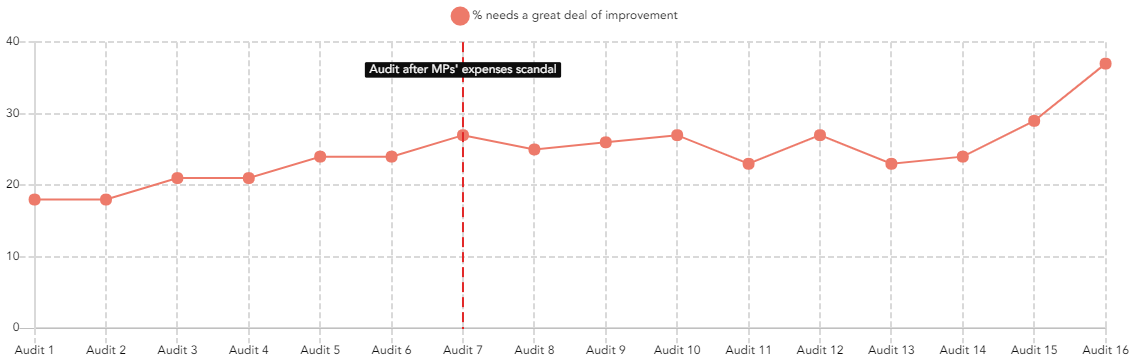
The Hansard Society’s Audit of Political Engagement, now in its sixteenth year, is an annual study, giving a benchmark to measure public opinion about politics and the political system, as well as how engaged people are in the process. The Society describes it as an ‘annual health check’ – and this time round, the patient is in a bad way. Commentators love to declare a crisis, and the Society has often cautioned against such framing. More often than not, there is more continuity than change. Yet this year’s findings can hardly be described any other way.  

Opinions of the system of governing are at their lowest point in the 15-year Audit series – worse now than in the aftermath of the MPs’ expenses scandal. People are pessimistic about the country’s problems, and large segments of the public seem willing to entertain radical changes which would alter or even undermine our democracy. While they are no less engaged in the democratic process, many people increasingly want to keep their distance and not to take part in decision-making.

Discontent: more widespread and more intense

The striking thing about this year’s Audit is that not only are more people unhappy, but the intensity of their discontent is unprecedented.  Our ‘core indicators’ are the best evidence that something is amiss – in particular, our question on ‘the present system of governing Britain’, and how much it could be improved. We find that discontent is at its historical peak, with more than seven-in-ten feeling it needs either ‘quite a lot’ or ‘a great deal’ of improvement. Furthermore, people are moving into the most negative category. The proportion who stated that it needs ‘a great deal’ of improvement, at 37%, has roughly doubled since the first Audit in 2004. This increased discontent is broad-based, occurring across all social classes, age groups and levels of education. If there is a common thread to where it occurs, it is among non-voters where discontent has risen most. It may be that people who are already disengaged are finding more reasons to hate politics, but many voters are, too.

system discontent audit diff graph (1)


Yet, while the wider system is held in contempt, it is mostly political actors that bear the brunt of this. We asked our respondents to give their level of confidence in different groups ‘to act in the best interests of the public’. Groups like civil servants and judges generally garnered positive ratings, but the government, MPs, Lords and political parties were judged more negatively, with around two-in-three expressing low or no confidence. The exception – in line with results of previous studies – was local councils and the Scottish government who were seen somewhat more positively than UK-wide actors. (more…)