
X Close
Menu

Monitor 75: The constitution under COVID-19

By Rowan Hall, on 7 July 2020

meg_russell_2000x2500.jpgalan.jfif (1)Monitor 75, the latest edition of the Unit’s regular news update on constitutional issues, was published this morning. Since the last edition in March, what had once been the defining issue of this political generation — Brexit — has been almost entirely subsumed by an even larger crisis: COVID-19. A new and inexperienced government has found itself temporarily without its Prime Minister, announced the departure of the Cabinet Secretary, and encountered significant dissension from the backbenches on more than one occasion. Tensions within the Union have been thrown into stark relief  by the increasingly different courses pursued by its constituent nations. As for the state of democracy, parliament has trialled numerous methods of operation, passing laws and changing how it regulates itself in multiple ways, whilst elections have been put on hold and organisations involved in deliberative democracy have struggled to continue their work. Meg Russell and Alan Renwick discuss the key events and themes of  the past four months, and also reflect briefly on the Unit’s history as it celebrates its 25th anniversary. 

As the last issue of Monitor went to press in early March the idea that COVID-19 might change everything was  only just dawning. In the subsequent four months, its impact on politics as well as daily life has been transformational. Just as the UK hoped to exit one torrid period of politics dominated by a single issue, a new, still bigger challenge eclipsed it. Brexit has barely featured in the past few months’ political news. Instead, Boris Johnson rapidly shifted from the Prime Minister who would ‘get Brexit done’ to the one who needed to steer the nation through a health crisis, and perhaps in due course through an economic crisis as well.

COVID-19 has touched almost every aspect of how politics is done, and raised new questions about the functioning of some aspects of the UK constitution, as this issue of Monitor sets out. The Coronavirus Bill was rushed through both chambers of parliament – with consent from the devolved legislatures – in just six days in March, as the official ‘lockdown’ was just beginning. At the outset this barred most workplaces from opening and confined most people – except when undertaking limited activities – to their homes. The Prime Minister spoke to the nation in a televised address, and daily Downing Street press conferences involving ministers and (usually) government scientists became the norm, seven days per week. On 6 April Boris Johnson himself was hospitalised with the virus, leaving Foreign Secretary Dominic Raab to deputise (see page 12). Other key ministers and officials – notably including Johnson’s chief adviser Dominic Cummings – also fell ill.

At the start of the crisis there was widespread support for the government’s position, within the governing party, across the parties and among the devolved administrations. Public approval for the government’s handling was high, in what political scientists would see was typical of the ‘rally round the flag’ effect often found in national crises. But since that time, tensions have gradually grown. (more…)

The Parliamentary Constituencies Bill: no fewer MPs but a very different constituency map

By Rowan Hall, on 22 June 2020

Pontefract_Parliamentary_Borough_1832A new bill currently before parliament alters the rules governing the periodic redrawing of the UK’s parliamentary constituencies, most notably by replacing a requirement to limit the House of Commons to 600 MPs with a new fixed size, set at the current 650. But, as Ron Johnston, David Rossiter and Charles Pattie show, the new rules are just as likely as those they replace to result in major disruption to the constituency map at all future reviews. 
In 2011, the coalition government passed the Parliamentary Voting System and Constituencies Act, which changed the rules guiding how the UK’s parliamentary constituencies are drawn up. Boundary reviews were to take place every five years (more frequently than before). Almost all new seats (with four exceptions) were to have electorates within +/-5% of the national quota (the average electorate). And the House of Commons was to be reduced in size from 650 to 600 MPs. To date, the Boundary Commissions have conducted two redistricting exercises under the 2011 Act. Neither review has been implemented: the first was lost to infighting in the coalition, and the second was tabled in September 2018 but has not yet been approved by parliament. The proposed changes they contained would have produced the largest shake-up in Britain’s constituency map in modern times.

Now the redistricting rules look set to change again. The Parliamentary Constituencies Bill 2019-21, published on 20 May, is now moving through its Committee Stage in parliament. It retains the requirements that all constituencies (with four exceptions) should have an electorate within +/-5% of the national average, but changes the number of constituencies to 650 – the argument being that with Brexit there will be more work for MPs, and thus a need for more of them, than if we had remained a member of the EU. If the Bill is passed, the Boundary Commissions will be required to recommend a new set of 650 constituencies by 1 July 2023 – in time for the next general election, due in May 2024. Subsequent reviews will then take place on a slightly longer timetable than under the 2011 Act – every eight years. (more…)

Ending of the hybrid House of Commons breached fundamental democratic principles

By Rowan Hall, on 8 June 2020

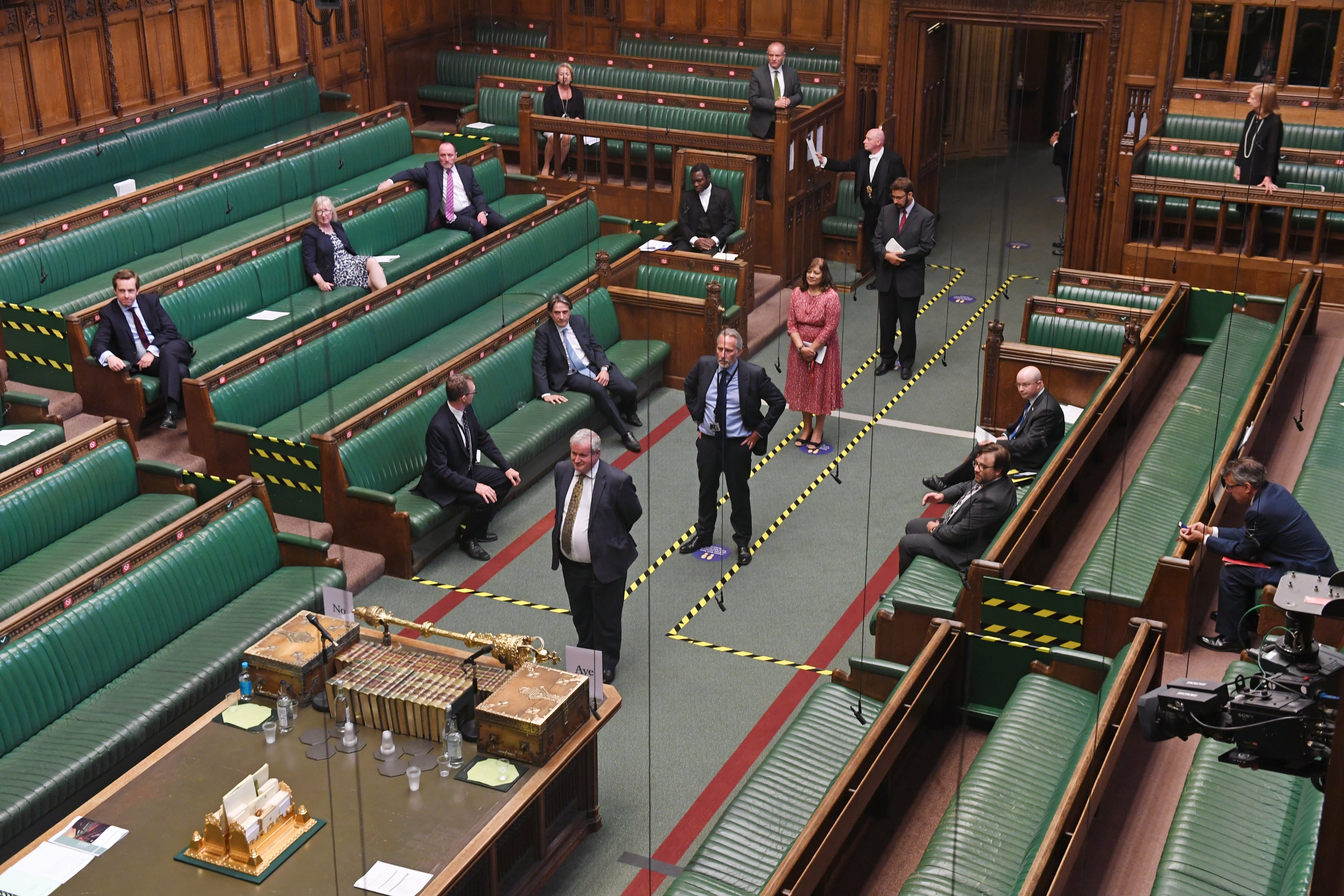
Last week Leader of the House of Commons Jacob Rees-Mogg demanded the end of ‘hybrid’ arrangements allowing MPs to participate and vote remotely during the COVID-19 crisis. In this open letter, a group of senior democracy specialists point out this breached the fundamental democratic principle of equality in decision-making, because the MPs most benefiting from remote participation (e.g. due to ‘shielding’) were excluded from the vote. They urge the Leader of the House to reinstate procedures allowing all MPs to participate fully in all Commons business.

IMG_20200608_051657

MPs queue to vote on Tuesday. Parliamentary copyright images are reproduced with the permission of parliament.

Dear Mr Rees-Mogg

We write to express our very grave concerns about the way in which the ‘hybrid’ House of Commons was suspended. As specialists in the principles and practice of democracy it is clear to us that these actions breached fundamental democratic principles.

The ‘hybrid’ arrangements, allowing for a mix of virtual and in-person participation in parliamentary proceedings were brought about by necessity, to enable the House of Commons to continue to fulfil its essential functions of scrutiny and representation during the coronavirus crisis. Parliamentary accountability is crucial at any time, but more crucial than ever when ministers have taken unprecedented emergency powers, and the broadest possible public consent for health measures, and restrictions on citizens’ usual freedoms, is needed.

At the initial stages of the crisis there were troubling suggestions that parliament might close down completely for up to five months (as reported in The Times on 5 March). Thankfully, attention soon moved on from this drastic (and fundamentally anti-democratic) suggestion, to exploring how parliament could keep working through the crisis.

Parliamentary staff have worked tirelessly to devise innovative technological solutions to allow MPs to contribute virtually, and online select committee meetings began during the Easter recess. The Speaker, and the House of Commons Commission, offered admirable leadership, with essential additional input from the Procedure Committee. At the early stages there was a clear commitment to working on a cross-party basis to ensure that the Commons could continue to function in a way which maintained essential representation and accountability, while protecting public health. The motions on 21 and 22 April to enable members to participate and vote remotely were warmly supported by opposition parties and unanimously agreed. This consultative, cross-party approach was exactly what was needed when bringing about such far-reaching changes to the functioning of our democratic process. It showed inclusivity and maximised the chances of maintaining public trust and support.

The attempt to dismantle the hybrid arrangements has, unfortunately, followed the reverse approach. Through a lack of consultation and cross-party decision-making it has sown unnecessary division. Furthermore, it has breached the fundamental democratic and parliamentary principle of equality in decision-making, excluding many MPs from the choice about how to run their own institution. It has done so to the detriment of some of those who are most vulnerable in this crisis. (more…)

The Parliamentary Constituencies Bill: how to ensure a level playing field

By Rowan Hall, on 5 June 2020

alan.jfif (1)professor_hazell_2000x2500_1.jpgLegislation now before parliament will reform how parliamentary constituencies are drawn up. Most controversial is a proposal that the recommendations of the independent boundary commissions should be implemented automatically. Alan Renwick and Robert Hazell argue that the principle of automatic implementation is right, but it should be combined with stronger safeguards on the commissions’ independence. 

The government’s Parliamentary Constituencies Bill was debated in the House of Commons for the first time earlier this week. The bill, if passed, will keep the number of MPs at 650, cancelling a cut to 600 that was legislated for in 2011 but has not yet been implemented. It will also alter the procedures for drawing up Westminster constituency boundaries, in four main ways. First, it will reduce the frequency with which boundaries are reviewed, from five- to eight-year intervals. Second, it will slightly shorten the duration of the next review (but only the next one), from 34 to 31 months, to ensure its conclusions can be implemented in good time for a 2024 election. Third, it will adjust the sequence of the review process, so that public hearings on proposed boundaries take place after an initial round of written submissions. Finally, and most importantly, it will make the implementation of new boundaries automatic: parliament will lose its current power to block the proposed changes.

Cancelling the cut in the number of MPs is no longer controversial. That reduction was introduced in 2011 in the wake of the MPs’ expenses scandal, when public scepticism about the value of MPs’ work was at a peak. It was designed to show that ministers understood people’s anger about perceived waste at the heart of politics. Since then, however, parliament has done much to reassert its value. MPs have become more independent-minded in holding government to account. Following reforms implemented in 2010 – some of which were strongly based in earlier Constitution Unit research – select committees have risen greatly in prominence, and are now widely seen as doing much important work. Furthermore, many constituents were discomfited when they saw that cutting the number of MPs would reduce their own local representation at Westminster. The cross-party support that exists for retaining 650 MPs is therefore welcome.

Some of the changes to review procedures have, however, proved more contentious. In particular, opposition parties have argued against the introduction of automatic review implementation. Speaking in the Commons on Tuesday, both the Shadow Minister for Voter Engagement, Cat Smith, and SNP Spokesperson David Linden called it ‘a power grab’ by the executive over the legislature. Labour’s Stephen Kinnock described it as ‘nothing short of a constitutional outrage’. (more…)