 Close
Close


Assessing the House of Commons Backbench Business Committee 15 years on
By Meg Russell and Hannah Kelly, on 19 November 2025

The House of Commons Backbench Business Committee was established in 2010, following recommendations from the ‘Wright Committee’ on reform of the Commons. At this 15-year point the committee is reviewing its operation, and in this post Meg Russell and Hannah Kelly summarise their submission to the review, which is due to be published shortly. They conclude that the Backbench Business Committee was an important innovation, but that changes are needed to get back to the Wright Committee’s vision of it helping facilitate a more responsive and independent House of Commons.
The House of Commons Backbench Business Committee was created in 2010 following reform proposals from the ‘Wright Committee’ (formally the Select Committee on Reform of the House of Commons). The Wright Committee deliberately sought to give MPs greater control over their own institution, removing some key powers from party (and in particular government) whips. Its recommendations to elect members and chairs of select committees were fully implemented; in contrast, proposed changes to who controls what is debated in the chamber were only partially so. The Backbench Business Committee was intended to sit alongside greater control by the chamber of all aspects of the Commons agenda (which MPs would approve weekly, following recommendations from a ‘House Business Committee’), but these other elements were never put into effect.
The Backbench Business Committee allocates debating time for issues proposed by backbench MPs, for a total of 35 full days per session, at least 27 of which must be taken in the Commons chamber (as set out in Standing Order no. 14). Debates in the main chamber can take place on ‘substantive’ motions, allowing MPs potentially to make policy decisions. The committee comprises eight backbench members (as set out in Standing Order no. 152J), and is currently chaired by Conservative MP Bob Blackman.
Fifteen years on from its creation, the committee is conducting a review of its own operation, whose conclusions will be reported soon. It is the first such review for 10 years. This post summarises a submission made by the authors to the review, and reflects in particular on how well the committee’s operation fulfils the Wright Committee’s original ambitions.
Two persistent issues stand out. First, backbench business has become confined primarily to slots on Thursdays, contrary to what the Wright Committee recommended. Second, and for connected reasons, it is being used relatively timidly, meaning it risks becoming a parliamentary ‘backwater’. The Wright Committee had envisioned something bolder.
The current review is therefore a test of how far the Commons is willing to reclaim the Wright Committee’s vision of a chamber that controls its own time, and where backbench voices meaningfully shape the agenda.
The early days of the Backbench Business Committee
The early operation of the Backbench Business Committee during the 2010–15 parliament demonstrated both its potential and its limitations. Two previous reviews were conducted in this period.
Backbench business was quickly used to stage high-profile debates, for example on the contaminated blood scandal, prisoner voting, and the Hillsborough disaster inquiry. A debate in 2011 calling for a referendum on EU membership saw the motion defeated, but exposed Conservative divisions, and helped drive David Cameron’s later commitment to a referendum.
The committee also facilitated decision making on Commons procedure. Between 2010 and 2015, 25 motions on procedure were debated, 12 of which had the effect of directly bringing about change. Outcomes included new rules on use of electronic devices in the chamber, revised sitting hours, and the creation of a select committee on Commons governance in response to discontent over senior appointments. Several of these proposals had come from the chamber’s Procedure Committee, in line with the Wright Committee’s ambition that backbench time should increase the opportunities for debating select committee reports, which too often languished on the shelf.
Initially, both the chair and members of the Backbench Business Committee were elected by the whole House, reflecting the Wright Committee’s wish that it should be accountable to all MPs. But in 2012, the government proposed a controversial change to the rules so that members were elected within party groups. This unilateral move, made while the Procedure Committee was reviewing backbench business, but was yet to report, provoked widespread criticism.
The Procedure Committee’s 2012 review concluded that the Backbench Business Committee had been a ‘successful and effective innovation’. But it noted that since Standing Order no. 14 sets out the number of backbench business days per session (as it also does for opposition days, and private members’ bills), demand for time had significantly exceeded supply in the long 2010-12 session. It therefore suggested that the number of backbench days should rise in proportion to session length. Although assurances were given by ministers that extra time would be granted in longer sessions, this did not always happen – at one point during the 2017-19 session, no backbench debates were held in the chamber for two months.
By 2015, the Backbench Business Committee’s own review reported that demand for time had stabilised, but another challenge had become pressing: the non-binding nature of backbench motions. Despite debates and votes, the government often failed to act on policy suggestions, frustrating MPs and the public. The Public Administration and Constitutional Affairs Committee (PACAC) subsequently highlighted a similar problem in relation to opposition days, and criticised ministers for undermining parliament by ignoring them. While this issue remains unresolved, the Commons still retains direct power to amend standing orders without government involvement.
The current state of backbench business and its problems
We compiled a comprehensive list of backbench business debates from 2010 to 2024, focusing on the 761 debates held in the Commons chamber, out of 1263 in total (the others having taken place in Westminster Hall). This feeds the analysis below.
Scheduling
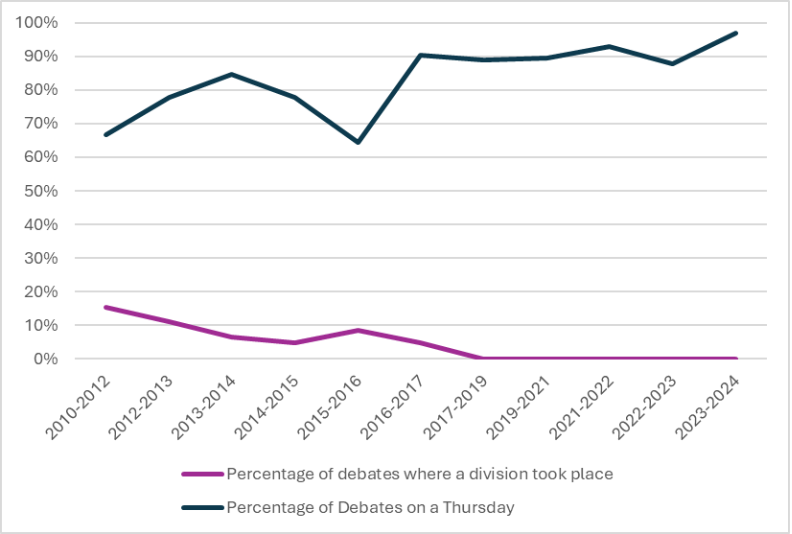
The Wright Committee had made very clear that it did not view Thursdays as a good option for scheduling of backbench business. It suggested that ‘Thursdays in the Chamber have lost status and are now increasingly used for unwhipped or only lightly whipped business’, and emphasised that it was ‘important that backbench business is not relegated to a backwater’. But our analysis (see Table 1 below) shows that backbench business has been overwhelmingly confined to Thursdays, with this trend intensifying over time. In the committee’s first parliamentary session (2010-12), two-thirds of chamber debates fell on Thursdays; but this had reached 97% by 2023–24 (when only one debate was held on any other day). This concentration has consequences: Thursdays continue to be poorly attended, as many MPs leave Westminster early to return to their constituencies, which significantly undermines participation.
Table 1: Backbench business debate days in the Commons chamber
| Session | Monday | Tuesday | Wednesday | Thursday | Total |
| 2010-2012 | 8 (11%) | 15 (21%) | 1 (1%) | 48 (67%) | 72 |
| 2012-2013 | 2 (4%) | 7 (13%) | 3 (6%) | 42 (78%) | 54 |
| 2013-2014 | 8 (10%) | 4 (5%) | 0 (0%) | 66 (85%) | 78 |
| 2014-2015 | 6 (10%) | 7 (11%) | 1 (2%) | 49 (78%) | 63 |
| 2015-2016 | 14 (24%) | 3 (5%) | 4 (7%) | 38 (64%) | 59 |
| 2016-2017 | 0 (0%) | 5 (8%) | 1 (2%) | 56 (90%) | 62 |
| 2017-2019 | 6 (4%) | 7 (5%) | 3 (2%) | 129 (89%) | 145 |
| 2019-2021 | 0(0%) | 3 (6%) | 2 (4%) | 43 (90%) | 48 |
| 2021-2022 | 1 (2%) | 3 (5%) | 0 (0%) | 52 (93%) | 56 |
| 2022-2023 | 3 (3%) | 5 (6%) | 3 (3%) | 79 (88%) | 90 |
| 2023-2024 | 1 (3%) | 0 (0%) | 0 (0%) | 33 (97%) | 34 |
Government control over the timetable means that it is whips that control the allocation, and the Backbench Business Committee has repeatedly called for time earlier in the week. It is this same control that creates problems in longer sessions.
As argued elsewhere, and in line with previous proposals both from the Procedure Committee and the Backbench Business Committee itself, a more even scheduling of slots throughout both the week and the parliament should be guaranteed. These decisions should, as far as possible, be taken out of government hands, and rights would ideally be specified in standing orders.
Substantiveness and topicality
The Wright Committee intended backbenchers to use substantive motions to test the will of the House and influence government action. Initially this ambition was realised: between 2010 and 2012, 63% of debates were held on substantive motions (Table 2). Since then, use has collapsed – falling below 30% after 2019, with only a modest recovery in 2023-24. Additionally, not a single division has taken place in backbench time since February 2017. These forms of decline closely mirror the growth in Thursday scheduling, which limits attendance and thereby discourages staging of votes (Figure 1). Meanwhile, there is fading expectation that government will act on motions even if they are passed. Consequently, backbench business increasingly resembles adjournment debates – a platform for airing views rather than shaping outcomes.
Table 2: Substantive motions and divisions in backbench time by session
| Session | No. of debates (chamber) | No. of substantive motions | % of motions which were substantive | No. of debates where a division took place | % of debates where a division took place |
| 2010-2012 | 72 | 45 | 63% | 11 | 15% |
| 2012-2013 | 54 | 26 | 48% | 6 | 11% |
| 2013-2014 | 78 | 24 | 31% | 5 | 6% |
| 2014-2015 | 63 | 29 | 46% | 3 | 5% |
| 2015-2016 | 59 | 39 | 66% | 5 | 8% |
| 2016-2017 | 62 | 34 | 55% | 3 | 5% |
| 2017-2019 | 145 | 66 | 46% | 0 | 0% |
| 2019-2021 | 48 | 14 | 29% | 0 | 0% |
| 2021-2022 | 56 | 15 | 27% | 0 | 0% |
| 2022-2023 | 90 | 21 | 23% | 0 | 0% |
| 2023-2024 | 34 | 13 | 38% | 0 | 0% |
Figure 1: Percentage of debates on Thursday, and where a division took place, over time
Another challenge lies in maintaining topicality. The Wright Committee expected the Backbench Business Committee to act as a sifting body, selecting the most pressing issues for debate. In practice, nearly all applications are now approved, and those speaking for the committee often hint that debates are effectively booked up months ahead; this risks reducing both the timeliness and impact of debates.
Caution in filtering debates may partly reflect the incomplete implementation of the Wright reforms. Because MPs cannot amend or vote on the weekly agenda, as the Wright Committee proposed, the Backbench Business Committee becomes a final gatekeeper, with no means for MPs to appeal its decisions. This lack of accountability to the whole chamber was exacerbated by the government’s sudden 2012 rule changes regarding how the committee’s members are elected. Meanwhile, government control of scheduling, and the fact that backbench time has on occasion been withheld, may raise concerns that ministers could block debates on more challenging topics.
Debates on changes to Commons procedure
As noted above, backbench business time was initially actively used to debate and implement procedural reforms, fulfilling an explicit vision by the Wright Committee that MPs should have greater control over Commons rules. Since then, however, this practice has sharply declined: only two debates on procedural matters have been held on substantive motions since 2015; the last was more than six years ago, in June 2019. This is despite clear opportunities for MPs to use backbench time to advance procedural change where the government withholds time for such debates. For example, proposals in a 2023-24 Procedure Committee report on scrutinising Lords ministers (prompted by David Cameron’s appointment as Foreign Secretary), were rejected by the government and never debated, even though the committee chair could have tabled a substantive motion in backbench time. Similar chances were missed on proposals by the Procedure Committee during the Covid pandemic, and previously on private members’ bill reform. A perception seems to have been re-established that such matters require government time, which is incorrect. However, the scheduling issues identified above clearly add to the problem.
Reviving the use of backbench business for procedural change would restore an important Wright Committee innovation. With many new MPs in the 2024 parliament eager for reform, it is important to remember this route; and the Backbench Business Committee should prioritise scheduling such debates if they are requested.
Conclusion
Fifteen years after its creation, the Backbench Business Committee remains one of the key legacies of the Wright Committee. Its establishment opened up the Commons agenda to debating substantive motions from backbench MPs, and provided a valuable forum for issues – including those raised by select committees – that might otherwise go unheard. Yet its potential has been steadily eroded by restrictive scheduling due to government control of time, and a cultural drift away from using substantive motions to test the will of the House – including on procedural matters where MPs themselves, rather than ministers, have the final word. Others have referred to its introduction as an ‘unfinished revolution’.
Reviving the Wright Committee’s original spirit will require both institutional and cultural change. Backbench time should be distributed more evenly across the week, and procedural matters should again be brought forward through backbench motions, especially when government time has been denied for such debates. The committee itself could adopt a more selective and topical approach to ensure that debates in backbench time are maximally relevant and impactful.
All of these things could potentially be achieved through behavioural change, given the political will, though a move away from Thursdays would require a change on the part of government. Entrenching a fairer distribution of backbench time throughout the session would require amending Standing Order no. 14, which itself specifies that backbench time cannot be used to do this (or to amend Standing Order no. 152J). But MPs could still use backbench time to express support for change, and press ministers to bring forward a motion in government time. Returning to the Wright Committee’s model of whole-House elections for Backbench Business Committee members would require a change to Standing Order no. 122D, which could be done in backbench time, but also likely to 152J, which could not.
Ultimately, it is for MPs to reassert the principle that parliament – not the executive – controls its own business. The Backbench Business Committee can still serve as the foundation for that renewal, but only if its purpose is actively defended and fully realised.
About the authors


Professor Meg Russell FBA is Director of the Constitution Unit. She served as principal specialist adviser to the Wright Committee, whose proposal for a Backbench Business Committee was strongly influenced by her own previous research.
Hannah Kelly is a Research Fellow at the Constitution Unit.
Image attribution: Contains Parliamentary information licensed under the Open Parliament Licence v3.0.
