 Close
Close


1/2 idea No. 26: Thatcher, PM, scientist
By Jon Agar, on 3 August 2021
(I am sharing my possible research ideas, see my tweet here. Most of them remain only 1/2 or 1/4 ideas, so if any of them seem particularly promising or interesting let me know @jon_agar or jonathan.agar@ucl.ac.uk!)
This one went from half an idea to a full idea to a full-scale research project which I finished!
You can read Science Policy under Thatcher, free and open access from UCL Press, here.
1/2 idea No. 25: Colin McClare
By Jon Agar, on 3 August 2021
(I am sharing my possible research ideas, see my tweet here. Most of them remain only 1/2 or 1/4 ideas, so if any of them seem particularly promising or interesting let me know @jon_agar or jonathan.agar@ucl.ac.uk!)
The Colin McClare story is extraordinary and tragic.
The bare bones can be gleaned from the biographical introduction to his archives at King’s College London:
McClare was born in 1937 and educated at Felsted School and Emmanuel College, Cambridge, where he read natural sciences, specialising in chemistry. He undertook research at Cambridge on the chemistry of free radicals in biology as a Medical Research Council student, 1958-1961, and on energy transfer in nucleic acids as a Beit Fellow, 1961-1963, and was awarded a PhD in 1962. He was Lecturer in Biophysics at King’s College, London, 1963-1977. From his growing interest in bioenergetics and the problems of muscle contraction he concluded that classical thermodynamics was inadequate for the description of biological processes, and that the application of the Second Law of Thermodynamics to biological machines required the introduction of time scales. His ideas were not generally accepted and although he wrote extensively on the subject his papers were not accepted for publication until four controversial papers appeared in the Journal of Theoretical Biology and Nature , 1971-1972. These generated a vigorous correspondence with scientists all over the world. McClare’s unorthodox views failed to gain the approval of established scientific opinion. He took his own life at the age of thirty-nine, 1977.
A sympathetic tribute to McClare, which gives some detail about the vicious scientific controversy that followed McClare’s publications of his ideas on the bioenergetics of proteins in muscles, has been written by Luca Turin, published in 2009. McClare, he tells us, had been ‘a hero to me since my student days’. (Turin, too, is a fascinating figure, a perfumer-scientist with radical theories of smell.) Turin regards McClare’s work as flawed but profound, and having opened further research avenues: ‘Thirty years later, we can see that McClare had got one fundamental thing right: vibrational energy can be stored and transmitted in proteins. Two other questions he asked remain complete enigmas: how are these excitations generated and how are they used at the receiving end?’
From a history of twentieth-century science perspective, there are several intriguing aspects of the case of Colin McClare.
First, McClare was not alone in the early 1970s to propose that fundamental laws in physics might need to be challenged. McClare questioned aspects of thermodynamics, while the electrical engineer Eric Laithwaite, for example, sparked outrage when he argued (including demonstrations in a televised lecture at the Royal Institution) that gyroscopes broke free from Newton’s laws of motion. I wonder if these radical, critical, anti-traditional views can be understood within the wider context of science in the long 1960s, which I have discussed here.
Second, there is the task of placing McClare into a broader history of biomedical, molecular-level scientific understandings of the body.
Third, as he waded deeper into controversy, McClare sought, and received, advice from Karl Popper. The philosopher had retired from the London School of Economics in 1969 but was still at the peak of his powers. McClare’s bold yet falsifiable knowledge claims were clearly of a kind that Popper would approve, and he did. Again, McClare was by no means the only scientist in post-war Britain to appeal for support from philosophers, especially Popper. Many of these scientists came from the field and life sciences, as Charlotte Sleigh has noted, wondering if there was an element of ‘physics envy’ at work. Neil Calver has argued that scientists’ embrace of Popper was a response to hostility during the Two Cultures debate – the boldness prized in hypothesis-making could be presented as culturally high status emblems of imagination and creativity.
So you might be wondering why I haven’t already written up this one.
A few years ago I went to King’s College archives and spent an excellent day amongst the McClare papers. I made copious notes. The notes I put in my bag, and the next day went to see my parents. While I was there, my parents’ car was broken into, and the thieves nicked my bag, notes and all. Disappointingly, the thieves have published nothing.
1/2 idea No. 24: Severn Barrage history
By Jon Agar, on 3 August 2021
(I am sharing my possible research ideas, see my tweet here. Most of them remain only 1/2 or 1/4 ideas, so if any of them seem particularly promising or interesting let me know @jon_agar or jonathan.agar@ucl.ac.uk!)
I have keen research interests in the intersections between history of technology and environmental history. I think the next step is to identify a rich case study. The Severn Barrage schemes – proposals to engineer the River Severn to draw on tidal power – have a long and complex history. Schemes have been proposed from the 19th to the 21st centuries, but have always been fiercely opposed on environmental, technical and other grounds.
I’ve just heard (thanks Marianna Dudley) about Alexander Portch‘s recent PhD thesis on the Severn Barrage projects, which sounds fantastic, and I am looking forward to reading it. Portch is part of a current major AHRC-funded environmental history project, The Power and the Water (PI Peter Coates). Great to see work in this area.
Probably means I am looking for a different case study…
1/2 idea No. 23: DSAC
By Jon Agar, on 2 August 2021
(I am sharing my possible research ideas, see my tweet here. Most of them remain only 1/2 or 1/4 ideas, so if any of them seem particularly promising or interesting let me know @jon_agar or jonathan.agar@ucl.ac.uk!)
Studying the history of defence research should not be laugh-out-loud funny.
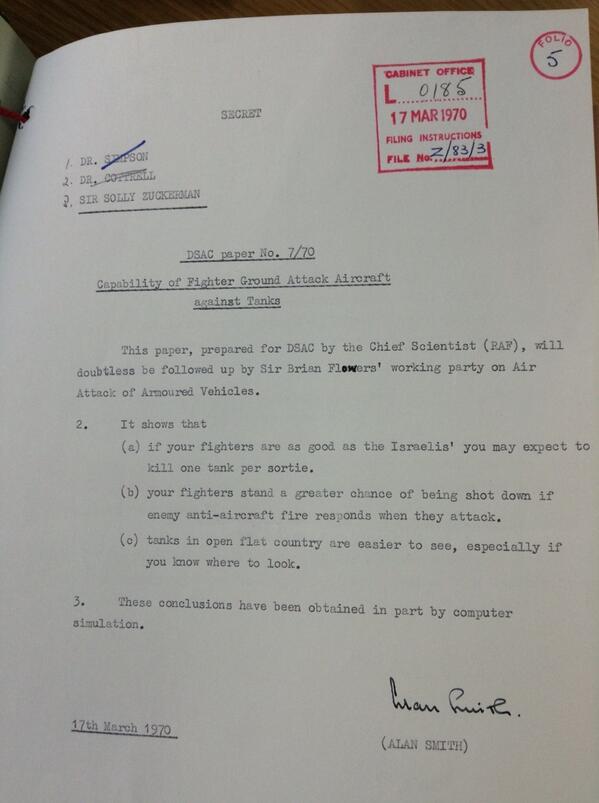
But here (pictured) is a civil servant in 1970 summarising a report on air capability against tanks for the Defence Scientific Advisory Council (DSAC):
“It shows that
(a) if your fighters are as good as the Israel’s you may expect to kill one tank per sortie.
(b) your fighters stand a greater chance of being shot down if enemy anti-aircraft fire responds when they attack.
(c) tanks in open flat country are easier to see, especially of you know where to look.
These conclusions have been obtained in part by computer simulation”.
Alan Smith, wrote this summary, and others, for his manager (Mr Simpson) and the two leading defence science advisers in the UK, Alan Cottrell and Solly Zuckerman, to warn them that a new and elaborate structure for channeling civilian scientific expertise into shaping defence research programmes was foundering.
The Defence Scientific Advisory Council had been established on April Fool’s Day, 1969. Composed ‘principally of scientists and technologists from outside the Ministry of Defence’, it was asked to provide advice, review ‘scientific and technological aspects of the Defence Research Programme’, advise on ‘long-term policy’ including ‘where appropriate… broader aspects of Defence Policy, advise on manpower, scope and balance, bring to attention relevant developments outside defence, and advise on specific issues on request’.[1]
Crucially it was not just a single panel, but sat atop a vast array of sub-committees, including but not limited to:
- Land Warfare Advisory Board
- Biological Research Advisory Board
- Air Warfare Advisory Board
- Maritime Warfare Advisory Board
- Civil Programme Advisory Committee
- Assessments Board
- Hull Committee
- Explosives Committee
- Equipment Planning Committee
- Military Engineering Committee
- Engineering Properties of Materials Committee
- Biology Committee
- Chemistry Committee
- Physics and Engineering Committee
- Weapons and Sensors Committee
- Vehicles Board: Fire Control Committee
- Ships Board
- Machinery Committee
- Applied Biology Committee
- Demolition Techniques Sub-Committee
- Computer Uses Sub-Committee
- Ballistics and Fire Control Committee
- Committee on Operational Research Methodology
- Materials Committee
- Mechanical and Electrical Engineering Committee
- Evaluation and Development Committee
- Committee on the Application of Computer Systems
Even allowing for some renaming over time, that is a considerable number. In 1970, Smith caustically reported that
1. DSAC has bred more boards and sub-boards than anyone can keep track of.
2. Most of these are yapping around the periphery of the MOD without coming to grips with real issues.
3. Some of them are still getting in one another’s way.
Another DSAC meeting was described by Smith as
rambling and inconclusive … in the course of which they raised several thorny and some potentially seditious questions, most of which concern subjects outside their terms of reference … If the Minutes are to be believed, this meeting was in the nature of a collective confessional, and about as constructive.
Yet I think DSAC deserves close historical scrutiny. Each of the committees, boards and sub-committees was filled with scientists most of whom otherwise worked in civilian science. The DSAC system probably represents the largest influx of civilian expertise into the UK defence research system since the Second World War. What did these experts bring, and what did they take away? How were military technologies and techniques shaped by these experts, if at all? Were there consequences for the development of civil science, in academia or industry? How does their work compare to, say, that of the JASONS in the US?
Furthermore the system lasted. Surely an advisory structure has hopeless as Smith portrayed would have been wound up quickly. But the DSAC system continued until 2016, and even then its function was merely reclassified, and was replaced by the similar-sounding Defence Science Expert Committee.
The concentration, and consequences, of British investment in defence research is often overlooked by historians, as David Edgerton has argued many times, not least in The Warfare State (2005). One reason among many for this amnesia is that the archives, born confidential, secret, or top secret, trickle into public view. Brian Balmer and I, when we examined the archives of the Defence Research Policy Committee, which operated from 1947 to 1963, found that commentators on science policy had repeatedly underestimated its significance largely because it had operated discretely and in secret. (I have also studied the DRPC’s successor body, the Defence Research Committee, DRC, up to the late 1960s, and confirmed the effect in a paper published in the collection, Scientific Governance in Britain, 1914-79, edited by Charlotte Sleigh and Don Leggett.)
If we want to understand the factors shaping military science in Britain, and the interdependencies between civil and defence research, then we need a historical account of the DSAC system.
[1] TNA DEFE 10/807. ‘Defence Scientific Advisory Council’, 2 April 1969.
1/2 idea No. 22: Do all public spheres have a science? Has entirely private science existed?
By Jon Agar, on 2 August 2021
(I am sharing my possible research ideas, see my tweet here. Most of them remain only 1/2 or 1/4 ideas, so if any of them seem particularly promising or interesting let me know @jon_agar or jonathan.agar@ucl.ac.uk!)
A couple of naïve questions, which can be answered with examples or counterexamples.
- Do all (modern?) public spheres have science?
- Have any entirely private scientists existed?
Science seems to be an inherently public process. Data can be gathered, experiments conducted, phenomena observed by isolated individuals. The conduct of more complex scientific procedures is usually the work of many, although such groups might remain private. But the validation of claims to scientific knowledge, the testing of claims by independent parties, and the incorporation of validated claims into a system of knowledge, held in common, all require not just multiple private persons but an opening into, and operation within, a public sphere.
The first question asks whether the overlap between public spheres and science is exact. If science is necessarily public, do all public spheres entail a science? Scholars of Indian Ocean have shown that there existed, prior to and outside of colonial networks, a vigorous global South-South public sphere. What kinds of science were implicated?
The second question might be in the category of things we don’t know we don’t know. Does, for example, anyone know of an example of someone working alone on their science in the twentieth century, who never tried, or was not able to, connect their science to public networks? What would their science be like? Would it indeed be science at all? It is possible to be an entirely private novellist, or an entirely private artist, but is it, categorically, possible to be an entirely private scientist?
The answer to the main question might be a group rather than an individual. So a second class of answers might be from private commercial science. (A third class might be from secret defence science.) Most commercial science is conducted mostly in private spaces, but is partly made public in minimised ways, such as through patent descriptions, or through the necessarily public connections required by metrological calibration. There are clearly degrees of privacy. But what would be the most extreme case? Has there ever been attempts to take science, so to speak, off grid?
1/2 idea No. 21: Journal/disciplinary genealogical map
By Jon Agar, on 2 August 2021
(I am sharing my possible research ideas, see my tweet here. Most of them remain only 1/2 or 1/4 ideas, so if any of them seem particularly promising or interesting let me know @jon_agar or jonathan.agar@ucl.ac.uk!)
We’ve all seen family trees, whether they be ones linking grandparents to grandchildren, or the various ways, especially after Darwin, the relationships between organisms have been pictured.
Scientific disciplines and specialties have something of a genealogical structure. Chemistry begets organic chemistry. Physics begets nuclear physics. Of course the topology of the genealogy of disciplines is not a simple tree. There are mergers of branches, for example, such as astrophysics or molecular biology. Furthermore, before roughly 1800, the map of knowledge looked radically different, with major divisions of natural philosophy and natural history as Diderot and d’Alembert’s famous Système figuré des Connaissances humaines from the Prospectus de l’Encyclopédie (1750) illustrates well. Foucault, Kuhn, and others, told us there were discontinuities or breaks. But modern science dates from the replacement of natural philosophy and is marked by the continuity, as institutions, of modern scientific disciplines.
The development of modern science can therefore be represented in something like a stable image.
Raphaël Sandoz’s wonderful resource, the Interactive Historical Atlas of the Disciplines, collects together many attempts to visualise the relations between the branches of science. Many are tree-like, but others are rings, spheres, triangles, flow-charts, and other shapes. Each was a medium for a message about how disciplinary knowledge does or should connect.
My simple thought is that the names and duration of existence of journals should provide the data for generating an image.
The Annalen der Physik has been published, albeit under a variety of names, and including relaunches, from 1790 to the present. As more physics journals appeared so the branch can be thickened. As specialties are defined, so new branches appear and are added to the picture. The process is repeated for all journals. But how are they found?
In the nineteenth century the Royal Society, faced by the alarming Babel-like proliferation of scientific papers and journals, each with its own specialist terminologies, sought to rein in the chaos by (near) complete bibliographic listing, resulting in the Royal Society Catalogue of Scientific Papers, 1800–63, volume I (1867). The project continued into the 20th century, when, as Hannah Gay has shown, it overwhelmed the hundreds compiling it. Nevertheless, such compilations, as well as 20th-century scientometrics, can be scraped for the data.
I’ve seen maps of science now – pretty constellations of clustered coloured dots. But I have not seen an attempt to give such automated pictures of science a dimension of time.
I’m sure it can be done. And I am curious to see what the result looks like. I don’t have the coding skills to do it myself.
I’ve sketched what I think they might, roughly, look like.


1/2 idea No. 20: Post-apocalypse historiography: Historiographical experiment #1
By Jon Agar, on 2 August 2021
(I am sharing my possible research ideas, see my tweet here. Most of them remain only 1/2 or 1/4 ideas, so if any of them seem particularly promising or interesting let me know @jon_agar or jonathan.agar@ucl.ac.uk!)
This is another of those primary source restriction experiments to see what history results if constraints are placed on availability of evidence.
One of my favourite sub-genres of science fiction is the post-apocalyptic, in which our protagonists usually retain some elements of a devastated culture, even if the full meaning or knowledge of that culture has decayed and changed. Examples include Russell Hoban’s Riddley Walker (1980), in which the inhabitants roam an irradiated South-east England full of wild dogs and hostile tribes and speak a language evolved form Kentish dialect. Or Kate Wilhelm’s Where Late the Sweet Birds Sang (1976), in which clones set out to recover technological culture from ruined cities.
And within this sub-genre are worked examples of what can and cannot be learned from surviving primary sources. In Walter M. Miller, Jr’s A Canticle for Leibowitz (1959), nuclear war, followed by ‘simplification’ (a backlash against learning) has destroyed written sources. An order of monks begins the path back to civilisation and technological progress, and are challenged to interpret the relics of the order’s founder, including what appears to be shopping list discovered in a bunker. Published almost simultaneously with Miller’s novel, but on the other side of the Iron Curtain, Stanislaw Lem’s Memoirs Found in a Bathtub (1961) has protagonists interpreting the sole ancient surviving texts of our time, preserved by accident under a lava-encased upturned bath. They deduce that ‘Ammer-Ka’ had a deity called ‘Cap-i-Taal’. It’s not Lem’s most subtle work, at least in translation.
These are historiographical experiments we can try ourselves.
What can be learned from a single primary source, or small set of surviving sources?
We have to agree rules to this game. We can decide whether:
- we retain the understanding of the language(s) of the source(s)
- we retain memories or knowledge of the history of entities mentioned
- whether we have a single source, a set of connected sources, or a set of disparate sources
- whether we are allowed to refer to other contemporary or older sources
The situation in which we have a set of sources but little or no understanding of the language would be a tough constraint indeed (although it is precisely the circumstance that, say, scholars of Pictish stones find themselves).
A reasonable set of rules would be 1. we retain the language 2. we refrain as far as possible from using memory or knowledge of entities mentioned. 3. we start with a single source, or small set of primary sources 4. we are not allowed to refer to other contemporary or older sources.
I have made one, small attempt at this experiment.
In the National Archives there are documents that have been preserved only as ‘Specimens of Classes of Documents Destroyed’. Such documents are attractive subjects for this experiment: they have already been through a destructive process and, quite contingently on an individual basis, survived. They are relics of a mundane, bureaucratic apocalypse.
Here is one such document. It comes from TNA LAB 900/1. If this was our only surviving primary source, if we found it under a post-apocalyptic bathtub or in a nuclear bunker, what history would we reconstruct?
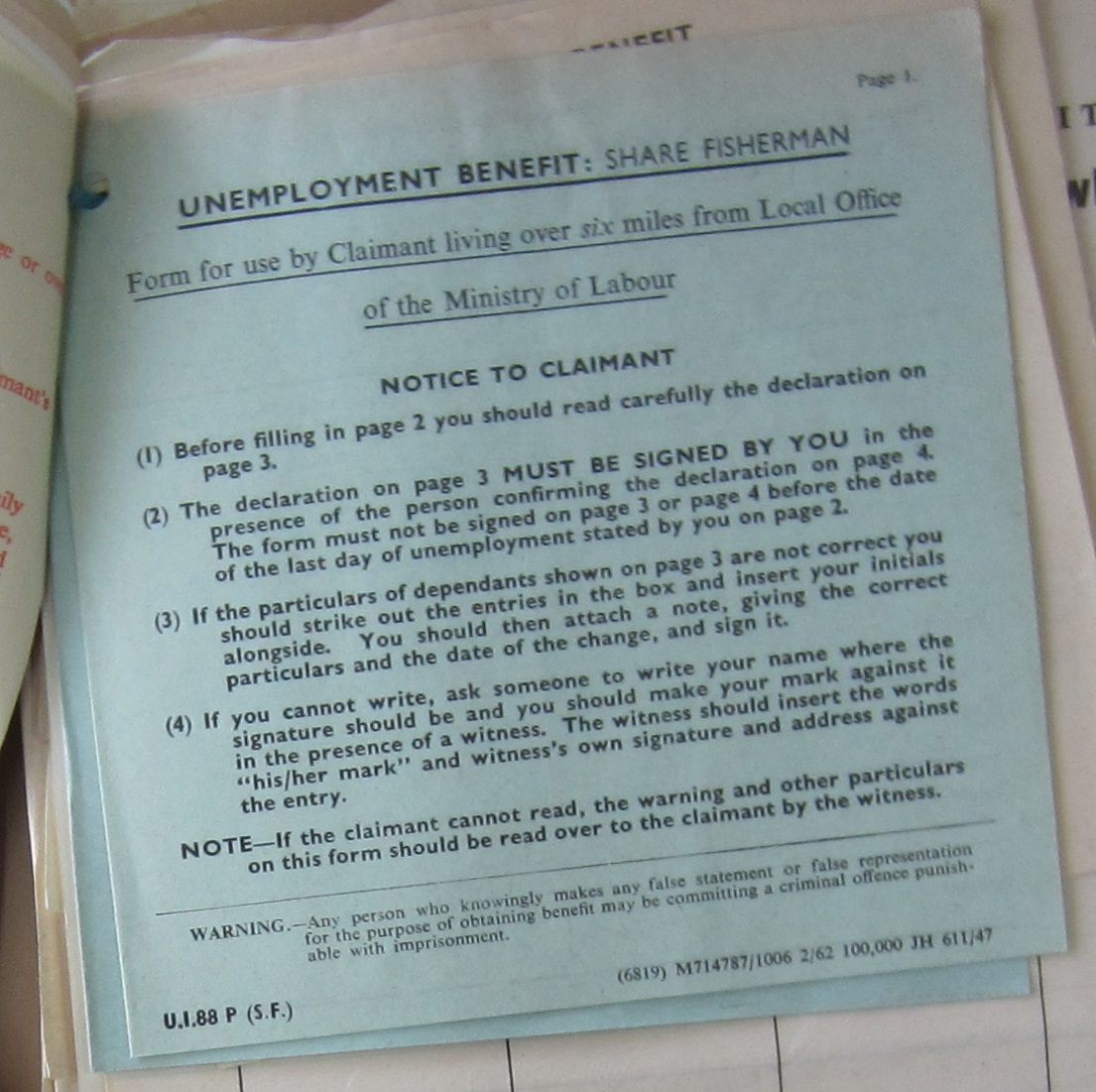
We have no reliable guide to a date. We can clearly see that this document was the product of a highly bureaucratic society (although we are also well aware of a bias shaping what gets written down). We can deduce at least two roles: a ‘claimant’ and an entity, a ‘Ministry of Labour’ (perhaps some religious institution?) that demands information from the ‘claimant’. Furthermore the claimant appears to take the role of ‘share fisherman’, from which we can speculate that the regulation of oceanic sources of nutrition must have been significant. The society, perhaps one divided between ministers and fishermen, was also only partially a literate one. The Ministry demands a ‘sign’, which may also be of religious significance, but which can be substituted by a mere mark. There must be some hierarchical organisation because those who make a mark have to be accompanied by betters, ‘witnesses’. The Ministry also possessed the power of punishment, a sign of an unequal society in which the application of violence was perhaps commonplace. Finally we can deduce that the underclass of fishermen possessed some kinship or social structure, as the tantalising but brief mention of ‘dependants’ reveals. In conclusion the document may have had some ritualistic significance.
1/2 idea No. 19: History of UK through elements
By Jon Agar, on 30 July 2021
(I am sharing my possible research ideas, see my tweet here. Most of them remain only 1/2 or 1/4 ideas, so if any of them seem particularly promising or interesting let me know @jon_agar or jonathan.agar@ucl.ac.uk!)
Book proposal: a history of the UK, but each chapter is a different element
Follow each element through the land, its cycles and processes, both natural and technological.
Carbon – the fattest chapter. Coal. Organic chemistry. The Industrial Revolution. Climate change.
Nitrogen. Fertiliser and air.
Beryllium. Aero-engines and defence research.
Uranium. Calder Hall. Windscale. Dungeness.
Gold. The Bank of England. Teeth.
Flourine. More teeth.
Calcium. Chalk. Cheese.
Neon. The city at night.
Iron. The Forest of Dean. Magnets. Ironbridge. Steel. Irn-bru.
1/2 idea No. 18: 1968 IMF/government computing breakdown
By Jon Agar, on 30 July 2021
(I am sharing my possible research ideas, see my tweet here. Most of them remain only 1/2 or 1/4 ideas, so if any of them seem particularly promising or interesting let me know @jon_agar or jonathan.agar@ucl.ac.uk!)
The late 1960s in the UK witnessed intensely choppy economic waters. In November 1967, following crises in sterling, the Labour Prime Minister Harold Wilson devalued the pound. Four visits from by the International Monetary Fund were scheduled in 1968. In all of this, knowing what was happening in the economic was difficult but crucially important.
In National Archives file T 433/23 there is an annex, ‘Forecasting in 1968’, part of a draft history of forecasting, I think by the economist and government adviser Andrew Roy, that was under Treasury review. The story it contains is fast-moving and detailed. In brief, the Wilson government needed accurate economic forecasts on which to base policy.
These forecasts were already partly computerised. What is clear from Roy’s accounts is that further computerisation was urgently being considered. Professor Jim Ball, the computer model expert from the London Business School, was consulted.
It is also clear that the forecasts were also deeply sensitive. The Economist magazine ran an editorial, ‘Full, publicity please’ in May 1968 demanding that the forecasts be published, and the Permanent Secretary of the Treasury, William Armstrong. summarised the argument in favour of doing so in terms of accountability in a democracy: “a democratic government ought to provide for public scrutiny the basis of the economic strategy that it intends to pursue”. But “publication could be an embarrassment to the Government … The forecast will sometimes be wrong”. He also stated “we ought, as a matter of principle, never to publish forecasts that reveal a situation compelling government action”. At one stage the forecasts were moved from SECRET to TOP SECRET, reflecting the extreme sensitivity.
Furthermore there was clearly sharp differences between advisers about what the forecast models should contain. Thomas Balogh, for example, argued the existing method was “based on a mechanical conception of the economic system which unwarranted and leaves out of the account not merely the basic psychological questions but also the close inter-relationship between policy and reactions to that policy”. The Chief Economic Advisor. Alex Cairncross, replied that Balogh misconceived the purpose and character of forecasting. Cairncross also expressed doubts about a computer’s capacity to reduce the burden of essential forecasting’.
There’s quite a lot here that interests me – computerisation of government work is my thing, and the word ‘mechanical’ is catnip.
Here are some notes about possible research leads:
- Was further computerisation a response to the fast-moving, urgent economic crises that the Wilson government faced?
- How does this story look when placed into a longer history of public knowledge of the economy? The dilemma expressed by Armstrong is a real one. The solution adopted, discretion and “minimum disclosure”, and even then only to trusted parties, was perhaps a typical position for the British state, and was a long way from open government.
- Look at the differences between the so-called ‘mechanical’ model, and the more dynamic one proposed by Balogh. The dynamic model computerises psychological responses – just how was that human agency turned into code? – and more feedback loops that have a cybernetic feel, even if that word was not used.
- More generally there is the material for a line-by-line analysis of the evolving Treasury computer model. This would be a history of software, and not just any software but the program that generated the economic forecasts on which the UK’s economic policy was set. If different interests, or values, shaped that code – and the disagreement between Cairncross and Balogh reflected deeper commitments – then the history of this software (and the policies based on them) is a history shaped by them.
1/2 idea No. 17: Algebra of history – Historiographical experiment #3
By Jon Agar, on 30 July 2021
(I am sharing my possible research ideas, see my tweet here. Most of them remain only 1/2 or 1/4 ideas, so if any of them seem particularly promising or interesting let me know @jon_agar or jonathan.agar@ucl.ac.uk!)
From my Notebook G (November 2013-September 2014), this one woke me up in the middle of the night and I scribbled it down. I’m not sure it makes sense. I quote verbatim.
-Can form an algebra of history
-level 1 from history books (ie all historiography)
H(actors, causes, …)
this is a finite algebra
-level 2 from reality
R(actors, causes, …)
-> how does H map onto R?
-is R finite?
– if H is aleph 0 and R is aleph 1 then can construct a unhistoriographical event, ie an element of R that does not/cannot be in H by diagonal argument
(Comment: there are some obvious problems with the above. But the key idea is that histories (written and capable of being written) can be placed into an order which can be listed against the natural numbers, (1, 2, 3, …) whereas what it describes might be as infinite as the real numbers. The diagonal argument is that of Cantor. Cantor showed that however you listed the real numbers there was always another that wasn’t on the list. To my mind it is one of the most magical mathematical proofs of all time. The application here, if can be made to work at all, which it almost certainly can’t, is that there is always history that escapes history)
I had a second idea, from Notebook J (October 2016 – July 2017), which I seemed to think was related:
What is the 1/f noise of history?
(This question struck me while reading Hal Whitehead and Luke Rendell’s The Cultural Lives of Whales and Dolphins, University of Chicago Press, 2014, which just shows how ideas can come from unexpected and apparently unconnected sources)
(Comment: ‘1/fα noise’ is a mathematical approach to measuring how predictable something changes. It came from 1920s investigations of electrical noise in vacuum tubes, but has been applied in a bewildering number of fields since, but not, to my knowledge, history. If alpha = 2 then the noise is random, like white noise hiss. The smaller alpha gets, between 0 and 2, the more organised the phenomenon is. Can the contingency of history be measured?)
Both of the above are applications of mathematical ideas to history. Turchin, Historical Dynamics (Princeton University Press, 2018) talks about other ways of formulating mathematical models of history. They tend to be sets of differential equations, as if history was treated like computational meteorologists treat the weather and climate, or how macroeconomics treats the economy. Turchin also notes the history of mathematised history, crediting, for example, Walter Bagehot (in 1895), Bertanffy’s General System Theory (1968, but ideas from 1940s), and Rashevsky (1968) as key texts.