Close
Close


Environmental Law LLM Students See Law in Action At House of Lords
By ucqhsva, on 20 November 2017
As part of their LLM module – ‘The Machinery of Environmental Protection’ – Professor Maria Lee and Dr Steven Vaughan asked students to experience a UK environment institution in action. They could watch a debate in either the House of Commons or the House of Lords, sit in on a Parliamentary select committee taking evidence from environmental experts, or visit a court to hear argument or judgment. In teams of 3 or 4, the students were asked to then produce a video of what they had seen.
Below is the first of these videos. Bhagya, Elaine, Monserrat and Vienne visited the House of Lords and sat in on two Select Committees, both on the topic of Brexit (one on trade, the other on energy). Vienne described the visit as an, “eye-opening experience”.
The four students also saw an exhibition at the House of Lords put on by the World Wildlife Foundation which directly connected to their teaching on the Environmental Law LLM specialism the day before. Reflecting on this, Monserrat commented, “What we learned yesterday, it feels like a hot topic now. We know so much about this.” Bhagya added, “It put everything we learned yesterday with Steven into context.”
https://youtube.com/watch?v=6eVfR3xDSdU%C2%A0
UCL Centre for Law and the Environment Briefing 2016-2017
By ucqhsva, on 30 October 2017
UCL’s Centre for Law and Environment was established to provide a focal point for the Faculty’s outstanding expertise and academic strength in the field of the environment and the law. The main goals of the Centre are to advance research and teaching and explore the role of law in meeting contemporary environmental and energy challenges. Have a look at what we’ve been doing over the past year and download our 2016 – 2017 Briefing
Enforcement of Environmental Law
By Richard B Macrory, on 21 October 2017
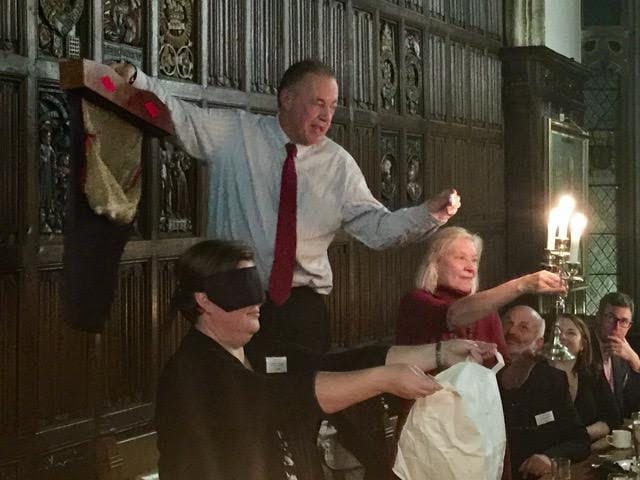 A major international conference was held in Oxford at the end of September on tackling environmental crime in Europe. Organized by three networks of bodies involvement in environmental enforcement – ENPE (European Network of Prosecutors for the Environment), EnvironCrimeNet (Police and Interpol), and IMPEL (environmental regulators), the conference was attended by over 100 delegates from Europe and other parts of the world including China, the US and Australia. Professor Macrory gave the after dinner speech, and provided a personal account of the challenges of developing and implementing a new vision for environmental regulatory sanctions that fully integrated criminal and administrative approaches. He concluded with a conjuring illusion demonstrating the difficulties of enforcement.
UCL Laws welcomes new academic colleague Dr Steven Vaughan
By Daniela Bragato, on 12 July 2017
UCL Laws is delighted to announce that Dr Steven Vaughan has joined the Faculty this month as a Senior Lecturer and has been appointed Co-Director of the Centre for Law and the Environment working with Professor Maria Lee.

Dr Vaughan’s environmental law research spans contaminated land, chemicals regulation, new technologies and the role (and ethics) of environmental lawyers. This coming year, he will be teaching on various of the Faculty’s undergraduate and postgraduate environmental law modules.
Speaking on his appointment, Dr Vaughan said:
‘I am thrilled to be joining the Faculty and the Centre, with its rich history and outstanding expertise in law and the environment.’
Learn more about Dr Vaughan’s work and find his contact details.
Precaution in the Governance of Technology
By Daniela Bragato, on 3 July 2017
Centre for Law and the Environment’s Annual Lecture
Tuesday 31 October 2017, 18:00 – 19:00
UCL Roberts 106 LT, Roberts Building, Torrington Place, London WC1E 7J

Speaker: Professor Andrew Stirling (University of Sussex)
Chair: Professor Maria Lee (University College London)
About the lecture:
Worldwide policy debates over governance of technology are pervaded by apparent tensions. One of the most intense and protracted sites for controversy surrounds the role of ‘the precautionary principle’ in research, regulation and international standard setting. A common – often loudly propounded – position in influential quarters of business, government and academia, is that precaution is somehow ‘unscientific’ or even ‘anti-technology’ in its implications. Such interests strongly assert the sufficiency of ‘risk-based’ decision making, treating choices among alternative directions for innovation in particular fields as if they were effectively purely technical – independent of political values, economic interests or democratic process.
It is clear that (as in any politically-salient field of scholarship or law), there exist many expedient misrepresentations or misapplications of precaution. In particular, precaution is best understood not as a notionally-definitive decision rule, but as a principle that points towards specific qualities of process. In making this case, this talk will argue that the above kinds of high-profile rhetoric around precaution are not only mistaken, but undermining both of science and democracy in governance of science and technology.
Crucial to understanding why this is so, is to appreciate that the full breadth and depths of incertitude in this field are far more profound and intractable than are routinely acknowledged in established forms of risk assessment. It is not necessarily ‘critical’ – but simply a matter of realism and rigour – to recognise that there exist many institutional pressures to suppress the typical scope and gravity of incertitude and treat it as a reduced notion of risk. The cumulative effect of this is to generate a kind of ‘organised irresponsibility’, under which consequences of neglected aspects of ‘uncertainty’, ‘ambiguity’ and ‘ignorance’ are effectively externalised onto the least privileged (often most vulnerable) social groups and their environments.
Seen in this light, the diverse implications of precaution are not simply about being more rigorous about different aspects of uncertainty. They are also about being more open in seeking to balance the routine effects of powerful interests within processes of technology governance. Precaution also entails a more realistic understanding of innovation as a branching evolutionary process. Here, discouragement of one particular powerfully-backed trajectory in any given can be recognised not to be inherently ‘anti-technology’, but typically to have the effect of encouraging alternative preferable innovation pathways.
It is on these grounds that carefully deliberate application of precaution in some of its many variant forms, can help enable technology governance at the same time not only to be more rigorous about the realities of uncertainty and innovation, but also more respectful of the imperatives of social justice and democracy.
Click here to book your place.
BREXIT and PARLIAMENT
By Richard B Macrory, on 4 June 2017
 On June 1st Richard Macrory was invited to speak in the House of Commons Library to researchers from the UK Parliament and Devolved Administrations on Brexit and environmental law. The panel of speakers included Victoria Jenkins from Swansea University and Navraj Ghaleigh from the University of Edinburgh. Richard focussed on international environmental law and the extent to which the UK will remain bound by international conventions after Brexit. There was a lively discussion on the challenges for Parliament and the devolved legislatures in monitoring regulatory developments following Great Repeal Bill.
Visiting professor appointed Deputy High Court Judge
By Maria Lee, on 2 June 2017
Many congratulations to our visiting professor Justine Thornton QC, who has been appointed a Deputy High Court Judge.
The role of Deputy High Court Judge is reserved for those who have the experience and expertise to d eal with very complex cases and will include work which would otherwise be undertaken by High Court Judges.
Justine is a barrister at 39 Essex Chambers, specialising in environmental law.
She is on the editorial board of the Journal of Environmental Law.
Justine Thornton QC says “It is an honour and privilege to be appointed to the judiciary. I look forward to public service and my role in upholding the rule of law.”
Brexit and environmental law
By Richard B Macrory, on 8 April 2017
Richard Macrory is co-chair of the UK Environmental Law Association’s Brexit Working Party. UKELA was neutral on the Brexit referendum, but is working to ensure the UK e nvironmental law is not jeopardized following the UK’s departure from the EU. Former DEFRA lawyer Rosie Oliver and barrister Joe Newbigdin have been employed by UKELA to research on environmental law issues, and the Faculty has kindly provided them with desk space over the next six months. This month the first newsletter outlining current activities has been published. Brexit newsletter 01
ANDREW LEES ENVIRONMENTAL ESSAY PRIZE
By Richard B Macrory, on 22 March 2017
UKELA has announced details of the 2017 essay prize open to all students. The prize is named after Andrew Lees who was Campaigns Director for Friends of the Earth and died in 1994 while campaigning against open-cast mining in Madagascar
The 2017 Andrew Lees Prize Article Competition opened for entries from 14 March. Please note extended submission date of 26 April 201.
You may choose from either ‘Brexit – threat or opportunity for the environment?’ or A topic of your choice that is relevant to UK Environmental Law
If you choose to submit an article on the topic of your choice, you may have prepared this, or a version of this, for another purpose, but it must have been researched and written after 1 January 2017. We may ask to see evidence of this.
Entries must be submitted between 14 March 2017 and midday on 26 April 2017.
The winner will receive a free place at UKELA’s Annual Conference at the University of Nottingham on 7th to 9th July 2017 (including travel expenses from within the UK)
Please read the competition rules and download an Student_Competition_Form to be submitted along with your entry. Entries and the form are to be sent to elly-mae@ukela.org by midday on 26 April 2017
The winner will also have their article published in UKELA’s journal e-law and on the UKELA website.
Environmental law appointments at UCL
By Maria Lee, on 7 March 2017
We are absolutely delighted to announce that two new environmental law colleagues will shortly be joining the UCL Faculty of Laws. Dr Eloise Scotford will be joining us as a professor, from her current position at King’s College London, and Dr Steven Vaughan will be joining us as a Senior Lecturer from the University of Birmingham.
Eloise has broad research and teaching interests in environmental law. She writes on the comparative legal treatment of environmental principles, air quality law, climate change governance, waste law, and legislative and adjudicative processes as they relate to the environment. At the core of this research is an exploration of the richness, variety and openness of legal institutions, doctrines and cultures in responding to and accommodating environmental problems.
Steven’s career began in the City as a solicitor specialising in environmental law (first at Freshfields, then at Latham & Waktins), before moving into academia. His research interests lie in the regulation and governance of three fields: environmental law, the legal profession, and corporate finance. In the environmental arena, he has explored the role of environmental solicitors on corporate finance deals, the regulation of business innovation in the context of new technologies, the framing of land use and redevelopment via the contaminated land regime, and the shaping and operationalisation of EU chemicals law.
These wonderful appointments will add to and enrich the teaching and research in the Centre for Law and the Environment.