 Close
Close


Doctoral Placement at University of Toronto. By Nenna Orie Chuku
By Ian Evans, on 5 July 2023
Participating in the UKRI Globalink doctoral placement scheme, Nenna spent 12-weeks in Toronto, Canada studying at University of Toronto. Read on to learn about her experience of short-term mobility as part of her doctoral studies.

Between January to April 2023, I spent 12-weeks in Toronto, Canada as part of a doctoral placement scheme funded by UKRI and Mitcas. During this time, I undertook a standalone research project in the Faculty of Information (iSchool) outside the focus of my doctoral study, which was supervised by Dr Jenna Hartel. The research project focused on bullet journaling, in particular the habits, practice, and environment of bullet journalers. As part of my placement, I participated in Dr Hartel’s Information Ethnography module, which provides training in the theoretical and methodological framework of ethnography and its use in Information Studies.
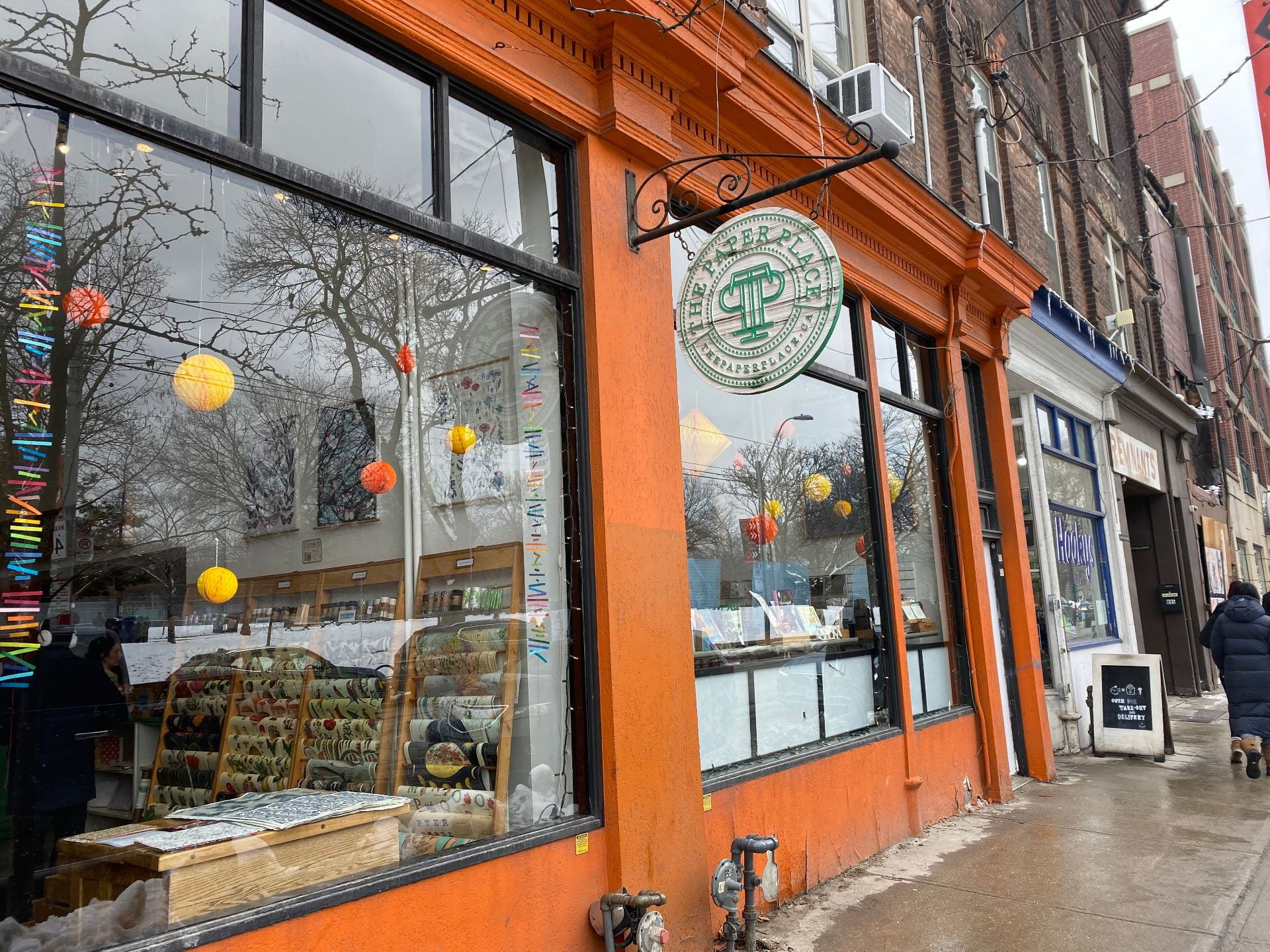
The bullet journal project consisted of three distinct parts: (1) interviews with bullet journal keepers, (2) observations at journaling related sites (such as stationery stores and book shops) and, (3) review of instruction manuals. Outings to related sites provided a chance to visit different parts of Toronto. Highlights include visits to “Paper Plus Cloth” in Parkdale on West Queen St West, “Wonder Pens” on Clinton Street, “The Paper Place” on 887 Queen St. West and “Labour of Love” on Carlton Street. Each of these stores are run by enthusiasts of paper and pens who provide advice along with a warm welcome.
Visiting Toronto during the winter months did present challenges; keeping warm whilst commuting during snowstorms, and getting out and about when it snowed or was snowing. Nonetheless, it was a great experience. I packed a long-padded coat and had the appropriate footwear, so kept things moving. As the weather warmed nearing the end of my placement, I got to see another side of the Greater Toronto Area. The hike organised by the Centre for International Experience and led by hike leads from Let’s Hike T.O. was another highlight, as it provided a different introduction to Toronto.
As a visiting graduate student, I was exposed to the higher education system in Canada, which has vast differences to the UK system. From this, I was able to meet amazing masters and doctoral students who provided a warm welcome into the various support and social networks available at the University of Toronto – thank you!
The experience of planning the placement (working on the research plan and the process of applying for funding) and spending time at the Faculty of Information has been invaluable to my doctoral experience. Whilst it did take a good amount of time and effort to organise, I would recommend a placement or similar types of mobility opportunities to other doctoral students.
Thanks to the funders (UKRI and Mitacs), Professor Oliver Duke-Williams, Dr Jenna Hartel, Ena Wehr and Ian Evans at UCL DIS, Kathy Shyjak, Carol Ng, Dube Burin and Alfredo Gonzalez all from the Faculty of Information for their support.
By Nenna Orie Chuku

Collaborating with those at home and overseas: Reliving and reminiscing about Sierra Leonean Krio heritage and culture online By: Nenna Orie Chuku, DIS PhD candidate
By Ian Evans, on 2 February 2022
In this student blog, Nenna Orie Chuku (DIS PhD candidate) discusses the Ɛmti bag nɔ ba tinap: documenting the intangible with the diaspora and the homeland, a collaborative Krio intangible heritage project with the Krio Heritage Foundation (based in the UK) and Freetong Players (based in Sierra Leone).
Moving Online
Tכk (conversations), dress, cham cham (edible snacks) and music are all key elements at Sierra Leonean gatherings throughout the UK. With COVID-19, such in-person occasions halted abruptly. Coming to terms with the change, some UK-operating Sierra Leonean community groups began to explore (then) unfamiliar digital technologies and online platforms to enable them to convene online. However, resources are not universally shared so cross-support is needed to help (where desired) the voluntary-run organisations move online. One of the organisations experimenting with ‘getting online’ is the Krio Heritage Foundation (KHF), a voluntary-run organisation that seeks to share, preserve, and celebrate Sierra Leonean Creole/Krio histories in the diaspora. Since 2019, the KHF has been utilising online platforms for meetings and events. Through trial and error, engagement with KHF programmes expanded from a UK-based Sierra Leonean audience to an international one involving Krio speakers from China, Nigeria, the USA and Canada. The KHF’s online event of pull-na-doe kickstarted the Ɛmti bag nɔ ba tinap project. Performed by the Freetong Players, this online re-enactment – of the Krio ceremony that marks the arrival of new life – included a lively and educational discussion on the history and changes of the ceremony. Why are daughters named after 7-days but sons named after 10-days? Why do families present their babies to those on their street via walking? The ability to arrive at a definitive guide to Krio culture is not possible. However, those present in these online spaces agreed that there was a need for reflective dialogues. While a dedicated archive of Krio heritage is not currently possible for the Ɛmti bag nɔ ba tinap project, creating opportunities to hold dialogues and re-enactments allows online participants to reminisce about Krio culture, and to consider how to continue or revive cultural practices. With a small grant from the UCL Centre for Critical Heritage Studies, a curated dedicated series on the intangible forms of Krio heritage and culture was formed.
Curating Ɛmti bag nɔ ba tinap: Connectivity & Knowledge
Early discussions focused on what is achievable considering the two key parameters of a Freetown-London programme: connectivity and knowledge.
Over the past couple of years, internet connections and electricity in Freetown have improved, but connectivity varies and is far from guaranteed. The programme relied on sufficient connectivity. Connectivity and equipment are important for documenting (through recordings) the knowledge shared by invited speakers and attendees. Although a research institution funds Ɛmti bag nɔ ba tinap, this project was dependent upon and seeks to build upon knowledge held by those in Freetown and connected diaspora. Whilst many of our invited participants are experienced public speakers and performers, a dialogue event format provided a means to coax out invaluable insights and knowledge from those with less experience. Consequently, this format influenced the content of the events. The first three topics of storytelling (parables and proverbs), ceremony, and music provided fruitful entry routes into Krio heritage. All three connect to intangible forms of heritage. Krio heritage is also found in architecture, but through organising the event it became clear that engaged discussions of architecture were infeasible. How could we navigate through the city of Freetown in real time with COVID restrictions, along with other connection and safety questions, whilst maintaining an online discussion? A resolution was unavailable given the constraints of the project’s resources, so a different topic was needed. Due to this the fourth topic became a dialogue on material culture through print style and design.
The delivery of the programme followed the KHF standard approach to events:
- A couple of weeks before the event, meet to finalise the content and whether any additional input or materials were needed.
- Order of event: music to welcome attendees, welcoming prayers, introductions, talk or performance, discussion, thanks and close.
- Krio to be used throughout and as much as possible. For those who can understand (hear) Krio but do not speak Krio, English is to be used.
- Attendees can remain on the online platform for more informal conversations up to the allotted advertised time. Time extensions can be granted by the Chair of the event.
- Review the delivery of the event at the following monthly meeting.
Krio Online Faves
Replicating the flow of physical interactions was impossible. However, with fewer chances to digress, entering a virtual space for a dedicated purpose provided a chance to connect in new rewarding ways. Below are some reflections from the co-producers and partners on what they enjoyed:
- “The attire [Print Style Evolution] because it reminded me of my mum when she would wear traditional wear to work. Her place of work allowed such dress on Fridays. It also reminded me of the times I attended weddings with my grandma. My grandma and other adults wore them. I did not wear them as a child because it was expensive to make them. They also reminded me of my aunt who used to make prints.”
- “I enjoy the monthly meetings and always look forward to it; it is a great time to ‘bump into’ old time friends and learn more about our traditions.”
- “Life stages/milestones and proverbs.”
- “I enjoy all of the Krio heritage as it gives one a wonderful and wholesome perspective of what heritage is about, it is all of the above rolled into one.”
- “Krio Proverbs because it gives life lessons in an enjoyable manner.”
- “Many parts. The storytelling elements so the parables but more general how the Krio language is used for expressions and cues etc.”
Repository Building
Events frequently end with sentiments of: what next with Krio culture? How can we preserve it? How can we archive it? What roles do we have in the preservation of Krio heritage and culture? Unsurprisingly, such discussions do not lead to a single resolution. Different people in different roles are needed. Below are responses to a feedback prompt asking what (if any) role do individuals, organisations (like KHF), researchers, and institutions (like universities) play in the preservation of Sierra Leonean Krio culture.
Individuals:
- “Individuals tend to have the knowledge researchers require. Without them some of these researchers can’t do their work and research cannot be conducted.”
- “Individuals can come together and settle on a particular research aspect to promote the culture, like sourcing the origins of some of our fabric and or getting together with interested cultures to inform and preserve these aspects.”
- “Individuals because I talk to people in my family and my surroundings about the culture. I try to educate young members of my extended family who were born in the Diaspora and have never been to Sierra Leone.”
Organisations:
- “It was easy to become part of this group [KHF] as I endorse the ethos they promote.”
- “Some of the members have ideas on the Krio culture, heritage, and tradition and to further engage with an organisation like Freetong Players based in Freetown, Sierra Leone to help enact the ways and life of the Krios.”
- “Teamwork is important too. As the saying goes: ‘if you want to walk further, work as a team and not alone’. This is also because everybody may be able to bring in their expertise in a particular area to enhance production or make things work.”
- “There is also the possibility of fundraising and sponsorship. Much as the individual can do it, organisations can really promote and fund various aspects of a programme.
- “KHF has been doing a very good job. We have had conferences, dinners and we had guest speakers who have written books and they spoke about the heritage and what it was like growing up in a Sierra Leonean household. We also have Zoom meetings where we looked at the origin of Krio music, Krio Entrepreneurship, the origin of the Krio attire, Krio lifestyle and much more.”
- “I think organisations like KHF are needed, and they should be active in recording their work and impact in their community. Let them be the authors of their stories, their histories.”
Institutions
- “An educational institution that is open to diversity and willing to support and learn from other heritage and culture.”
Researchers
- “Some researchers are able to tap into funds that small groups like the KHF are not able to access. Large research groups know where funding is located and can apply for them.”
Although video-conferencing platforms present a chance to record these exchanges and re-enactments, internet connection ultimately determines the quality of visuals and sounds. This dictates the usability of these recordings and whether such approaches should be considered accessible and viable. Whilst the possibility of online archiving is found in different pockets of the internet (such as YouTube, SoundCloud, and social media), questions about discoverability, accessibility, sustainability, and one-voice narratives remain important in the connection between Krios in Sierra Leone and overseas.
———————-
Ɛmti bag nɔ ba tinap: documenting the intangible with the diaspora and the homeland was funded by the UCL Centre for Critical Heritage Studies small grants fund 2019-20. Working with the Krio Heritage Foundation, Freetong Players International and videographer and designer Thomas Sawyerr, four events were delivered on the topics on spoken word and storytelling, ceremonies, music, and attire. The delivered programme:
- Parebul en Provabs with Mr Charlie Haffner, 24 July 2021
- Put Stop: The Engagement performed by Freetong Players, 21 August 2021
- Goombay & Maringa, 18 September 2021
- Print Style Evolution, 30 October 2021
Thanks to KHF members for their feedback and reflections.
Event round-up: Recording it Ourselves by Kirsty Fife
By Ian Evans, on 20 August 2021
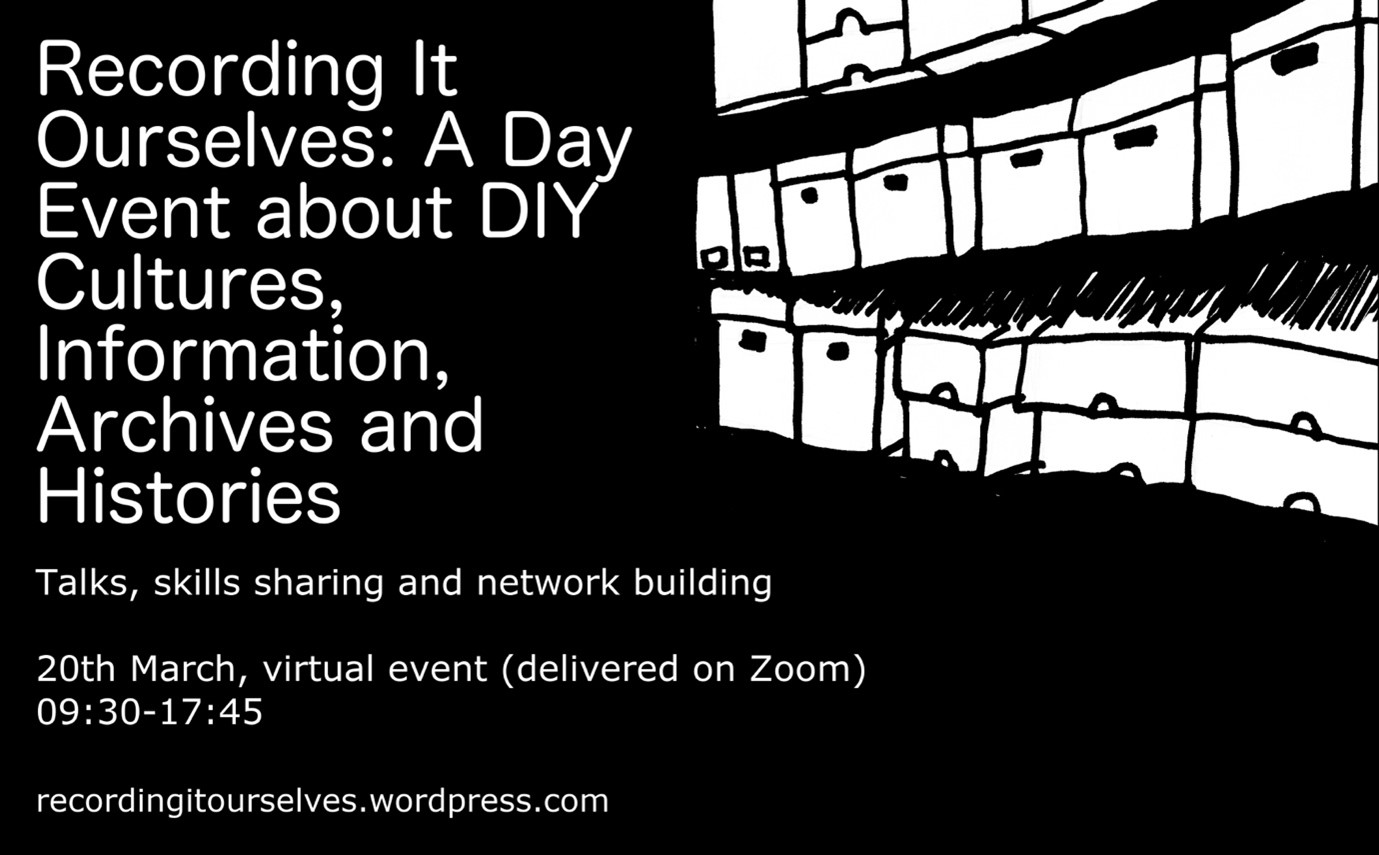
Recording it Ourselves: A Day Event About DIY Cultures, Information, Archives and Heritage was an online event hosted via Zoom webinar on 20th March 2021. The event was a day long knowledge sharing event about DIY cultures (which we defined as grassroots and political cultures/practices – examples include grassroots spaces; music and zine making; blogging; podcasting; housing co-ops; activism etc) and archives, information and/or heritage.
The event aimed to create a space to build networks, share knowledge and support each other in grassroots heritage work. Presentations were given by projects including Decolonising the Archive, Mother Tongues Collective, Queer Encounters Kings Cross, the Gezi Archive, Archiv der Jugendkulturen and the Refugee Archive at University of East London. The event was attended by over 170 people, and successfully drew a mixture of attendees from activist groups, information sector organisations, research organisations and different community groups. The organising collective were a group of individuals loosely connected via DIY cultures, information work and/or research.
We were granted funding from the Centre for Critical Heritage Studies’ small grants scheme, which allowed us to pay all speakers, hire a live captioner for the event, and pay one of our collective to do event support admin work. Although payment for speakers at academic events is not standard, we believed that community members should be compensated for their time and labour – especially when doing information work outside of professional salaried posts – and encourage other collectives situated between the academy and communities to organise with similar politics.
Our final programme is available via our website here: https://recordingitourselves.wordpress.com/programme/.
A selection of recordings are also available: https://recordingitourselves.wordpress.com/presentation-slides-and-recordings/
As a collective, we hope to continue our work together in some format in 2022, and are exploring developing skills sharing workshops for our next project.
Encountering and learning from differences by Open Aspirations
By Ian Evans, on 24 September 2020
27 years ago, I was a seventeen-year-old international exchange student who stayed in a small town in Saskatchewan, Canada. It was my first ever experience of travelling abroad, as well as living away from home in an overseas country. The life in the community was not easy for an introvert. The only places where I felt relaxed were my host family’s home, the school library and the way to walk back home from school, where I could enjoy a great view of prairies and the sky.
The biggest challenge I faced during my stay was the community’s prejudice against homosexuality. I remember: in 1993 after a church service, an old lady asked me to sign my name on a form, which I understood was a campaign against legal protection on the basis of sexual orientation. I blinked for a few seconds, felt extremely uncomfortable, even scared, but said “No, I can’t.”
For the first time after almost three decades, I am revisiting this memory without being swallowed up by the intense emotions I felt back then. Right now, I am making plans for a series of workshop sessions focusing on diversity and inclusion, and, having a flashback of 1993, I searched online to find out what was happening in the province during the 1990s. A wonderful subject guide on sexual and gender diversity is available, and this webpage, developed and maintained by the University of Saskatchewan archivists and librarians, answered many of my questions. By reading these resources including an annotated chronology, I can finally contextualize my experience within Canada’s LGBTQ history. And I am proud of that timid, socially awkward girl who was yet able to make the right decision.
The sessions I am organizing with the help of Alison Hicks have three main themes:
- A safe place
- Encountering and learning from differences
- Reimagining our learning space
Other sub-themes are storytelling, history, memory and social justice.
My aim is to create an informal space, where students can explore how these topics intersect with our knowledge (not limited to Library and Information Studies), professional practices and personal experiences.
So far, I have chosen the following articles and children’s story for suggested reading, based on my interests in student engagement and wellbeing, oral history, and critical librarianship:
- Andersson, J., Sadgrove, J. and Valentine, G. (2012) ‘Consuming campus: geographies of encounter at a British university’, Social & Cultural Geography, 13(5), pp.501–515. Available at: https://www.researchgate.net/publication/254359520_Consuming_Campus_Geographies_of_Encounter_at_a_British_University [Accessed: 12 July 2020].
- Cooke, N.A. (2016) ‘Counter-storytelling in the LIS Curriculum”, in: Gorham, U., Greene Taylor, N. and Jaeger, P.T. (eds.), Perspectives on Libraries as Institutions of Human Rights and Social Justice, Advances in Librarianship, 41. Bingly, UK: Emerald Group Publishing Limited, pp. 331-348.
- Lobel, A. (1979) ‘Alone’, in: Days with Frog and Toad, New York: HarperCollins, pp. 52-64.
- Rose, S. D. (2013) ‘”It wasn’t a sweet life”: engaging students in Oral History interviewing across race, class, and generations’, in: Barnett, T. and Noriega, C. A. (eds.), Oral History and communities of color. Los Angeles: UCLA Chicano Studies Research Center Press, pp. 76-97. Available at: https://scholar.dickinson.edu/cgi/viewcontent.cgi?article=1184&context=faculty_publications [Accessed: 12 July 2020].
- Smith, N.L.A. (2020) ‘How effective are academic libraries’ attempts at dismantling racism?’, EARLL, 1 September. Available at: https://www.earll.co.uk/post/how-effective-are-academic-libraries-attempts-at-dismantling-racism [Accessed: 12 September 2020].
- Tatum, B.D. (2019) ‘Together and alone?: the challenge of talking about race on campus’, Daedalus, 148(4), pp.79-93. Available at: https://www.amacad.org/sites/default/files/publication/downloads/Daedalus_Tatum_Fall2019.pdf [Accessed: 12 September 2020].
More details on the event will follow soon, and I really look forward to starting conversations with my fellow students!
Open Aspirations (Twitter: @O_Aspirations)
On embracing the labels of PoC/BAME as a library school student by Open Aspirations
By Ian Evans, on 14 September 2020
The following article is written by a current LIS student at UCL. Based on work written for the INST0016 Supporting Users module, the article provides an excellent summary of a number of key resources for any LIS student or library worker who is looking to inform themselves on key LIS resources related to race, equality and diversity. The article also touches on the experience of studying as a PoC at a library school. In 2019, BAME/PoC students made up 15% of the LIS student body at UCL. While this is a higher percentage than in the librarian workforce overall (97% White), it is not a statistic of which we are proud. Publishing article such as this one is one of the many steps that we are taking to address the role that we play in shaping workforce diversity, along with other progressive stacking measures, including tackling representation in module, reading list and panel/events, establishing student-led reading groups and working with UCL Libraries to purchase access to titles from the Black Excellence in LIS syllabus. Thank you to Open Aspirations and other students for their work leading and supporting these initiatives.
Alison Hicks, Programme Director, Library and Information Studies.
On embracing the labels of PoC/BAME as a library school student
Back in 2018, when I started to attend the LIS programme at UCL, I would have had to search the Internet to find out what the acronyms PoC (people/person of colour) and BAME (Black, Asian and Minority Ethnic) stand for. Having lived in several different countries before moving to the UK in 2014, I saw myself as someone seeking to become a world citizen. It was in this somewhat naïve and colour-blind mindset that I shielded myself from internalizing racialized labelling.
This attitude has changed over the past two years. I still remember my first day in one of the LIS modules, where I felt panicked to see I was the only apparently (east) Asian-looking student and there was only one Black student. The emotional labour of standing out in the classroom was overwhelming, but this experience prompted me to look into the low representation of BAME LIS students as well as BAME academic librarians, the sector I aspire to work in.
Out of this exploration, I wrote an essay about the key resources for library school students to engage with the “decolonizing academic libraries” movement — the recent initiatives that tackle the lack of racial and ethnic diversity in the overall practice of UK academic libraries. Thank you, Alison Hicks, for suggesting me to share my findings with the DIS community.
Here is a brief summary of the list I compiled…
- Research Reports
Factual sources, specifically the recent official research reports published by UK organizations are essential in understanding the diversity issues within academic libraries and beyond. Among them, particularly useful ones are:
- A study of the UK information workforce (2015)
- BAME staff experiences of academic and research libraries (2019)
- Insider-outsider: the role of race in shaping the experiences of Black and Minority Ethnic students (2019)
- Library Conference Presentations
Before the Covid-19 outbreak, attending day conferences was a popular way of information sharing on the subject of decolonization for librarians.
- Talent Untapped: BAME Academic Librarians’ KnowledgeX at University of East London (2019)
- Decolonising Library Collections and Practices: from Understanding to Impact at Cardiff Metropolitan University (2019)
- Decolonising the Curriculum: the Library’s Role at Goldsmiths, University of London (2020)
Among these three, Cardiff and Goldsmiths organizers made the conference presentation slides available through online databases.
- Library Juice Press Publications
In this time of uncertainty, I have found it quite beneficial to explore the work of the US publisher Litwin Books, especially the publications of their imprint Library Juice Press. A few titles relating to decolonization initiatives are:
- The politics of theory and the practice of critical librarianship
- Topographies of whiteness: mapping whiteness in Library and Information Science
- Where are all the librarians of color?
The LJP publications help us to 1) gain comparative understanding of the history, research and practice of critical librarianship in the UK and the US; 2) learn to see library activism as an ongoing historical process and continuing efforts; and 3) develop strategies to face up to the challenge of tackling racism and advancing inclusion in the new social context, which is emerging from the current pandemic and anti-racism movement.
I hope these resources are useful for the DIS community. By exploring them, we are most importantly invited to reflect on our own experiences. Self-reflection, which I have learnt from writing my essay, is one of the keys to raising awareness, building empathy and becoming more open to having conversations on racial inclusivity.
Open Aspirations (Twitter: @O_Aspirations)
Academic Book Week: What is it, and how can you get involved? By Charlotte Webster
By Ian Evans, on 4 March 2020

Academic Book Week is a celebration of academic books, and the impact they have on our society and our world. The week aims to draw attention to the ‘diversity, variety and influence’ of academic books, increasing awareness of the academic book as ‘a vehicle for ground-breaking ideas.’ Run by The Booksellers Association, the week aims to spark debate across various stakeholders, and to provide a space for those who ‘read, write, publish, sell, or work with academic books’ to share their views.
This year, Academic Book Week is running from 9-13 March, and will involve a range of events, panels, and promotions. This year’s theme is ‘Academic Books and the Environment,’ and the Booksellers Association have released a diverse list of ‘recommended reads’ that tackle the climate emergency.
If academic books are important to you, then shout about it! Here are some ideas for how you can get involved:
- Attend an Academic Book Week event. Our own Caroline Wintersgill is hosting a discussion with Lewis Dartnell, author of Origins, on the 9th of March at Waterstones Gower Street. Post about any events you do attend on social media.
- Read a book (or books!) on the ‘recommended reads’ list. Does it change your perspective or inspire you to take action in some way?
- Reflect on your own experiences with academic books. When was the last time you bought an academic book? Did you buy it from a conventional bookshop, an academic specialist, a second-hand bookseller, or maybe from Amazon? Was it an e-book, or in print? Maybe you rely on the library to provide access to academic books for you? What could publishers could do to encourage students to purchase academic books – what new models might entice you?
- Think about the academic book that has most impacted you, or influenced your viewpoint in some way – recommend it to a friend!
Publishing Against the Paradigm by Charlotte Webster
By Ian Evans, on 14 February 2020

UCL Comparative Literature’s Panel Event: Publishing Against the Paradigm invited guest speakers Alison Devers, founder of The Second Shelf, Gary Budden, founder of Influx Press, Brekhna Aftab from Pluto Press, and Nicola Beauman, founder of Persephone Books, to reflect on their experiences in independent publishing and bookselling.
Large conglomerates like Amazon and Penguin Random House represent the vast majority of the market for print books. In this environment, how do small independent publishers and bookshops survive? Well, it’s hard, say the panellists of Tuesday’s discussion, but independents are thinking of new and increasingly creative ways to find their market and ensure long-term sustainability. Brekhna Aftab emphasised the importance of direct sales to readers, bypassing other links in the supply chain like Amazon. Pluto Press has re-launched the Left Book Club, originally founded in 1936 by Victor Gollancz, a subscription service which entitles members to either six or twelve of the ‘best radical and progressive’ political books a year. Left Book Club books are designed to be instantly recognisable, with standardised yellow and black covers and typography. Independent bookshops and publishers, the panellists agreed, must find their niche in order to survive. Social media is helping: publishers can communicate directly with their readers, build loyalty, and form a virtual community across potentially disparate geographies.
Alison Devers noted that Big 5 publishers focus disproportionately on ‘general bestsellers,’ to which they devote almost all of their marketing and PR spend. It is the role of indies, she felt, to answer to this by publishing and publicising books that don’t fit a ‘general audience’ – a term that she noted almost always means ‘white’. The controversy surrounding Macmillan’s publication of American Dirt by Jeanine Cummins was a topic of much discussion. Despite having no issue with writing about cultures other than your own, Devers felt that the marketing spend on American Dirt was outrageous, given that there are several other books that discuss similar themes, written by Latinx authors. The money was devoted to Cummins’ book, she felt, because it was more in line with the ‘general audience’ that publishers so often target.
Brekhna Aftab added that publishers will continue to prioritise white authors when the industry itself continues to be made up of an overwhelmingly white workforce. She noted the danger that diversity within the industry becomes a passing fad, and felt that structural changes are needed to address the issue long-term. Publishing continues to be a low-pay industry: salaries are often omitted from job advertisements, and many publishers offer internships without pay. To secure these internships in the first place, applicants must navigate informal networks, and the industry continues to be overwhelmingly London-centric. These issues have become deeply embedded, but should be confronted to ensure that publishers are producing books that are truly reflective of their readers’ lived experiences.
So what can readers do to affect positive change in the publishing industry? Buy indie, says Alison Devers. This seems like a simple solution, but the fact remains that people buy with Amazon because it is cheaper; it can afford to make a loss on books, while small indie bookshops simply can’t. New forms of direct sale such as subscription schemes might offer a solution, though; the Left Book Club for example offers a starting price of £4.99 a month. In a fiercely competitive and uncertain economic environment, independent publishers and booksellers are struggling to remain viable. Wherever possible, the panellists encouraged, readers should buy indie. We should consider the impact that the books we buy have on our society because, as Nicola Beauman reminds us, publishing is always political.
One Book at a Time by Lucy Owen
By Ian Evans, on 10 February 2020
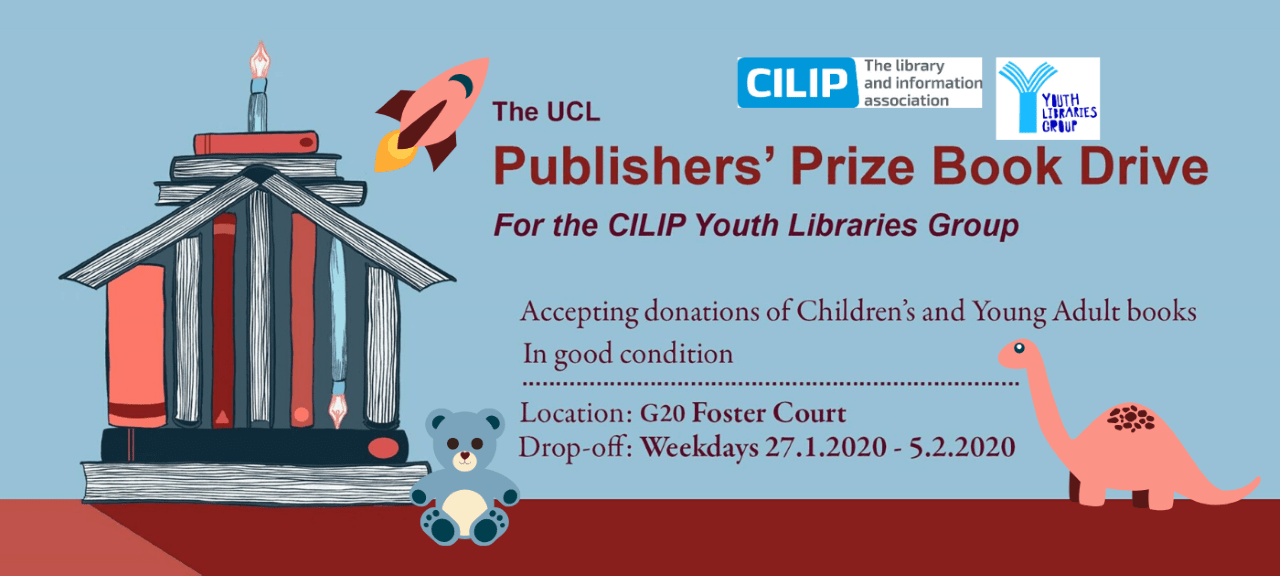
This week, the UCL Publishers’ Prize team was delighted to host a Book Drive in collaboration with CILIP and Youth Libraries Group!
This year coincides with the centenary for the Department of Information Studies, a very exciting event for UCL! UCL’s Department of Information Studies began the first school of Librarianship, so it is only fitting that the theme for this year’s Publishers’ Prize is libraries.

(Instagram: @uclpublishersprize)
In celebration of our theme, we decided to give back to libraries around the country by encouraging donations of children’s and young adult books from UCL students and staff, and they certainly delivered!

(Instagram: @uclpublishersprize)
We received books of every genre, suitable for a wide range of ages. The books were all in fantastic condition and lovingly chosen by our generous donators. We ended on a high note with our ‘Tea for Books’ event, where we gave away a hot cup of tea or coffee in exchange for donations. We also had a cheeky bit of Swiss chocolate, kindly donated by Fabienne Schwizer!

(Instagram: @uclpublishersprize)
Thank you very much to everyone who brought in donations. They are going to a very worthwhile cause and are much appreciated! Also, thank you also to the Publishers’ Prize marketing team, Anna and Karina, for putting together the event and promoting it so well!
Be sure to keep an eye out for the 2020 Publishers’ Prize, an anthology written and published by students!
Find us online!
Twitter: @UCLPubPrize
Instagram: @uclpublishersprize
Website: www.uclpublishersprize.com
Community Archives and Heritage Group annual conference. A report by Christopher Scales
By Ian Evans, on 17 July 2019
As the result of support from the Dean’s Strategic Fund at UCL I was able to attend the Community Archives and Heritage Group annual conference, which this year was taking place in Scotland for the first time, in Glasgow.
The day featured presentations about various projects centred on archives and community, often detailing the way that mainstream archives or funders had partnered with community groups and people-led initiatives to preserve stories from a diverse range of people. The focus of the conference was on projects relating to migration. The day included projects such as ‘Colourful Heritage’, centred on interviewing the first settlers of the Glasgow Asian community to create a unique video archive, and the largest of its kind in the U.K. Other projects showcased focused on creating awareness and tangible archives relating to Jewish communities in Scotland, the British Ukrainian community, Armenian heritage in North West England, and the Scottish LGBT+ community. It was fascinating to learn about the range of exciting projects taking place across the U.K. and the variety of contexts in which they were being supported, through the hard work of many individuals both community-based and in the archive and museums sectors.
While the day showed that funders are keen to invest in stories of diversity, it was clear that for some the funding didn’t necessarily come easily or regularly, and that these projects were as much a labour of love for the individuals involved as a ‘funded’ process. One speaker notably told of feeling unable to ask for certain administrative costs in the budget when apply for a HLF grant, and taking on too much of the burden personally despite being advised they could likely bid for more money. This perhaps illustrates one of the key issues with this kind of one-off funding – that due its nature as short-term and project-based, community members may feel that the funding is a blessing or a great favour, and therefore attempt to personally work overtime to match the supposed ‘favour’. The duty here is very much with funding bodies and the archive sector to explicitly encourage applicants to apply for a full range of roles in funding bids to enable them to deliver their projects without pushing community members beyond their personal limits. The archive and heritage funding sector should be providing the funding and framework so that community members are providing their expertise and passion, but not being expected to give more than they are able.
All in all it was clear that the relationship between community project and funders or supportive archive bodies was mutually beneficial and fruitful in expected and unexpected ways, at least for the duration of the projects. The work shown was also clearly filling a much needed gap in the heritage sector, recording the memories of members of communities and migration experiences often for the first time creating unique new records.
While in Glasgow I also had the opportunity to explore the Mitchell Library, home to the city archives and a wide arrange of other services. Recommended for the obvious but also for the seriously impressive array of 1970s carpets, worth a visit!
All in all it was an excellent day, and a great opportunity to learn about the exciting range of community-led and centred projects taking place around the country, as well as connect with my Scottish colleagues.
Integrity Checking on a Budget | Recipient Report – Helena Clarkson and Taylor Harwood
By Ian Evans, on 27 June 2019
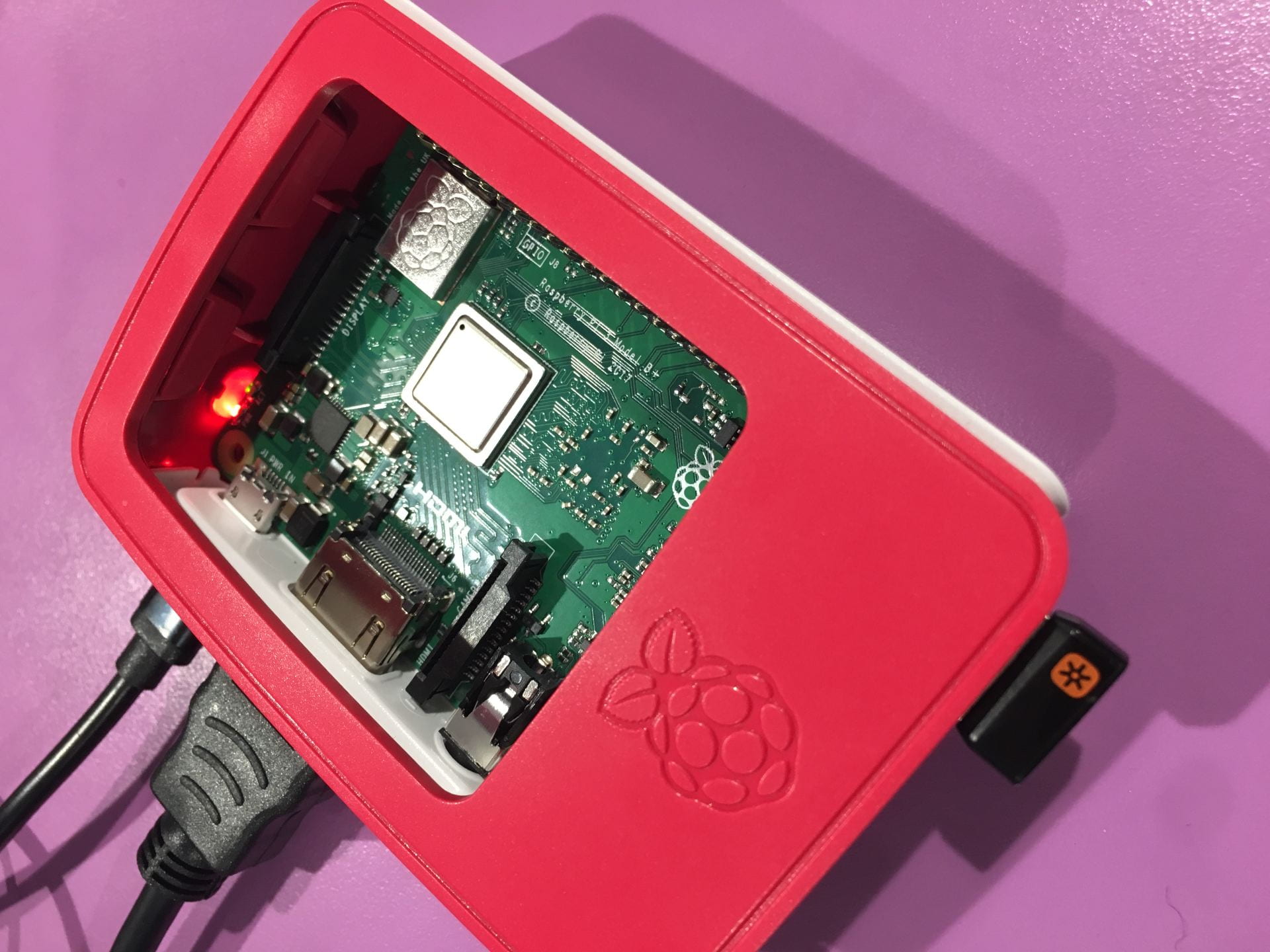

The two of us applied for the UCL DIS Dean’s Strategic Fund 2018-2019 so we could purchase materials for our projects in our optional module Digital Curation, part of our MA in Archives and Records Management. The funds enabled us to purchase Raspberry Pis (very basic computers used for coding projects) along with their associated equipment, so we could implement and experiment with Fixityberry, an existing open source software specifically designed to assist low-resourced archives with fixity scans and fixity checking.
Digital curation and preservation are broad, all-encompassing, and at time daunting subjects for budding archivists. For students like us, without computer science backgrounds, this module was an opportunity to challenge ourselves and to embrace new digital tools. As students with a greater familiarity with the analogue world – both from arts and humanities backgrounds, and limited digital archiving experience – we believe it is important for us to learn, explore, and understand some of the issues and trials that digital archivists face today.
Digital curation involves the management, preservation and adding of value to digital assets throughout their life-cycle. This module aimed to fully engage us with this process, through a mixture of teaching, independent study, and practical exercises.
Thanks to the support of the Dean’s Strategic Fund, we have been able to carry out our chosen digital curation projects based on our research and our interest in the practical aspects of digital curation that the module covered. By purchasing our own Raspberry Pis, we were able to gain experience beyond our assigned reading in a supportive classroom environment, and we will be able to use both that knowledge and the Pis in future projects throughout our careers.
Fixity checking is just one facet of digital preservation, involving integrity management. It consists of the monitoring of bits within digital files in order to check if they remain unchanged or ‘fixed’ over time— not unlike hiring a security guard to make rounds of a physical archive, checking to ensure boxes and materials remain untampered with. Integrity checking, then, is important within the holistic process of digital preservation and in the safe-guarding of our digital assets and information. Pause for a moment to think about all the digital information you have, at home and at work, and you’ll begin to appreciate the importance of keeping it from degrading or being altered. Fixity scans provide reports of the integrity of a digital file, and warn an archivist if degradation has occurred.
Archives can purchase fixity checking software for their digital collections, but what about community archives and other projects on a shoestring budget? Fixityberry was something we read about in class, which was presented as a way for low-resourced archives to meet the standards for digital preservation. We tried it ourselves, to test its viability. With help, we got the software to work, learned as we went, and evaluated the practical application of the software.
Our experiment with the Fixityberry software and foray into the field of digital archiving culminated in two blogs, one of which you can read here. This was where we charted our trials, tribulations and small successes along the way.
The support from this project was vital to us; it allowed us to test and explore the important skills necessary in the development of digital archiving skills, and build our confidence. Setting aside our own personal goals, it also brought into sharp focus the difficulties that archives with low financial and expert resources face, and in turn, the challenges of meeting current preservation standards. It is important for archivists to explore and understand the necessity of devising long term storage solutions, and monitoring that storage when working with digital material.
This experience has brought us greater clarity about the need for a strong digital archiving community and well-documented open source software, as well as the importance of embracing cross-disciplinary relationships (which in our case were a couple of friendly IT gurus).
The funding enabled us to engage with the ever-changing and fast paced world of digital curation and preservation, and expand our understanding of why it is essential for new professionals to work with born-digital content. As emerging professionals, we now have a strong grasp on the importance of working with digitised and born-digital content, which, thanks to this project, has inspired us to advocate for digital literacy within the archives sector, and to bring this knowledge to our chosen careers.
We would like to thank the Dean’s Strategic Funding bid and our tutor Jenny Bunn for their support whilst undertaking our projects.

